by Sherri Sylvester | Oct 18, 2013

Hi! We’re talking about customizing your patterns again today. There are so many things you can do if you know how… so – here’s another tutorial this week (previous one here) on how to help make any pattern into your own creation!
Adding gathers to a shoulder seam can do a few things. First – it will add extra width to the top or the whole bodice – especially nice if you have a fabric with a great drape, or if you need a bit of extra wiggle room in the width of your pattern. Second – it adds a nice feminine touch and a bit of visual interest to the shirt – especially if it is a straight-forward simple pattern.
Wanna try it?
You will need:
- bodice pattern piece – must include shoulder area (I used the Skipper Top from Sew Much Ado – pattern review here)
- paper the length of the bodice
- pen
- ruler or straight edge
Here we go:
(1) Determine how much of the neckline on your pattern piece will be taken up with the seam allowance and/or neckline finish – mark this on your pattern piece. This pattern, for example, has a hemmed neckline and a neckband finish. Since I was using the neckband 1/2″ from the seam allowance would be removed from the visible shoulder area.
(2) Determine where to put the extra width for the gathers.
- (2a,b) Because I used a dolman sleeve top it is not immediately obvious where the gathers should be placed because the sleeve has no shoulder indication. I measured my daughter and found about 2″ of room before her shoulder started. I decided to leave 1″ between my seam allowance mark from Step (1) and where the gathers would start.
- OR If you are starting with a set in sleeve pattern this is a much easier process. Because you know where the shoulder starts, draw a mark at the centre of the shoulder seam area.
(3) Determine how you would like the final shirt to fit.
- Do you need extra width in the top of the shirt only, or also through to the bottom of the bodice (say, to cover a toddler belly!)? For my daughter’s shirt I picked a size width that would cover her belly and added the extra width only to the top 2/3 of the pattern. I ended up cutting a size 5 width, with a size 4 everywhere else.
- Top only (Track A): (3a) Pick and mark a spot about 2/3 of the way down the bodice along the centre line – Draw a line from your Step (2) mark to this new mark. ** The area above this mark will have added width – so be careful with your choice! Do not place your mark too high or the fit of your sleeve and/or neckline will be off due to the extra width that only occurs around the top of the shirt.
- Through the whole shirt (Track B): (3b) If you like you can add width all of the way through the shirt by drawing your line from your Step (2) mark to the hem, parallel to the centre fold line. ** Be careful, the width you add will be doubled – once on each side of the shirt!
(4) Cut the line you just drew.
- Track A: (4a) If you followed Track A cut the line ALMOST to the edge of the centre seam. Leave a little “hinge” of paper.
- Track B: (4b) If you are following Track B you can cut your line all the way down the pattern.
(5) Determine how long you want the gathers to be. I decided to add in 1 3/4″ of extra space – though, I think looking back I should have only added 1″ because the added width distorted the top a bit much.
- Track A: (5a) Spread the top of the paper by the amount of gathering space you want to add. Tape another piece of paper underneath the entire area you just opened up.
- Track B: (5b) Spread the pattern pieces apart by the amount of gathering space you want to add. Tape them to another piece of paper the length of the pattern piece, matching up the hemline. Make sure they are evenly spaced all of the way along.
(6) Cut away the extra and even out your pattern lines.
- Track A: (6a,b) Draw a line from neckline point to sleeve point along the shoulder/sleeve seam.Cut along the line to remove the excess paper. Add in paper to straighten the bodice centre line. Tape the paper in and draw a line from neckline centre to hemline centre. Cut along this line.
- Track B: (6c,d) Draw a line from neckline point to sleeve point along the shoulder/sleeve seam. Draw a line along the hemline from side to side. Cut along these new lines to remove the excess paper and straighten your pattern lines.
- NOTE: If you have curved lines (say, at a hemline) eyeball a curve instead of straightening the pattern line.
YAY! You now have your new pattern piece!
(7) Cut out your pattern pieces as per the pattern instructions. * You may need more yardage if you are adding a lot of extra width.
(8) Line up your new pattern piece with the shoulder seam of your fabric. Now you will mark the area you will need to gather. (8a) Mark 1 edge even with one edge of your added width, I chose the right side. (8b) The gathers will need more space than the width you added, so mark 1/2″ to 1″ extra on the other side of your extra width, I added 1/2″ extra. Mark the other shoulder seam in the same way* If you do not have the room and are making a set in sleeve with a skinny shoulder seam, you can gather the whole shoulder seam. Or, distribute the extra amount by adding 1/4″ – 1/2″ on either side of the extra width instead of on one side only.
(9a) Make two lines of basting width straight stitches within your seam allowance area. (9b) Gather the area to match the shoulder/sleeve width of your back bodice and tie off the ends of the gathering stitches to keep them in place. Continue following the pattern instructions as written using your newly gathered shoulder!
I’d love to know how your project went. Post your project on Facebook and it might end up in a “You Made It” post on the blog! I’d love to hear if you liked this tutorial or any changes you might make.
by Sherri Sylvester | Oct 15, 2013
Since it is quickly becoming cooler around here these days, I am finding that a lot of my go-to kids patterns have short sleeves! Not a problem – there is an easy way to change a simple sleeve pattern so it is fall and winter appropriate.
I traced one of my daughter’s shirts when extending the sleeve of the Figgy’s Banyan Tee for my oldest.
You will need:
- long sleeve tee that fits and uses the same fabric as your pattern (woven tee – woven pattern, knit tee – knit pattern…)
- short sleeve pattern piece
- paper a bit longer than the length of the sample tee sleeve
- pen
- ruler or straight edge
Here we go:
(1) Fold your sample sleeve exactly in half. (2) Check the seam allowance amount in your pattern directions and mark it on the pattern piece. (3) If your sleeve is not cut on the fold, find the centre and lay it on the edge of your paper (4) Lay the sample long sleeve on the pattern piece with the fold along the edge of your paper. Line up the shoulder seam with the seam allowance mark on your pattern piece.
(5) Trace the sleeve edge allowing extra at the wrist for hemming. Trace a few inches up the side of the sleeve, adding in the seam allowance amount.
(6) Mark the top corner of the sleeve pattern piece with a dot (see photo).
(7) Use the straight edge to make a line from the bottom hem edge to the dot you just marked.
(8) Finish by tracing the rounded part of the sleeve around to the edge of your paper.
Proceed as detailed in your pattern instructions with your new long sleeved pattern piece. Be sure to mark your pattern piece so you don’t forget to cut it on the Fold! It is on the straight paper edge of your pattern piece. You will also need a bit more yardage than the pattern instructions suggest to fit your new sleeves.
by Sherri Sylvester | Sep 5, 2013
Today I get to tell you how to remix your Scirocco pattern! I know you have seen the super-twirly Empire Waist Sundress I’ve made using the Scirocco pattern from Figgy’s. I’ve also made her Banyan tee, it turns out really cute. And of course the Scirocco-based bathing suit too! Figgy’s directions are very easy to follow and I love her clothing designs. There are some new Fall patterns coming out soon. Follow Figgy’s on Facebook so you know when they arrive! (You’ve also got to check out the Sunki. I love the pockets, it’s next on my list!)
I’m also super excited to be able to give you a discount code to buy this or any other of Figgy’s patterns! Figgy’s owner, Shelly, has kindly offered a discount for Thread Riding Hood readers – 10% off all Figgy’s Patterns! Use the discount code: “FIGGYSTRH”. The code expires September 11, 2013, so you’ve got a week to buy them!
You can read more about this dress in my July post here. I LOVE how twirly it is, and of course, so does my daughter! The twist in the back is one of my favorite things to sew this summer. Hooray for Figgy’s!
Want to get started making your own Empire Waist Scirocco Sundress?
You will need:
- fabric – green tiered ruffles – aprox. 1/2 metre for size 4/5
- fabric – pink tiered ruffles + bodice, lining – aprox. 1 metre for size 4/5
- Figgy’s Scirocco pattern
- 1/4″ wide elastic
- ruler, pencil, paper scissors (for altering pattern)
Before you begin:
- Print, glue/tape and cut out your Scirocco pattern pieces as per the directions. You will only need to print pages 13-18, because we will be using only the Dress Front and Dress Back pattern pieces for this tutorial
- Note: I made this dress in a size 4/5 – you may need to adjust some measurements if you are making the dress significantly larger or smaller. I have noted how to change the measurements throughout the tutorial.
Altering & Drafting the Pattern Pieces:
Bodice Height: (1) Get one of your daughter’s empire waist dresses. Measure from the shoulder to the bottom of the empire waist. My measurement was 8″. (If you don’t have one handy, borrow a measurement from an empire waist dress in the correct size the next time you are at the mall!) (2) Mark a 1/2″ seam allowance on the shoulder seams of both pattern pieces. (3) Using the Dress Front, measure down from your shoulder seam allowance mark to your empire bodice measurement length + a 1/2″ seam allowance. I measured 8.5″. (4) Use this measurement to mark a line across the Dress Front that is parallel to the bottom of the pattern piece. (5) Mark the Dress Back in the same way. Cut along the new length lines of both pieces – you now have your empire length Dress Front.
Dress Back Modification: (6) Measure 2″ in from the side of the Dress Back and mark. (7) Use a ruler to draw a line from the bottom of the centre back (see photo) to your 2″ mark. Gently curve the line and cut to finish your new empire length Dress Back pattern piece.
Tiered Ruffles Height: Measure the length of your sample dress from the bottom of the empire waist to the hem (or other desired length). This dress has 4 tiers, so divide your length measurement by 4 to get “X”. Each tier height = “X” + 1″ (The 1″ is for a 1/2″ seam allowance on each edge). My ruffles were 5″ high each. IMPORTANT: Add 1″ extra to the bottom tier so your ruffles are all the same height after hemming.
Tiered Ruffles Length: The top tier should be double the chest measurement of your child. I rounded down from a 22″ chest measurement to 20″ and doubled it to get a 40″ length top tier. From there I added 20″ to each tier, as follows. Tier 1: 40″ length, Tier 2: 60″ length, Tier 3: 80″ length, Tier 4 (bottom): 100″ length. Tier 1 is almost half of the Tier 4 length. Depending on your Tier 1 measurement, you can add/remove length as necessary to achieve the same proportions. Note: You can also use the Dress Front pattern piece as a guide – measure across the bottom of the Dress Front, double to get the “chest measurement” and then double it to get your Tier 1 length. (If you use the Dress Front measurement your finished Sundress will be fuller than mine, because of the ease already factored into the pattern piece.)
Back Elastic Casing: You will need a small piece of fabric to use as a casing for the back elastic. It should be 2.5″ tall (to fit 3 casings for 1/4″ elastic) and the length of your chest measurement. (We will be cutting the length a bit shorter later on in the tutorial, mine ended up being 17″ wide.)
Cutting your Fabric:
(8) Cut out your altered Dress Front and Back pieces as per the Scirocco instructions (don’t forget the lining!). My fabric looked the same on both sides, so I found it helpful to put a safety pin the right side of each piece as I cut it out, as per this trick. (9) Cut 1 each of the 4 ruffled tiers based on your drafted sizes above – Tier Height by Tier Length. You will likely need to stitch several pieces together to get the desired length. Don’t forget to add an extra inch to the height of the 4th (bottom) tier to allow for hemming. Also cut out the Back Elastic Casing piece (drafted above), you will need 1 of these.
Here we go:
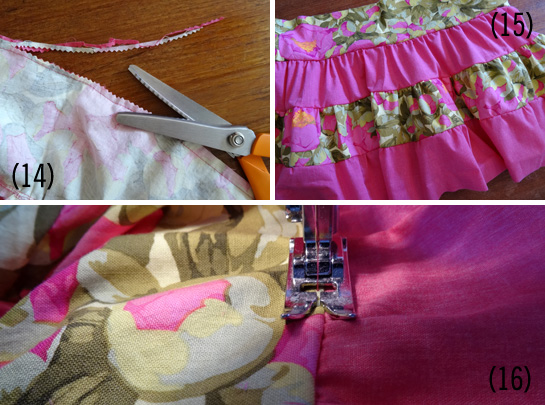
(10) Follow the Scirocco directions (Figgy’s steps 1 through 18) to make the bodice for the dress. (11) Match up the short ends of your tier pieces, one at a time (right sides together) – pin, stitch at 1/2″. Serge, zigzag or trim with pinking shears to finish the edges. (12) Gather the top edge of the three bottom tiers to the width of the tier above. (Size of the top edge of Tier 4 should equal the full width of the Tier 3 piece etc.) DO NOT gather the edge of the top tier yet. (13) Match the top edge of each tier with the bottom edge of the tier above it. Pin, stitch at 1/2″.
(14) Finish the raw edges. (15) You should now have the entire skirt sewn portion together. (16) Top-stitch each tier. Stitch close to the bottom edge of each tier, making sure your seam allowances are pressed up so they are “caught” in the top-stitching. (17) Hem the bottom ruffle. Iron the raw edge up 1/2″, then 1/2″ again. Press well and stitch close to the top folded edge.
(18) Mark the “sides” of your skirt with pins along the top edge. Measure between the pins and subtract 4″. Cut your Back Elastic Casing to this length. (19) Hem both short raw edges of your Back Elastic Casing by folding and pressing under 1/4″, then 1/4″ again and stitching. (20) Iron up 1/4″ on one bottom edge of your Back Elastic Casing (this guide is really helpful). Press well.
(21) Centre the raw (unfolded edge) of the Back Elastic Casing right sides together on the back top edge of the dress skirt. Stitch with a 1/2″ seam. (22) Gather the skirt top along the raw edge to match the bodice bottom edge. Do not ruffle the Back Elastic Casing. (23) Pin the bodice to the skirt, right sides together along the front of the bodice. (24) Match up the back dress bottom edges with each edge of the elastic casing. (Note: Gather the skirt top more or less to match the length to fit.) (25) Stitch with a 1/2″ seam allowance, finish your edges.
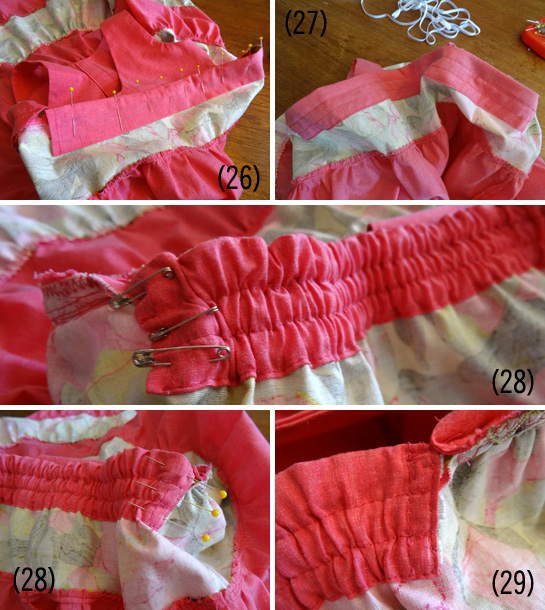
(26) Iron the Back Elastic Casing down, enclosing the seam allowance. (27) Stitch across the bottom edge of the Back Elastic Casing, and twice more to create 3 evenly spaced casing tunnels (see photo). (28) Insert elastic through the casings, each piece should be roughly 1/3 the length of your child’s chest measurement (This will likely give you more than you need). Pin the end of each elastic piece on one end, and safety pin it at the other end. (29) Stitch over the pinned elastic in a rectangular shape to catch each elastic twice. This is visible on the outside of the dress – so be tidy! (30) Try the dress on and adjust the elastic as needed. (My elastic casing ended up being 6″ long once inserted in the casing.) Stitch as per Step 29. Done!
Hooray! Put it on a twirly someone and take a picture! I’d love to see your creation. If you would take a second to post a photo on the Thread Riding Hood Facebook page that would be amazing! You might even get shared (if you’d like) on a Made by You blog post!
by Sherri Sylvester | Aug 16, 2013
I’m in the midst of (what seems like) turning our house upside-down. The kids’ playroom upstairs has now moved to the basement so they have a TON more space to run around. My sewing area and my husband’s office are moving from the basement to join forces in what was the playroom and right now it doesn’t look habitable! Hopefully by the end of the weekend?! In the midst of it all I’m super excited, I have wanted to re-organize my sewing things for a while now and this is the perfect time. I think I’m even going to put all of my fabric on mini-bolts as per this Smashed Peas and Carrots idea.
Now, back to the shorts. If you haven’t seen Monday’s post on how to shorten your shorts, I’m doing a mini 2-part series on pattern altering. Today I’m covering off how to widen or narrow the legs of your shorts. Before you use these instructions you might want to read through the first few paragraphs in the previous post. There are some good instructions on tracing and pattern paper, and an explanation of why I needed to alter the shorts pattern in the first place!
{how to} Narrow the Leg of your Shorts
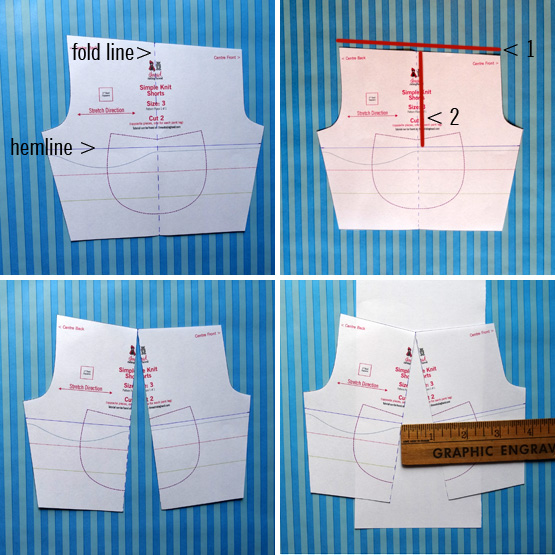
(1) Fold your pattern piece down the centre (along the side of the shorts), line up the hemline from one side to the other, the waist may not match up. I drew in the dashed line to show where the fold is. This pattern piece is already marked at the new hemline (see this post), I have not removed the excess pattern paper because we can use it later. (2a) Now we do some math. Measure around the shorts recipient’s leg where the hemline will be, and note the measurement as A. Measure the hemline on the pattern and call it H. (2b) Add ease (1″ for knits) and twice your seam allowance to measurement A – call this new number B. (2c) Subtract B from H and get measurement C (this number is the amount you need to remove from the pattern piece to narrow the leg of your shorts). (2d) Divide C in half to get D, you will use D to remove the same amount from both sides of the shorts. Now we can move on!
(3) Note down two measurements on your current pattern, for reference later – 1: From centre-front to centre-back (along the waist/top of your pattern piece) 2: Your side seam from top to (shortened) hemline, along the fold you created. (4) Mark D (in my case 1/2″) along the hemline of your shorts and on either side of your centre fold line. (5) Draw two diagonal lines from the top of your pattern at the fold line, through the D marking you made on the hemline, and continue to the bottom of your pattern piece.
(6) Cut along your diagonal lines ALMOST to the top of the pattern, leave a little hinge to hold the pattern together. (7) Tape the pattern piece back together along the line. (8) Straighten your hemline (a) and waistline (b) by lining up the edge marks of the current ones and drawing a line with your ruler. (9) Before you cut out your new pattern, use your noted measurements from Step 3, and measurement B from Step 2 to make sure they are correct. Your new waistline should match the old waistline measurement, the new hemline should match your new intended width (Measurement B), and the side seam measurement should match your old measurement from Step 3.
(10) Cut your pattern piece at the new hem and waist lines and you are done. Go stitch up some shorts!
{how to} Widen the Leg of your Shorts
(1) Fold your pattern piece down the centre (along the side of the shorts), line up the hemline from one side to the other, the waist may not match up. I drew in the dashed line to show where the fold is. This pattern piece is already marked at the new hemline (see this post), I have not removed the excess pattern paper because we can use it later. (2a) Now we do some math. Measure around the shorts recipient’s leg where the hemline will be, and note the measurement as A. Measure the hemline on the pattern and call it H. (2b) Add ease (1″ for knits) and twice your seam allowance to measurement A – call this new number B. (2c) Subtract H from B and get measurement C (this number is the amount you need to add to the pattern piece to widen the leg of your shorts).
(3) Note down two measurements on your current pattern, for reference later – 1: From centre-front to centre-back (along the waist/top of your pattern piece) 2: Your side seam from top to (shortened) hemline, along the fold you created. (4) Cut along the folded centre line ALMOST to the top of the pattern, leave a little hinge to hold the pattern together. (5) Find a piece of paper as tall as your pattern piece and a bit wider than measurement C. Place the paper under your pattern and use a ruler to measure width C between the hemline markings you created (in my case I added 1″). Tape the paper into the pattern to hold it in it’s new position.
(6) Draw a new hemline by lining the ruler up between the outside hemline markings. (7) Add a piece of paper as wide as your pattern piece under the waistline area and draw a new waistline by lining the ruler up between the outside waistline markings. (8) Before you cut out your new pattern, use your noted measurements from Step 3, and measurement B from Step 2 to make sure they are correct. Your new waistline should match the old waistline measurement, the new hemline should match your new intended width (Measurement B), and the side seam measurement should match your old measurement from Step 3. (9) Cut your pattern piece at the new hem and waist lines and you are done. Go stitch up some shorts!
All done, wasn’t too painful, eh? In reality what I did was a lot quicker. I knew from making the Skort pattern before that the legs were roughly 2″ or so too large around. So I cut up the centre of the pattern piece and overlapped the pieces (to narrow the leg) by about 2″. If you have not made the pattern before, however, it is not so easy, and it is better to follow the instructions above!
If you happen to have a two piece shorts pattern (as opposed to the one piece pattern we used above) you can remove the excess in a similar fashion. You will need to take in or widen the back and front pattern pieces. Take in or widen each leg by half of the the amount you need to change. Fold each front and back pattern piece in half and follow the instructions from there for each leg. (Let me know if you would be interested in a tutorial, and I’ll put one together.)
Hope that helps! We’ll see if another post comes up before Monday. It all depends on how far we get on the sewing room! Let me know if you have any questions, I’m always happy to help.
by Sherri Sylvester | Aug 13, 2013
I made this Tennis Skort for my oldest a while ago to match this one that I made for my youngest in May. I love this Heidi &Finn pattern, the sizing is great and they turn out really cute. This skirt is especially good because of the shorts that are built into it. It’s a perfect match for little girls that like to play modestly at the park and still wear skirts!
I did find one change I would have made to the first Tennis Skort, and that is to make the shorts’ legs a bit narrower. I found that they were very loose, not so good for the coverage I am looking for under a skirt. When I made this size I took in about an inch or so to make them more like a bike short, and was much happier with the final result.
When I asked you what to write about in this coming year, I got a reply from Jonquil looking for alteration tips – so, here we are! Today I’m sharing tips on how to change the length of a simple one piece shorts pattern (easiest step first!). In the next few days I will post how to make them wider or narrower around the leg. My original plan was to do them all today, but the summer (and the kids) are calling this week and my time was cut short. Do you find that the days seem to fly by more quickly when the weather is good?!
Altering a Shorts Pattern – Take 1
If you are going to alter a pattern, it is a good idea to print out an extra copy or trace the current one you are using – just in case you make a mistake! For this tutorial I have printed off a mini version of the pattern piece onto regular paper because it is easier to photograph. If you are tracing yours, freezer paper is a good substitute for regular paper if you have it around. It is light enough to see through for tracing, and the plastic coating makes your final pattern more durable. Because I do not want to compromise Heidi and Finn’s pattern, I’m using my size 3 simple knit shorts pattern piece for the sample photos. You can draft your own shorts pattern using this tutorial if you’d like. Even better, if you have one you’d like to change already just follow along below!
{how to} Shorten Your Shorts
(1) Measure your child, or a pair of shorts that fit, and note the length of the inseam you would like to alter the pattern to – This is “A”.
(2) Add the seam allowance and hem allowance (check your pattern instructions) to “A”. This new number is now “B”.
(3) Measure “B” length down from the crotch on your pattern piece and mark it. Do this for both the front and the back inseam.
(4) Draw a line across the pattern piece between your two marks. This is your new length line.
If you are altering the width of the shorts, do NOT cut off the excess length just yet. If you are stopping here, go ahead and cut along the line. Follow your pattern instructions to sew up your shorter shorts (now the perfect length!)
See you soon with more pattern altering instructions! What would you be interested in knowing how to alter when you sew?


 (5) Determine how long you want the gathers to be. I decided to add in 1 3/4″ of extra space – though, I think looking back I should have only added 1″ because the added width distorted the top a bit much.