by Sherri Sylvester | Jul 22, 2013
I got a couple of Peek-a-Boo Pattern Shop patterns in the bundle I bought back in February. I just pulled out the Alex and Anna Summer PJ’s a few weeks ago to make some PJ’s for my oldest daughter. This pattern is really easy to follow and has sizes 6 months through 8 years – so it will grow a long ways with your child. The printable pattern pieces don’t take up much paper either. The only thing I don’t like about printing my own patterns is the amount of paper it takes to print all of the pieces. This layout is well thought through to save you time gluing and paper too!

I made size 6 shorts and lengthened the sleeveless top to make a nightgown. The sizing worked really well. The top is a bit big – but I was expecting that based on the sizing chart. The two pieces went together fairly quickly. I think it took me just over 2 hours to finish both pieces – and that includes matching the stripes. Though I did take a shortcut and didn’t hem the nightgown to save time. Since it is a knit it won’t fray anyhow. The knit came from my Ottawa Street shopping trip. At $4 a metre I think the total price for the pj’s comes out around $2 and I still have more to make another set. Can’t complain about that!
I usually use my stretch stitch when I sew knits, but I decided to try something different this time. I have had two different patterns suggest stitching the whole thing using a double needle recently (this one and the Heidi and Finn Skort). I was a bit wary of this because it seemed like overkill to sew two rows of stitching when I could just use one. To save time switching needles I decided to sew the PJ shorts almost entirely with my double needle and I am super happy with the results.
If you have not used a double needle before, check out the picture above. The top of your stitching looks like two straight stitch rows. The bobbin thread on the back view weaves between the two top threads and creates the stretch you need when sewing knits. I have a ballpoint double needle – because you should use a ballpoint tipped needle when stitching knits. A regular needle point is sharp and will cut through your individual fabric threads, creating tiny holes in your fabric. The ballpoint tip will push the threads aside as it goes through the fabric so they don’t get cut.
Here is a quick explanation on how to thread your machine to use a double needle.
(1) Grab two spools of thread and your double needle. If you don’t have two spools of the same colour you can quickly make a bobbin to use as your second spool. (2) Check out the top of your machine – you should have the option to use two posts. One for each spool. If you don’t have space for two spools check out your machine instruction book – I’m sure it will show you where to put them. (3) Put one spool on each post. (4) Thread the machine as usual – using one thread from each spool – they should both follow the same path through your machine.
(5) Get your double needle. It should have a flat spot on one side of the shank (the post above the plastic that holds the needles together). Remove your current needle and note where the flat spot is. On my machine it is at the back. Put your double needle into the machine with the flat spot in the correct place and tighten it. (6) Separate your two threads and thread one through each needle. My machine also has two hooks to hold the threads separate. One on each side where I change and tighten my needle. (7) Set your machine to a normal length straight stitch. Set your needle position so the double needle comes down in the centre of your presser foot – so you don’t break it by accident the first go ’round! I also set my tension a bit higher to 8 (normally it is set at 5) when I stitch with my double needle. Now, stitch – easy peasy!
Hope that helps! Try it – it’s easier than it seems and really does make stitching and hemming knits look more professional.
Come back tomorrow for Sew Essential #12. (and click here (if you haven’t already) to enter to win a bundle of Tula Pink fat quarters!)
by Sherri Sylvester | Jul 15, 2013
Okay, I know I have talked about these pouches before – hmmm… lots! And I know that you already know that I love them – they make a great quick gift idea. But they also use a technique that I have found really useful, so that is why they are front and centre again today!
Noodlehead Open Wide Zipper Pouch
Funny thing, this blog started (1 year ago now) with an Open Wide Zipper Pouch, here. Since then I have posted a few I’ve made here and most recently here. That given, so far I have only made the smallest of the 3 sizes that Anna provides a tutorial for. As usual with Anna’s tutorials the photos are easy to follow, the directions are specific and everything looks super polished when you are done. I can’t say enough good about her tutorials and patterns. Try this pouch even if you have not installed a zipper in a project before. Her instructions make the process really simple and will leave you wondering why you hadn’t used them before!
Now, on to our technique.
Whenever I stitched something in the past that had to be turned right-side out, I was always irritated by the uneven edge that was left to stitch up, and it would take a long time to evenly fold the seam allowances to the inside.
I found that if I took a second to fold and iron the seam allowance before turning, the edge was already marked – without all of the extra fiddling and folding.
Here’s what I mean, using the Noodlehead Open Wide Pouch. The opening is in the bottom of the lining. (Sorry for the orange dots – it’s a bit hard on the eyes!)
(1) Fold the seam allowances open to both sides. (2) Iron them flat. (3) Turn the pouch, take a look at the precisely folded edges on the opening! (4) Match and pin your ironed and tidily folded edges. (5) Stitch close to the edge to close the opening. ~ Wasn’t that easy!
This also works on flat items, like the Super Hero Cape. Just fold both seam allowances up and iron (use lots of steam to get a good fold). Then turn and top-stitch or hand-stitch the opening closed.
Come back tomorrow for Sew Essential #5. (and click here (if you haven’t already) to enter to win some Tula Pink fat quarters!)
by Sherri Sylvester | Jun 10, 2013
Don’t forget – today is the last day to enter to win a free pattern from Among Brenda’s Quilts. Visit this post and scroll to the bottom to enter. The giveaway ends at 10pm tonight!
Near the end of last year I was happy to find out that I had quite a few friends that were sewing on a regular basis, so we started a little Sewing Club (for lack of a better name!) that meets about once a month. We had a meeting a few weeks ago and one of my friends suggested that I try to sign up to test some patterns for Heidi&Finn. I checked them out and they have some really cute kids patterns. The latest is the Tennis Skort (coming soon) and I’m glad I could test this one.
Heidi&Finn – Tennis Skort Pattern
I am super pleased with the results – and so are my kids! Thank goodness I have enough knit left over to make a 5T version for my oldest as well. This pattern goes together quickly, despite my not having a serger (yet?!). The steps are well explained and it has lots of photographs. The style is so versatile – each layer of the skirt can use a different fabric – making it really fun to play around with! I love that it is a skort as well. The shorts underneath are perfect for a trip to the park! I think too many little girls are running around in skirts these days that don’t know how to sit properly in them. At least this way you can let them feel like a princess and still be sure they are modest at the same time. What do you do when your little girls want to wear skirts all the time?
Since I needed to make this in a week I got to buy some fabric (yay!) and headed out to my local Fabricland store. Amazingly, since they don’t usually stock it, they had some Michael Miller knits available! I ended up with this pink/yellow pattern by Patty Young, part of her Heaven and Helsinki line. The fabric is AMAZING to work with. It is a stretch cotton blend jersey knit fabric with a 4-way stretch. The fabric is super-soft too. I was worried that the 4-way stretch would make it harder to sew, but it was no different than the regular medium weight jerseys I’ve worked with before. The yellow stripe on the top skirt was very thin and needed a bit more care – but I really like the contrast with the pink – so I’m glad I took the extra time to use it. What do you do to help stop the fabric from stretching when sewing knits? I know lots of readers who are scared to sew with knit that could really benefit from your tips and tricks!
We had so much fun on this photo shoot! The weather finally co-operated yesterday, since it has decided to seem more like very-early-spring here instead of almost-summer. Grandma let us borrow her tennis racket and we headed off to a nicely hidden group of courts near our house. Thankfully there were not too many people there! We took over the end court and my youngest asked me “Mommy, how do you use this thing?” as she attempted to use the racket more like a hockey stick – though (thankfully) not hitting the ground with it!
My experience with this pattern was so good I will be back to Heidi&Finn soon to get some more patterns. I’ve got my eye on their Summer Maxi Dress pattern, or maybe the Colorblock dress? I can’t decide… what do you think? Is there another pattern from them that I should try? Maybe I should use some of the fabric I won from Whimsical Fabrics?
Here’s your chance to let your opinion count, Thread Riding Hood Commenter’s cheques are in the mail every third Friday of the month! (Hee, Hee!) Either way, I reply back to EVERYONE (generally through email, but sometimes on the post). We’d all like to hear what YOU have to say!
by Sherri Sylvester | May 27, 2013
I made an amazing diaper bag when I had my youngest. I used Abby’s tutorial, from Sew Much Ado to make it. As usual (since I can’t seem to follow someone else’s directions without making changes!), I did a few things of my own. Little did I know when I posted it here, that so many people would like it and it began to get some interest on Pinterest (hee, hee!). Lots of people liked the fabrics – so I posted this to help them out. But, there was also interest in a tutorial on the changes – so – here it is! And, I have to say that Abby has been super kind in allowing me to use her tutorial to post this! Thanks Abby!
The nice thing about Abby’s bag is that it can double as an amazing tote bag, which is great for me since I don’t need a diaper bag anymore (Hurray!). The extra exterior pockets are great for keys and your phone. The inside works perfectly for holding water bottles, sunscreen, hats, toys and snacks. Great for a trip to the park or an impromptu picnic. A picnic blanket will even fit in the bottom of the bag!
Sew Much Ado Diaper Bag à la Thread Riding Hood
You will need:
- Exterior (Top) Fabric * – 1 Metre/Yard – 44″ wide
- Exterior (Bottom/Pocket) Fabric * – 3/4 Metre/Yard, 44″ wide
- Lining Fabric * – 1 Metre/Yard (1 1/4 to be safe), 44″ wide
- Medium/Lightweight woven fusible interfacing – 1.5 Metres/Yards
- 1/4″ elastic – 1 Metre/Yard – You will need 2 pieces 14″ long
- 1/2″ double-fold bias tape – 1 1/2 Metres/Yards – You will need 2 pieces 26″ long.
- Velcro – 2 pieces, 1″ long (both hook and loop sides)
* Yardage is for pre-washed fabric. Abby uses home decor weight fabric, I used quilting cotton because I like the larger selection of fabric choices. Abby’s is likely a bit stiffer/more bag-like as a result. You could use quilting cotton with a heavy weight interfacing and/or interface all pieces instead of just the ones indicated in the tutorial to make quilting cotton stiffer.
Before you begin:
- Cut out all pieces from their corresponding fabrics following the cutting diagrams below. The outer line surrounding the measured pieces indicates the 44″ wide yardage selvage to selvage.
- For photo reference: Exterior Top is Comma Asterisk in Chalk (Creme/Orange), Exterior Bottom is Comma Intersecting Circles in Slate (Gray/Creme), Lining is Kona Cotton Carrot (Orange) – I ordered my Comma fabric from Fabric Spot.
- All measurements in the drawings are Width x Length.
- Take care to ensure you are cutting any one-way-up fabrics the right way up. (Reference the drawings – Top of the drawing = Top of the fabric)
- Cut out and iron on interfacing for Light Gray pieces ONLY in the diagrams. I used medium interfacing for the Exterior Bottom pieces and lightweight interfacing on everything else.
- Cut 4″x4″ squares (indicated by the dotted line on the drawings) out of the bottom corners on your 2 Exterior Bottom pieces and your 2 Main Lining pieces
- Angle the bottom corners on your Tab pieces if desired – (indicated by the dotted line on the drawings)
As an aside – Something fun I ran into (hang on, the tutorial is coming!) – One of my friends has come up with an idea that I think would be fun to give along with this diaper bag as a baby gift. Or, if you are pregnant and making this bag for yourself I think you’ll find them useful too! They are called Mood Magnets and you can check out this fun video they have on YouTube to see how they work. I asked for a write-up on their “Pregnancy Mood” magnet, so here it is.
Expressing yourself has never been so much fun! Well, maybe that’s a bit of an exaggeration but Mood Magnets from Fun Fridge Magnets (www.funfridgemagnets.com) is a great way to tell your household just how you feel in a simple and fun way.
Featuring the ‘Pregnancy Moods’, ‘New Mom Moods’ and the ‘New Dad Moods’ magnets, these fun products are placed on your fridge and allow the user to move the indicator to a wide range of feelings or moods that best describe how they’re feeling at that moment.
Pregnancy and Parenthood can be a constant roller coaster of emotions, which can be difficult to express, but with ‘Mood Magnets’ it becomes much easier. Meant to be light and playful, the Mood Magnets also have a therapeutic element to them and for under $10, it’s well worth the money.
So while your sitting on your couch with your belly bigger than a beach ball or you’re knee deep in dirty diapers remember one thing – a quick trip to the fridge can be just what you need to survive.
They are great, eh?! Now, on to the tutorial.
Here we go:
The first part of the tutorial focuses on the portion of the outer part of the bag – this is the part that I changed. The inside of the bag is exactly the same as Abby created it, aside from the pocket lining I added. We will be using both tutorials for this one – I will let you know when you need to link to her tutorial from mine.
Note: All seam allowances are 1/2″ length unless otherwise noted.
Make sure you have all of the following pieces of fabric:
Step 1: Creating Outer Pockets with Faux Piping: (1) Stitch your Exterior Pocket to your Exterior Pocket Lining along the top edge with a 1/4″ seam. (the Lining will be 1/4″ longer than the Exterior piece) (2) Press the seam allowance toward the Exterior side. (3) Fold the new piece that you have in half, right sides together, and press. The Lining will extend about 1/8″ over the Exterior pocket fabric creating the Faux Piping. (4) Stitch down the sides (not across the bottom) of the pocket pieces with a 1/4″ seam. (5) Clip the top corners to reduce bulk and turn right side out. Press. (6) Top-stitch the top edge of your pocket aprox. 1/8″ away from the top edge of the Exterior fabric. ~ Now stitch the other Exterior Pocket the same way.
Step 2: Adding the Velcro and Pocket Pleats: (1) Back Pocket Velcro: Use a glue stick to attach the soft side of a 1″ piece of Velcro to the top-centre of your Back Pocket Lining, right under the top-stitching. Use a small zig-zag to attach the Velcro (this stitching will show on the outside of the pocket). (2) Front Pocket Velcro: Use your glue stick to attach the soft side of a 2nd 1″ piece of Velcro to the top-centre of your Front Pocket Exterior, 1″ down from the top of the pocket. Stitch as in (1). (3) Fold the Pocket in half so the side seams are touching and iron lightly to mark the centre. (4) Mark a line, 1″ over from the centre seam, that is 1 1/2″ long. Stitch on the line. Pin the pleat (from the Exterior side) so it is centred evenly. (5) Top-stitch around the pleat. Baste the bottom of the pocket to hold the pleat in place. (6) Add a label/tag to the top edge of the pocket or cut out a patch (like the first diaper bag I made) and stitch it to the Front Exterior Pocket.
Step 3: Attaching the Exterior Front Pocket: (1) Iron your Exterior Top piece lightly to mark the vertical centre. (2) Line up the bottom of the Front Pocket with the bottom of the Exterior Top. Use the centre line to line it up. (3) Baste the bottom of the pocket to the bottom of the Exterior Top. (4) Pin the pocket sides. They should be parallel to the sides of the Exterior Top piece. (5) Top-stitch the side seams to the Exterior Top, make a triangle at the top of the pocket for extra stability.
Step 4: Attaching the Exterior Back Pocket: (1) Iron your 2nd Exterior Top piece lightly to mark the vertical centre. (2) Mark the Back Velcro placement: Use the ironed centre line to line up the Back Pocket with the bottom centre of the 2nd Exterior Top piece. Mark the top of your Pocket Velcro on the Exterior Top fabric. (3) Use a glue stick to adhere the Velcro (aligned to your mark) to the Exterior Top fabric. Stitch with a small zig-zag. (4) Follow Steps 3(2) through (3)5 to stitch the Back Pocket to the 2nd Exterior Top piece.
Step 5: Attaching the Exterior Top to the Exterior Bottom: (1) Pin the top of the Exterior Bottom to the bottom of the Exterior Top – right sides together. Stitch with a 1/2″ seam. (2) Press the seam allowance toward the Exterior Bottom. (3) Top-stitch along the top edge of the Exterior Bottom.
Step 6: Finish the Bag Exterior: Follow the Sew Much Ado Diaper Bag Tutorial Steps 2 & 3. You do not need to follow the directions for the magnetic snap as we are using Velcro.
Step 7: Make the Tab and Straps: Follow the Sew Much Ado Diaper Bag Tutorial Steps 4 & 5. Again, you can omit the magnetic snap directions. Instead attach a 1″ piece of Velcro (hooked side) to the bottom centre of the tab before continuing with Abby’s other directions.
Step 8: Making the Inner Pockets: (1) Stitch each Inner Pocket piece to a Inner Pocket Lining piece. Stitch along one long edge of each with a 1/4″ seam. (If you have one-way-up fabric, stitch along the BOTTOM edge.) Open, “fold” along the seam line and press. Line up and baste the raw edges together. (2) Note: The basted raw edges are the TOP edges of your pockets and the seamed edges are now the BOTTOM edges of your inner pockets. (3) Follow the Sew Much Ado Diaper Bag Tutorial Steps 6 through 10 to complete the pockets and attach them to the Main Lining.
Step 9: Making the Bag Lining: Follow the Sew Much Ado Diaper Bag Tutorial Step 11 to finish the lining.
Step 10: Stitch the Exterior to the Lining: (1) Pin/Baste the Tab to the Exterior on the top centre edge of the side opposite the Front Pocket. Make sure the Velcro is facing out and the outer side of the tab is right sides together with the Exterior when you line it up. (See the photo) (2) Follow the Sew Much Ado Diaper Bag Tutorial Step 12 to line everything up. You can omit the instructions about attaching the tab. (3) Follow the Sew Much Ado Diaper Bag Tutorial Step 13 to stitch the Exterior to the Lining – IMPORTANT: Omit Abby’s directions regarding the top-stitching.
Step 11: Add Faux Piping and Top-Stitch the Exterior: (1) Pull the lining of the bag up slightly higher (roughly 1/8″ – to match the Faux Piping on your pockets) than the Exterior Fabric and pin all around the top of your bag. (2) Top-stitch the top edge of your bag roughly 1/8″ away from the top edge of the Exterior fabric.
Done! And… you have enough scraps of fabric to make a matchy pacifier pocket, pacifier clip and/or a diaper pouch to go with your Mood Magnets! The perfect gift!
Just in case you are wondering, I did not receive compensation from Fun Fridge Magnets and all opinions are (as always) my own. Also, you can use this tutorial for personal items and charity sales, but (as usual) please do not sell items made from this tutorial. Thanks! Sherri
by Sherri Sylvester | Apr 29, 2013
I love my daughter very much, and she loves rainbows – so, when I decided to make some (badly needed) reusable snack bags this weekend, it turned into a rainbow project. I think it started with a fat quarter of Anne Kelle Remix that I bought at the Creativ Festival on Friday last week. Somewhere between Anne Kelle and a random pile of scraps I dug out yesterday a tidy stack of snack bags (in rainbow order) ended up in front of my camera.
We Wilsons: the Reusable Snack Bag Tutorial
I made some snack bags a few years ago, and after searching high and low through snack bag tutorials I came upon this one by Laura from We Wilsons. It is the fastest and best tutorial I have come upon as yet. Laura has obviously put a ton of time into thinking through each step to make the bags fast and easy to put together. Her tutorial is easy to follow and she even provides a pdf download for it, so you can save it to your computer, or print it out easily.
I did things a bit differently than she did – some things to speed up the process and some to make them more “scrap friendly”! So I’ve decided to document what I did here so you can decide how you’d like to make yours!
First thing I do is line the bags with ripstop nylon. If you go to buy this you can ask the friendly employees at your local fabric store which nylon is the “ripstop” type. If you can’t find anyone to help you – look for the tiny squares on the fabric. Ripstop nylon is reinforced with a crosshatch pattern that regular nylon does not have. It is considered food safe and is FDA approved for use with food, just make sure you use the shiny side of the nylon as the “wrong side” when you are sewing it into the snack bag.
There are two other things I do when making snack bags for kids. (1) I cut my regular 3/4″ velcro in half lengthwise. The velcro sticks just fine and it makes the bags easier to open. (2) I add in a grosgrain ribbon tab on the top of the bags, again, making them easier to open because you can pull on the ribbon tabs instead of fiddling with the flat top of the bag. I add a 3″ piece of ribbon (folded in half so the tab is 1.5″ long) to the centre of each end before following step 2 of Laura’s tutorial. When I am sewing I like to double-stitch over the spot where the ribbon is, for added strength. It also helps to cut the ends of the ribbon with pinking shears so it doesn’t fray.
When I sew step 4 on the We Wilsons snack bag, I use one line of wide zig-zag stitching to attach the velcro instead of stitching around all of the edges. Because the velcro is half the width it holds just fine and makes the whole process much faster. I also like to attach my velcro with a glue stick before I stitch it, so it stays in place without pins.
Since I wanted to use up some of my scraps I decided to have 3 different versions of the bags. All of my bags measure 6″ wide by almost 5″ high when finished. Here are the measurements for how I get there. The labels on the photos are CUTTING measurements for the height of the pieces. The width of the pieces should be 6.5″ and all measurements include a 1/4″ seam allowance. If you have “one way up” fabric, use the “OR 2 pieces” size to cut your largest pieces. Once they are cut, stitch them together, you should end up with a rectangle roughly 6.5″ by 10.5″-11″ long. Go ahead and follow Laura’s tutorial.
Now, take your stack of snack bags and fill them up – your kid will have the best dressed snack around! I’ll be posting a review of the Creativ Festival later this week so you can see some of my new stash!
P.S. Just in case you need more rainbow inspiration. Here are a few more things I love:
Rainbow Quilt (photo: Made By Rae) |
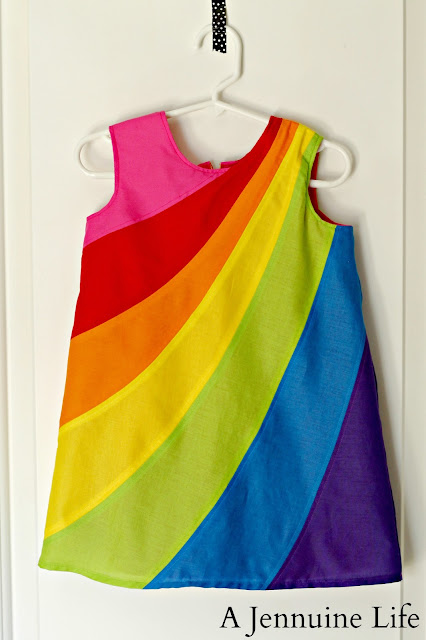
Arden’s Rainbow Dress (photo: A Jennuine Life) |
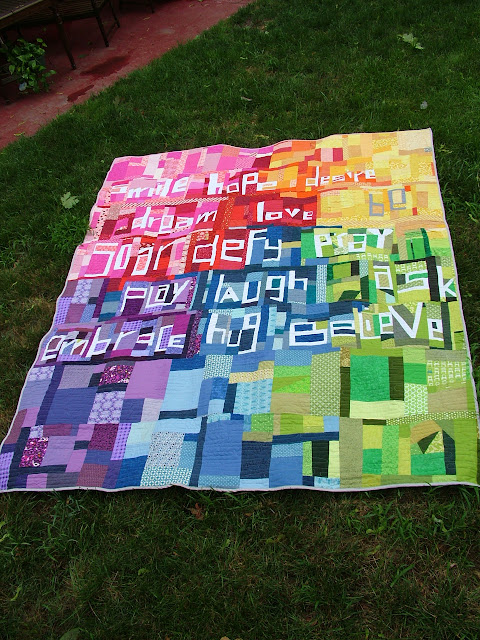
Rainbow Improv Quilt (quilt: Kelli P, photo: Lazy Gal Quilting) |
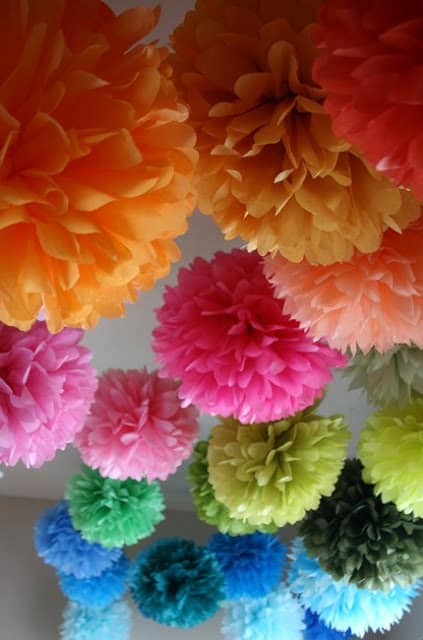
Pom Pom Tissue Flowers (photo: Design Dazzle) |
by Sherri Sylvester | Apr 8, 2013
One little kitten lost her mittens and she began to cry,
“Oh Mama dear, I sadly fear, my mittens I have lost”
and Mama said,
“Don’t worry dear, there’s a great mitten pattern on ikat bag and some fleece that I’ve been trying to use up in the closet downstairs.
I’ll have new ones for you by tomorrow!”
The ikat bag Mittens
So, it is spring here – and has been for a few weeks now. Problem is, the weather is not cooperating! It keeps getting a bit warmer and then cools down again. And we’ve had wind… not a nice calm balmy wind – freezing cold angry wind. This leads me to this post. I found some great thin fall/spring mittens at our local Dollar Store, and I usually stock up with 5 or 6 pairs in the fall, but somehow, by spring they are usually mismatched and lost (maybe even in our house – how irritating!)
I don’t want to have to go back and buy more at this point. So I decided to make some myself. I remember using this pattern by ikat bag before (so I’m not sure why I still continue to buy mittens at the Dollar Store!) I’ve got one pair down and one more to go for my youngest. I might get them done tonight even, if I can clear the too small or “storeable-for-later” clothing out of the middle of our newly made playroom and get the dishes done with time to spare before bedtime! (Who am I kidding, it’s afer 10pm already. And “Yes” the dishes are still not finished!)
Anyhow, the pattern is great. It includes sizes 2, 4 and 6 – and is easily adaptable to other sizes as well. The way LiEr designed the pattern even makes it possible for the mittens to be reversible. I also got to use up some extra fleece from the lining of the “It’s a Hoot” coat I made for my oldest last fall. It’s nice to be able to get some more fabric out of the closet – especially seeing as how I have some more coming (this week I hope?!) for a project I’m super excited about!
The coat and mittens also look cute with the pink “Wrapped in Bows” scarf I made this winter after reading Disney’s tutorial from Ruffles and Stuff. (Which I think I found through Sew Can She – it’s a small world!) It is so much fun when you send your kid off to school in a (mostly) handmade outfit – even down to the coat – it’s very satisfying to say the least! I think tomorrow I will try to get a photograph of her with the whole thing on and put it on twitter.
By the way – if you need some mittens for yourself I have used this tutorial from The Purl Bee to make some from felted wool. They are the warmest, most amazing (and comfortable) mittens in the middle of winter! Because I can’t knit (and because I felted my own sweater to use for the mittens) I was able to use the felted ribbing on the bottom of the sweater to make the cuffs for the mittens instead of having to knit them myself. More on felting your own wool here.
Don’t forget – the Double Decker Fabric giveaway is still on, but this Friday is your last day to sign up! Don’t miss your chance to win 7 gorgeous fat quarters! You can also use the discount code included in the post to buy fabric from Double Decker until Friday. I’ll be posting and emailing the winner on Saturday morning – be sure to watch your email so I can get your address if you win!
Update: My husband just got home and says all of the mittens are in the backyard – ack!