by Sherri Sylvester | Jan 28, 2014
*Update: This Quiet Book is now a Sew-Along! Check out more information in the Overview post.
I’m so glad all of you are excited about this project! Thanks to everyone who took the time to comment on the last post. I especially think that Shari’s comment about switching out the binder rings for large key rings is genius! That would work way better and there would be zero chance that the kidlets remove the pages or get hurt/pinched that way. If you are just joining in, the last post was about the construction of this quiet book and the next post will have the last 6 pages. I’ll link it up here when it is posted. *Update: The last 6 pages are here.
Here are the first 6 pages of the Quiet Book:
The first page is a good ‘ol “button the flower” page. I had a lot of fun with green rick rack and some felt flowers I had picked up on sale somewhere. I think I bought these bee buttons especially for this page. Make sure the button hole is BIG so little hands don’t have problems practicing their buttoning. The curly lines are made with a fabric paint pen.

Next is the pretty purple purse page (say that 10 times fast!). I wanted a way to include family photos in this book because little kids love looking at pictures of people they know. The purse holds a tiny album (made with clear plastic) and a photo of every family member. I think it is the silver rings and purse handle that make this one cute. It’s just like a real purse – only with less stuff inside!
This is the shirt and pants page. The “please learn to dress yourself” page! I included the bottom of an old shirt and the top of an old skirt. The skirt can be used for snap and zipper practice, and the ribbon belt can be buckled and unbuckled. The shirt holds a little surprise – it comes with it’s own belly button, very Cabbage Patch-esque! My daughter thinks it’s hilarious – so I’m glad I put it in.
The telephone page always gets the most use at our house. As you can see from the seam that needs mending on the receiver. I’m not sure why I made such an old fashioned phone. I suppose a cell phone would have made more sense – or a cordless one at least! But the kids know it is a phone, so it works. The cord is a curly shoe lace. The number pad is made using white fabric and an inkjet t-shirt transfer.
Tying your shoes comes much later in life, so I’m not sure why I included it. This shoe lace has actually spent most of it’s life tied in a double-knot – so my 1+ year old couldn’t untie it and choke on it. Maybe I should remember this page for when my oldest gets her first pair of tying shoes!
Counting is always good, and puzzles. This page combines them by using some really great fabric I think I still have a bunch of. The numbers and pictures are cut out with notches for each. All of the pieces are stuck on with Velcro. They can be interchanged, but they don’t match up if you do it wrong! Tricky! (hee hee) I think I put fusible fleece in between my layers to make them thicker.
That’s it for the first 6 pages. Hang in – there are still 6 more pages to go! I’m sure I will be posting them in the next few days.
by Sherri Sylvester | Jan 28, 2014
This week’s post subject is a un/happy accident – or not (we will find out tomorrow!). As I was finishing today’s project my machine decided to make some lovely loud clunking noises. So I decided I should pull out a project to show you that has been around for a while.
*Edit* This book is now a free tutorial series! CLICK HERE for the FREE 12 Page Quiet Book Series – Including links to all 27 posts and tutorials!
I made each of my girls a quiet book when they were 1, this book is my youngest’s. It is one of the most time consuming projects I have ever made, but I love the results! Everything is attached to the book – which was important to me – I hate lost pieces! And (almost) nothing is felt. If you are here for ideas, please take them. Be warned – this takes a long time, a really long time! But, in the end it is worth it, and it is a wonderful keepsake.
The no-felt idea came about because I really wanted everything to last as long as possible. I think I have/had the idea in my head that felt balls up and tears and is in general an inferior product to fabric. I think though, if I was to do it again, I might be open to using some – just maybe the “good stuff”, and not the felt from my local craft store. Either way, not using felt makes the whole project take a lot longer, since every seam must be finished and pieces need to be “good on both sides”!
I have made a few of these and I think the method of attaching the book pages is different in each one. I like this book’s construction the best. It is the easiest to add pages to and simplest to construct. One piece of grosgrain ribbon, stitched with 2 channels for 2 binder rings. Each book page has 2 loops added when it is stitched together, and it is hooked into the binder ring – tada! I thought maybe my daughter would figure out how to take it apart, or start chewing on it and happily neither thing happened! So I think it is a success.
This book also has a ribbon tag on the outside edge for each page. The ribbons all correspond to something on that page and I love how they look. It makes the book all the more fun-looking. I also love the outside fabric – Alice in Wonderland. It may seem to be a bit morbid to make a child’s toy in black – but it sets off the colourful pages so nicely! Inside this one I was apparently into making work for myself, because many of the pages have a patchwork background. I love looking through and remembering where a lot of the fabrics came from. I really need to make a scrappy quilt top someday to use up my scraps and keep my memories somewhere!
The outside of the book is flat, I think I added in some interfacing and fusible fleece. If I was doing it again I would most definitely add in some batting and fun quilting. But this thing is almost 3 years old and I’ve learned a lot since! The grosgrain ribbon goes all the way around the book to the back, where I’ve added a tab and velcro. It was sewn on before the inside was attached. So the stitching doesn’t show on the inside. I’ve also used ribbon and bias tape to finish the bottom and top edges of each page. It was what I had on hand at the time, and with an almost 1-year-old around you generally don’t just “run” to the store for something!
This was going to be the world’s longest, most photo heavy post – so I decided to split up the construction and the pages and post a few times in a row this week. I will update each post with links to the others as I go. What do you think so far? *Update: You can find the first 6 pages here and the last 6 pages here.
by Sherri Sylvester | Oct 18, 2013
Hi! We’re talking about customizing your patterns again today. There are so many things you can do if you know how… so – here’s another tutorial this week (previous one here) on how to help make any pattern into your own creation!
Adding gathers to a shoulder seam can do a few things. First – it will add extra width to the top or the whole bodice – especially nice if you have a fabric with a great drape, or if you need a bit of extra wiggle room in the width of your pattern. Second – it adds a nice feminine touch and a bit of visual interest to the shirt – especially if it is a straight-forward simple pattern.
Wanna try it?
You will need:
- bodice pattern piece – must include shoulder area (I used the Skipper Top from Sew Much Ado – pattern review here)
- paper the length of the bodice
- pen
- ruler or straight edge
Here we go:
(1) Determine how much of the neckline on your pattern piece will be taken up with the seam allowance and/or neckline finish – mark this on your pattern piece. This pattern, for example, has a hemmed neckline and a neckband finish. Since I was using the neckband 1/2″ from the seam allowance would be removed from the visible shoulder area.
(2) Determine where to put the extra width for the gathers.
- (2a,b) Because I used a dolman sleeve top it is not immediately obvious where the gathers should be placed because the sleeve has no shoulder indication. I measured my daughter and found about 2″ of room before her shoulder started. I decided to leave 1″ between my seam allowance mark from Step (1) and where the gathers would start.
- OR If you are starting with a set in sleeve pattern this is a much easier process. Because you know where the shoulder starts, draw a mark at the centre of the shoulder seam area.
(3) Determine how you would like the final shirt to fit.
- Do you need extra width in the top of the shirt only, or also through to the bottom of the bodice (say, to cover a toddler belly!)? For my daughter’s shirt I picked a size width that would cover her belly and added the extra width only to the top 2/3 of the pattern. I ended up cutting a size 5 width, with a size 4 everywhere else.
- Top only (Track A): (3a) Pick and mark a spot about 2/3 of the way down the bodice along the centre line – Draw a line from your Step (2) mark to this new mark. ** The area above this mark will have added width – so be careful with your choice! Do not place your mark too high or the fit of your sleeve and/or neckline will be off due to the extra width that only occurs around the top of the shirt.
- Through the whole shirt (Track B): (3b) If you like you can add width all of the way through the shirt by drawing your line from your Step (2) mark to the hem, parallel to the centre fold line. ** Be careful, the width you add will be doubled – once on each side of the shirt!
(4) Cut the line you just drew.
- Track A: (4a) If you followed Track A cut the line ALMOST to the edge of the centre seam. Leave a little “hinge” of paper.
- Track B: (4b) If you are following Track B you can cut your line all the way down the pattern.
(5) Determine how long you want the gathers to be. I decided to add in 1 3/4″ of extra space – though, I think looking back I should have only added 1″ because the added width distorted the top a bit much.
- Track A: (5a) Spread the top of the paper by the amount of gathering space you want to add. Tape another piece of paper underneath the entire area you just opened up.
- Track B: (5b) Spread the pattern pieces apart by the amount of gathering space you want to add. Tape them to another piece of paper the length of the pattern piece, matching up the hemline. Make sure they are evenly spaced all of the way along.
(6) Cut away the extra and even out your pattern lines.
- Track A: (6a,b) Draw a line from neckline point to sleeve point along the shoulder/sleeve seam.Cut along the line to remove the excess paper. Add in paper to straighten the bodice centre line. Tape the paper in and draw a line from neckline centre to hemline centre. Cut along this line.
- Track B: (6c,d) Draw a line from neckline point to sleeve point along the shoulder/sleeve seam. Draw a line along the hemline from side to side. Cut along these new lines to remove the excess paper and straighten your pattern lines.
- NOTE: If you have curved lines (say, at a hemline) eyeball a curve instead of straightening the pattern line.
YAY! You now have your new pattern piece!
(7) Cut out your pattern pieces as per the pattern instructions. * You may need more yardage if you are adding a lot of extra width.
(8) Line up your new pattern piece with the shoulder seam of your fabric. Now you will mark the area you will need to gather. (8a) Mark 1 edge even with one edge of your added width, I chose the right side. (8b) The gathers will need more space than the width you added, so mark 1/2″ to 1″ extra on the other side of your extra width, I added 1/2″ extra. Mark the other shoulder seam in the same way* If you do not have the room and are making a set in sleeve with a skinny shoulder seam, you can gather the whole shoulder seam. Or, distribute the extra amount by adding 1/4″ – 1/2″ on either side of the extra width instead of on one side only.
(9a) Make two lines of basting width straight stitches within your seam allowance area. (9b) Gather the area to match the shoulder/sleeve width of your back bodice and tie off the ends of the gathering stitches to keep them in place. Continue following the pattern instructions as written using your newly gathered shoulder!
I’d love to know how your project went. Post your project on Facebook and it might end up in a “You Made It” post on the blog! I’d love to hear if you liked this tutorial or any changes you might make.
by Sherri Sylvester | May 27, 2013
I made an amazing diaper bag when I had my youngest. I used Abby’s tutorial, from Sew Much Ado to make it. As usual (since I can’t seem to follow someone else’s directions without making changes!), I did a few things of my own. Little did I know when I posted it here, that so many people would like it and it began to get some interest on Pinterest (hee, hee!). Lots of people liked the fabrics – so I posted this to help them out. But, there was also interest in a tutorial on the changes – so – here it is! And, I have to say that Abby has been super kind in allowing me to use her tutorial to post this! Thanks Abby!
The nice thing about Abby’s bag is that it can double as an amazing tote bag, which is great for me since I don’t need a diaper bag anymore (Hurray!). The extra exterior pockets are great for keys and your phone. The inside works perfectly for holding water bottles, sunscreen, hats, toys and snacks. Great for a trip to the park or an impromptu picnic. A picnic blanket will even fit in the bottom of the bag!
Sew Much Ado Diaper Bag à la Thread Riding Hood
You will need:
- Exterior (Top) Fabric * – 1 Metre/Yard – 44″ wide
- Exterior (Bottom/Pocket) Fabric * – 3/4 Metre/Yard, 44″ wide
- Lining Fabric * – 1 Metre/Yard (1 1/4 to be safe), 44″ wide
- Medium/Lightweight woven fusible interfacing – 1.5 Metres/Yards
- 1/4″ elastic – 1 Metre/Yard – You will need 2 pieces 14″ long
- 1/2″ double-fold bias tape – 1 1/2 Metres/Yards – You will need 2 pieces 26″ long.
- Velcro – 2 pieces, 1″ long (both hook and loop sides)
* Yardage is for pre-washed fabric. Abby uses home decor weight fabric, I used quilting cotton because I like the larger selection of fabric choices. Abby’s is likely a bit stiffer/more bag-like as a result. You could use quilting cotton with a heavy weight interfacing and/or interface all pieces instead of just the ones indicated in the tutorial to make quilting cotton stiffer.
Before you begin:
- Cut out all pieces from their corresponding fabrics following the cutting diagrams below. The outer line surrounding the measured pieces indicates the 44″ wide yardage selvage to selvage.
- For photo reference: Exterior Top is Comma Asterisk in Chalk (Creme/Orange), Exterior Bottom is Comma Intersecting Circles in Slate (Gray/Creme), Lining is Kona Cotton Carrot (Orange) – I ordered my Comma fabric from Fabric Spot.
- All measurements in the drawings are Width x Length.
- Take care to ensure you are cutting any one-way-up fabrics the right way up. (Reference the drawings – Top of the drawing = Top of the fabric)
- Cut out and iron on interfacing for Light Gray pieces ONLY in the diagrams. I used medium interfacing for the Exterior Bottom pieces and lightweight interfacing on everything else.
- Cut 4″x4″ squares (indicated by the dotted line on the drawings) out of the bottom corners on your 2 Exterior Bottom pieces and your 2 Main Lining pieces
- Angle the bottom corners on your Tab pieces if desired – (indicated by the dotted line on the drawings)
As an aside – Something fun I ran into (hang on, the tutorial is coming!) – One of my friends has come up with an idea that I think would be fun to give along with this diaper bag as a baby gift. Or, if you are pregnant and making this bag for yourself I think you’ll find them useful too! They are called Mood Magnets and you can check out this fun video they have on YouTube to see how they work. I asked for a write-up on their “Pregnancy Mood” magnet, so here it is.
Expressing yourself has never been so much fun! Well, maybe that’s a bit of an exaggeration but Mood Magnets from Fun Fridge Magnets (www.funfridgemagnets.com) is a great way to tell your household just how you feel in a simple and fun way.
Featuring the ‘Pregnancy Moods’, ‘New Mom Moods’ and the ‘New Dad Moods’ magnets, these fun products are placed on your fridge and allow the user to move the indicator to a wide range of feelings or moods that best describe how they’re feeling at that moment.
Pregnancy and Parenthood can be a constant roller coaster of emotions, which can be difficult to express, but with ‘Mood Magnets’ it becomes much easier. Meant to be light and playful, the Mood Magnets also have a therapeutic element to them and for under $10, it’s well worth the money.
So while your sitting on your couch with your belly bigger than a beach ball or you’re knee deep in dirty diapers remember one thing – a quick trip to the fridge can be just what you need to survive.
They are great, eh?! Now, on to the tutorial.
Here we go:
The first part of the tutorial focuses on the portion of the outer part of the bag – this is the part that I changed. The inside of the bag is exactly the same as Abby created it, aside from the pocket lining I added. We will be using both tutorials for this one – I will let you know when you need to link to her tutorial from mine.
Note: All seam allowances are 1/2″ length unless otherwise noted.
Make sure you have all of the following pieces of fabric:
Step 1: Creating Outer Pockets with Faux Piping: (1) Stitch your Exterior Pocket to your Exterior Pocket Lining along the top edge with a 1/4″ seam. (the Lining will be 1/4″ longer than the Exterior piece) (2) Press the seam allowance toward the Exterior side. (3) Fold the new piece that you have in half, right sides together, and press. The Lining will extend about 1/8″ over the Exterior pocket fabric creating the Faux Piping. (4) Stitch down the sides (not across the bottom) of the pocket pieces with a 1/4″ seam. (5) Clip the top corners to reduce bulk and turn right side out. Press. (6) Top-stitch the top edge of your pocket aprox. 1/8″ away from the top edge of the Exterior fabric. ~ Now stitch the other Exterior Pocket the same way.
Step 2: Adding the Velcro and Pocket Pleats: (1) Back Pocket Velcro: Use a glue stick to attach the soft side of a 1″ piece of Velcro to the top-centre of your Back Pocket Lining, right under the top-stitching. Use a small zig-zag to attach the Velcro (this stitching will show on the outside of the pocket). (2) Front Pocket Velcro: Use your glue stick to attach the soft side of a 2nd 1″ piece of Velcro to the top-centre of your Front Pocket Exterior, 1″ down from the top of the pocket. Stitch as in (1). (3) Fold the Pocket in half so the side seams are touching and iron lightly to mark the centre. (4) Mark a line, 1″ over from the centre seam, that is 1 1/2″ long. Stitch on the line. Pin the pleat (from the Exterior side) so it is centred evenly. (5) Top-stitch around the pleat. Baste the bottom of the pocket to hold the pleat in place. (6) Add a label/tag to the top edge of the pocket or cut out a patch (like the first diaper bag I made) and stitch it to the Front Exterior Pocket.
Step 3: Attaching the Exterior Front Pocket: (1) Iron your Exterior Top piece lightly to mark the vertical centre. (2) Line up the bottom of the Front Pocket with the bottom of the Exterior Top. Use the centre line to line it up. (3) Baste the bottom of the pocket to the bottom of the Exterior Top. (4) Pin the pocket sides. They should be parallel to the sides of the Exterior Top piece. (5) Top-stitch the side seams to the Exterior Top, make a triangle at the top of the pocket for extra stability.
Step 4: Attaching the Exterior Back Pocket: (1) Iron your 2nd Exterior Top piece lightly to mark the vertical centre. (2) Mark the Back Velcro placement: Use the ironed centre line to line up the Back Pocket with the bottom centre of the 2nd Exterior Top piece. Mark the top of your Pocket Velcro on the Exterior Top fabric. (3) Use a glue stick to adhere the Velcro (aligned to your mark) to the Exterior Top fabric. Stitch with a small zig-zag. (4) Follow Steps 3(2) through (3)5 to stitch the Back Pocket to the 2nd Exterior Top piece.
Step 5: Attaching the Exterior Top to the Exterior Bottom: (1) Pin the top of the Exterior Bottom to the bottom of the Exterior Top – right sides together. Stitch with a 1/2″ seam. (2) Press the seam allowance toward the Exterior Bottom. (3) Top-stitch along the top edge of the Exterior Bottom.
Step 6: Finish the Bag Exterior: Follow the Sew Much Ado Diaper Bag Tutorial Steps 2 & 3. You do not need to follow the directions for the magnetic snap as we are using Velcro.
Step 7: Make the Tab and Straps: Follow the Sew Much Ado Diaper Bag Tutorial Steps 4 & 5. Again, you can omit the magnetic snap directions. Instead attach a 1″ piece of Velcro (hooked side) to the bottom centre of the tab before continuing with Abby’s other directions.
Step 8: Making the Inner Pockets: (1) Stitch each Inner Pocket piece to a Inner Pocket Lining piece. Stitch along one long edge of each with a 1/4″ seam. (If you have one-way-up fabric, stitch along the BOTTOM edge.) Open, “fold” along the seam line and press. Line up and baste the raw edges together. (2) Note: The basted raw edges are the TOP edges of your pockets and the seamed edges are now the BOTTOM edges of your inner pockets. (3) Follow the Sew Much Ado Diaper Bag Tutorial Steps 6 through 10 to complete the pockets and attach them to the Main Lining.
Step 9: Making the Bag Lining: Follow the Sew Much Ado Diaper Bag Tutorial Step 11 to finish the lining.
Step 10: Stitch the Exterior to the Lining: (1) Pin/Baste the Tab to the Exterior on the top centre edge of the side opposite the Front Pocket. Make sure the Velcro is facing out and the outer side of the tab is right sides together with the Exterior when you line it up. (See the photo) (2) Follow the Sew Much Ado Diaper Bag Tutorial Step 12 to line everything up. You can omit the instructions about attaching the tab. (3) Follow the Sew Much Ado Diaper Bag Tutorial Step 13 to stitch the Exterior to the Lining – IMPORTANT: Omit Abby’s directions regarding the top-stitching.
Step 11: Add Faux Piping and Top-Stitch the Exterior: (1) Pull the lining of the bag up slightly higher (roughly 1/8″ – to match the Faux Piping on your pockets) than the Exterior Fabric and pin all around the top of your bag. (2) Top-stitch the top edge of your bag roughly 1/8″ away from the top edge of the Exterior fabric.
Done! And… you have enough scraps of fabric to make a matchy pacifier pocket, pacifier clip and/or a diaper pouch to go with your Mood Magnets! The perfect gift!
Just in case you are wondering, I did not receive compensation from Fun Fridge Magnets and all opinions are (as always) my own. Also, you can use this tutorial for personal items and charity sales, but (as usual) please do not sell items made from this tutorial. Thanks! Sherri
by Sherri Sylvester | Jan 10, 2013
*** Update! There is now a tutorial on how to sew this bag here. ***
I noticed that the photo of my gray diaper bag – blogged here – is sending a lot of people from Pinterest my way. (Hooray!) Comments say “love the colours” – so in hopes of helping them out here are most of the fabrics I used.
The white dots: Michael Miller Fabrics – CX3755 Gray Huevos
The elephant fabric: Here is a similar one on Fabricworm: Jay-Cyn Designs for Birch Fabrics, Mod Basics, Organic, Ellie Fam Orange
Inside I used gray with white polkadots: Michael Miller Fabric – CX3744 Gray Quarter Dot
Unfortunately I can’t locate the gray with flowered white “dots” in my selvage pile – so this one is going to have to be anonymous for a while. I will post the name if I find it.
Along with that, Abby, the creator of Sew Much Ado (who posted the original tutorial) left me this super-nice comment – “These are great! Probably my favorite that I’ve seen yet! So cute, I love the additions you made, and the gray fabric is perfect!” How nice of her to comment back, and just minutes after she noticed that I commented leaving a note on her blog. So much fun!
by Sherri Sylvester | Oct 29, 2012
The Best (Ever) Diaper Bag
*** Update! There is now a tutorial on how to sew this bag here. ***
This Diaper bag is amazing! I made it when I had my second daughter and loved it.
I used this tutorial by Sew Much Ado, and (of course) added in some pockets and things of my own.
The inside is super roomy, even for a mom like me that can’t forget ANYTHING (just in case!) I packed it to take to the hospital and didn’t need any other bags. The bottom (under the pockets) will fit a small fleece blanket, and then you can pile things in on top of that as well.
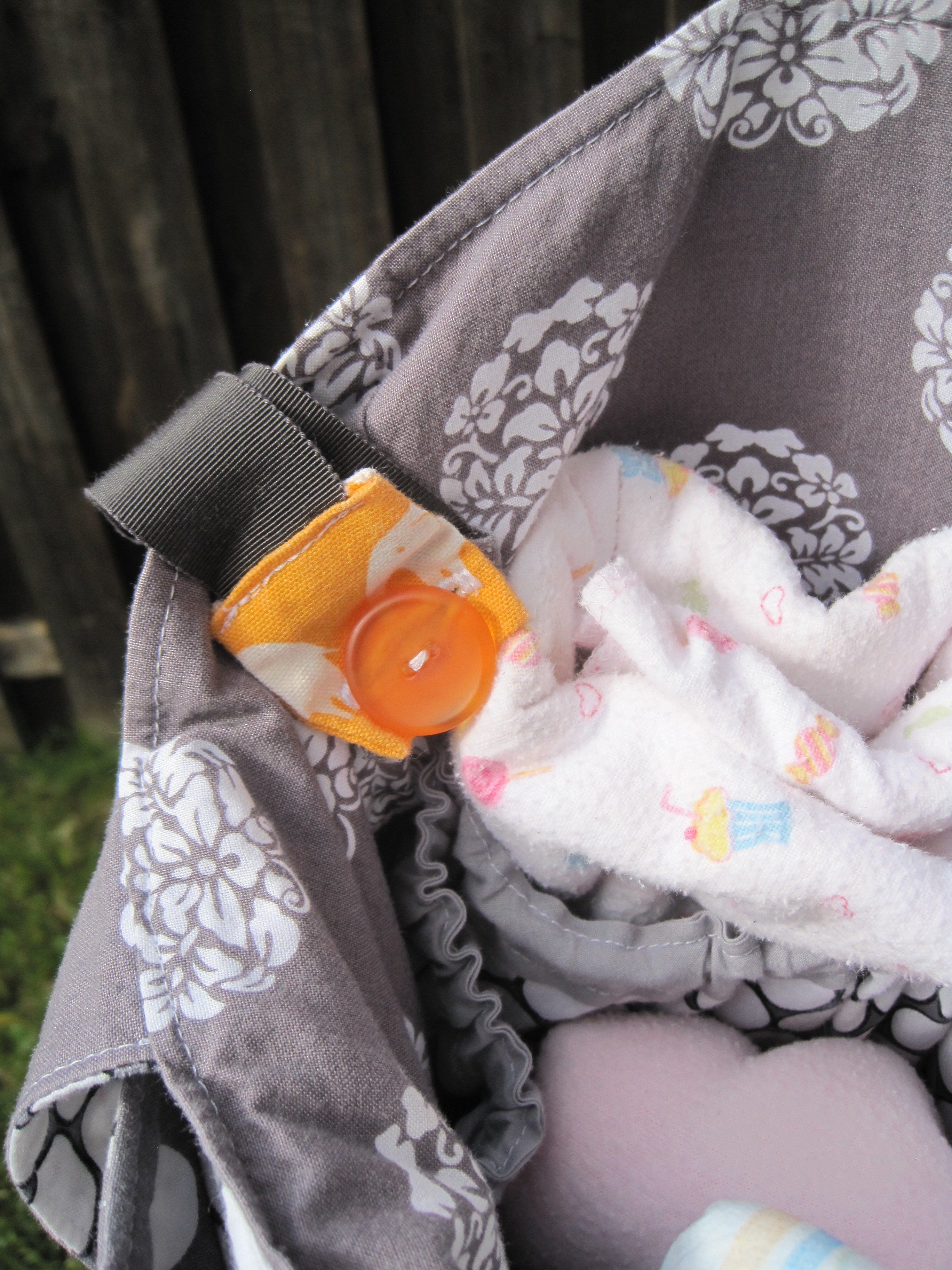
This is a view of the back. I added in the pockets and also some side button on straps for fitting onto your stroller handles. I also changed the pattern to allow for a bottom band of colour, which makes it look a bit nicer.
Stroller Strap CloseUp
Funny thing – I actually ended up making two of these. The first batch of fabric I ordered was a bit greener (read florescent!) than I thought when I saw the colour online. So I ended up making the gray one above, which I was much happier with.
Nice thing is though, now I can use one for each girl when they stay overnight at grandpa and grandma’s house. Of course I still dream of making these – though I think that may be far, far in the future! (Like maybe after I finish the list of Christmas gifts!)