by Sherri Sylvester | Jun 12, 2014
UPDATE 2020-07-17: Sew Mama Sew is unavailable. Please use the links to access the original tutorial and pattern.
Click to download the FREE INSULATED LUNCH SACK PATTERN PDF
Click to ACCESS THE LUNCH SACK TUTORIAL on the Wayback Machine
___________________________________________
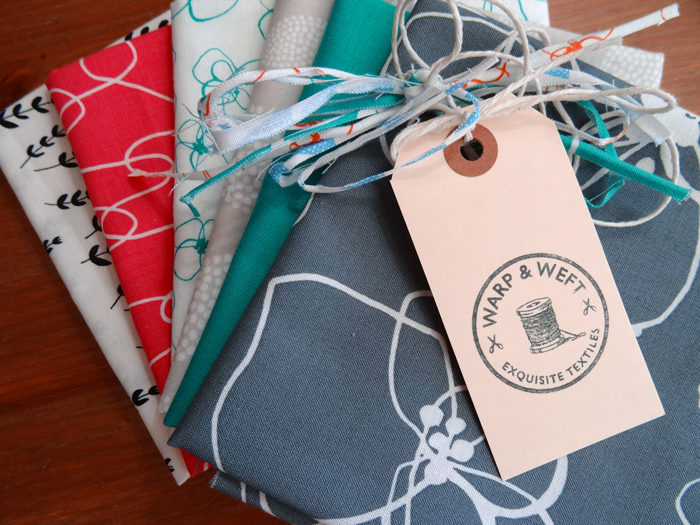
I’ve been busy working with Warp & Weft and Sew Mama Sew to make another tutorial! This time around, it is for a flat-folding lunch bag tutorial, and I got to work with the new Anna Maria Horner collection – Pretty Potent! (Woot Woot!)

When I thought up the idea of making this lunch bag a few months ago I was thinking about how amazing it would be to make this type of lunch bag. You’ve likely seen similar ones at for sale… they fold flat with a zippered closure and lovely oval shaped handle cut-out? Unfortunately for me, some of the details on this bag were stupid complicated extra fun to figure out! Especially if your aim is not to use bias tape because you can never sew it on around curves (or is that just me?) Lucky you – because I’ve done all of the hard work, you can make it the easy way the first time around! (And I get to have extra workable-but-not-quite-right lunch bags around for… umm… using… for stuff… hooray for stuff!)
All kidding aside – I LOVE this tutorial and will likely use it to make my kids’ lunch bags from now until they are finished University. They are insulated with Insul-Bright, and water resistant because they are lined with ripstop nylon. Of course, all of the materials are washable – so they are kid-proof as well! They are very simply constructed, especially the Velcro closure version – since you can omit the longer zipper insertion instructions. I’ve listed a few ideas for how to use them on the main Sew Mama Sew tutorial, and here are a few more. Teacher gifts? or maybe the bus driver, piano teacher, swim instructor or a coach. Maybe you could even make some to use on picnics – everyone packs their favorite meal in their own bag!
Can I talk about the Anna Maria Horner fabric for a while? To be honest, I haven’t been a long-time fan of her work. I have always considered her work interesting, but not interesting enough to buy. But… this collection changed everything, I think I’m now officially hooked and may soon become one of “those people” who are geekily showing off their knowledge of and devotion to AMH! The deep bold colours are beautiful. And somehow she’s managed to mix varying types and styles of art into a cohesive collection. I can think of so many ways to use these individually, but I think my favorite would be an amazing quilt with blocks made of a mix of each print – all together. No solids added. Is that crazy?! (If you want some, you can get the fabrics I used in this tutorial from Warp & Weft!)
Are you ready to make one? This tutorial is a short supplement to the main tutorial posted on Sew Mama Sew and only covers how to use a Velcro closure instead of a zipper closure for the lunch bag. Please be sure to read the directions posted on their site and the instructions below before you begin.
In addition to the main tutorial’s materials you will need:
- one 13” piece of ¾” Velcro – with hook and loop sides together (omit the 12″ separating zipper from the main tutorial’s materials list)
Here we go:
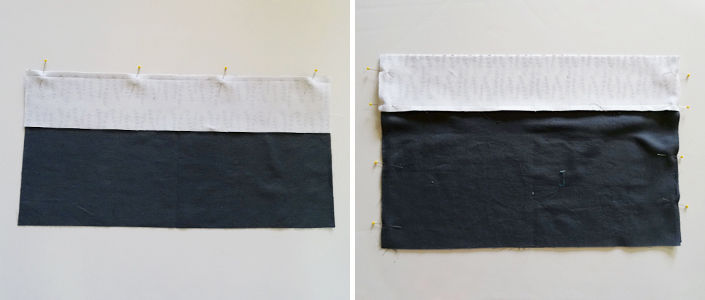
Step 1: Align and pin straight edge of lower lining and straight edge of upper lining, right sides together. Stitch with a ¼” seam. Repeat for other lining side.
Step 2: Finger press the seam allowance to the lower lining side. Align one half of the Velcro to the lining, centering it over the seam. Pin the top only. (
Do not iron, the nylon lower lining may melt!)
Step 3: Stitch the Velcro close to the top edge. Pin the bottom edge of the Velcro, making sure that the seam is flat underneath the Velcro.
Step 4: Stitch the Velcro close to the bottom edge. Trim any extra to the width of the bag.
Step 5: Repeat Steps 2-4 of this tutorial to attach the Velcro to the other lining side.
Step 6: Place one side of the lower lining right side up on your work surface. Align one side of lining base right sides together with the base on top and pin. Stitch with a 3/8” seam allowance. Start stitching at one marked dot and stop your seam at the other marked dot.
Step 7: Fold stitched side of base up out of the way and align and stitch the other side of the lower lining to the other side of the base. Start and stop your seam at the marked dots, as in the last step.
Step 8: Fold the base pieces together and align and pin both sides of the lining. Pin and stitch with a 3/8” seam. Begin stitching where the base stitches meet and finish stitching at the top of the bag.
Step 9: Stitch outer base and sides together (with attached Insul-Bright) in the same way as the lining (Steps 6-8 of this tutorial). Trim away half of all 4 outer base and side seam allowances to reduce bulk.
Return to the main tutorial on Sew Mama Sew to complete your Velcro closure lunch bag. Continue on starting with Step 17 and follow all further steps to the end of the main tutorial.
I hope you love your new lunch bag! Please share your photos on the Thread Riding Hood
Facebook page, or hashtag #alongforthreadride or #threadridinghood on
Instagram or
Twitter. And don’t forget to get your Anna Maria Horner fix from
Warp & Weft!
** Please note: This is a sponsored post and the fabric was provided to me at no cost by Warp & Weft, through Sew Mama Sew. However, as always, all opinions are my own and I will not promote a business that I do not love myself!
by Sherri Sylvester | May 29, 2014
When I got the Merchant and Mills Camber Set pattern from Warp & Weft I felt a little like a kid in a candy shop. Then she let me use her Essex Linen to make it. Then I realized the Sajou ribbon she gave me last year matched it… then I kind of geeked out a little and stared of into space and thought about how amazingly fortunate I am to be able to work with all of these beautiful things!
I loved working with the Essex Linen. It washed up wonderfully and wrinkles just the right amount for a linen (and for non-ironing me!). I sound a bit like a fabric snob when I talk about how well it ironed – but it’s true! It presses beautifully, the wrinkles just ease right out with a bit of steam. I have read online that it does tend to fray easily, so I made sure to finish all of my seams with a zig-zag stitch. It would be simple to french seam any future Cambers, but I wasn’t sure if it would leave too much bulk at the side seam? Of course, if you have a serger that would be simplest option for finishing the seams.
The Sajou ribbon… what can I say? The name of the one I used is “Semis Gris” and Sajou ribbon is woven near Saint-Etienne in France. What more could a fabric geek want?! I decided to machine stitch it on either side, after taking a deep breath of course. I am happy to say that I even still have half of my ribbon left for another project! You can get your own from Warp & Weft – she has a great ribbon collection, and she even has Sajou lace in stock!
The pattern itself is beautifully designed, of course! And the instructions are well thought out and illustrated. The part I liked the most were the easy “snipped in” notches that match up and mark the seam allowances at all of the corners. They make fitting all of the pattern pieces together a lot easier. The instructions themselves are not super-detailed, but if you have made anything with sleeves before you will be fine. Actually, there are only 5 pattern pieces to make either the dress or the top. They are pretty simple to put together, and if you have sewn a Camber before it is a super-fast project.
I love this pattern and it is beautifully drafted. If you have sewn apparel before the care taken in drafting it is evident in the lines and how the pieces connect together. The front of the dress curves less at the hips than the back piece, creating a more fitted shape, while still allowing it to be worn without any closures. The lovely snipped notches I was talking about mark the approximate waist and hip locations so it is not hard to stitch the side seams properly, even with the extra curves.
Despite the beautiful drafting I am not going to tell you that the road to a well-fitted Camber Set is super easy. Of course, you can stitch up the size closest to your measurements and I’m sure it will look beautiful. But if you’d like to tailor it more to your exact shape it is going to require a muslin or two. I made the mistake of trying to size my first muslin without having attached the sleeves. The fit completely changes once the sleeves are attached. The second muslin I made worked out much more easily – especially since I had realized at this point that my shoulders are 2 pattern sizes larger than the rest of me. I knew I had broad shoulders, but wow – two sizes is broader than I thought. No wonder ready-to-wear shoulders never fit!
The only thing I think I may still change in a future Camber is to take in the back with darts, or some shirring. Depending on your body shape, there is a lot of fabric in the centre back area. Though adding any more shape may mean inserting a zipper. I will be adding some shirring/elastic to the back of one of my wearable muslins and will report back!
Like I usually do, I read other pattern reviews online and get some hints as to how I should proceed with any possible alterations. I found a few great tips from Cheeky Cha Cha and a good review from Roobeedoo. I thought I’d throw my two cents in – so here is my list of helpful hints & fitting tips when making the Camber.
Helpful Hints:
- Trace your pattern pieces – don’t cut them out! You can never go back, and what a shame it would be to lose that amazingly drafted sizing. I like to use freezer paper since it is really durable and still easy to see through for tracing.
- When making the muslin – don’t back-stitch. This may seem like common knowledge, but I spent more time taking out my back-stitches than I would have liked!
- Use deep pins – by that I mean, make sure you pin well into the 5/8″ (1.5 cm) seam allowance. I’m so used to a 1/4″ or 3/8″ seam allowance that I pinned for a shallow seam allowance and had to re-pin (especially when setting in the sleeves) several times.
- When Merchant and Mills says “jump” you ask “how high”! They didn’t get this big without a reason – since the instructions are well-written but sparse, each one counts. Don’t skip out! For example, sew up the side seams and then set in the sleeve. Trying to set in the sleeve before sewing up the sides works for some patterns, but these sleeves are very well drafted and therefore much easier to set in at the end.
Fitting Tips:
- The Camber is a loose fit. I made the mistake of trying to fit it too tightly, so it loses the ability to fit over your head without an added side zipper.
- I found the length quite long, though I am average height at 5′ 4″. I took off quite a bit of length and made a double 1″ hem at the bottom. Check the length before you cut your fabric and you can save yourself quite a bit of yardage.
- Since I have broad shoulders, I cut the arm scythe and shoulder at a size 12, and the side seams and sleeve side seams at a size 8 (like the rest of the dress). I was concerned this would not give me enough space in the sleeve, but it worked out well. It is actually quite easy to move in this dress, due to the great sleeve fit. I read that apparently the closer the underarm seam is to your actual underarm the better the fit.
- I found since I have a smaller bust measurement that the front of the dress was too wide. I narrowed the entire front of the dress by 1 1/4″ by placing it 5/8″ over the fold when cutting (tip found here). It fits much better, though it also makes the neckline smaller, so I had re-drew it 5/8″ wider in the front and the back neckline to make up for it.
- I also adjusted the shoulder, according to Aunty ChaCha. I took 5/8″ off the top of the front shoulder seam and putting it on the back shoulder seam. This also extends the top of the sleeve, where it is eased in, creating a wider shoulder. I found this really helpful in creating a better fit for my larger shoulders.
- The last thing I did, and this made a big difference, was to move the point of the bust dart up. I left the base of the dart in place, and moved the point up about an inch. This really helped to remove excess fabric that was at the top of the bodice, as well as make the bodice fit better. I found that without this dart movement, the top of the dress was fairly shapeless.
I hope this helps! I also hope I have not scared you away from trying the pattern. It truly is beautiful, just read through comments from other bloggers online! Or google “camber set” to find images. This is one of the first woven fabric garments I have made where I really am proud of the work I did to make it fit properly. Using a pattern and making it fit your body are two different things and I would encourage you to try some alterations and spend the extra time with a muslin or two. It is worth the extra time. If you are lucky you will be able to create a wearable muslin along the way!
I have Esmari to thank for letting me work through this process. I love my Camber Dress and will wear it often. You can get the Camber Set pattern, beautiful Essex Linen (in more than 10 colours!) and amazing Sajou products from her shop. Until next time!
** Please note: This is a sponsored post and the fabric and pattern were provided to me at no cost by Warp & Weft. However, as always, all opinions are my own and I will never promote something to you that I do not love myself. **
by Sherri Sylvester | May 16, 2014
Happy Friday, I hope you have a great weekend planned. We have Monday off for Victoria Day and an extra day to relax is never a bad thing!
Today I’m sharing a quilty something. I’m so excited that my foray into quilting is progressing along nicely. I’m happy to actually have made something substantial – with straight line quilting and a binding and everything! I know that may not seem that amazing to all of you quilters out there – but to me it’s one step closer to actually making a real live actual quilt – the kind you can cozy up with.
I have been stalking Blueberry Patch Cathy’s Wonky Star Table Runner tutorial ever since I saw Cynthia Frenette’s version of it last year. So my plan was to make one for my mom this year some time and Mother’s Day seemed like the best option. I took her out to the local Hobby Lobby for some fabric selecting when we were visiting her in December for Christmas. She loved these green, yellow and red (mostly) batiks and they match with her kitchen colours really well. The natural background she picked is perfect for this table runner. It was pretty fun since she had no idea what I was going to make from it!
I don’t usually work with batiks, but I like how they tend to look “one colour” and more quilty-modern with a solid background I think? The wonky stars are really simple to put together. There’s one in the centre of the 6×6 fabric tray as well. Once I had all the pieces sewn my youngest even had fun helping arrange them. She loves green so maybe that is why they are mostly in the centre area?!
This table runner was made starting with 4.5″ squares. Cathy made hers with 4″ squares – which in hindsight may have been easier. There is not a lot of room for a “full star” block when you use only 3 squares across. I found arranging the “split” star pieces had to be done carefully so the colours still balanced. The quilting was fun too – though I wish I had some Aurafil or other “better” thread to work with. The regular Gütermann I use just doesn’t have the same look. The whole thing is self bound. I made the backing bigger and folded it over to the front and machine-stitched it. It works well, but the quilting has to stop exactly on the edges of the runner or it will show on top of the binding.
There’s a super-cute zakka label on the back. I found them at the Creativ Festival! I will have a review of it (and my stash!) coming next week, I think. I just washed up all of my new fabrics yesterday – doesn’t a wash-tub full of new fabric just make you super-happy?! And then folding it all up into little mini-bolts for my shelf is my favorite. I even cut up some of them yesterday for new Bohemian Babydoll dresses for the kids. Seriously can’t say enough good about this dress/top pattern – it is really quick (with no closures to sew!) and my girls love it. I’ve got fabric for 4 of them on my cutting table right now.
Do you quilt? What do you think of batiks? I’m curious, since it seems everyone generally chooses modern or traditional fabric and then there are batiks…? Since I’m not quilting a lot yet I’m not sure how that works.
by Sherri Sylvester | Apr 25, 2014
So – I am reminded that I should likely not promise to post something “next day” unless I already have it finished. Everything for the tutorial was ready on Tuesday, except for the post and on Wednesday our furnace broke and I needed to be otherwise occupied with random things until late into the evening. Of course that was too late to get this to you Wednesday as promised, so I am going to refer back to my post on “No Stress” sewing and attempt not to feel too bad for going back on what I said. I suppose sometimes life has to happen whether it’s convenient or not!
I would like to thank each of you for the kind comments about the Spring Market Totes you have posted! I generally answer each comment individually – but since you were entering the contest as well I thought I’d send out a general THANK YOU, THANK YOU to each of you here. (I hope you can hear me, I’m yelling really loudly!) I’m so glad you are enthusiastic about them. I know I’m excited and this is going to be my “go to” bag this summer!
Just in case you haven’t seen it yet – the Spring Market Totes are part of the Warp & Weft Sewing Society’s Lotta Jansdotter Challenge Blog Hop that comes with a gorgeous 12 fat quarter bundle giveaway! Check out this post for more details, the contest closes April 27th, 2014. All of the fabric for these totes is from Lotta Jansdotter’s Mormor and Sylvia collections available at Warp & Weft!
On with the Tutorial!
Size Information: The Spring Market Tote bag is 12″ wide by 6″ deep across the base and approximately 18″ wide at the top of the bag. The handle drop is about 7″. The Mini Spring Market Tote is 9″ wide by 4″ deep across the base and 13″ wide at the top of the bag. The handle drop is about 4 1/2″. Each bag is fully lined. This tutorial does not include pockets, but they would be simple to add to the lining before it is assembled and attached to the tote.
You will need:
- Outer Bag: aprox. 6 fat quarters of quilting cotton or similar weight fabric will make 1 Tote & 2 Mini Totes (see cutting notes below)
- Lining: 1/2 yard 44″ wide fabric per Tote AND/OR 1 fat quarter or 1/4 yard 44″ wide fabric per Mini Tote
- Batting & Canvas Upper: 2 pieces 20″ x 14″ each per Tote AND/OR 2 pieces 15″ x 10″ each per Mini Tote (I used low loft Warm & Natural)
- Base Stiffener, Batting & Canvas Base: 13″ x 7″ each per Tote AND/OR 10″ x 5″ each per Mini Tote (I used 7-Mesh Plastic Canvas as a stiffener)
- Medium Weight Fusible Interfacing: 1/2 yard for each Tote AND/OR 1/4 yard for each Mini Tote (assuming 20″ wide interfacing)
- Rope Handles: 60″ of 1/2″ rope for each Tote AND/OR 40″ of 1/2″ rope for each Mini Tote
- Grommets: 7/16″ grommets (size indicates hole size, grommet is actually 1″ wide) – 4 per tote
- Pattern Pieces: Spring Market Tote Pattern Pieces (click the link to download)
- General Sewing Supplies
- a Walking foot, Leather/Denim needle and Basting Spray are helpful, but not necessary
Before you begin:
- Print out the pattern piece pdf on letter size (8.5″ x 11″) or A4 paper. Important: Do not select “fit to page” when printing, make sure you print at the original size. Once you have printed the pages, measure the 1″ test square to ensure the pattern is the correct size.
- Check to make sure you can sew a fairly exact 1/4″ seam or the dimensions of your bag may be off, possibly making it impossible to fit the lining or base. Here is a good tutorial to follow to check that you have a 1/4″ seam. (This tutorial is also linked on my Sewing Tips and Tricks Pinterest board.)
- I broke a few needles stitching over the thick layers of batting and canvas. Especially while stitching over the pleat at the end of the base. A thicker denim or leather needle is helpful while stitching around the base. It is also helpful to stitch slowly and carefully – being sure to avoid pins and using the hand wheel as necessary to get over the thickest areas.
- If you would like to make your own rope – Use 4 strands of 3/16″ thick braided cotton per rope. I purchased 2 50′ lengths of 3/16″ thick braided cotton string at the hardware store. Search online for instructions on how to make a “4 strand round braid”. I found this YouTube video to be particularly helpful.
Cutting your fabric:
It is difficult to say how much fabric you will need for each tote as you can decide how many fabrics you would like to use. This tutorial follows how to create a striped tote with 6 different fabrics + a lining fabric OR a striped mini tote with 5 different fabrics + a lining fabric. Here is the cutting layout I used to make my 3 totes (
please note my fat quarters were aprox. 21″x20″)
- Use the pattern pieces to cut the base from multiple materials as per the pattern piece instructions and the list below. Please be sure to follow the appropriate drawing/pattern line for the size you wish to make!
- Outer: You will need to cut 2 of each of the strips as indicated in the photo below for the outer shell of each tote. You will also need 2 reinforcement strips and 1 base from the outer fabrics for each tote. I cut my strips longer than needed (see photos) and trimmed them after they were stitched.
- Lining: Cut 2 pieces 18.75″ x 9.25″ and 1 base per Tote AND/OR cut 2 pieces 14″ x 6″ and 1 base per Mini Tote.
- Batting/Canvas: Cut as indicated in the “You will need” list. You will have 2 rectangles and 1 base per tote.
- Interfacing: Cut 2 reinforcement strips and 1 base per tote.
- Base Stiffener: Cut 1 base (along the base stiffener cutting line) per tote.
Here we go:
I used a quilt-as-you-go technique to assemble the sides of the bag. Keep in mind that making your seams even will help the stripes to match up at the ends of the tote.
- Lay all of your strips out in the order you wish to assemble them in. Refer to the cutting photos to ensure the thicker and thinner strips are in the correct order.
- To begin, layer one canvas upper with one batting upper on top of it and make sure the edges are even. These pieces are oversized so the quilted outer can be trimmed after stitching. Place the largest strip at the bottom centre of the canvas/batting layer. Align the next strip right sides together (RST) with the top of the bottom strip. Pin and stitch with a 1/4″ seam. Press the strip to the top and smooth over the batting to ensure everything is flat when you are finished. Continue pinning, stitching and pressing each strip until the first side is finished. Repeat for the opposite side.
- Trim and square off each quilted upper. Trim the Tote to 18.75″ wide x 12.5″ tall. Trim the Mini Tote to 14″ wide by 8.75″ tall. Do not trim the bottom of the quilted upper because this will affect the position of the strips and the ends of the stripes will not match on your final tote.
- Place both trimmed uppers right sides together. To ensure the stripes match, pin each as you would with a quilt block. Here is a good tutorial about pinning matching seams. (This tutorial is also linked on my Sewing Tips and Tricks Pinterest board.)
- Stitch both sides of the upper with a 3/8″ seam. Press the seam open well from the wrong side and press the seam on the right side as well to ensure the batting/canvas/outer layers are as flat as possible. You now have a large upper tube shape. Set the upper aside.
- Interface the outer base fabric on the wrong side following the manufacturers instructions. Layer the base: canvas on the bottom, batting in the centre, outer on the top. Pin/Spray baste to hold them together. Quilt the base as desired. I used straight lines, starting in the centre and moving out to each edge. If you do not have a walking foot take care to pin these layers many times to ensure the fabrics do not shift while you are stitching.
- Quilt the tote upper as desired. I quilted once in the centre of each stripe and every 5/8″ on the bottom stripe. DO NOT quilt the top 2 stripes – 3 ¼” down from the top of the Tote OR 2 ¾” down from the top on the Mini Tote. We will do this once the lining has been inserted. Be sure to keep the side seam allowances open while quilting so they stay as flat as possible.
- Mark the outer base: Place a pin in the centre of each oval end. Now pin 1.25″ on either side of the centre mark (blue pins in the photo). Fold the oval in half with the end of each oval matching and mark the top and bottom centre of the base as well.
- Fold the upper tube so the side seams are aligned . Mark each fold at the bottom of the upper tube with a pin. This marks the centre of each side.
- Match the top and bottom centre marks on the base (step 8) with the centre pins on each upper tube (step 9). Pin the base and upper tube RST. Continue pinning the upper tube and base together starting at each centre side pin and working your way toward the ends. Pin only until you get to the pins marking either side of the centre pin (blue pins in the photo). Leave the ends open.
- Stitch the pinned area (between the blue pins) on each side with a 3/8″ seam. Again, make sure to leave the unpinned ends open.
- Fold and flatten the unpinned upper tube ends into the centre of the base oval ends, making a pleat and matching the base and upper tube’s raw edges. Pin as much as necessary to hold everything together.
- Stitch (slowly and carefully over the thicker areas!) around the unstitched end of the base with a 3/8″ seam allowance. This will close the end of the base and secure the pleat. Turn the base right side out to check that the pleat is stitched correctly.
- Once you are happy with the pleat and base stitching, turn the base wrong side out and trim the bottom seam allowance to 1/4″. Set aside.
- Interface the 2 reinforcement strips. Pin each reinforcement strip to the top edge of one lining piece. Take care that one-way fabrics are aligned in the correct direction. Stitch with a 1/4″ seam allowance. Align the 2 lining pieces RST and pin the side seams matching the reinforcement seam. Stitch side seams with a 3/8″ seam allowance.
- Press the lining side seams open. Press the top edge of the reinforcement fabric 1/4″ to the wrong side.
- Place your base stiffener (I used plastic canvas) in the bottom of the wrong side out tote. It should fit within inside the seam allowance on all sides. Trim if necessary to make it fit.
- Lay the wrong side out lining so the wrong side out outer and lining bases match up with the base stiffener in between them. Hand tack each end and centre side of the lining, stiffener and outer together. This will keep the stiffener and lining in place.
- Turn the outer tote right side out. Open up the lining and bring the lining top edge up and over the outer tote. The fold at the top of the lining (step 16) folds over the top edge of the outer tote by 1/4″. Pin well through all layers.
- Top stitch along the edge of the folded lining as in the photo.
- Now we can finish quilting the top 2 stripes. Pin through all layers on the top 2 stripes, smoothing and matching the lining and the outer so everything is flat and well attached. Quilt as desired.
- If you quilt a straight line in the centre of each stripe the stitching should just catch the bottom of the reinforcement stripe and/or the top of the lining as in the photo of my tote’s lining below.
- Open the edges of the base and press well.
- Mark the grommet placement.
- The Tote grommets are placed just above the centre of the 2nd stripe. They are 5″ over from the side seams.
- The Mini Tote grommets are placed between the top 2 stripes and 4″ over from the side seams.
- Attach the grommets to your bag as per the manufacturers directions. Practice first on a layered lining/canvas/batting/outer scrap sandwich if you have not used them before!
- Cut the length of rope in half. Each Tote handle is 30″ long. Each Mini Tote handle is 20″ long. Thread them through the grommets and tie a large knot in the lining side of the tote. Make sure the handles are the same length and then tighten your knots. Trim any excess rope as necessary.
You are finished! Congratulations. Head on out and get shopping. If you made a matching Mini Spring Market Tote make sure to take a break somewhere fun with your little one. Might I suggest a stop at the toy store?!
*As usual, please do not sell items made with this tutorial. It is for personal or charitable use only. If you are interested in a license to sell products made using this tutorial please contact sherri@threadridinghood.com and I will create a purchasable license for you.
by Sherri Sylvester | Apr 22, 2014
I’m so excited to be part of the Warp & Weft Sewing Society’s first ever blog hop this week! We were all given a 6 fat quarter bundle of Lotta Jansdotter’s new (gorgeous!) collections Mormor and Sylvia. The challenge was to make something that celebrates Spring. You can get your hands on some of this amazing fabric by entering the giveaway at the end of this post – 12 Fat Quarters of Lotta Jansdotter goodness! **Update: The giveaway is now closed.
I had so many ideas for this challenge, most involving quilts – but, since many of the other Sewing Society members are talented quilters I supposed I should choose something else! In the end I decided a new spring tote bag was the way to go – because you can never have too many bags! The bright, springy bundle Esmari expertly mixed for me is so light and happy, that I decided to share and make 3 totes. A Mommy and Daughters trio! (This post was getting a bit long, so the Spring Market Tote tutorial is coming up tomorrow! *Update: The Spring Market Tote & Mini Tote Tutorial is here.)
I wanted to make something striped that could feature each of the prints in my fat quarter bundle and was inspired by the beachy rope handled totes I was seeing online. It was great when the prints came together into a tote that is a bit more formal – perfect for shopping! The large size makes a very roomy bag, and I tried to duplicate that by making the girls’ mini totes oversized as well. They were able to fit all of their (self chosen) shopping necessities with them. It was fun to see them excited to feel “all grown up” with their own matching totes!
I had fun trying to find rope that I liked in an appropriate thickness for the totes. With my pre-made options exhausted, I bought some braided cotton at the hardware store and made my own rope! A 4-strand round braid is actually very simple to make and I’m really happy with how it looks. The grommets are fun even though it was momentarily terrifying to cut holes for them in my perfect “finished” bag! They turned out so well I think I’ll have to do it again!
The tote is made with a quilt-as-you-go technique so the outer comes together really quickly. Inspired by my Noodlehead Cargo Duffle I layered quilting cotton, low loft batting and canvas. It holds it’s shape really well, and the interfaced reinforcement strip at the top of the bag folds over to easily install the lining. There is a small pleat on the ends of each oval base, making it simple to fit the outer perfectly to the circumference of the base. And I love how it gives the Spring Market Tote a little more shape.
I would like to thank Esmari especially for choosing the perfect bundle for me! The Slate Blomster is my favorite print in the Mormor collection, my oldest loves pink, and my youngest’s favorite colour is green – so the emerald was perfect for her. Win-win all around. I split up the girls’ totes to accent their favorite colours, while mine includes all of them together – lucky me!
**Update: The Giveaway is now closed. ** You can win 12 Fat Quarters from Lotta Jansdotter’s latest collections, Mormor and Sylvia! In order to enter this Giveaway please follow the Rafflecopter instructions in the widget below and leave a comment on this post. You can obtain 7 entries in total by leaving a comment on each participating blogger’s Lotta Jansdotter Challenge post.
a Rafflecopter giveaway
I’m second on the blog hop this week – be sure to check out the kick-off post! The quilt Esmari posted yesterday on the Warp & Weft blog is gorgeous. The fabrics look amazing on a white background with the coloured thread she chose. Carla is coming up tomorrow and her work is impeccable, I’m so excited to see what she’s going to post!
Esmari – Warp & Weft: April 21 ** blog kick-off yesterday!
Sherri – Thread Riding Hood: April 22
Carla – My ½ Dozen Daily: April 23 ** tomorrow’s post!
Shannon – The Finished Garment: April 24
Cathy – Blueberry Patch: April 25
Cynthia – cynthiaf: April 26
Lysa – Lysa Flower: April 27
Winner to be announced here on the Rafflecopter widget: April 28th
I hope you like the totes and come back to check out the tutorial! It’s really simple in its construction – and if you want to get some Lotta to make your own you can find it at the Warp & Weft shop – I know you need a new Spring Tote! Be sure to get all of your entries in by following the blog hop around, I’ll see you at Carla’s tomorrow!
** Please note: This is a sponsored post and the fabric was provided to me at no cost by Warp & Weft. However, as always, all opinions are my own and I will never promote something to you that I do not love myself. **
by Sherri Sylvester | Mar 17, 2014
Wow – I feel like it’s been a while since I posted something on Monday. I’m so glad the weather is sunnier and we can all start looking forward to spring – if it decides to show up! Since it’s still pretty chilly here I made a little shirt over the weekend to hold me over until I can wear my summer things again. How is your corner of the world doing?
I think I have had this stripey knit since the fall – but of course I’m only getting to it now. It’s a lightweight sweatshirt fleece and is amazingly cozy. I’ve worn this shirt two days in a row now and there might be a third in it’s future since I haven’t had a run-in with a small set of sticky hands yet! Is that bad?! I could tell you I washed it in-between, but I suppose that wouldn’t be true… hmmm…
I’ve been eyeing the abundance of drop shoulder shirts out there. Especially in sweaters this winter. So I pulled out my self-drafted High-Low Chevron dress pattern to start and went from there. The new shirt is shorter and has almost no high-low hem, though I did make it about 2″ higher in the front – you can’t really tell. And obviously this shirt has long sleeves. The body of a drop shoulder shirt is actually quite similar to a dolman sleeve shirt, in fact I suppose it could be exactly the same, though my research tells me I am only half right. Apparently the drop shoulder shirt generally has a more structured underarm area that leads to the sleeve, where-as the dolman tee is usually looser and has a large armhole that continues to where the cuff is attached.
Anyhow… I have discovered that I love the drop shoulder for two reasons. First – it is really great for me because I have broad shoulders. I tend to have trouble buying fitted shirts because my shoulders just don’t fit. This means I gravitate towards raglan, dolman and now – drop shoulder – type sleeves. They don’t have a seam at the shoulder so I don’t have to worry about fit there. Second – they are super comfy, likely because they are mostly (exclusively?) made from knits! If there is anything I like it’s a comfortable top. I am most definitely not one of those people who will wear something uncomfortable because they are supposed to. (Though I think I tried to do that a lot to fit in in high school!)
I aimed to match stripes, but I purposely didn’t try too hard because I wanted the shirt to be more relaxed looking. I cuffed the sleeves and used my double needle to top-stitch around them and the neckline. I also used it to hem the bottom of the shirt, because I decided I didn’t want to add a cuff to the hemline because it would look too “casual sweater” and not so much “shirt”. The back of the shirt has a seam down the centre – which for some reason I did not photograph – sorry. The seam helps to shape the shirt and I really like how it looks. The extra seams add that extra little detail to make your shirt look more professional.
I am happy to tell you that these are really easy to make, since there is no “easing in” of a sleeve. The sleeve fits into the place where you would normally sew a cuff on a dolman tee and extends from there. I likely should make another one and show you – but that may have to wait until the fall when I will hopefully/maybe/possibly sew another one of these for myself! If you want to try it you can use the Dolman Tee tutorial I have written on how to draft and sew a dolman tee. Or you can get a great Dolman tee pattern from Sew Much Ado and add some sleeves. To add sleeves, I put the finished (no cuffs added) dolman tee on and measured from the armhole to my desired sleeve length along the inside/underside of my arm. Then I traced a sleeve from a sweater I like, marked the length from the hem of the sleeve up, made sure the armhole and top of the sleeve were the same size and sewed them together. Hmmmm… maybe not so clear unless you are super adventurous? Let me know if you want one and I will put the tutorial on my list.
One more shot of me being model-y with awesome squintey far-away eyes. (how embarrassing!) I must thank my husband (no relation to the previous sarcastic comment intended) for going out and taking these photos. It was -6 degrees Celsius out, that’s 21 degrees Fahrenheit, and he was kind enough to carry my coat so I could try to warm up between shots! Super chilly – but the outdoor pictures are so much nicer that it’s totally worth it. Oh, and let’s leave with this one… me staring at my shoes at dusk in a deserted area – with no purse, coat or hat in the middle of winter… Eek! I’ve got to think up some more realistic settings!