by Sherri Sylvester | Dec 11, 2015
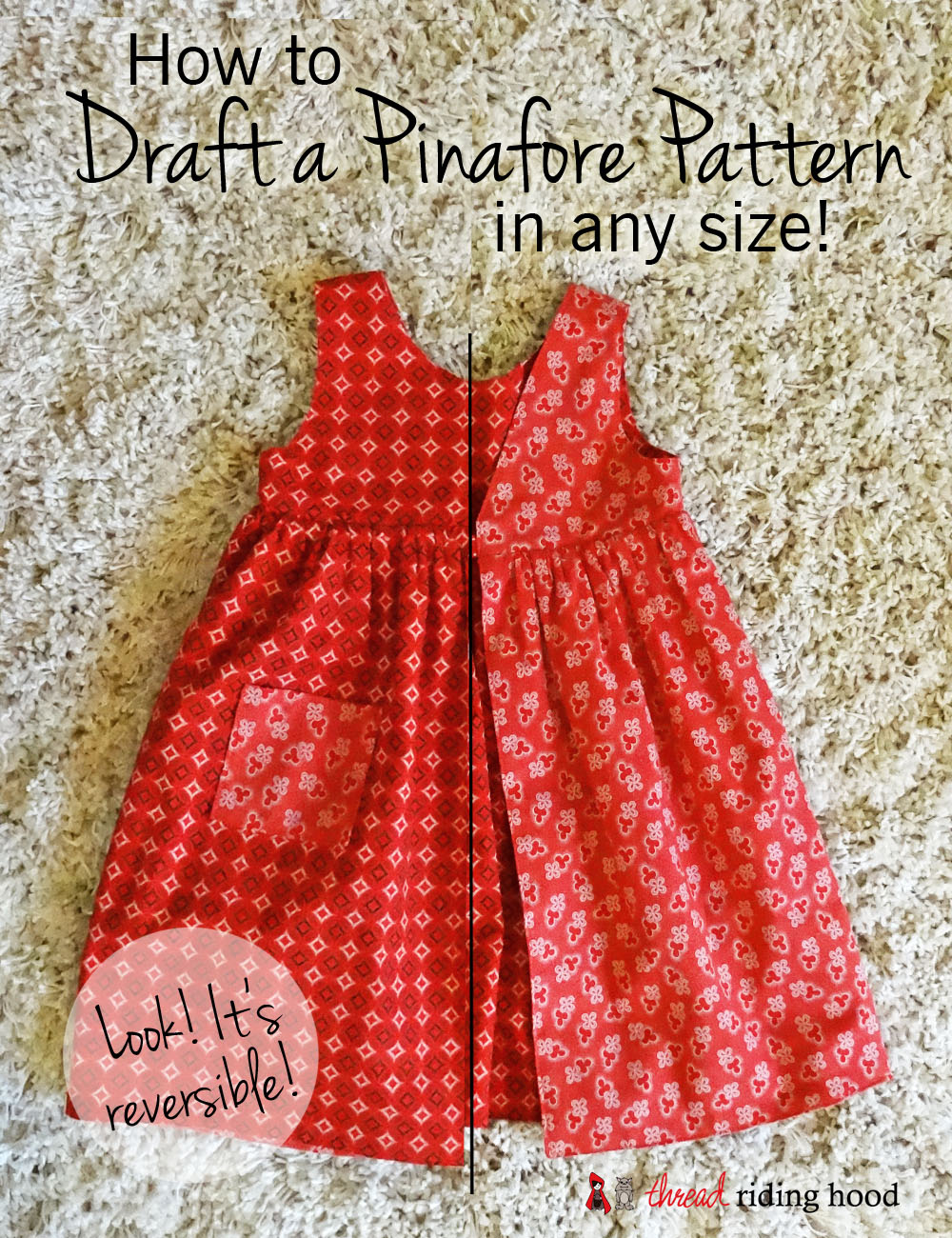
 Yesterday I introduced Meerkat Shweshwe and showed you how to draft a pinafore pattern in any size. Today’s tutorial tells you how to sew up a reversible pinafore using that pattern! (This post is sponsored by Meerkat Shweshwe. Thank you for supporting the sponsors that support this blog!)
This pinafore is made from two prints of Authentic Three Cats Shweshwe. You can find out more about this unique, high-quality cotton fabric and purchase yardage directly from Meerkat Shweshwe, a Canadian distributor of this South African fabric.
I also promised yesterday I’d tell you why my daughter’s doll (that my mom made, more on that next week!) has a matching reversible pinafore. When I was speaking with Meerkat Shweshwe’s owner, Céleste, she asked if I’d want to make a matching doll dress, and told me a story from her childhood. Her grandmother lived too far away for regular visits, so Céleste’s mother would send fabric and patterns to her grandmother so she could make dresses for Céleste and her sister. Her grandmother would use leftover fabric scraps to make a matching dress for their dolls. What a great idea! Such a special gift. I thought it would be super-cute to make one and my daughter is so happy with it!
How to Sew a Reversible Pinafore {in any size!}
Materials:
- Sweshwe yardage is calculated based on your drafted pattern pieces. You will need enough fabric to cut one set of pattern pieces for each side of the reversible pinafore. (See the sample cutting layout below)
- 2 buttons for the back closure, 1″ works well
- 1 length of ribbon for the back closure, 10″ is plenty
- matching thread suitable for top-stitching both fabrics.
How to determine Yardage:
I was able to make this size 6 Pinafore with pockets and matching doll dress from 1 1/2 metres each of 36″ wide (before pre-washing) Sweshwe fabric. Be sure to measure your pieces carefully, taking into account shrinkage from pre-washing and the width and length of your fabric. Don’t forget to take any one-directional fabric into account as well. The cutting layout below may help. (Note: I actually left myself a little bit less yardage than I meant to because my rough yardage draft had quite a bit more space. Make sure to order a little bit more if you want a less nerve-wracking cutting experience!)
Cutting your fabric:
- Pre-wash, dry and press your fabric.
- Cut the following pieces from each length of fabric:
- 1 Skirt Front
- 2 Skirt Backs
- 1 Bodice Front (on the fold)
- 2 Bodice Backs
- 2 Patch Pockets
Sewing the Reversible Pinafore:
Seam allowance is 1/2″ unless indicated otherwise. It is recommended that you finish all seam allowances to produce a longer-lasting garment. Options include: trimming raw edges with pinking shears, zig-zaging all raw edges or serging all raw edges.
Sew the Bodice:
- Align both matching Back and Front Bodice pieces at the shoulders. Stitch. Press seam allowances open.
- Fold the ribbon into a small loop – you will need about a 5″ length to do this. Pin it in the middle of the centre back on one bodice, as in the photo below. Make sure there is enough ribbon to go around your button and include the 1/2″ seam allowance. Baste with a 1/4″ seam.
- Align the two Back/Front Bodices along the neckline/centre-back edges, matching shoulder seams. Stitch.
- Trim/Clip the seam allowance along the curve to help it lay flatter.
- Turn the bodice right side out, press carefully along the seam. Double-check to make sure the button fits through your ribbon. (Do not top-stitch, we will do this in a later step.)
- Now we can stitch the armholes together, pay careful attention to the photos for help as you go. Lay the bodice flat on your work surface. Open the left side of the bodice so the fabrics are laying wrong side down.
- Roll/fold the right side of the bodice until it is centred on the seam that connects the left two reversible sides of the bodice.
- Fold the left side of the bodice around the rolled fabric, aligning the armhole edges. Pin, Stitch. Be careful not to accidentally stitch over the folded fabric.
- Clip/trim the seam allowance along the curve. Open the layers and pull out the folded fabric, turning the bodice right side out again. Press the stitched armhole well.
- Lay the bodice flat on your work surface again. Open the right side of the bodice so the wrong side is laying wrong side down.
- Roll the left side of the bodice into the centre of the right side, over the seam.
- Fold the right side of the bodice around the rolled fabric, aligning the armhole edges. Pin, Stitch, being careful not to stitch over the folded fabric.
- Clip/trim the seam allowance along the curve. Open the layers and pull out the folded fabric. Press the stitched armhole. Tada! You have almost finished the bodice.
- Open the sides of the front bodice and align them so they are right sides together with the back bodice side seam, match up the underarm seam. Stitch.
- Fold the bodice wrong pides together again and press well. Set aside.
Prepare the Skirt for Pockets:
- Stitch each matching Back Skirt to each side of the Front Skirt along the side seams (length of the pieces, from the drafting instructions). Press the seams open.
Sew the Patch Pockets:
- Press the top of the pocket to the wrong side by 1/2″. Turn the pocket over and press the folded top of the pocket over another 1″, this time to the right side.
- Stitch around the sides and bottom of the pocket with a 1/4″ seam. Turn the top of the pocket right side out and fold the sides and bottom following the 1/4″ seam. Make sure the seams don’t show on the front of the pocket.
- Top-stitch the top of the pocket 3/4″ away from the top folded edge. Repeat for all 4 pockets.
- Measure the width of the Front Skirt from seam to seam and divide by 3. Mark these measurements on the Front Skirt.
- Align the left/right edge of a patch pocket on each 1/3 measurement – closer to the side seam. Pockets should be about 5 1/2″ down from the top of the Skirt. (If your skirt is much larger/smaller, place your pockets where you would like accordingly.)
- Top-stitch around the sides and bottom of each pocket about 1/8″ away from the edge.
- Repeat steps 1-6 to attach the patch pockets to the other Front Skirt.
Sew the Skirt:
- Align the two sewn skirt panels right sides together, matching side and bottom edges. Stitch the sides and bottom leaving an 8″ opening somewhere along the bottom edge. Clip the corners. Make sure your pockets are aligned correctly!
- Press both edges of the 8″ opening 1/2″ to the wrong side.
- Turn right side out, neatly push out the corners and edges and press well. You will have a raw edge on the top of the skirts only. (Do not close the opening.)
Attach the Skirt and Bodice:
by Sherri Sylvester | Dec 10, 2015
It’s a Shweshwe Holiday over here! This post is sponsored by Meerkat Sweshwe, who contacted me a while ago to see if I’d like to create something with their fabrics. I fell in love with the these red prints and we agreed they would be perfect for a holiday pinafore. (+ Come back tomorrow to find out how to sew a reversible pinafore, and hear the story of why my daughter’s doll has a matching dress!)
Before we get too far into the Pinafore tutorial – I know some of you are asking, “What exactly is shweshwe?” It’s a lot less complicated than it sounds! This fabric is 100% high quality cotton, produced in South Africa. It’s history is fascinating, and you can find out a lot more about where it came from, or get a condensed version in my earlier interview with Meerkat Shweshwe’s owner, Céleste.
This unique fabric is treated with starch, a traditional way of preserving it during long sea voyages. Depending on who you purchase it from it comes pre-washed or in it’s original state. I was curious to pre-wash it myself and my youngest and I had lots of fun doing it. The fabric started out very stiff and it smelled like a new box of crayons. First, we pre-soaked it in super-hot water, to remove the treatment. (Pushing it underwater with a wooden spoon is super fun according to the five year old!) Then I washed and dried it like I would a regular load of laundry and it came out super soft, just like any cotton fabric you’d use for a project. It is really nice to iron as well, very crisp and easy to press. And you can tell it is high quality – with a tight weave that will last. I tried to take a few before and after photos below so you can see the difference in the fabric.
Unwashed Shweshwe
Unwashed Shweshwe
Soft, Washed Shweshwe
I’m also excited to let you know that Meerkat Shweshwe just opened an online store! Their well laid out shop has large photos and lots of options. There is an opening special of 10% off everything in the store, until December 18, 2015! Use the promo code DOORCRASHER, minimum order $18 before tax and shipping.
If you ever get a chance to talk to Céleste directly take it! (at Creativ Festival maybe?) She is so passionate about these fabrics and their use, and it is so fun to talk to her because of it. You’ll have to ask her about her having a part in working to provide more jobs for South Africans by supporting the Da Gama Textile factory. I really appreciated talking to her and being able to work with fabrics that hold so much history!
This tutorial will show you how to draft Pinafore pattern pieces in any size. I will be finishing this series up tomorrow with a tutorial on how to use these pattern pieces to sew a reversible pinafore. It’s easier than you think – and my fashion-loving five year old really likes being able to choose (and change) her outfit so easily. I love the traditional look of a pinafore, and it adds extra warmth (and cuteness!) to a basic shirt/leggings in the winter.
This drafting tutorial requires a simple woven dress bodice pattern to use as a base, it works especially well with a bodice that has flutter sleeves or no sleeves. I have used the First Day Dress as my base to draft from.
This tutorial assumes your base pattern has a 1/2″ seam allowance. If your seam allowance is different, please be sure to compensate for that when drafting this pattern.
Draft the Pinafore Bodices:
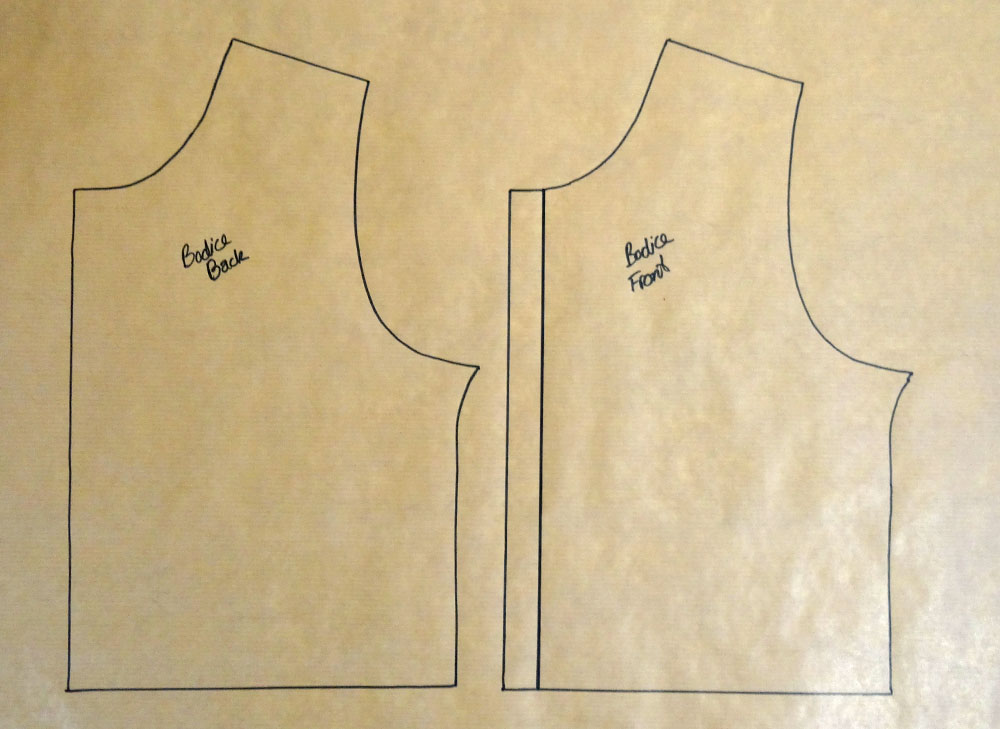
- Trace the bodice front and back onto a larger sheet of blank paper. Choose a bodice size that is generous, to allow for a shirt to be worn under the pinafore. I added 3/4″ to the centre of the front bodice to allow for even more extra room.
- We are drafting an empire waist pinafore. If your base pattern has an empire waist, skip this step. If not, measure 2-3″ (+ 1/2″ seam allowance) down from the armhole along the side seam and mark the empire waist as a straight line across the front and back bodice.
- Many pinafores have a lower rounded or square front neckline. If you would like to change it, mark the changes on your pattern piece. Remember, your neckline will be 1/2″ lower than your new marking because of the seam allowance. (Pink line below.)
- The back of the pinafore is also generally cut into a v-shape, which fits well with the button closure we will be using. Mark a line from the inside of the shoulder to about 2″ up from the empire waist line. Remember the actual pinafore will be 1/2″ smaller due to the seam allowance.
- Mark the centre fold, size, cutting directions and name on each pattern piece and cut them out. The Front Bodice is cut once on the fold, the Back Bodice is cut twice.
Draft the Pinafore Skirt:The skirt pieces are large rectangles. You will need one “Skirt Front” and two “Skirt Back” pieces. Follow the steps below to find the measurements for each one.
- Skirt Front and Back Length: Measure the length of the skirt in your base pattern + the amount you removed to make the empire waist + 1″ for seam allowances and hem. Example: My base skirt length 14″ + the 4″ I removed to make the empire waist + 1″ for seams and hem = 19″ Skirt Length.
- Skirt Front Width: Measure the width of the bottom of your drafted Front Bodice, double it to account for cutting the bodice on the fold, multiply it by 1.75 to add fabric for gathering. Example: My Front Bodice width was 7 1/2″, doubled is 15″, multiplied by 1.75 = 26 1/4″ Front Skirt Width (I changed this to 26″ for easy cutting).
- Skirt Back Width: Measure the width of the bottom of the drafted Back Bodice, multiply this width by 1.75 to add fabric for gathering. Example: My Back Bodice width was 7 1/2″, multiply by 1.75 = 13 1/8″ Back Skirt Width (I changed this to 13″ for easy cutting).
- Each final measurement for the Front and Back Skirt piece = the Length by the appropriate Width. Example: My Front Skirt was 19″ long by 22 1/2″ wide. My Back Skirts were 19″ long by 11 1/4″ wide each.
Draft the Pinafore Pockets:
- I used simple square patch pockets for each side of the skirt. Decide on a size you like and add 1″ to the width and 1 1/2″ to the height for hemming. Example: My finished pockets are 4″ wide by 4.5″ high. The pattern piece is 5″ wide (4″ wide + 1″) by 6″ high (4 1/2″ high + 1 1/2″).
Hold that thought. (and those pattern pieces!) Tomorrow I’ll be back with the tutorial on how to sew the pinafore! In the meantime, check out the variety of fabrics in the Meerkat Shweshwe Shop.
by Sherri Sylvester | Dec 4, 2015
It’s that time again, I got to choose fabrics for the Monthly Sparks December subscription bundle from Fabric Spark!
This bundle is quite different from the one I chose in June. I started out with the idea to have a rainbow bundle, and it turned into a bundle with a low/high volume fabric for each colour. (Is high volume even a thing?!) It was fun perusing the Fabric Spark collection for hours a while choosing my favorites. There were so many of them! Once I sent over a few options, Daryl worked with me to substitute in a few choices that worked better with her stock and here it is!
I have been wanting to create a rainbow quilt of some kind for a while now – and so this bundle will join the Fabric Spark Cotton + Steel FQ bundle I bought last year. It might be a while before I get around to working on it… but it’ll happen. Until I get the perfect inspiration, this rainbow is #tooprettytochop. I can’t wait for it to arrive in my mailbox!
The Cotton + Steel Fat Quarter bundle is sold out, but wait, there’s good news! Daryl just started a new monthly subscription bundle – the Monthly Rainbows Subscription! A rainbow in your mailbox every month. Perfect for stash-building. Or that amazing rainbow quilt you’ve been planning?
What do you think? My favorite in this month’s bundle has to be the orange Sherwood animal outlines, or maybe the Morris Jewels floral reproduction, or…. Ack. I can’t choose! Which is your favorite?
Disclaimer: Fabric Spark is a sponsor of this blog and I was given the December Monthly Sparks fat quarter bundle. As always, my opinion is honest and my own – thanks for reading and supporting this blog’s sponsors!
by Sherri Sylvester | Nov 30, 2015
Happy Monday! This is the 17th shop I’ve interviewed for our continuing Canadian Online Fabric Store interview series! Today’s feature is Flare Fabrics – Marlene’s shop is “where to go” for batiks and bold contemporary cottons. Plus she stocks lots of other fabrics, yard dyes & linens, tons of notions and bag hardware and patterns. Don’t miss her gorgeous Lecien giveaway bundle, or the month-long discount code at the bottom of this post. (Good until Dec 31!)
** PLUS: Don’t miss out on the Flare Fabrics Cyber Monday Sale – Nov 30th ONLY! Save 22.2% on everything in the shop with code FF2015! **
“I started the store with a focus on batiks, a traditional fabric that is handmade in Indonesia. In the last few years as the “modern” quilt movement has grown, I love to mix and match batiks with solids and modern fabrics. It’s an exciting blend of old and new. I’m always on the look out for the unusual – a new fabric artist or a line that people haven’t seen.” ~ Marlene, Flare Fabrics
I was re-introduced to Flare Fabrics when I talked to Marlene this Spring at Creativ Festival. I worked with her Cory Pepper shot cotton in my Indiesew spring collection post. It’s gorgeous cotton and I’m still hoarding my leftovers. Here are a few favorites of mine from the shop – click to find out more! You’ll have to check out the bottom of this post for the most gorgeous Marcia Derse Bookends – she has created really amazing, unique and beautiful fabric.
Thread Riding Hood: Why did you decide to start Flare Fabrics?
Marlene: Like every quilter, I was always looking for that “one” perfect fabric for my current design. Online shopping opened numerous doors, so when I couldn’t find what I wanted in Canada, I kept turning to the U.S. Why not have these fabrics in Canada, I thought? And so Flare Fabrics was born.
My professional career was concentrated in communications. I’ve been a journalist, a photographer, a marketing consultant, a graphic designer, a web developer…to name a few. When I started Flare Fabrics in 2010, I was working full time so an online fabric store was a perfect fit with my skills, interests and availability. Or so I thought. Busy, busy, busy! Last year I left my “regular” job and took the business full time. I’m really enjoying having the time to experiment with the fabric we sell.
Thread Riding Hood: What is your favorite type of sewing project? Quilting, Apparel… ?
Marlene: I’m partial to projects that can be sewn in 2 weekends – or less! I don’t sew anything larger than a decent size lap quilt and I prefer simple patterns where the texture of the fabric shines. That’s one of the many reasons I love batiks. Lately I’ve become enamoured with bags and purses and I have a large extended family so lots of people to sew pouches and totes for 🙂
Thread Riding Hood: What is something coming up in the near future that you are especially excited about?
Marlene: Flare Fabrics is moving! I have completely outgrown my home space – both the small outside studio in our Toronto backyard and the basement of the house. And so now I can finally combine my love of fabric with my love of the country. Our new home-based studio is rural – outside Perth in Eastern Ontario – and hopefully we won’t outgrow this one too quickly!
Thread Riding Hood: Thanks Marlene! My postage-stamp of a suburbian backyard can’t compete with your new place. Wow! Looks amazing!
Check out this super-generous gorgeous L’s Modern Basic by Lecien 12 Fat Quarter Giveaway! The cool blues and grays are fantastic blenders for your projects, and I think they’d make a fabulous wintery quilt all mixed together!
This giveaway is open to readers in Canada & the US, from today (November 30) until midnight December 7, 2015. Use the Rafflecopter widget below to enter – and if you don’t have Facebook to sign in with, just use your name and email address. There’s a “click to enter”, no social media login entry too!
a Rafflecopter giveaway
Thanks so much to Marlene, we can use the discount code “THREAD15″ to save 15% on your order at Flare Fabrics from December 1-31, 2015! (Christmas shopping anyone?!)
Here are a few of my favorite Marcia Derse prints to get you going!
Thanks for reading. Don’t miss a post – Follow along below!
Disclosure and Privacy Policy: I asked Flare Fabrics to be a part of this series. I will never recommend or highlight a shop that I do not love, and my opinions will and have always been my own. Thanks for reading!
by Sherri Sylvester | Nov 17, 2015
Having the correct supplies for your job is important. Firefighters need boots and helmets, dentists need that crazy metal picking thing they use. I need fabric for my job. (along with lots of other things!) That makes keeping track of it all an important part of my life. And, as with all supplies, they need be taken care of properly.
As I re-organized my sewing room a few months ago, I found a lot of fabric sitting in the bottom of the closet because it wasn’t pre-washed. I didn’t want to mix the washed and pre-washed becuase there wasn’t a fail-proof way to distinguish the two. #sewistproblems I also realized that I didn’t know important information about the fabrics in my apparel fabric section – like what they were made from, or if they were suiting fabric or chambray, or where I bought them.
That led me to design some simple labels that I’ve been using for a few months now. Pre-print a few pages of them and use them as the fabric goes onto the shelf. They are quick and easy to fill out. And I found it’s really helpful to know the exact details of at least 1/2 of my fabric. (I decided only to label the “stuff on the floor”. Yes, imagine 1/2 of my stash on the floor… yikes!)
Since I’ve loved using these I thought I’d share them with you. Click on the link below to download the free PDF and print some of your own! I used standard 1″x2″ label sheets from my big box office supply store. If you don’t have any, print these on plain paper, cut them out and pin or paperclip them to the fabric instead. In case you are worried about sticky residue from the labels – so far they haven’t left anything on my fabric and are removed easily. (You may want to test your own brand of labels though!)
How do you keep track of your fabric?
by Sherri Sylvester | Oct 21, 2015
Many times I scroll through an online fabric shop‘s stock and see licensed fabrics – Princesses, Avengers, even Dr Who – and I scroll right past.
It happens every time. Not sure why? Maybe it’s the cartoon-y look, or the overabundance of princess gear everywhere? If my kids are with me they immediately notice, “Mommy, go back! Up there! I think I saw – insert character here -.“
Last month, an email from The Fabric Society showed up in my inbox. They asked if I’d like to work with them. I clicked over to their site and sat scrolling through their huge stock of licensed fabrics – sitting, for once, with no other option. I realized the reason I don’t use licensed fabrics is not immediately clear to me. I realized it’s not all about me, I may not generally use licensed fabrics, but my kids LOVE them!
Going forward, there will be more stopping and less scrolling.
Since I love making my kids happy I changed my mind. I wrote back to The Fabric Society saying, “… I’m sure one or both of my girls (or even my husband!) would love to have something made with your fabrics.” #truth And that is how my youngest ended up with a My Little Pony and Marvel Immortals reversible skirt – with pockets. (Pockets are super important!)
“It’s not all about what I think, I may not generally use licensed fabrics, but my kids LOVE them!”
The perfect pattern to use for these (non-sleepwear) fabrics is the Potato Chip Skirt from Tie Dye Diva Patterns. I bought this pattern last year, I think, and have made it twice already. It comes with or without the all-important pockets and you can make it unlined, lined or reversible. I love that it will last you a long, long time because it comes in sizes 12-18 months through 13/14!
The instructions are well thought out and easy to follow. The finished skirt looks professional and so cute! I love the a-line shape and the fact that the elastic back does not need fasteners for dressing. I can see using it a lot more – maybe making a denim one with back pockets or adding front patch or inseam pockets to a linen version. Honestly, I’m pretty sure there isn’t anything I didn’t like about this pattern. I followed all the instructions exactly each time. The only thing I changes was to lower the front rise by 1″ – which seems to fit my kids better with most patterns.
“Honestly, I’m not sure if there is anything I didn’t like about this pattern.”
When I sat down to look through fabric options with my kids, it took 45 minutes for them to decide on their favorites! We linked and saved and scrolled back, over and over (and over) again. After much (much) debate, my youngest chose My Little Pony and Avengers. My oldest has some Cinderella and Star Wars fabric waiting in my to-do box as well! The girls didn’t want to leave my husband out, so they chose something for him too – not sure what for yet, but I’ve added it to the stash. It will likely turn into another pair of pajama pants.
Join the conversation! Do you sew with licensed fabrics? Why or Why not?
One day soon I will post about the other two skirts. For now, I’m still recovering from my weekend away at BlissDom – a social media and blogging conference. It was amazing and I’m hoping to write and tell you about it later on this week.
Follow #alongforthreadride!
Disclaimer: The Fabric Society provided the fabric for this skirt at no charge in exchange for a mention in this post. My opinions are my own and I will not support or write about anything I do not love or believe in. Thanks for reading! (Privacy Policy)

 Yesterday I introduced Meerkat Shweshwe and showed you how to draft a pinafore pattern in any size. Today’s tutorial tells you how to sew up a reversible pinafore using that pattern! (This post is sponsored by Meerkat Shweshwe. Thank you for supporting the sponsors that support this blog!)