by Sherri Sylvester | Nov 8, 2013

When Warp & Weft introduced their Sewing Society I was excited to find three new Canadian bloggers that I hadn’t heard of yet! One of them was Cynthia Frenette, whom I’ve been following ever since. She writes cynthia f – a highly addictive blog – trust me I know! Aside from that she is a quilter, illustrator, designer and artist in general. If that is not enough, she keeps Made In Magazine going and has designed fabric for Robert Kaufman. And I’m sure there is more I don’t know!
As I was saying, her blog is addictive, and one day I stumbled on the post of her latest project – a pouch pattern – that asked for pattern testers. I’m super happy to have volunteered and gotten to make it! Aside from raving about how great this pouch is (truly!), I can honestly say it has great directions. I was excited to read through the well-thought out instructions and find they were very easy to follow.
The clear window gives this pouch the great feature of having two “fronts”! You can choose an amazing fabric for the back quilted panel and the lining – because it shows through the window. Score! I was excited to use my Fabric Spot Tsuru bundle for both pouches. Which is a good thing, because I only had one snap hook to use for the handle, and now I can swap it based on whichever I’m using at the time!
I love the size, it is even large enough to fit a regular sheet of paper – so you are able to carry printed pattern sheets and your sewing supplies at the same time! I really would like to make a few more of these to fill with “kid stuff”. It would help keep them occupied when we visit my family via plane in December. And it is easy for them to see what is inside – key to not digging through your bag too much in an enclosed space!
The pattern is almost available and I will most definitely tell you when it is so you can make 17 of these for yourself (or as a great Christmas gift!). Hope you have a happy Friday and a great weekend. See you on Monday!
by Sherri Sylvester | Nov 6, 2013
Have you seen what’s happening over on Sew Mama Sew this month? It’s the Handmade Holidays y’all!
Every year since 2007 Sew Mama Sew has put together tutorial roundups for everyone you can imagine needing a gift for. One theme every day! I got hooked on these a few years ago and they are an amazing source of information. This year they are having guest curators who have spent many hours searching the internet for gift tutorials based on a category they have suggested. The lists are an amazing resource that can be used all year long – especially when you need something unique for that hard-to-buy-for person and you need an idea (or 20!).
Today’s “Gifts for Geeks” led me to this amazing LEGO-endorsed Star Wars quilt – and the patterns for the paper piecing are amazingly available for free! My husband would LOVE this quilt!
Just in case you want to get stuck online doing something other than searching Pinterest today, here are the links to the past 6 Handmade Holiday Master Lists – and you can go directly to Sew Mama Sew for the first 6 posts of this month! (and then of course go there every day until the end of November for more!)
Handmade Holidays 2007 · Handmade Holidays 2008 · Handmade Holidays 2009
Handmade Holidays 2010 · Handmade Holidays 2011 · Handmade Holidays 2012
Since I don’t want to get sucked into making too many of these for Christmas, I have made myself a giant list for this month already! Instead I will be pinning my favorite amazing projects to start in December? or maybe April…. – whenever my work runs out!
by Sherri Sylvester | Nov 5, 2013
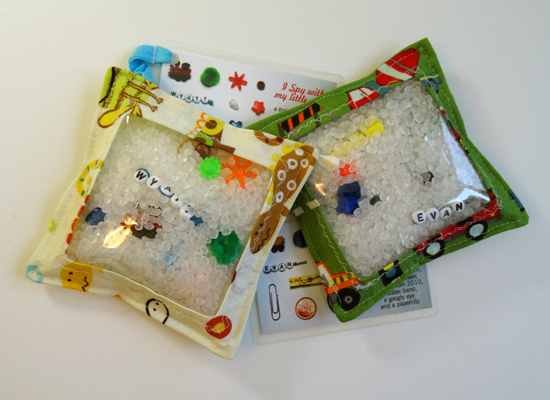
Today I’m bringing back an oldie-but-goodie! The I Spy Bag has been around for quite a while but the most recent tutorials that pop up on my Google search are from 2011. It seems the trend to make these has died down. When I went searching for a tutorial for this myself it was used to make gifts for the kids at my youngest’s first birthday party over 2 years ago! I went searching high and low through my bookmarks trying to find the same tutorial I used then and I can’t find it anywhere. So… I have made a new tutorial for you based on what I can remember with the usual “few changes” of course! (If you happen to find an I Spy tutorial made this way can you tell me? I’d like to give proper credit where it is due. Thanks.)
It’s amazing how quickly these go together. Once you have the supplies it only requires a few seams and you are good to keep your kids busy for a while! They make great party favours, easy gifts or stocking stuffers and are great to give with a new baby gift so any siblings don’t feel left out. Despite their ease, I have a confession to make. This is one of those projects that has been on the back burner for far too long. If I have calculated it right I promised to make these 2 years ago… oof… how did that happen? I’m pretty embarrassed about it, and feel guilty that I know the friend I’m making them for will be super gracious about it. I am really relieved to have finally finished these. I suppose telling you this is a somewhat cathartic exercise for me – though I’m not sure I feel entirely “better” having confessed! It is just good to have finished.
I am always surprised at the number of projects I start that I have not finished even a year later (never-mind two!). I have a friend who will only work on one thing at a time and won’t move on until she is finished. How I envy her discipline! I’m curious how you handle your projects – do you finish everything you start? Or begin and end when the mood strikes?
Either way – here is the tutorial so you can finish a bunch, or leave them on your shelf for a year! (and “either way” – be sure to pin it so you don’t forget!)
You will need:
- 2 pieces of 5 1/2″ square fabric
- 1 piece of 5 1/2″ square clear vinyl – I used 8 gauge vinyl
- 5″ length of ribbon or twill tape
- mini objects for spying (beads, pom poms, buttons)
- cardstock printed or laminated card with items
- fabric glue for extra durability – I used Liquid Stitch
- plastic pellets – I got mine from Michael’s with a 40% off coupon
Here we go:
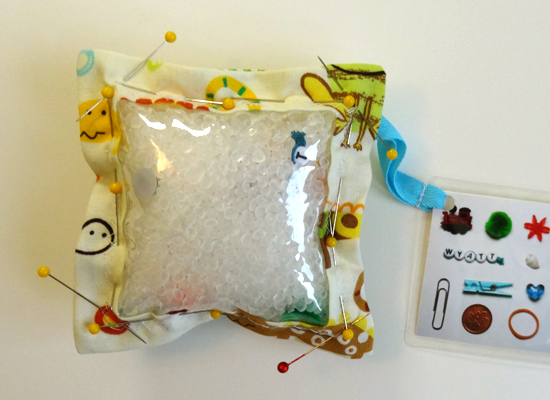
(1) Make the cards with the listed items. I used a business card size and found a self-laminating kit at our local Dollar Store. Punch a hole in one corner. Feed the ribbon/twill tape through the hole and fold it in half. Stitch through the tape close to the card to hold it in place.
(2) Draw a 3″ square in the middle of the wrong side of one piece of fabric. Cut through the small square from corner to corner diagonally (see photo).
(3) Fold each triangle back along your drawn line to make the I spy window. Centre and glue the vinyl on the wrong side of the fabric. Glue ONLY around the window area.
(4) When the glue is dry, trim the excess fabric “triangles” to approximately 1/2″ (see photo). Stitch twice around the window area. I used a decorative stitch. If the presser foot sticks to the vinyl try using this trick. Do not trim the vinyl, it adds extra strength to the toy.
(5) Glue the window (with vinyl backing) and outer back fabric, right sides together around the edge. Leave a 2″ opening in the top left hand corner for turning. ** Make sure the glue is only within 1/2″ of the outer edge so it is in the seam allowance when you sew it. When the glue is dry, stitch around the edge with a 1/2″ seam allowance, making sure not to stitch over your opening. Clip corners and trim all edges to 1/4″ except at opening (see photo). Finish your edges by cutting with pinking shears or use a zig zag stitch on all edges except the opening.
(6) Turn the bag inside out. Fold the opening edges to the inside. Iron the edges, be careful not to melt the vinyl.
(7) Fill with the plastic pellets. I used 1/2 cup. Fill with a funnel and be sure to insert your mini objects. (I usually double-check that I have the correct objects as I put them in, just in case!) Insert the ribbon 1″ into the opening and glue the opening shut.
(8) When the glue is dry, unpin the opening and re-pin around the edge of the bag, forcing the pellets into the centre. Top-stitch around the edge of the bag, this will also close the opening. Double-stitch over the ribbon to make it extra secure. All done!
I’d love to see your I Spy Bag! Post your project on Facebook and it might end up in a “You Made It” post here on the blog. I’d love to hear if you liked this tutorial or any changes you might make. Thanks!
by Sherri Sylvester | Sep 16, 2013
So I’m sure you all have heard of this blog called Made by Rae (ha!), who hasn’t! And also, Rae’s Toddler Backpack pattern?! How boring of me to post something so common you say? True maybe, but I have a few ideas to share and a flapped pocket tutorial & pattern for you that could work on any purse or bag, but was originally sized for the Toddler Backpack.
Made by Rae – Toddler Backpack
I started the journey to this backpack by trying to find something “quick” to make for a newly-turned-1-year-old’s birthday. I did not like any of my ideas until I was searching through my patterns and found my well-loved copy of the Toddler Backpack pattern. I started out making one for my oldest when she was just under two, and have since made one for each of my nephews and a larger one for my youngest as well.
The pattern turns out so well, and is super-cute. My kids love filling it up too, and it is perfect for day-care or dropping them off at Grandma & Grandpa’s for the day. I was a bit hesitant to use it for this project because the original pattern did not come with a lining, and there was only “so much time” to make it, never mind hand-stitch the lining to the zipper. (Yes, it is true, it wouldn’t have taken that long – but I really don’t like handstitching!)
Rae has since included a section on lining the pack – and on how to make it a bit taller to fit most school-size folders. Still, I didn’t want to create an extra lining because it would involve sewing twice as many seams. (Yes, I really was that lazy in a hurry!) For the sake of my not photographing the process, I will run down the steps I took to line the inside.
- Cut lining pieces for everything as indicated in the instructions.
- Stitch the zipper panels together as indicated with one each of the lining and outer, right sides together, zipper tape sandwiched between. Stitch on both sides of the zipper panel. Press and top-stitch.
- Attach the side panels to the zipper panels as indicated, but sandwich the zipper panels in-between your lining and outer pieces again and stitch. Press and top-stitch.
- Attach the bottom panel by sandwiching it, one short side at a time, between each side’s outer and lining side panels. The second one will be a tad tricky to line up, but pin it and you will be fine.
- Turn it all around and you will have a fully lined side loop with raw edges on both sides.
- Attach it to the front and back panels as indicated.
- Bias tape bind the raw edges.
I also always have added two things to the pattern. First, I always cover the bottom panel in a layer of medium weight clear plastic before quilting it. It makes it a bit sturdier and also keeps it cleaner. I discovered a great way to stitch over plastic on the weekend as well – hurray – as I won’t be needing to spend the $15 on a Teflon foot for my machine anytime soon. I’ll be posting how I did it later in the week.
Bottom Quilted with Plastic
I also always add a pocket on the front. It’s a simple one, with an elastic loop sewn into the front-centre of the pocket flap. I love how it looks and it’s useful for all kinds of things. You can use a dollar store coloured hair-tie for the elastic, so it always matches!
You can download the pocket pattern pieces HERE. (Make sure to print them at 100% – do not choose Fit to Page. Check the 1″ test square once the pattern pieces are printed.) Here is a quick run-down on how to stitch them together:
(1) Cut one Outer, Lining and Interfacing piece for each flap and pocket pattern piece. (2) Fuse the Interfacing to the Outer pieces. (3) Mark as per the pattern pieces. (4) Pin right sides together between stitching marks. (5) Pin the elastic in place where indicated. The part of the elastic that will hold the button should be INSIDE the pocket flap.
(6) Stitch flap and pocket with a 1/4″ seam allowance, right sides together, beginning and ending at the indicated marks. (7) Clip the square corners and trim the curved corners with pinking shears (or clip). (8) Iron the seam allowances open for each pocket or flap opening (this trick). (9) Turn the pocket and flap right side out and press.
(10) Top-stitch the sides and bottom curved edge of the pocket flap – back-stitch over the elastic several times to secure. (11) Top-stitch the top edge (without the opening) of the pocket. (12) Align the pocket on the front of your back-pack. I like to leave an even space around the bottom and sides. Pin & stitch the sides and bottom of the pocket closing the opening as you go. (13) Align the pocket flap 1/2″ to 1″ above the top of the pocket. Stitch the top of the flap, again, closing your opening.
(14) Mark the centre-bottom of the elastic where it lays on your pocket. (15) Stitch your button on. Done!
And, talking about quick, I also omitted the piping. I was sad about that one because it looks so good, my husband even remembered that I usually put it on and asked about it! I just didn’t have any on hand and didn’t have the time to go out and buy some. I also didn’t have any D-rings, so the adjustble straps (which my daughters never adjusted anyhow) were taken out too. With a lined pack (minus sewing double the seams) and the piping and extra strap omitted it was even faster. Thankfully I’m happy with the results, due in part to the Michael Miller Zoology (from my trip to Hamilton) and Spa Scallop fabric! Love that their collections are colour coordinated! Hooray for a quick(er) gift idea!
I’m off to get started on my Project Run and Play idea for this week. Candy inspired here we come! Check out the great ideas already posted for the sew-along.
by Sherri Sylvester | Aug 27, 2013
I made up a quick sunglasses case for myself at the end of July, and thought I would post it here as a tutorial. Turns out, the more I thought about posting it the more I thought that there must be a better way than the flat, very soft case that I made in about 15 minutes. It had no shape and no intrigue, and worst of all I don’t think it would do a spectacular job of taking good care of my sunglasses either! Since I’m super good at procrastinating (and really busy with the kids this summer) I gathered up all of the sunglasses cases that I could find and lined them up on my cutting table Sunday night. Too late into the night to mention, I came up with the Sunny Glasses Case! It is really simple to make, mostly because I’ve done all of the trial and error through 6 or 7 versions so you don’t have to!
Come #alongforthreadride! Follow Thread Riding Hood on social media for sneak peeks, tips and process photos. Hope to see you there!
Once you’ve finished one, you can likely make another in about 1/2 hour or less. Which makes it a super quick gift, and it can be made for almost anyone. Men, Women and children of all ages would enjoy a safe place to stash their sunglasses. Bonus, it doesn’t look like it only took half an hour to make (woot!) and – added bonus – you can use up some of your large scraps to make it! And, just in case you think I’m crazy posting a sunglasses case tutorial when Fall is approaching my part of the world, I do wear my sunglasses a lot in the winter. And these would make great stocking stuffers if you are inclined to start gifts now! As I was making these I came up with 4 useful options for making the case. Option 1 makes for a regular case with Velcro closure. Option 2 has a button & elastic closure and a swivel clip, this is so my oldest can attach it to her school backpack and (hopefully) keep her sunglasses unscratched and un-lost! Option 3 is mine, I added a magnetic closure to the flap. Option 4 is for my husband, who wanted it to be able to attach to his car’s visor. * Update: Don’t feel like sewing a Sunny Glasses Case yourself? Buy one from a licensed seller! Check out the sellers list. Are you a shop owner? You can buy a Sunny Glasses Case seller’s license as an instant download. *
This tutorial covers all 4 ways of creating the Sunny Glasses Case. Follow the main instructions for Option 1. The other options use the same directions with additional steps. These are listed below the directions for Option 1. You will need:
- 11″wide by 10″h scrap of your main outer fabric and lining fabric
- 10″x10″ scrap of fusible fleece
- 5″x9″ plastic canvas (I used size 7 mesh)
- The pattern pieces – Click on this link to download the printable pdf: Sunny Glasses Case pattern pieces
- Other Helpful Things: School Glue Stick, Point Turning Tool or Chopstick, Water Soluble (or other) fabric marker, Pins
- Option 1 & 4 Only – 5″ loop Velcro and 2.5″ hook Velcro
- Option 2 Only – Button Closure + Swivel Clip: Button, Hair Elastic or 4″ piece of Round Elastic, Swivel Clip with 1″ D-ring, Fabric for strap: 5″x4″
- Option 3 Only – Magnetic Closure: 1 Magnetic Snap
- Option 4 Only – Car Visor: 1 piece of 1″ wide elastic, 9″ long
Materials for Option 1
Before you begin:
- Print out all 3 pages of the pattern piece pdf on letter size (8.5″ x 11″) or A4 paper. Important: Do not select “fit to page” when printing, make sure you print at the original size. Once you have printed the pages, measure the 1″ test square on page 1 to ensure the pattern is the correct size.
- Cut Outer and Lining, Fusible Fleece and Plastic Canvas as per the pattern pieces. Make sure to line the pattern pieces up on the fold where necessary. I found the easiest way to cut the plastic canvas was to precut my pattern piece, trace the edges with a permanent marker onto the canvas, and then cut it out.
- If you want to piece your fabric together (I have added a small contrast piece on the closure edge of the flap), do this first and then cut your outer fabric. Topstitch after fusing your fleece for a “quilted” look.
- Mark the “Velcro” and “Flap” marks (as indicated) onto the right side of the Outer fabric with a water soluble fabric marker. Be sure to mark the “Flap” marking on each edge of the Outer fabric.
Cut Materials for Option 1
Option 1 – Velcro Closure:
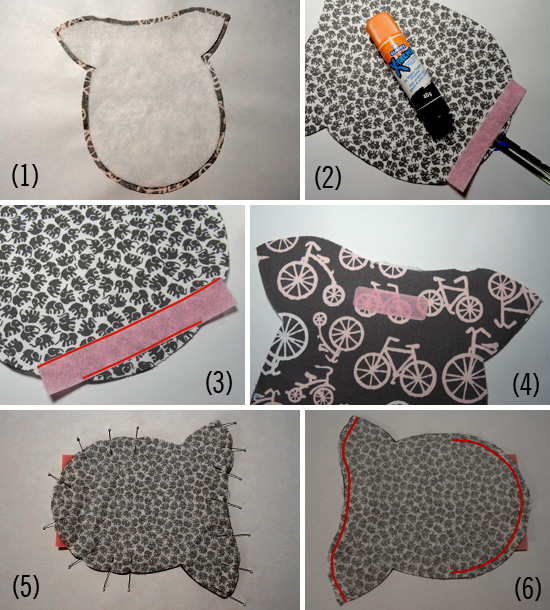
(1) Iron Fusible Fleece (centred) on the wrong side of your outer fabric. (2) Use your glue stick to glue the loop side of your Velcro to the rounded edge of the lining. Centre it 1/4″ above the bottom of the curve. (3) Stitch along both long edges of your Velcro, you do not need to stitch the short sides. (4) Round the corners of the hook side of your Velcro. Use your glue stick to centre it on the “Velcro” mark on your outer fabric. Stitch all 4 sides neatly. (5) Place your Outer and Lining fabrics right sides together. Pin around the curve between the “Flap” marks and the straightest edge (see photo). (6) With the fleece side up, use the edge of your fused fleece as a stitching guide. Do not stitch ON the fleece, stitch BESIDE it. Stitch the straightest edge from point to point. Stitch around the curve, begin at one “Flap” mark and end at the other. (7) Trim the excess Velcro & clip the curve where the Velcro is – you do not need to clip the entire curve. (8) Clip your seam allowance at both “Flap” markings. Clip up to but NOT through the seam threads. (9) Turn everything right side out through the openings. (10) Pin the straightest edge and top-stitch approximately 1/8″ away from the edge. (11) Pin the large curve between the “Flap” marks. Do not stitch – we will do this later. (12) Make sure the un-sewn seam allowances are lying flat on the outside (see photo). (13) Draw a line across the outer fabric between your “Flap” markings. Topstitch along the line. (14) Insert your plastic canvas between the lining and the fusible fleece. Centre it from side to side. It should be in approximately 1/4″ from each fusible fleece edge. Use two pins to secure the plastic canvas in place. (15) Almost done! With the outer right sides together, fold the bottom of the glasses case up. The point should meet up with the top of the “Flap” marking. Pin along the edge. (16) We are going to finish the case with a French Seam. Stitch a scant 1/4″ seam on both sides of the case along the raw edges. (17) Trim the seams you just finished to approximately 1/8″ on each side. Flip the bottom of the case right side out. (18) Finish the case by stitching around the edges with a generous 1/8″ seam. Start at the bottom on one side and end at the bottom on the other. Do not stitch across the bottom edge. Done! For Options 2,3 and 4, follow the Step numbers as outlined for each Option. Example: STEP (1). (2.1a)… means – follow STEP (1) above, then follow (2.1a) as outlined in the Option 2 instructions.
Option 2 – Button Closure + Swivel Clip:
My oldest picked the Monkey Bizness – Market Stall fabric used in her sunglasses case when I placed my latest Warp & Weft order. I love how it turned out, the print is just the right scale for this project! STEP 1. (2.1a) Make the strap. Iron your fabric in half lengthwise to make a 2″x5″ piece. Unfold and iron each edge into the centre, refold. Top-stitch each edge. (2.1b) Fold the strap around your D-ring. Stitch as close as you can to the ring – it might help to use a zipper foot. Set the strap & clip aside. STEP 5. (2.5a) Fold your elastic in half, centre it at the closure end of the case. Pin it between the outer and lining, 1/4″ in from the edge, with about 1/2″ of elastic (folded) on the “inside” of the case and the rest sticking out. (I have completed Step 6 in this photo) STEP 6, Note: Double-stitch over the elastic when you reach it. STEPS 8-14. (2.14a) Pin and Baste strap in place on outer fabric, centred as per the photo. Trim excess strap to match the seam allowance. STEPS 15-18. (2.18a) Place your glasses in the case and sew the button on where appropriate. Done!
Option 3 – Magnetic Closure:
STEP 1. (3.1a) Attach the bottom piece of your magnetic snap centred on the Velcro mark you made on the outer fabric. (3.1b) Attach the top of the snap to the lining 1″ away from the curved flap edge. Be sure to interface behind the lining snap. (I used a scrap of fusible fleece.) STEPS 5-6. STEPS 8-18. Done!
Option 4 – Car Visor:
STEPS 1-14. (4.14a) Centre your elastic piece across the fabric as shown in the photo. Baste the edges with a 1/8″ seam allowance. Trim the excess elastic. STEPS 15-17. (4.17a) Make sure the elastic is along the back of the case when you turn it inside out. This is important when stitching the next step. STEP 18. Done! There you have it! One (or 20!) easy, customizable gifts for everyone in your life. Take a minute to post a photo to the Thread Riding Hood Facebook page, we’d all love to see your creation!
Are you a seller that would like to buy a Licence to Sew and Sell the Sunny Glasses Case Pattern? If you are interested in selling cases made with this pattern you can buy a license here and receive an instant pdf download!
As usual, please feel free to use my patterns/tutorials for your personal projects and gifts and for charitable fundraising events. Please do not sell anything made with this pattern unless you have purchased a Seller’s License. Please contact me for more information: sherri (at) threadridinghood (dot) com
by Sherri Sylvester | Jul 23, 2013
Today I’m talking about changing zipper pulls again, but… if you’ve seen it already don’t go away yet. I am also talking about a cute, quick gift idea you can make that (of course) includes a new zipper pull!
If you are brand new at Thread Riding Hood, I just discovered that it is possible to change the tiny zipper pull from your regular zippers to something customized, larger, more useful and more amazing looking! I have permanently stolen borrowed the needle-nose pliers from my husband’s toolbox to change all of my zipper pulls. I love this tip – so much that I want to include it in the Sew Essential list – even if it was posted only a few weeks ago. Check out the “Change a Zipper Pull” post for a full tutorial.
For the rest of you – check out fabric designer Aneela Hoey’s Oval Box Bag. This is a great little gift idea. It is just big enough to include a little something inside. She talks about the bag being a bit scary to make. But if you follow the directions, and look at the detailed photos you should be fine. Aneela writes everything out very well and give lots of direction. When you are done making the bag, you can use a scrap to change the zipper pull and voila! The perfect gift! I finally got to use the fabric I bought for this project at the Creativ Festival in May. This is a good fat quarter project – and you will definitely have lots of fabric left over.
I likely should have taken measurements so you would know how big it is when it is finished. I gave it to my mom for her birthday so she has it now and might be able to post measurements in the comments (Please?!) so you can estimate what might fit inside! Here are a few ideas. It would be a great little makeup pouch. For a seamstress it could be a sewing box for thread or a small hand sewing kit. If you made it for your kids they could use it to carry around their Hot Wheels or Littlest Pet Shop collection. It is sturdier than I thought too – I interfaced both the outer and lining fabrics with medium weight fusible. I think my favorite part of the Oval Box Bag is the handle – it adds the perfect little touch on top, and it is useful too.
Only two more days until the giveaway is over! Check out Sew Essential #13 tomorrow.