by Sherri Sylvester | Jan 3, 2014

I’m excited to share how far gone my foray into quilting EVERYTHING is with you today. I made my sister a few things for Christmas and got a tad excited about free motion quilting along the way. This is my new favorite thing and I have about 17 projects lined up to use it in when I get home from my vacation. Not to get ahead of myself or anything!
This whole set is made using scraps from a 1/2 metre of Early Bird (Cosmo Cricket for Andover Fabrics) that I bought at least 3 years ago. Unfortunately I can’t locate any more for sale – likely since it came out in 2010. I’ve been gifting handmade things to my sister using this for a few years now. My favorite part of the fabric says “If we were meant to pop out of bed we’d all sleep in toasters.” SO TRUE!
The whole project started with the tea cozy. It is something my sister said she could use a few years ago. I cannot say enough good about the tea cozy pattern by Teje that I located on Craftsy. It is a free download – a great size, and the little hanging tea bag makes it perfect! I love that there is a ton of room for little quilty details too. I straight line quilted the front of the cozy, and cheater quilted the centre of it along the fabric lines. The back got some of my loops (as first seen in the Cargo Duffle Backpack!). These are so much fun to do and I don’t mind in the least that they are uneven, it adds to the artsy creativeness! I would love to quilt a whole quilt with these… but I may need a new machine with more throat space first.
Next up – the oven mitt. The pattern for this is from my One Yard Wonders book. It is a simple project with lots of room for quilting! The only thing I was not fond of was turning it. Because the insulated batting adds so much thickness it is amazingly difficult to turn right side out once it is sewn. I would also have lined it if I was making it again, since the pattern doesn’t include one. I got to use some of my organic Tsuru on this one, mixed in with the Early Bird and some other scrappy stashed bits. I love using things up!
Last up – the trivet. I used some insulated batting on this one as well. It is paper pieced with the same fabrics using the Teacup 1 pattern from Piece by Number. I think I made it backwards – I would have liked the handle to be on the right…. ooops. Anyhow – it reminded me how much I love this tiny quilty work. I’m really going to have to get on with a real quilt before I drive you all crazy! The trivet is self-bound using the same technique as the herringbone hot pad I made a while ago.
On the quilty theme – I was able to photograph all of these on a quilt that my mom made and hand-quilted. I think she finished it in the last 2 years? It’s gorgeous and I think might be mine some day. (Yippee!) Here’s a shot of it without all of my projects in the way. What patience – I am in awe of her dedication to the whole thing – it’s queen sized! And did I mention it was HAND-quilted?!
We are having so much fun on vacation here, I don’t know if you’ll hear from me again until next week when we get home. Though I have one thing I want to make before I leave – we’ll see if it happens! Follow along on Instagram if you want to see what we’re up to before then.
by Sherri Sylvester | Dec 20, 2013
Today I’m posting a little tutorial that Allison asked for earlier this week. She’s trying to make the Super Hero Cape for her older daughter and wants it to be longer than the original pattern. Thankfully it is pretty simple to lengthen – so you can make capes for all of your big kids. Perfect quick Christmas gift! (Hint, Hint – Just sayin’!)
First you will need to print out the free Super Hero Cape pattern pieces from the original post. Grab an extra sheet of paper, some tape, a pencil and a ruler. Cut the pattern pages along the outer border – not the lines of the pattern! – the ones that are closest to the edges of your paper.
Here we go:
(Step 1) Tape the bottom of the cape pattern pieces (4 pages on the right) together as noted in the Super Hero Cape tutorial (and see illustration below). Leave a space between the top of the cape (left) and the bottom 4 pages. This gap should be equal to the amount you want to lengthen the cape.
(Step 2) Tape the extra piece of paper into your space. Re-connect top and bottom of the cape pattern lines as illustrated by the red and blue lines below.
(Step 3) Cut out your new cape pattern along the outer edges of the cape and the new lines you just created. See the blue shape in the illustration for which lines you should cut. DONE! Easy Peasy! Now you can use the Super Hero Cape tutorial to finish your cape, just check your yardage – you might need more than the tutorial calls for now that the cape is longer.
Come on back tomorrow for Sewing Survey Saturday!
by Sherri Sylvester | Dec 13, 2013
I made another Sunny Glasses Case a while ago with the most perfect fabric ever. It’s the Geekly Glasses line by Riley Blake Designs (from Double Decker Fabric). When Dorienne sent me this fabric I knew it needed to be a glasses case and I love how it turned out!
These glasses cases are about a 2 hour project – if that – and they work for anyone on your Christmas shopping list – Man, woman or child! Everyone that’s seen mine has said “You made that?!” Which is the universally known in sewing circles as meaning: “That doesn’t look handmade!” and/or “Can you make me one?!” If that is not convincing enough I’m not sure what is – ha!
Warning: If you decide to make one of these when you’ve gotten together with some friends – say at a monthly sewing night – make sure you cut your fabric the right way up! I was so mad when I realized that I cut my amazing deer fabric upside down…. argh! But, it happens – and it still holds my glasses safe and sound – and I’m not making another one, at least not right now! You can even sneak a peek of the case in the Mini Tote giveaway post from Monday – did you spot it?
I’m running to get my Christmas sewing wrapped up (hee hee!) and my wonderful husband is taking care of the kids tomorrow so I can have all day to sew – HOORAY! I’m hoping to finish before next week. But, I usually over-plan, so at least I will have next week to finish everything up! How is your holiday sewing going? What are you making? Really… I’m a super curious person!
Don’t forget to throw your two cents in for “Sewing Survey Saturday” – check out last week’s results and a new survey tomorrow!
by Sherri Sylvester | Dec 9, 2013
I have had the inclination to call this a “Tote-torial” all day, but it wouldn’t help anyone find it on Google – so I have resisted the urge. If you haven’t been introduced to this Mini Tote yet you can check the previous post for more information and enter win it! This tote is part of the 11th Sew Mama Sew Giveaway Day. There are giveaways being hosted all over the world!
Since today is also Made by Me Monday – I’m posting a tutorial for this lovely fully-lined little tote! It is quick to stitch up and is a wonderful and easy-to-sew gift. I love that the trim embellishment on the front can make a plain tote into something much more fun!
Ready to make one?
You will need:
- 2 pieces of outer fabric – 14″x14″
- 2 pieces medium fusible interfacing – 14″x14″
- 2 pieces of lining fabric – 14″ wide by 13″ tall
- 2 pieces handle fabric – 3″ wide by 20″
- 2 pieces medium fusible interfacing – 3″ x 20″
- 15″ long piece(s) of sequin trim, or trim as desired
- Optional: 1/4″ cording for the handles – 2 pieces 18″ long
- your general sewing gear
Here we go!
Step 1: Interface the outer fabric and handles with your medium fusible interfacing by following the manufacturer’s directions.
Step 2: Make the handles. There are two options for the handles – with or without cording. I used a piece of cording to make my handles stiffer and so they had a rounder shape. They would look great (and be a lot faster!) without it as well. Follow whichever you’d like then continue on with Step 3.
Without cording: (a) Fold each handle in half lengthwise & press. (b) Unfold and fold each lengthwise edge to the middle (pressed) fold line. (c) Fold the whole handle in half again. (d) Top-stitch close to both handle edges. Set the handles aside.
With cording: (e) Fold each handle in half lengthwise & press. (f) Unfold and fold each lengthwise edge to the middle (pressed) fold line. (g) Fold the whole handle in half again. (h) Centre the cording lengthwise on the handle, it should be 1″ from either end. (i) Fold each handle over and push the cording toward the folded edge. Pin along the length of the handle. Top-stitch each handle on the open edge, making sure the two folded edges match up as you go. (You can use a zipper foot to make this easier) (j) Push the cording toward the newly-stitched edge (away from the folded edge), pin and top-stitch the second side of each handle. (k) Done! Set the handles aside.
Step 3: Cut & Sew the Outer and Lining Bottom Seam. (a) Cut out 2 1/4″ squares from the BOTTOM right and left corners of your 2 outer and 2 lining pieces. (Make sure to cut the lining correctly – it is 14″ across and 13″ high.) (b) Pin and stitch your trim on as desired. I used 2 1″ cream sequin stripes on either side of a 2″ tan stripe. (c) Line up the outer and lining pieces right sides together. Pin across the bottom of the outer pieces. Pin the lining as well, but leave a 3″ opening in the centre of the seam. Stitch across the bottom of the outer pieces with a 3/8″ seam allowance. Stitch across the lining with a 1/2″ seam allowance, leaving the 3″ gap open. (d) Press the outer seam open if desired. Press the lining seam back on itself along the opening area. This makes it easier to line up once it is turned as per this trick.
Step 4: Sew the Outer and Lining Corners and Side Seams. (a) Match the outer right sides together, pin and stitch the side seams with a 3/8″ seam allowance. (b) Match the lining right sides together, pin and stitch the side seams with a 1/2″ seam allowance. (c) Match up the bottom and side seams at each outer and lining corner, pin and stitch with a 3/8″ seam allowance for the outer and a 1/2″ seam allowance for the lining. (d) Turn the outer right side out.
Step 5: Stitch the Top of the Bag and Attach the Handles. (a) Place the outer inside the lining with right sides together. (b) Mark each side of the lining (front and back) at 3 1/2″ from the edge. (c) Pin the handles (1 handle per side) where the marks are. Use 2 pins each to make sure they will be sewn on straight. (d) Pin the lining and outer together, matching side seams. Stitch with a 3/8″ seam allowance.
Step 6: Finishing Up! (a) Turn the bag right side out through the hole in the lining. (b) Line up the edges of the opening in the lining. Pin and stitch close to the edge or hand-stitch closed. (c) Push the lining into the outer and down into the bottom of the bag. Make sure the outer folds 1/2″ down into the inner bag. Measure and pin around the top of the bag. (d) Stitch around the top of the bag 1/8″ away from the top edge of the lining. I chose not to stitch over the trim – so I began and ended the stitching on either side of it.
All done! Take some fun photos and post them with the hashtag #alongforthreadride! I’d love to hear your thoughts on the tutorial and how your tote turned out.
by Sherri Sylvester | Dec 4, 2013
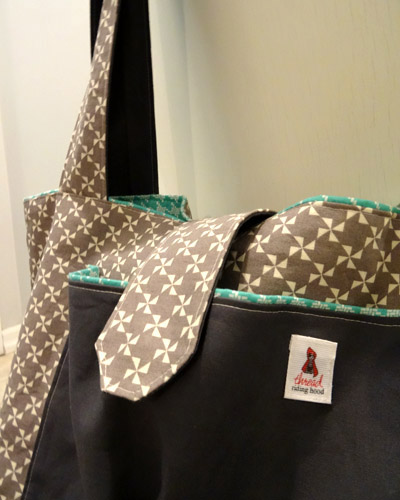
Oh how I wish this bag was mine! But, at least I know it has a good home. My sister-in-law mentioned that she liked my tote bag back in the summer. So I thought I would make her one for her birthday.
The randomness of choosing the fabrics myself didn’t sit well with me. I’m always nervous to choose something for someone because of the amount of work that goes into making it. I think if it was a less “visible” gift (ie. Not used outdoors with actual people around!) I would have not had so much trouble. Since she was/is hopefully going to be able to use it a lot I sent her a few fabric options within her colour choices of gray and turquoise.
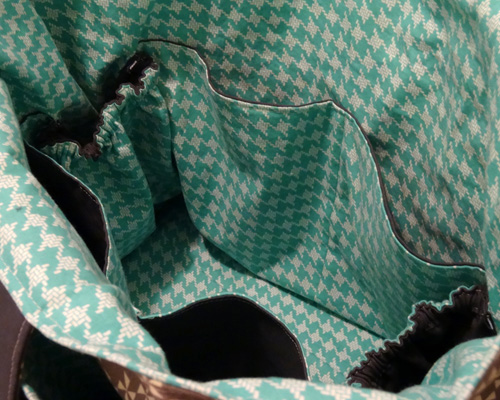
I’m so glad she chose these – they are gorgeous! I may have “accidentally” ordered a 1/2 metre too much in the gray pinwheels… That said, the turquoise houndstooth is hands-down my favorite. Here’s a close up shot of the print – it is actually made up of tiny lines so it looks woven.
As I was making this one I started to regret using the white thread, since it showed a lot in the top-stitching, I had to be super-careful to make sure I was sewing straight! Thankfully when I was done I loved the effect! I don’t think it would look nearly so stylish without the contrasting thread. I also really like the solid base and outer pockets. It is a lot less busy than the previous bags I made. I think if I make another one I will do the same thing. I switched up the pockets on this one as well, and added elastic only at the ends. I use the end pockets on mine for holding the kids’ water bottles. I also added a magnetic closure to the front instead of Velcro – which makes it look a lot more professional.
The pattern for the tote is one that I made using Abby from Sew Much Ado’s Diaper Bag tutorial. I love her design and added a coloured base and some outer pockets to it. So far I’ve made 4 of these and each one has gotten a ton of use. Abby kindly allowed me to post my changes to her bag. You can find the instructions for the tote here, complete with cutting layouts and yardage.
What do you think? Do you have a favorite tote-worthy fabric? How about a favorite tote pattern? I’d love to hear what you think! (Oh, and if you need a Christmas gift idea – this is a good one!)
Fabric Notes: Free Spirit Designer Solid in Manatee, Mama Said Sew Pinwheel in Cream/Mist, Avignon Houndstooth in Blue all from Fabric Spot
by Sherri Sylvester | Nov 27, 2013
Have you heard of Spoonflower? It’s a printing company located in North Carolina. They print custom wallpaper, decals, gift wrap and FABRIC! You are able to print your own designs – or you can buy a design from their marketplace of amazing designs. I came across the idea to make artwork with their printed linen-cotton canvas a while ago and finally made it happen!
This project is a “no sew” project – amazingly! The design is inspired by a piece of art I saw about a year ago. I love what it says, but had to fight the urge to add “Canadian” to the list of words in my artwork. For those of you who live in Canada I’m sure you will remember the “I Am Canadian” commercial from Molson a few years ago. This commercial is funny mostly because Canadians are NOT like the guy in the commercial. We are generally super quiet about our country – though a little more enthusiasm would likely be good! Anyhow, I didn’t want a beer reference in my daughters’ room – so I didn’t add it in.
Wanna make one yourself?!
Here’s what I did to make my art:
I designed the artwork to fit within a fat quarter of linen-cotton canvas. If you need help with the art, you can check out the Spoonflower helpful-page, which has lots of useful information and suggestions for creating and uploading your artwork. Because the linen-cotton canvas is 54″ wide, a fat quarter is 27″ x 18″. I used a final artwork size of 24″ x 14″ for my art – which left me just barely enough space to wrap the canvas around my 1 1/2″ deep gallery-style stretchers – really it was too little, but it worked! I would recommend using a final size of 22″ x 12″, to give yourself a few inches of wiggle room when stretching the canvas (instead of 1/2″!). If you get the thinner 1/2″ deep stretchers you will have lots of room at 24″ x 14″.
You will need:
- 4 stretcher strips – I found mine at my local art store for less than $3.50 each
- staple gun
- your Spoonflower printed artwork!
- picture hanging eye hooks and wire
Here are the steps I took:
(1) Attach your stretcher strips by pushing them together at the corners. I used a block of wood and a hammer to help out. Measure corner to corner and then the opposite corner to corner. Wiggle them around until the measurements match. This means your frame is square. (Note: I think you are “supposed” to add a few staples across the stretcher joints to make sure they stay square. Mine were so tight fitting I omitted this step.)
(2) Lay the frame on your artwork in the approximate middle. The curved part of the frame is the front, the flat side is the back.
(3) Wrap the canvas around and staple an even amount of canvas at the centre of each side.
(4) Continue to wrap and staple the canvas around the frame evenly. Staple one side beside the previous staple, then staple the opposite side. Flip the canvas over after each staple as you go to make sure the artwork is straight. Remove and re-staple as needed. This proved to be a tad more difficult for me than I had expected, because the text needed to be straight I had to be super-careful not to overstretch the canvas or it made the letters wonky. Continue around the canvas until the staples are within 2 or 3 inches of the corners.
(5) Perfect corners! (a) Staple one of the canvas edges close to the corner. (b) Fold the canvas around the corner and on a 45 degree angle “inside” the other side’s canvas. (c) Staple the bottom layer of canvas along the edge to hold it in place. (d) Fold the rest of the canvas down, ensuring the corner matches the front corner of the frame and the edge matches the edge of the frame. The 45 degree angle can be wiggled around a bit to make everything match exactly. (e) This is a photo to show that the canvas folded inside the outer layer will show a bit.
(6) Attach two eye hooks and a length of wire approximately 1/3 of the way down the frame. This will make sure the frame hangs correctly on the wall.
All done – now go and hang up your new artwork!
I hope this tutorial has been helpful. I am most definitely going to use this to make some more for myself. Please let me know if you have any questions or comments!