by Sherri Sylvester | Sep 17, 2014

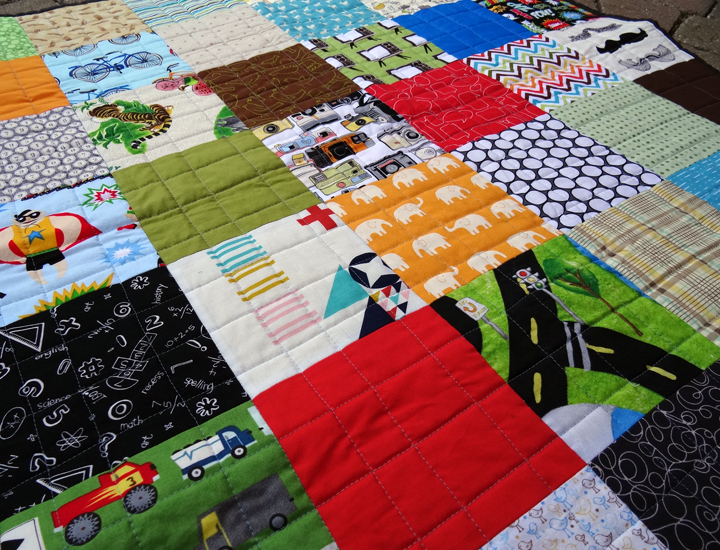
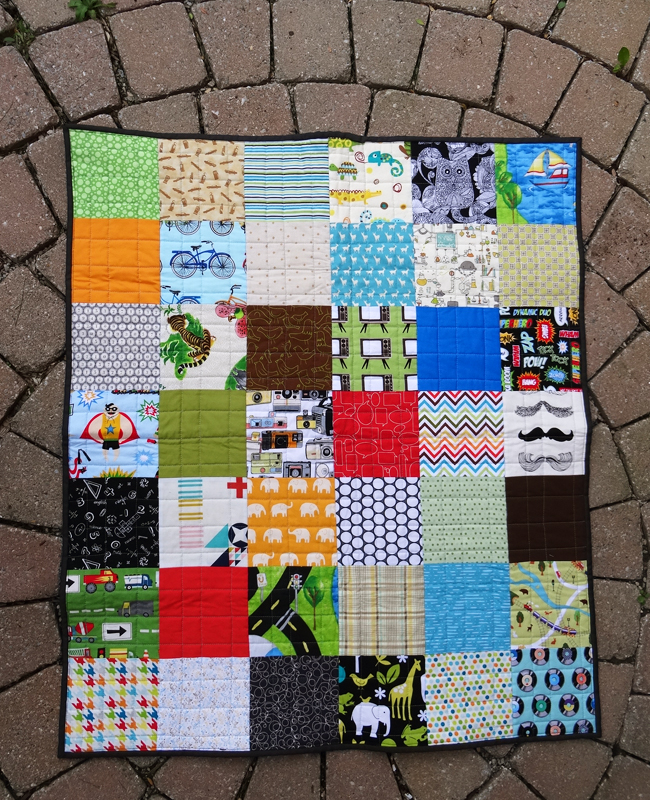
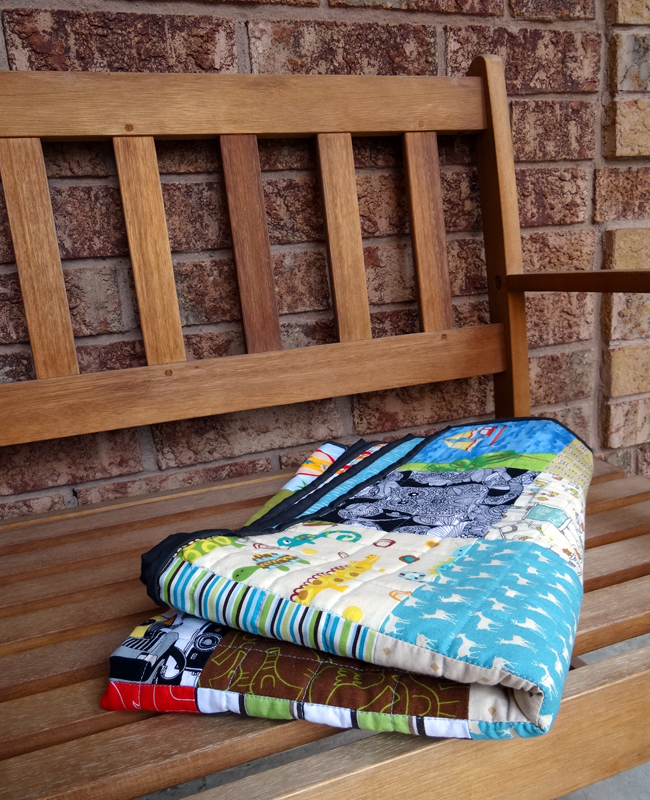
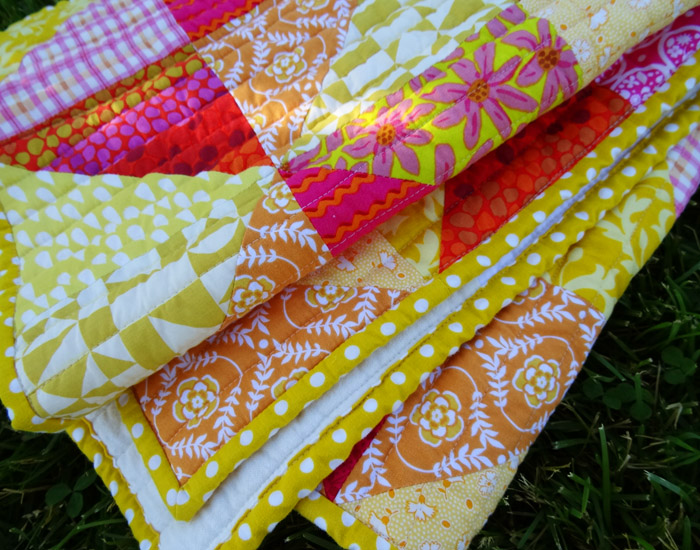
Friends of mine had a baby boy a few weeks ago and I found a great “need” to make him a little quilt. Seems that since I have found this new skill of mine I am anxious to spend lots of time quilting, though the faster projects seem to win out. I think I’m going to have to get good at writing progress posts, instead of only posting finished projects!
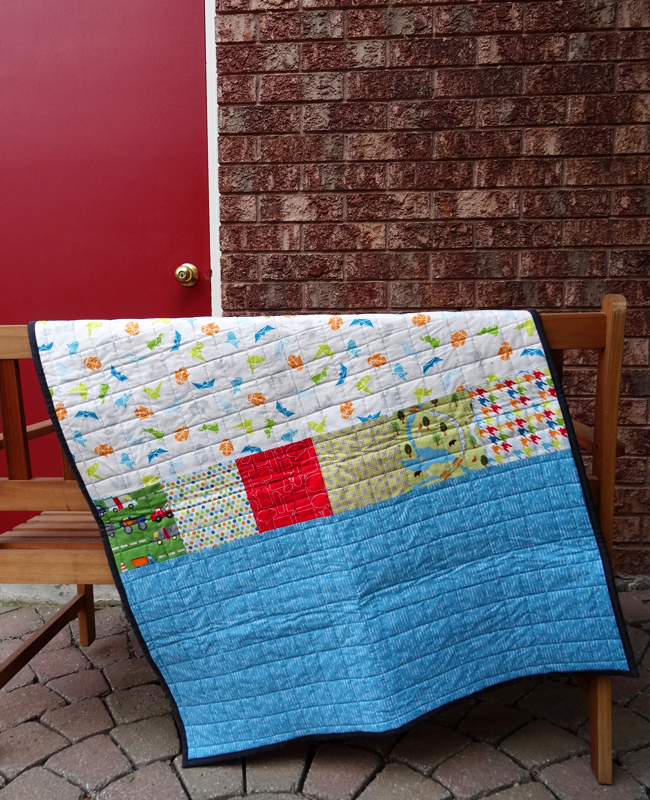
I also have a great desire to rid myself of my overflowing scrap bin – so, I landed on making an I Spy quilt with over-sized squares. It was really a lot of fun going through my stash and scraps to find the 6″ squares with the most fun boyish prints and kid-friendly designs. I even finally found a good place to use a small piece of my mustache fabric!
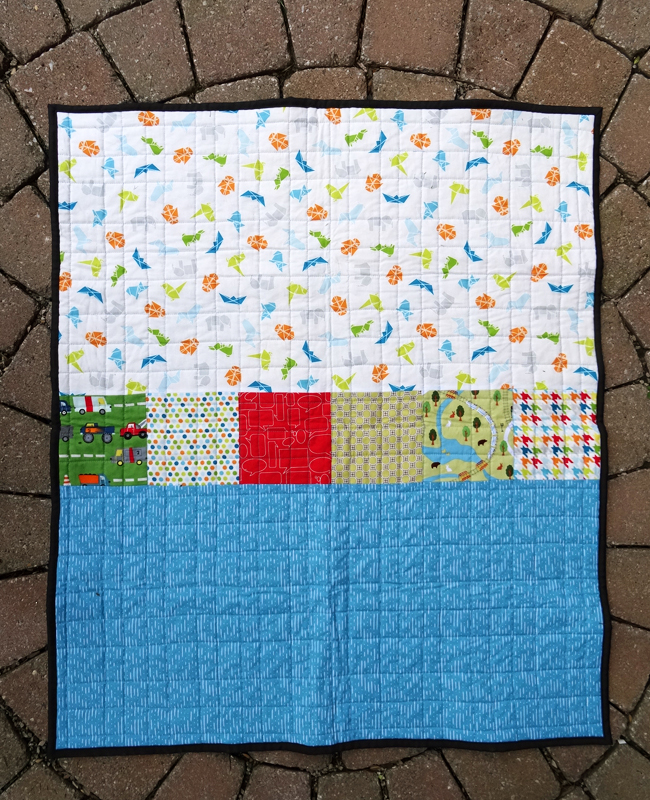
The whole thing was inspired by some multi-coloured Origami Sprouts yardage I recently ordered from Double Decker Fabrics and this quilt from Blueberry Patch. The Mixed Bag collection by Studio M for Moda is perfect for kids and works really well in a little boy’s project. I had 1/2 metre, so I used it for the top of the pieced backing. Thankfully I’ve got a little scrap left to stash for another project, it’s so cute! I also had the blue stripey fabric (some Dear Stella from a stashing trip last year). The pieced squares on the back made the other two larger pieces just long enough to fit the length of the quilt.
As I talked about quilts being slow earlier, that’s actually not the case with this one – even though it did take me a month from start to finish. I know this because of the internet (as usual) since I Insta-documented the beginning on August 15th. Sewing the little squares together and piecing the back doesn’t take long, especially on such a small quilt. Even the wonky “graph paper” straight line quilting (does that have a real name?) only took me a few hours. I likely could have finished the whole thing in 6-8 hours had I been able to find one sewing session that long!
I have to admit, that while I was arranging and piecing the front of the quilt I was a bit skeptical and didn’t figure I would like it. Even after straight line quilting it parallel to the long edge it still looked random to me. It was only after I quilted it in the other direction that I started to like it. I think the last lines of quilting brought the whole thing together. I have learned through this process that I like modern “random” quilts (like the amazing ones Cynthia Frenette makes). But I don’t as much like so many random prints and colours pieced together in such large blocks, because they don’t have any semblance of continuity. Even the colourful “scrappy” vibe is hard to find.
Thankfully, with the quilting in place this one has grown on me and I think it will be fun for the baby to lie on and look at – goodness, it’s got enough going on to keep his attention for at least a little while! Anyhow, if the parents hate the busy side, it’s got a lovely toned-down backing that could be used as the front instead.
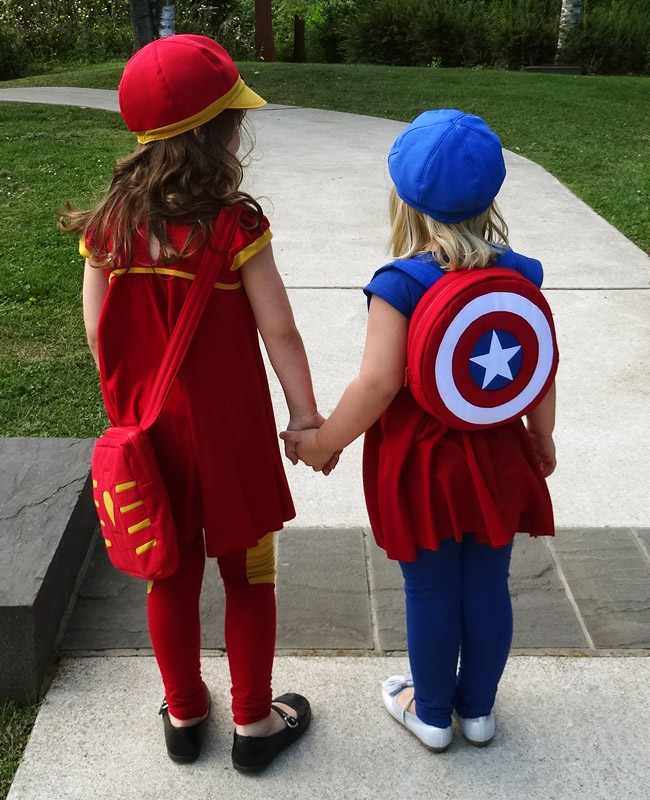
In other news, some BIG happenings I have neglected to let you know about for tooo long… The results of the Crafting Con Avengers month competition were posted earlier this month and I get to be the proud first place winner! I was so excited when I heard the news and I get to find myself some new patterns from PeekABoo Pattern Shop and something from Fabricworm! Hooray! The kids are still carrying around those bags and there might be a plan to make the little round one into a proper sale-able pattern. (yippee…!) You can see my post about the competition here.
Reader Feedback: What is your favorite new baby sewing project?
*This is not a sponsored post, though this blog is proud to say that Double Decker Fabric is a current sponsor. I wanted to share where I got the fabric from so you could find it if you need some. And… an unrelated note to self, iron the quilt before photographing it next time!
by Sherri Sylvester | Sep 4, 2014
Wow! I have severely overestimated my ability to get things done and get two kids started in school. Especially since my body decided to let me catch a cold earlier this week! This past few days has been a rush of emotion and busyness, all while trying to get a few things ready for some really fun events coming up soon. More on that another day, suffice to say – I’m just happy to have “finally” posted something new since last week!
At the risk of using almost the same title twice in a row, I have made another mini quilt. (First one here.) This one is made from a little bundle of pre-cuts I received from Daryl at Fabric Spark. These photos were taken at the end of June, believe it or not. I’m feeling a bit behind in letting you know what’s going on around here! Either way, I am so happy with this little quilt. It has lived in our car for the entire (thankfully cool) summer and been loved a lot. We even have to keep track of who’s turn it is to use the “blanket mommy made”! You can tell we don’t have many of those yet!
(P.S. Fabric Spark is running their Mystery Fat Quarter event again – on now until September 14th! Buy the equivalent of one yard of fabric or more and use the code “FQfun” to receive a coordinating “Mystery” fat quarter absolutely free! Click here to visit Fabric Spark and see her great selection. I think you’ll have trouble stopping at 1 yard!)
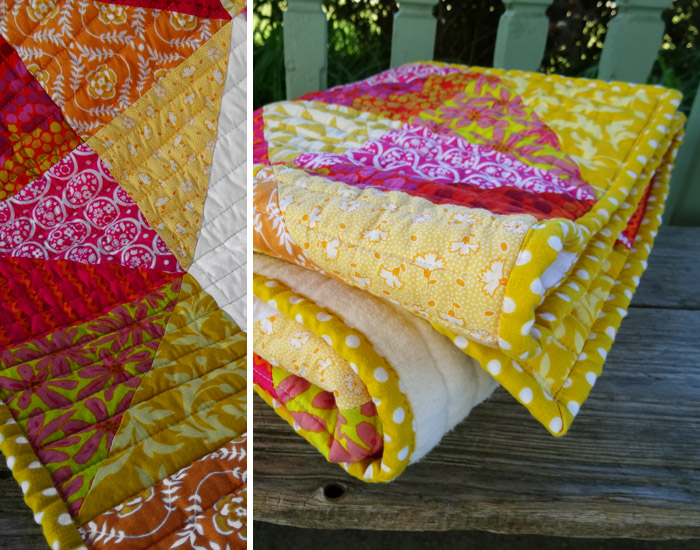
When I got the pre-cut bundle, little did anyone know it would hold the most perfect number of colours and white squares possible! It almost exactly matched the requirements for the Big Love Quilt by Modern Handcraft for Dear Stella. The only thing it lacked was size, so I made it using a 5.5″ square instead of a 10″ square. So I guess instead of a Big Love quilt, I made a Little Love quilt. (hee hee!) I would love to try this again with another set of fabrics. I’ve got at least 4 bundles stashed that are waiting for quilts and I’ve begun cutting a 5th for something else.
This quilt is made from half square triangles (HST’s), with a few full white squares in the centre of the heart. It was extremely fast to sew up, even for a beginner quilter like me, and I love the results. Actually, I have several heart-related things pinned to my “Quilts I Might Make” Pinterest board, maybe it’s time to do a little round-up? I love that a quilt is an art-piece that you create to keep someone warm and let them know that you love them – so the heart theme is quite appropriate!
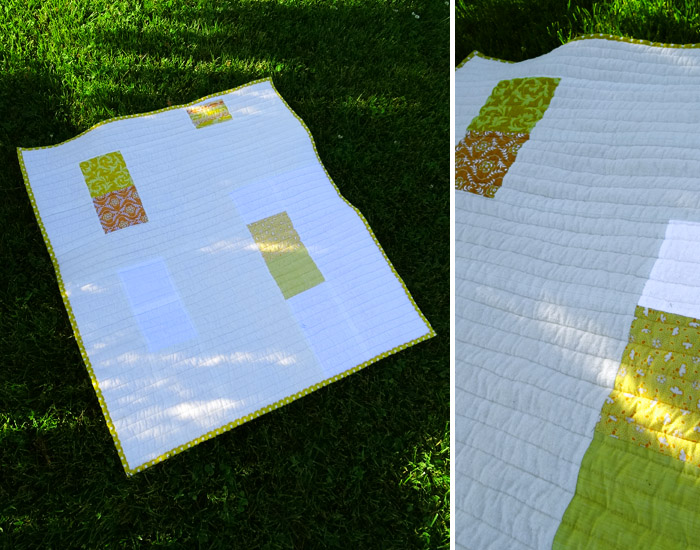
I am absolutely in love with the back of this quilt as well. It was nerve-wracking and fun to sort out how to stitch these pieces together so they came out in the positions I wanted them to, but it turned out great I think! I am quite happy with the low-volume modern-ness that it made itself into. And it’s amazing how clean it has stayed, even in the back seat of our car! (Though there was that one incident with the chocolate milk… but thankfully it came out in the wash!)
It is straight-ish line quilted and I used a double layer of fleece blanket for the batting. That amount of fleece would be perfect for a baby play-mat, nice and squishy! Unfortunately, squishy doesn’t really drape over your lap, but it is cozy, and the kids don’t notice things like drape anyhow! The most perfectly coloured binding is the same vintage yellow dot fabric I used to make my youngest’s Easter dress this spring. I love how it picks up on the yellows in the quilt. It’s machine sewn, since I haven’t had the compulsion to hand-stitch a binding on as yet!
Well, I’d better go now, I’ve got lots of things on the list to do tonight! Amazing how time flies by. First up… clean the house! (Today’s Trivia Question: How many times can you use the word love in a post? A: 11!)
by Sherri Sylvester | Aug 27, 2014
A few months ago Lindsay from Stay Home Fabrics asked me if I could create a tutorial using fabric from her online shop. Of course, more fabric? How could I resist! And it’s even more fun because she’s selling a kit for my mini quilt in her shop. It’s times like these that I LOVE being a blogger, Yippee! Lindsay also has provided a discount code for you to use in her shop (Thanks Lindsay!), use the code “sewhappy” to get 15% off your entire purchase! (Valid until Sept 3, 2014)
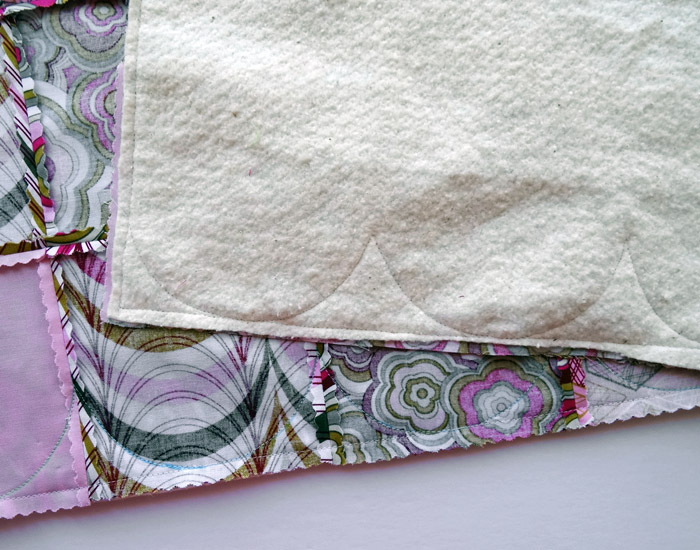
When I received the Lovelorn 5″ charm pack from her I sat on my living room floor and set those 49 squares into about a dozen combinations before I sorted out the arched design. But it still needed something fun, so I added a scalloped edge to the bottom of the quilt. Just in case the fabrics weren’t feminine enough on their own! I can see it being used for a baby’s quilt or playmat or a toddler cuddle quilt. For older kids (like mine), keep it in the car for cold winter days when their legs need a bit of extra warmth – think dresses in Canadian winters!
Don’t be fooled by the scalloped border, this mini quilt is very simple to make. It finishes at around 31″ square, and is sewn “pillowcase style” so it doesn’t require a binding. I didn’t even use a walking foot to quilt it! This project is easily finished within a day, so it would be a perfect quick shower or new baby gift. I think an advanced beginner would have no problems finishing this quilt, provided that you have some experience sewing curves.
Before we get to the tutorial, and just in case you need something to spend your 15% discount on, (like we all need a discount to force us to buy new fabric?!), Lindsay just posted some new fabric in her store for you! Here are just a few from the new Indelible collection by Katarina Roccella for Art Gallery. (Click the photos below to visit the listing in the Stay Home Fabrics shop.)
Ready to make a quilt?
You will need:
Before you begin:
- Since you are using a charm pack, there is no need to pre-wash your fabrics. I washed my quilt before I took these photos and it came out just fine.
- Print and cut out the Scalloped Edge Pattern Piece, check the 1″ square to make sure it is the correct size. Make sure to use the “actual size” setting when printing it out.
- Double-check to make sure you know how to sew an accurate and consistent 1/4″ seam on your machine. Here’s a good tutorial on accurate 1/4″ seams.
Here’s how to make it:
- Begin by finding a flat area (floor or table-top) to lay out your pre-cut charm squares. Follow the diagrams below to lay the pieces out in the correct order. When you finish, you will have a square 7 pieces high by 7 pieces wide. Make sure all of your one-direction fabrics are facing in the same direction!
- Next, stack your fabrics in order into piles (one for each row) with the left-most charm square on the top of the pile. I keep track of this left-most square by placing a pin on the left side of it. This also helps to keep track of which way “up” the quilt rows go together, since it can be simple to accidentally reverse a row by placing it upside-down. The pinned square is always on the left of the quilt.
- Stitch your rows together by placing each fabric square right-sides-together with its adjacent square and sewing a 1/4″ seam. Then add the next adjacent square to the first two and so on. When you finish you will have 7 rows pieced together. Since the rows are in piles, begin by placing the top square right-sides-together (RST) with the square underneath it, stitch, then add the next square etc…
- Press all of your seams open or to the side.
- Now we can sew our rows together to create the quilt top. Match the adjacent raw edges of each row in order, just like you did with the charm squares and stitch them together with a 1/4″ seam. I like to pin at each seam, to make sure they match up. Here is a good tutorial on matching quilt seams. Press all of your seams open or to the side.
- Now you should have an aproximately 33″ square quilt top. (Congratulations!) Go ahead and square up the quilt top. Here is a good tutorial on squaring up a quilt. (They square it after it is quilted, but we need to do this step now because we are not binding this quilt.)
- Layer your 33″ square batting with the quilt backing right-side-up on top of it. Now place the quilt top right-side-down on the quilt backing. This is your quilt sandwich. You will need the back and batting to be the same size as the quilt top, so smooth everything down (really well!) and cut away the excess. It is best to use a ruler and rotary cutter for this step, so the quilt stays square.
- Pin well around all four edges of your quilt. It is a good idea to do this right after you square up the quilt and before you move it, since moving the quilt between the cutting and pinning will shift the layers around.
- Mark a 6″ space on one side of the quilt (not on the bottom scalloped edge). Stitch around all four edges of the quilt with a generous 1/4″ seam, leaving the space open for turning. Stitch with the quilt top under your presser foot and the batting next to your feed dogs. Make sure the layers feed evenly through the machine.
- Use the pattern piece to trace the scallops onto the bottom edge of the quilt. Line up the pattern piece so the scallop is even with the seam you just stitched. The edges of the traced scallops will meet at each seam.
- Pin the scalloped edge of the quilt. I pinned once on each side of each curve and at every seam.
- Stitch along your traced scallops, pivoting at each seam to begin the next curve.
- Trim the scalloped edge to 1/4″ and clip all curves. Clip into each pivot point, being careful not to cut your seam! Remove any previous stitches that might be inside of your curved stitching. Clip the two top 90 degree corners of the quilt to reduce bulk.
- Press the seam allowance within your 6″ gap to 1/4″ on both sides – press the batting back as well. This sewing trick is better explained here.
- Turn your quilt right side out, push out all corners and edges. Press well – especially around the edges of the quilt, ensuring they are all even. Pin the opening closed. Take care to ensure the edges match once they are pinned.
- Carefully stitch the opening closed with a ladder stitch. Here is a tutorial on how to hand sew a ladder stitch.
- Smooth out the quilt again on a flat surface and use safety pins to baste the quilt so it is ready for hand quilting. I used safety pins and placed one in the centre of each square. Use more or less depending on what you are comfortable with.
- Top-stitch around the entire edge of the quilt roughly 1/8″-1/4″ from the edge.
- To begin quilting, stitch all the way around the centre dark pink block in the quilt. I used my presser foot as a guide to stitch approximately 1/4″ away from the block on all sides. Move one block away and quilt a larger square around the next, and then 1 more large square around the next set of blocks to finish quilting. Make sure all layers of your quilt are feeding evenly through your machine. If they are not, remove stitching, add more pins and try again.
- Remove your safety pins and you are finished! Give it a wash to make it wonderfully soft and crinkly. Perfect!
I’d love to see your creations! You can share your projects on Twitter and Instagram @sherrisylvester with the hashtag #alongforthreadride or #threadridinghood, or post them on the
Thread Riding Hood Facebook page.
* This is a sponsored post, I was given the fabric from Stay Home Fabrics to complete this project. A always, all opinions are my own. *
by Sherri Sylvester | Jul 5, 2014
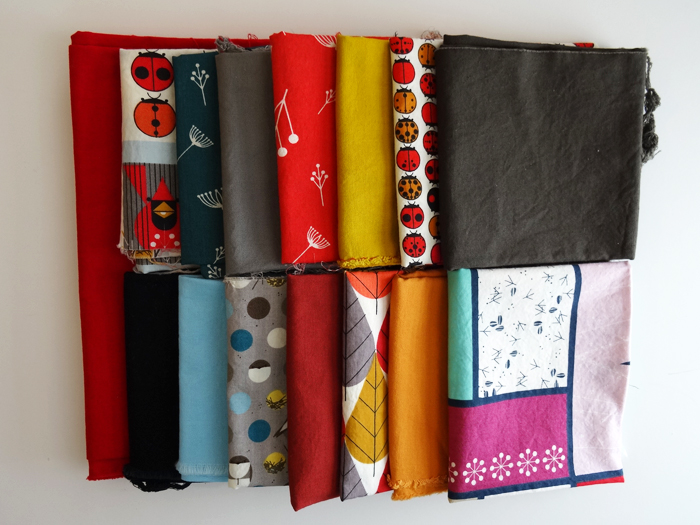
Here is the tutorial for the Getting Antsy Picnic Quilt! I went over the background for this quilt in the previous quilt background post, so I’ll just jump right into the tutorial here. I used the Charlie Harper Fat Quarter Bundle from Warp & Weft as the base and inspiration for the quilt.
A word of warning about this tutorial. It is simplified and assumes that you know some basics about quilting and have made a quilt before. If you have any questions please feel free to email me – sherri@threadridinghood.com and I’ll do my best to help you out.
You will need:
- 1 set of 7 Charlie Harper fat quarters (from Warp & Weft here)
- 6 solid coloured fat quarters
- 3/4 yard/metre border (cut to 2 3/4″ strips)
- 1/2 yard/metre binding (cut to 2 1/2″ strips)
- 4 yards/metres non-directional backing
- 1/8″ black ribbon (100% polyester)
- 1/4″ black ribbon (100% polyester)
- scraps of black quilting cotton (fits within 1 fat quarter)
- quilt batting to fit – aprox. 75″x75″
If you would like to colour in your layout instead of laying it out you can click here to print out the quilt template and use it to plan your quilt. I laid out my fabrics with the “cool” colours on the top left and the “warm” colours on the bottom right and worked my way to the centre with each.
Here we go…
- Cut each of your 13 fat quarter into 3 rectangles 5.75″ high x 19.75″ high each. You should have 39 rectangles in total.
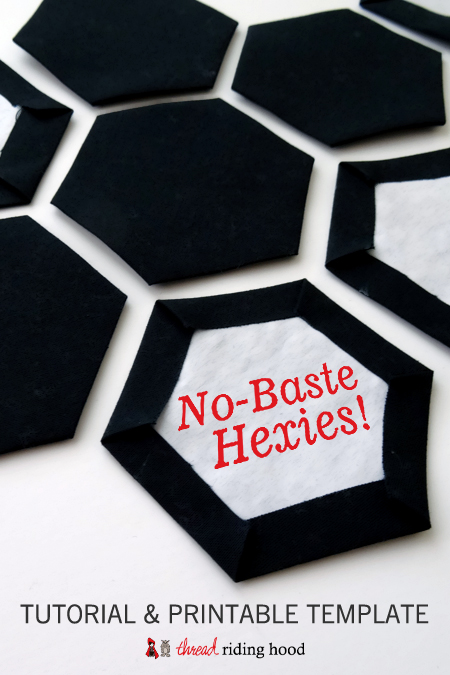
- Make 9 black hexies. If you’d like you can use my no-baste hexie tutorial. In the tutorial post there is also a template for creating the hexies in the proper size. They should be 3.5″ from point to point and 3″ high.
- Lay out your rectangles in the order you want them. You will need 3 columns with 12 rectangles each. You will have 3 rectangles left over. Lay out your ants as well so you can make sure to position them where the background is not as busy. This way they will show up better when you stitch them on. (As you can see I was going to mark a “trail” for the ants in ribbon and changed my mind at the end.)
- Stitch each column together in the order you placed the rectangles.
- Press each seam open.
- Pin the columns together at each seam and stitch them together. Press your seams open.
- Piece the border strips together to make one strip aprox. 250″ long.
- Stitch the border to the top and bottom of the quilt first.
- Trim the strip to 90 degrees at each corner as you go. Stitch the border to the left and right side once the top and bottom are sewn and trimmed. Press all of your seams open.
- Piece your backing together. I used the 3 extra rectangles + a few small scraps of my favorite prints and a solid red square. I cut my backing fabric in half and pieced one half on each side of the scrappy stripe. Then I trimmed off enough height from the top piece of backing fabric to allow the stripe to be approximately 1/3 of the way down the back. (see a photo in the last post)
- Lay your backing right side down on the floor or table, place your batting on top of the backing. Add your quilt top right side up to create your quilt sandwich. Make sure to align the stipe on the backing and the stripes on the quilt top so they match up with where you will be quilting/tying your quilt. Baste/Spray/Pin to hold everything together.
- Remove the paper hexie template from each hexie and pin them in place where the ants will go. This marks the quilt, so you can avoid tying it where the ants are attached. The body of the ant is made by matching two straight hexie sides. The head is made by matching the point on one hexie with the centre straight edge of another. (Please ignore the ribbon “trail” under the bottom ant.)
- Tie your quilt at the corner of each rectangle and twice in-between along the lines. I used painter’s tape and my quilting ruler to keep track of where I was tying.
- Machine quilt the border. I stitched my lines about 1/2″ apart.
- Cut 6 legs from 1/4″ ribbon per ant. The front legs are 2 1/2″ long and the back legs are 3″ long. Also cut 2 antennae from 1/8″ ribbon per ant. These are also 2 1/2″ long. Use a flame to *carefully* melt both ends of each leg or antennae. This will prevent them from fraying.
- Pin the ribbon legs and antennae to your hexies as indicated in the photo. About 1/2″ of one end of each ribbon will be underneath the hexie. Pin along the edges of the hexie to keep it in place as well.
- Stitch each ant to the quilt. Sew along the centre of each ribbon and around the edge of each hexie. Repeat until all three ants have been stitched on.
- Sew the binding strips together to make one long strip aprox. 300″ long. Bind your quilt using your favorite method. I use the cluck cluck sew tutorial to machine stitch my bindings.
All finished and ready for picnicing. Go take some photos and show it off! And of course, I’d love to see your creations. You can share your projects on Twitter and Instagram @sherrisylvester with the hashtag #alongforthreadride or #threadridinghood, or post them on the Thread Riding Hood Facebook page. (As usual, this tutorial is for personal/charitable use only – thanks!)
** Please note: This is a sponsored post and some of the fabric was provided to me at no cost by Warp & Weft. However, as always, all opinions are my own and I will never promote something to you that I do not love myself. **
by Sherri Sylvester | Jul 4, 2014
I do not know the last time I felt this excited to show you a project! I’m so proud of this quilt and I love how it turned out. I love the photo shoot, and I love the fabric… it has been an all around amazing journey! When I first saw the Charlie Harper collection I knew I wanted to use it for something, so when Esmari from Warp & Weft gave me a chance to use it for a Sewing Society post I was thrilled! I’m going to post a simple tutorial for this quilt separately today, since the post is getting quite long and photo heavy! So here is the background on it… (**Update: the tutorial for the quilt is posted here.)
I love Charlie Harper’s art, and the outdoor nature of them was perfect for something picnic-related. I tried to come up with something other than a picnic quilt, but in the end I failed to think of something I would rather make – and I’m so glad I didn’t! I wanted the quilt to look modern, but typical, all the way down to it being hand-tied. My quilt is neither difficult or complex or even many pieces – is is, however, my 2nd “real” quilt finish and I’m quite enjoying my foray into the world of HST’s and OBW’s.
I figured, since I was not likely inventing a super-complicated quilt for a tutorial the first go around, that I would add in some fun applique. I am so IN LOVE with my ants! Ants and picnics just go together – and I am super-excited to have created my family’s picnic quilt for many years to come. I have made many clothing projects, for my kids and for myself… and for my husband… nothing compares to the feeling I got finishing this quilt. The sense of heirloom and keeping someone dry and/or warm with it. The happiness, many picnics and fun memories I want to create around our future adventures with the quilt.
I used the fat quarter Charlie Harper bundle from Warp & Weft plus some of my randomly stashed solids and solid red, binding and backing from my local big-box fabric store. I would have been more adventurous on the backing – but it’s going to mostly be on the ground, so a dark wobbly stripe it was plus a little piecing with a bit of extra fabric.
The binding is the most perfect wobbly criss-cross fabric and I took some inspiration from the striped bindings I’ve seen from some of the other Sewing Society members lately. I’m super happy with it and the fact that it looks hand-drawn is just a further nod to the Charlie Harper artwork.
I decided that machine quilting the whole quilt was a bit adventurous, so I tied it with embroidery floss instead. Much “safer” and faster! I did want to make sure it had some machine quilting, though, since I love how it looks – so I stitched straight-ish lines around the border. I figured out later that I think I would have been fine to quilt the whole thing, since it probably would have folded up small enough to fit in my machine. Ah well – next time! The quilt finishes at around 70″ square. Lots of room to fit our family of four.
I also toyed with the idea of making the backing waterproof. In the end I decided that I wanted it to be available to use as a quilt, not just for sitting on. I’ve had too many picnics growing up where the cold weather caused one or more of us to huddle under the picnic quilt for warmth. A waterproof quilt would not be cuddly! I think instead I will carry an inexpensive vinyl tablecloth around to put underneath the quilt, if it is needed, to keep us (and the quilt) dry.
I’m off to finish writing and posting the tutorial before cleaning my house for tonight’s sewcial. I love my monthly get-togethers, even if I don’t get much done for all of the sewing-talk!
What do you think? I’d love to hear about your quilting adventures. Have you made a favorite picnic quilt?
** Please note: This is a sponsored post and some of the fabric was provided to me at no cost by Warp & Weft. However, as always, all opinions are my own and I will never promote something to you that I do not love myself. **
by Sherri Sylvester | Jun 29, 2014
I managed to only post twice last week – oops. I finished a quilt in 5 days though, so it was necessary! I’m so excited – you can see some peeks of it on Instagram if you’d like. It’s not a complex pattern, or huge, or even “all-over” machine quilted (I tied most of it), but it’s finished and I love it! It’s actually my second quilt finish in as many weeks. The first one is photographed and ready, I’m just waiting for a good time to post it.
Friday was the last day of school for us, so I’ve got summer in full swing now, including my 2 year Blogiversary that is coming up really soon! I’m planning some fun stuff to thank you all, so stay tuned…
As part of my next Warp & Weft Sewing Society post I have put together a little tutorial as part of a larger tutorial for the quilt coming at the end of this week. I needed a few black hexies for a very mysterious part of the quilt (hee hee, you’ll have to come back to see it!) and I thought I would make my life a little easier. Turns out you can make these things without basting them! Instead of thread and a needle – you just need some freezer paper and an iron.
Now I know that the hand-sewn element involved in basting these hexies allows you to baste in the car, or make them as a “take-along” project. So, if you are one of those people I have a solution for you too. Instead of using an iron to adhere your freezer paper, try bringing along your hair straightener! The Riley Blake Instagram account posted this last week – and it would work perfectly. You could even use one of those outlet plugins in the car and make them on the road!
You will need:
Here we go:
Step 1: Cut the freezer paper to a size that will fit into your printer. I used a letter size sheet – so 8 1/2″ x 11″. I put them into the paper tray shiny side up, so my printer would print onto the matte side. Check which way your printer works before inserting the sheets. Now print out your hexie template. You can use the one I’ve provided in the “You will need” list or another one in the size you’d like.
Step 2: Cut out your hexie templates. This is not super fun, but it was a lot quicker than I thought it would be. I’ve noticed that there are pre-cut freezer paper hexie templates for sale online – so you could try that too.
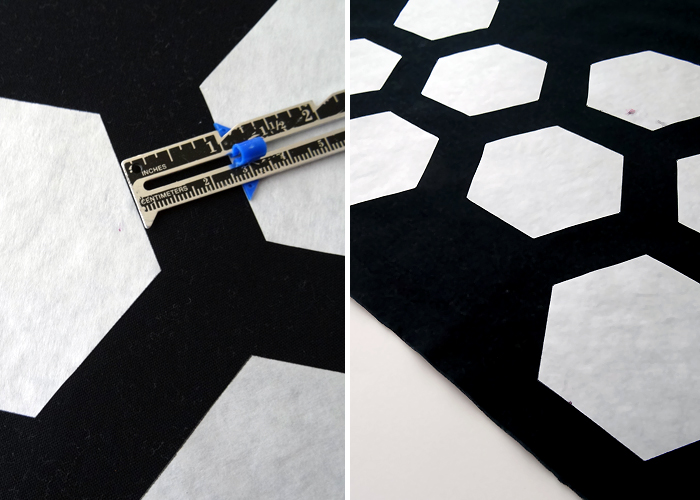
Step 3: Iron the templates onto the wrong side of your fabric, leaving at least 1″ of space between them. The space accounts for the 1/2″ seam allowance. Make sure the shiny side is DOWN, unless you want the paper to stick to your iron! The shiny side of the freezer paper is actually a thin plastic layer, so when you iron it, it temporarily sticks to your fabric. I use the heat setting on my iron that matches my fabric, in this case it was cotton. Iron just long enough to get the paper to stick.
Step 4: Cut out around your templates. Leave at least 1/2″ seam allowance around all edges of your hexies. This is the part that will get folded under and usually gets hand basted.
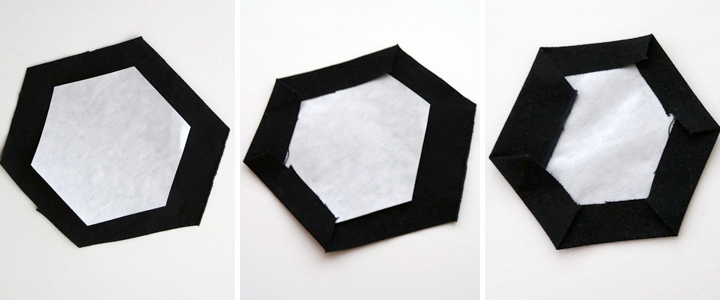
Step 5: Grab one freezer paper/fabric pair. Pull to remove the freezer paper and flip it over so the shiny side of the paper is facing up, centred on the wrong side of your cut fabric. Fold one edge of your hexie seam allowance over onto the freezer paper and iron it down. Easy peasy, it sticks to the plastic layer! Proceed around the hexie template folding and ironing each side down.
Step 6: When you are done, turn it over (paper side down) and give it a quick press with lots of steam on the right side, to secure the shape. (It might stick a little to your ironing board, but no harm done, just pull it off.) One hexie done! Repeat until you have enough to make your project.
When you want to stitch your project, just remove the freezer paper templates. Because the paper can be ironed multiple times, you may even be able to do this as you finish stitching them together. Anything to save cutting more templates, right?!
I feel that it is a little sad to be posting a tutorial with all of the hexies in black, they are so pretty when they are made in colour! Unfortunately, I needed black hexies, so that is what we get. Curious about the quilt much?! Here’s a little peek… I got to use Warp & Weft’s Charlie Harper Fat Quarter bundle. You’ll have to come back at the end of this week to check it out. I’m so excited to show it to you!