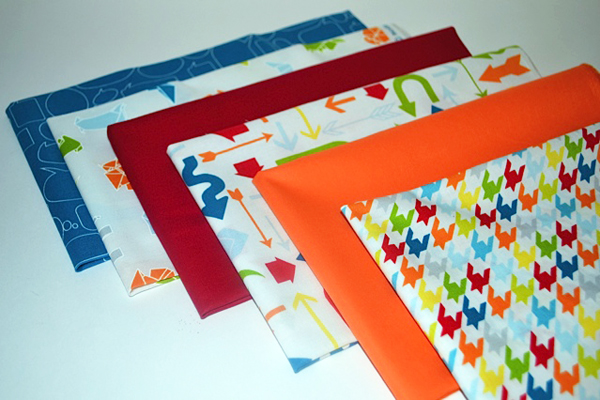
by Sherri Sylvester | Jun 17, 2014
Good Tuesday to you! After a long and drawn out technology war with my computer today, I finally get to introduce a new sponsor – Double Decker Fabric! I met Dorienne online when I interviewed her last year for my Canadian Online Fabric Store series. She has a giveaway and a discount code for you today, so stay tuned!  Before we get to the giveaway, I thought it would be fun to pair some of Dorienne and my favorite tutorials with her fabric. I love finding out what other people’s favorite tutorials are. Sometimes I have seen them before, and sometimes (like with Dorienne’s today) I find a few new ones, and some new favorite bloggers too. I hope you enjoy the list!
|
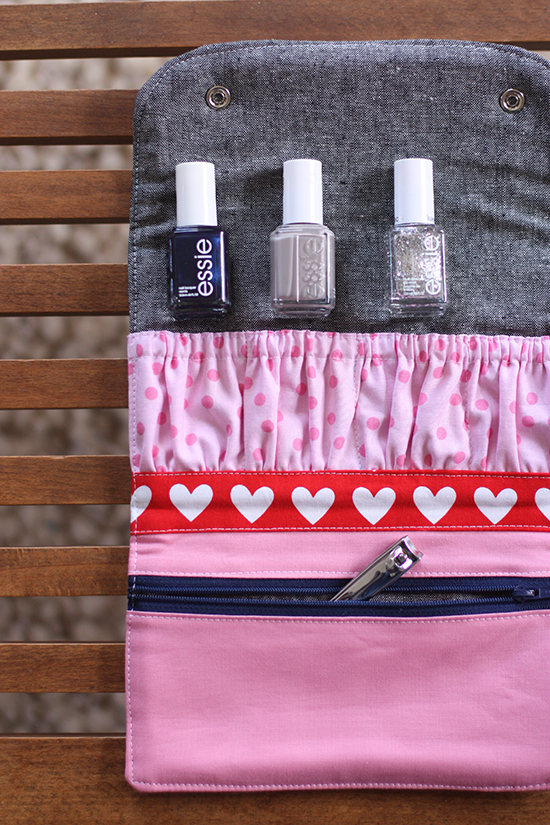
Tutorial: Snappy Manicure Wallet from noodlehead
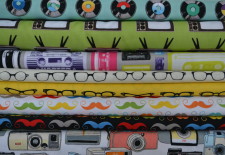
+ Double Decker Fabric’s “Geekly Chic”
Use Dorienne’s extensive collection of Geekly Chic from Riley Blake Designs to make one (or several!) of these cute manicure wallets.
|
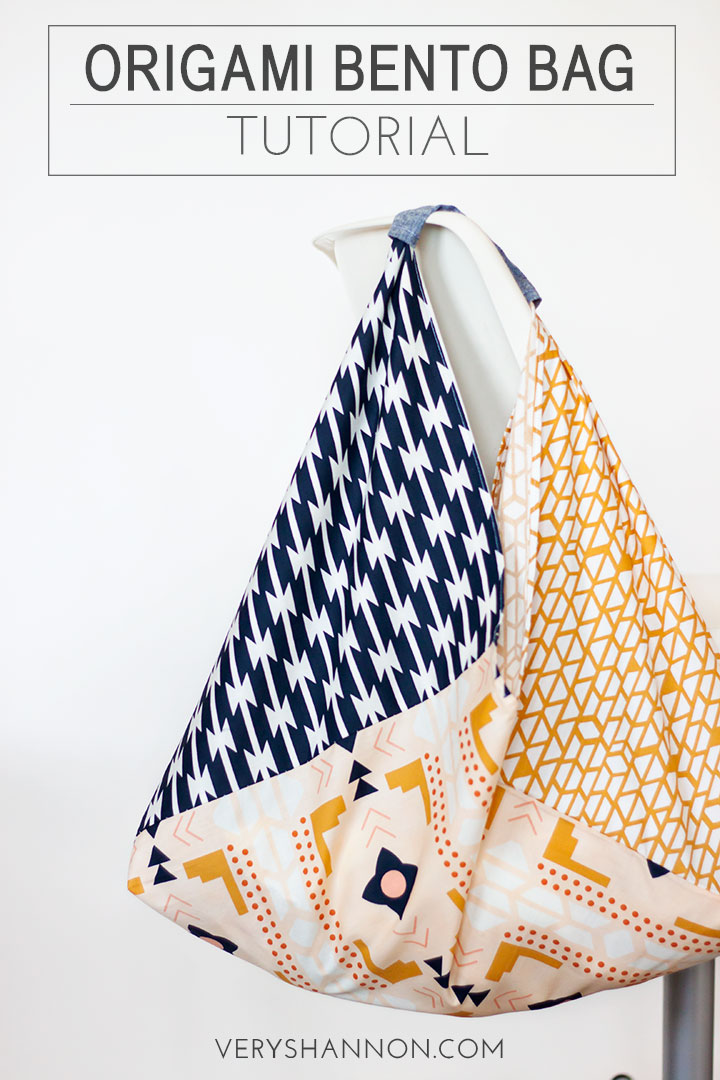
Tutorial: Origami Bento Bag from Very Shannon
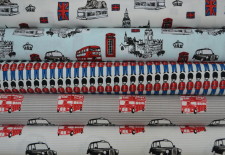
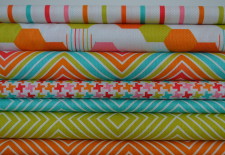
+ Double Decker Fabric’s “British Invasion”
British Invasion is the perfect trendy fabric to use for a fun summer bag. This tutorial is so quick and easy. Sew up a summer hostess gift in no time! |
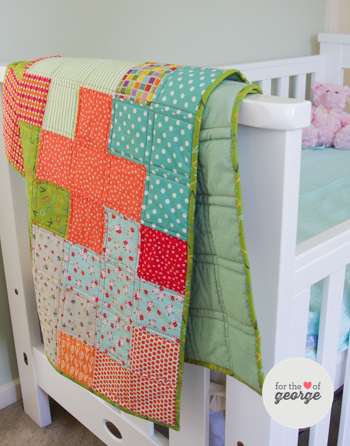
| Tutorial: Plus Quilt from For the Love of George
+ Double Decker Fabric’s “Mixed Bag”
This Mixed Bag collection from Studio M for Moda is so colourful and looks great together, it would be perfect for an easy-to-make Plus Quilt! |
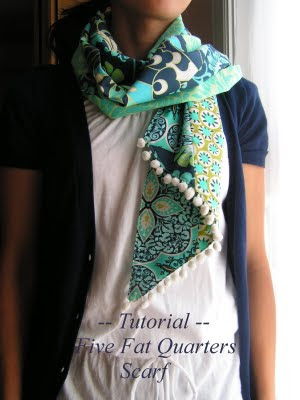
Tutorial: 5 Fat Quarters Scarf from Tea Rose Home
+ Double Decker Fabric’s “Textured Basics”
Use these textured basics to make a gorgeous bright scarf for summer. Perfect with those neutral colours that are so popular! |
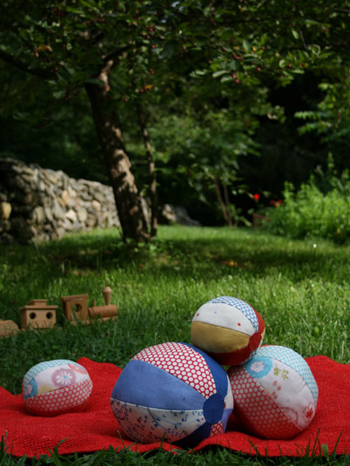
| Tutorial: Fabric Beach Balls from the Purl Bee
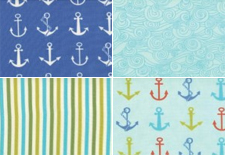
+ Double Decker Fabric’s BarthloMeow’s Reef
BartholoMeow’s Reef from Moda fits perfectly into this summer’s nautical trends and would be so cute as a fun soft beach ball! |
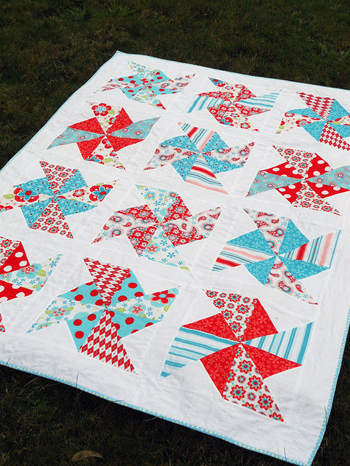
Tutorial: Pinwheels in the Park from Sew Mama Sew
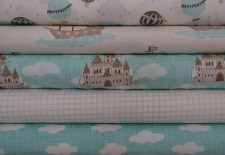
+ Double Decker Fabric’s “Storybook”
Add a few of Dorienne’s solids to this lovely Storybook fabric from Kate & Birdie for Moda and this tutorial would make the sweetest little boy’s quilt! |
Hooray for summer sewing, Dorienne has provided a discount for you that lasts until the end of June! Use the code “Summer15” to get 15% off your purchase from today until June 30, 2014. Head on over and stock up, I know you must have summer projects planned. (Or you could plan some now!)
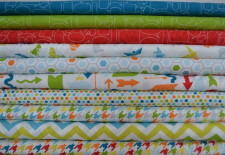
Last, but certainly not least, you can try your hand at winning some fun fabric today! Dorienne is giving away a bundle of Mixed Bag by Studio M for Moda. When I saw this collection I thought, “Oh my, I have to have some of those origami animals… and the houndstooth… and the dots… and I’ll need some of those red speech bubbles!” (Hee Hee, I know what I’m going to be spending my 15% off on!) pic of mixed bag bundle This contest is open to Canada and the US, and will remain open from today until midnight on Monday, June 23, 2014. Use the Rafflecopter widget below to enter – and if you don’t have Facebook to sign in with, just use your name and email address!
a Rafflecopter giveaway
by Sherri Sylvester | Jun 12, 2014
UPDATE 2020-07-17: Sew Mama Sew is unavailable. Please use the links to access the original tutorial and pattern.
Click to download the FREE INSULATED LUNCH SACK PATTERN PDF
Click to ACCESS THE LUNCH SACK TUTORIAL on the Wayback Machine
___________________________________________
I’ve been busy working with Warp & Weft and Sew Mama Sew to make another tutorial! This time around, it is for a flat-folding lunch bag tutorial, and I got to work with the new Anna Maria Horner collection – Pretty Potent! (Woot Woot!)
When I thought up the idea of making this lunch bag a few months ago I was thinking about how amazing it would be to make this type of lunch bag. You’ve likely seen similar ones at for sale… they fold flat with a zippered closure and lovely oval shaped handle cut-out? Unfortunately for me, some of the details on this bag were stupid complicated extra fun to figure out! Especially if your aim is not to use bias tape because you can never sew it on around curves (or is that just me?) Lucky you – because I’ve done all of the hard work, you can make it the easy way the first time around! (And I get to have extra workable-but-not-quite-right lunch bags around for… umm… using… for stuff… hooray for stuff!)
All kidding aside – I LOVE this tutorial and will likely use it to make my kids’ lunch bags from now until they are finished University. They are insulated with Insul-Bright, and water resistant because they are lined with ripstop nylon. Of course, all of the materials are washable – so they are kid-proof as well! They are very simply constructed, especially the Velcro closure version – since you can omit the longer zipper insertion instructions. I’ve listed a few ideas for how to use them on the main Sew Mama Sew tutorial, and here are a few more. Teacher gifts? or maybe the bus driver, piano teacher, swim instructor or a coach. Maybe you could even make some to use on picnics – everyone packs their favorite meal in their own bag!
Can I talk about the Anna Maria Horner fabric for a while? To be honest, I haven’t been a long-time fan of her work. I have always considered her work interesting, but not interesting enough to buy. But… this collection changed everything, I think I’m now officially hooked and may soon become one of “those people” who are geekily showing off their knowledge of and devotion to AMH! The deep bold colours are beautiful. And somehow she’s managed to mix varying types and styles of art into a cohesive collection. I can think of so many ways to use these individually, but I think my favorite would be an amazing quilt with blocks made of a mix of each print – all together. No solids added. Is that crazy?! (If you want some, you can get the fabrics I used in this tutorial from Warp & Weft!)
Are you ready to make one? This tutorial is a short supplement to the main tutorial posted on Sew Mama Sew and only covers how to use a Velcro closure instead of a zipper closure for the lunch bag. Please be sure to read the directions posted on their site and the instructions below before you begin.
In addition to the main tutorial’s materials you will need:
- one 13” piece of ¾” Velcro – with hook and loop sides together (omit the 12″ separating zipper from the main tutorial’s materials list)
Here we go:
Step 1: Align and pin straight edge of lower lining and straight edge of upper lining, right sides together. Stitch with a ¼” seam. Repeat for other lining side.
Step 2: Finger press the seam allowance to the lower lining side. Align one half of the Velcro to the lining, centering it over the seam. Pin the top only. (
Do not iron, the nylon lower lining may melt!)
Step 3: Stitch the Velcro close to the top edge. Pin the bottom edge of the Velcro, making sure that the seam is flat underneath the Velcro.
Step 4: Stitch the Velcro close to the bottom edge. Trim any extra to the width of the bag.
Step 5: Repeat Steps 2-4 of this tutorial to attach the Velcro to the other lining side.
Step 6: Place one side of the lower lining right side up on your work surface. Align one side of lining base right sides together with the base on top and pin. Stitch with a 3/8” seam allowance. Start stitching at one marked dot and stop your seam at the other marked dot.
Step 7: Fold stitched side of base up out of the way and align and stitch the other side of the lower lining to the other side of the base. Start and stop your seam at the marked dots, as in the last step.
Step 8: Fold the base pieces together and align and pin both sides of the lining. Pin and stitch with a 3/8” seam. Begin stitching where the base stitches meet and finish stitching at the top of the bag.
Step 9: Stitch outer base and sides together (with attached Insul-Bright) in the same way as the lining (Steps 6-8 of this tutorial). Trim away half of all 4 outer base and side seam allowances to reduce bulk.
Return to the main tutorial on Sew Mama Sew to complete your Velcro closure lunch bag. Continue on starting with Step 17 and follow all further steps to the end of the main tutorial.
I hope you love your new lunch bag! Please share your photos on the Thread Riding Hood
Facebook page, or hashtag #alongforthreadride or #threadridinghood on
Instagram or
Twitter. And don’t forget to get your Anna Maria Horner fix from
Warp & Weft!
** Please note: This is a sponsored post and the fabric was provided to me at no cost by Warp & Weft, through Sew Mama Sew. However, as always, all opinions are my own and I will not promote a business that I do not love myself!
by Sherri Sylvester | Jun 9, 2014
Last week my church made some new t-shirts available in adult sizes. After my husband and I picked one up, I thought there must be an easy way to make them into dresses for the girls. So we brought home two extra-small women’s tees. Of course, once we got them home I needed more than just a dress to make them happy. Gray is “boring” apparently – we needed to add colour as well. I totally should have seen that coming!
A little research later and my great love of collecting coloured Sharpie’s has finally paid off. We spent a few fun hours colouring in all of the screen-printed lettering. I let them dry for 24 hours, (no idea if this is necessary, it just seemed like a good idea). Then I heat-set them in my dryer (inside out) on high for 20 minutes. After that I washed and dried them with a dark load of laundry, just to be sure the colour was permanent.
The pillowcase dress style is nothing new, but since I made them in a super-easy way and prevented the usual “knit stretching” fiasco with interfacing I thought I’d put up a little tutorial for them. I hesitate to call things easy too often, but seriously – this is easy! After the first one, I made the second in about 1/2 an hour. It left me wanting to take all of my small tees and turn them into dresses for the girls!
You will need a ballpoint needle for your machine – but don’t be afraid! They are easy to buy at your local sewing supply store. If you don’t know how to already, grab your manual (or look it up online) and find out how to change your needle. Once you have sorted out how to change it you will wonder why you haven’t done it yet! You can find out why you need to use a ballpoint needle here.
Ready to start?
You will need:
- one adult tee – it is best if the tee is not much larger around than your child & the “right” length for a dress or tunic
- one long knit or woven scrap 2″ wide by about 44″ long (or you could use ribbon)
- lightweight fusible interfacing (knit or woven is fine)
- ballpoint sewing machine needle
- matching thread, scissors, water soluble or other fabric marker, your regular sewing supplies
Here we go:
- Wash and dry your tee in a normal load of laundry. This will prevent it from shrinking after it is finished.
- Fold the tee in half, so the armholes seams match up. Take extra care to make sure all of the parts of the t-shirt are laying flat.
- Measure about 1/3 of the way down the armhole on the tee, in my case this was right under the neckline. You will need at least 2″ of un-printed area under this line if you want all of the wording on your tee to show. Mark a line across the tee, including the sleeves, at your measured point. Cut your tee across this line.
- Next, unfold the tee and open up the sleeve area. Cut each sleeve about 1/2″ away from the armhole seam. You will not be cutting the body of the tee, you will be cutting into the sleeve following the curve of the armhole seam. (see photos below)
- Fold each sleeve along the seam-line, so the 1/2″ of extra sleeve is tucked inside the armhole. This creates a facing (nice finished edge) for your dress’ armholes. Pin and stitch each side once or twice as desired.
- Cut two rectangles of fusible interfacing. They should be 1.75″ high each and as wide as the top edge of your shirt, just inside the armhole stitching. If you are using knit interfacing, make sure to cut the length of the interfacing along the direction of least stretch. Fuse the interfacing to the top of the tee. If you have done this correctly, the top of the tee will not stretch from side to side.
- Fold, press and pin each interfaced edge down. Line each raw top edge of the tee with the bottom of the interfacing to make a casing for your straps. This helps keep your casing an even width across the top. Stitch along the bottom edge of each casing about 3/4″ away from the folded edge. (sorry, this stitching is not pictured)
- Get your strap fabric. I used knit, so I also cut a piece of interfacing 1″ wide by the length of the strap fabric (again, the length is cut along the direction of least stretch).
- Fuse the interfacing to the centre of the 2″ knit fabric strap (if using). The strap should not stretch along the length if the interfacing was cut correctly.
- Fold each strap edge into the centre and press. I used the edgs of the interfacing as a guide for where to fold. The edges of the fabric tend to fold over where the interfacing starts. Your strap will be about 1″ wide with each edge folded to the centre. Fold the strap again, so the folded edges meet. Pin along the length of the strap.
- Stitch once on each edge of the strap.
- Use a safety pin to thread the strap through the casing front and back. Be careful not to twist the strap.
- Try the dress on your child and tie the strap in the correct position. Cut each strap about 5-6″ away from the shoulder knot. Knot the bottom of each strap to finish it.
- Pin the straps in place on each edge of the casing, making sure that the front and back “neckline” of the dress are the same width. Also make sure the straps are the same length before pinning.
- To permanently tack the straps in place, stitch over the casing and strap at each of the 4 ends of the casing – as indicated in the photo below.
And you’re done! I hope your little one enjoys her new summer dress. You can share your projects on Twitter and Instagram with the hashtag #alongforthreadride, or post them on the Thread Riding Hood Facebook page. And, of course, if you have any questions please be sure to contact me on any of the above or email sherri@threadridinghood.com. I’d love to hear from you!
by Sherri Sylvester | Jun 2, 2014
My youngest needed something to do the other day while I was sewing so I decided to see what she would do with some hand stitching. I gathered up a few supplies – 10″ embroidery hoops I found the day before, some spare rectangles of canvas and some embroidery floss I bought for my fabric tray tutorial. Those plus a needle and a water soluble marker and we were good to go!
I got her busy colouring her hoop with markers while I drew a few straight dashed lines and tied a knot in the end of the floss – no point in teaching her how to do it without a knot yet. I was happy to find out that she actually enjoyed finishing up her “sewing work”! Of course, she took breaks in between, but by the end of the afternoon she had managed to finish her three lines one at a time.
I have to admit it was a bit scary giving my almost-4 year old a sharp needle. But she did very well with it and only pricked her finger (very lightly) once. It was good that the canvas has such a loose weave, because we were able to easily back out of a stitch the few times she forgot to go “up” on the same side she went “down” into with the needle. I used very technical terms to describe everything to her (hee hee)!
The next day my oldest was looking for something to do and spotted her sister’s canvas – so she had to start one of course! Since she’s a bit older, she decided to draw something herself and then proceeded to sort out how to embroider it. I did try to teach her a back-stitch, but in the end it was more fun for her to do her own thing. I decided that it was not important to teach her this time, and that we’d try again later. I’ll have to post photos when she is finished, since she’s not keen on letting me post it here half done – though you can see a peek on instagram (that she agreed to) if you’d like!
Speaking of Instagram, I am playing along with Made for Kids Month this June. This is a Liesel Gibson (Oliver & S) and Rae Hoekstra (Made by Rae) invention. Post photos of your kids wearing clothes that you have sewn with the hashtag #madeforkidsmonth. You can find out more here. So far my kids have randomly chosen clothing I have made each day, so that has been fun! I have definitely sewn them a lot more summer things than I have winter things, so my odds are good! Follow along if you’d like!
by Sherri Sylvester | May 23, 2014
Hello Quiet Bookers! Today’s post is a planning ahead post. Since we are going to need a pretty specific fabric for the puzzle page in a month or so I thought it would be good to plan ahead and let you know now.
When I made this page I used Sheri Berry Designs fabric. The print is “Child’s Play with Kate & Nate”, Pattern 6682. I got the flannel version from my local quilt shop. It repeats every 12 or so inches. If you want to be safe, you will need 2 of each pattern because they are next to each other in the print and you need to cut matching notches into the sides of each. I would recommend a 1/2 metre – then you can have extra to make a great game of memory for your kids when they get older!
The print comes in very boy blue and very girl pink, so if you are making a unisex book it might be helpful to find another print you could use. Something with a long animal or other pattern that can be matched up. Each puzzle piece is 2″ tall x 2 3/4 – 3″ wide. So you will need a print that is 5 or 6″ long so it goes across both puzzle pieces. I checked in my stash and actually found it quite difficult to come up with something suitable. So check your local shops and bring your ruler!
Of course you don’t have to buy anything specific if there is a perfect piece in your stash. See you next week to work on another page!
by Sherri Sylvester | May 13, 2014
A few weeks ago my youngest needed a bunny costume because her preschool was having “Dress Like a Bunny” day. It was the perfect opportunity to use this bunny hat tutorial from the Purl Bee. I commented on Instagram that it might possibly be the cutest thing I have ever made!
I decided to make the outer portion from fleece instead of wool, since I didn’t have any on hand. This meant I wanted to finish the ear edges, so I doubled them, stitched around the edges and turned them before stitching them on. It fits my almost-four year old perfectly and is super adorable. The tutorial also includes a tutorial for mittens to go with the hat. Since it wasn’t practical to send her to school in them I didn’t use that part, but they would add so much to the costume!
My youngest decided that she most definitely needed a tail to go with the hat. So I was tasked with making one the night before. I started with the fleece blanket I had used to make the hat. I got it for about $5 at a big box store a while ago to make my oldest’s winter cat hat. I see a lot more white fleece in our future – the blanket is huge. It’s a pretty inexpensive way to purchase fleece, but make sure you check the quality before making something important. These blankets are not usually made to last!
We decided to attach the tail to the back of the gray & lace dress I made a while ago. Since it’s gray my youngest has decided it is not fun to wear… but it’s perfect for a little gray bunny! Especially since we already had some gray pants to go with it. Here’s a little tutorial on how I made the tail. You’ll need some fleece, scissors and a needle & matching thread + a shirt or dress to stitch the tail to. Since it is hand stitched it is really easy to remove when you are finished with the costume!
Step 1: Cut a long strip of fleece about 2 1/2″ wide and the width of your fabric. I think mine was at least 45″ long, since it was a throw size blanket. Cut vertical lines through 2/3 of the width of your fleece all along one side of the strip. If you are lucky you can just cut a strip from the end of the blanket – since mine already had the “fringe” detail on both ends.
Step 2: Start rolling one end of the fleece around itself. Once you have rolled it twice or so, stitch through the non-fringed side of the strip of layers to keep the centre of the tail together.
Step 3: Continue rolling and stitching, making sure to stitch along each side to secure the tail well. I alternated my stitches between the top and bottom and then the left and right sides of the roll as I went. With lots of hopping, you wouldn’t want your tail to come loose!
Step 4: When you have finished rolling the fleece, stitch around the entire edge, make sure your needle has passed through and secured each layer. Here it is from the front as well – so cute!
Step 5: Figure out where you’d like the tail to be stitched onto the dress/top. Stitch around the entire edge of your bunny tail through the inside of the dress.
Step 6: Since the tail is still a bit floppy, separate 3 or so top layers of the tail and stitch them close to the dress near the bottom. This makes the the tail fluffier!
And there you are, a super-fast tail for your little bunny’s costume. Enjoy!
This blog is proud to be sponsored by:

 Before we get to the giveaway, I thought it would be fun to pair some of Dorienne and my favorite tutorials with her fabric. I love finding out what other people’s favorite tutorials are. Sometimes I have seen them before, and sometimes (like with Dorienne’s today) I find a few new ones, and some new favorite bloggers too. I hope you enjoy the list!