by Sherri Sylvester | May 3, 2018
Hey there, it’s finally getting warmer outside! We’ve been listening to the birds (with the windows open!), walking to school and searching out our local convenience store for slushies. Ahhh…. feels good!
To celebrate, I’ve teamed up with A Material Girl, a Canadian online fabric shop, to bring you and your kids a brand new pattern tutorial – the Simple Springtime Skirt in 3 kids’ sizes. (P.S. A Material Girl is also offering a discount and giving away fabric to you lovely readers. Enter for your chance to win below!)

This post is sponsored by A Material Girl Fabrics and they have provided the fabric for this post. As always, I only work with sponsors that I love. Enjoy the tutorial!
Before we start, I’d be remiss not to let you know about this new-to-me shop. It’s just around the corner from me in Milton, Ontario. Owner Nicole started her shop in 2014 and noticed that her customers loved having access to organic fabrics. (Yay!)
Branching out from there, she also sells knit prints, woven character fabrics, double gauze and so much more by the yard. As a bonus, all A Material Girl shipments within Canada are only $5.75 and she can make arrangements to ship to the US as well.
The knit organic Birch Fabrics bows I used for this tutorial washed up buttery soft and so easy to stitch. And my youngest was over the moon excited when she got to choose the magic rainbow shine fabric by Alexander Henry.
4 Prizes:
A Material Girl is giving away the fabric you need to make a Springtime Skirt. Four lovely readers will win their choice of 1 yard of fabric, enough to make a skirt for their favorite kid and 1/2 yard extra just for fun! You can find your favorites in advance in their shop.
These giveaways are open to everyone, internationally, from today until Thursday, May 10th, at midnight EST. Use the Rafflecopter widget below to enter – and if you don’t have Facebook to sign in with, just use your name and email address. There’s a “click to enter”, non-social media login entry too!
a Rafflecopter giveaway
Recieve 10% off at A Material Girl using the discount code: STUCKINTHE80s
A Material Girl is also offering a month-long 10% discount! Valid from today until June 3, 2018.
How to Sew a Simple Springtime Skirt
This tutorial comes in 3 sizes, for an average fit on ages 6/7, 8/9 and 10/12. It can be made in both knit or woven fabrics and requires only a 1/2 yard of fabric. The elastic waist pulls on for easy dressing and (I’m told, lol) that also makes them so comfy! Plus, a nice sized hem allows the fabric to lay flat and look great.
Of course, it’s also called “Simple” because it only requires 10 steps and a couple of hours to finish. Your kids will love their quick spring wardrobe pick-me-up!
Size Chart:
Fit the skirt to your child based on their hip measurement. When in doubt, choose the larger measurement.
Size 6/7 fits a 22 1/2 waist and 26 1/2 hip, finished length is 14 1/2″
Size 8/9 fits a 23 1/2 waist and 29″ hip, finished length is 14 1/2″
Size 10/12 fits a 24 1/2 waist and 31″ hip, finished length is 16 1/2″
Helpful Links:
For tips and tricks for sewing knits please see these posts:
You will need:
- 1/2 yard woven or knit fabric
- under 1 yard of 1 1/2″ or 1 3/4″ wide elastic
- fabric matching thread
- elastic matching thread
- removable fabric marker
- ruler
- sewing machine
- your usual sewing supplies
- optional: Stretchy Fusible Seam Tape for knits (Knit-N-Stable Tape)
- optional: serger for sewing knit fabric and finishing edges
Cut Your Fabric and Elastic:
Cut your fabric as indicated below according to the size you need. The elastic can be cut to your child’s waist measurement or you can follow the size below.
NOTE: These measurements are slightly different for knit and woven fabrics to allow for the extra ease and hem depth needed in a woven skirt – be sure to choose the right one!
Size 6/7 Knit Cut 2: 14 1/2″ wide x 14 1/2″ high, cut 1 length of elastic 22 1/2″
Size 6/7 Woven Cut 2: 15 1/2″ wide x 15″ high, cut 1 length of elastic 22 1/2″
Size 8/9 Knit Cut 2: 15 1/2″ wide x 15 1/2″ high, cut 1 length of elastic 23 1/2″
Size 8/9 Woven Cut 2: 16 1/5″ wide x 16″ high, cut 1 length of elastic 23 1/2″
Size 10/12 Knit Cut 2: 16 1/2″ wide x 16 1/2″ high, cut 1 length of elastic 24 1/2″
Size 10/12 Woven Cut 2: 16 1/2″ wide x 17″ high, cut 1 length of elastic 24 1/2″
Cut the Skirt Shape:
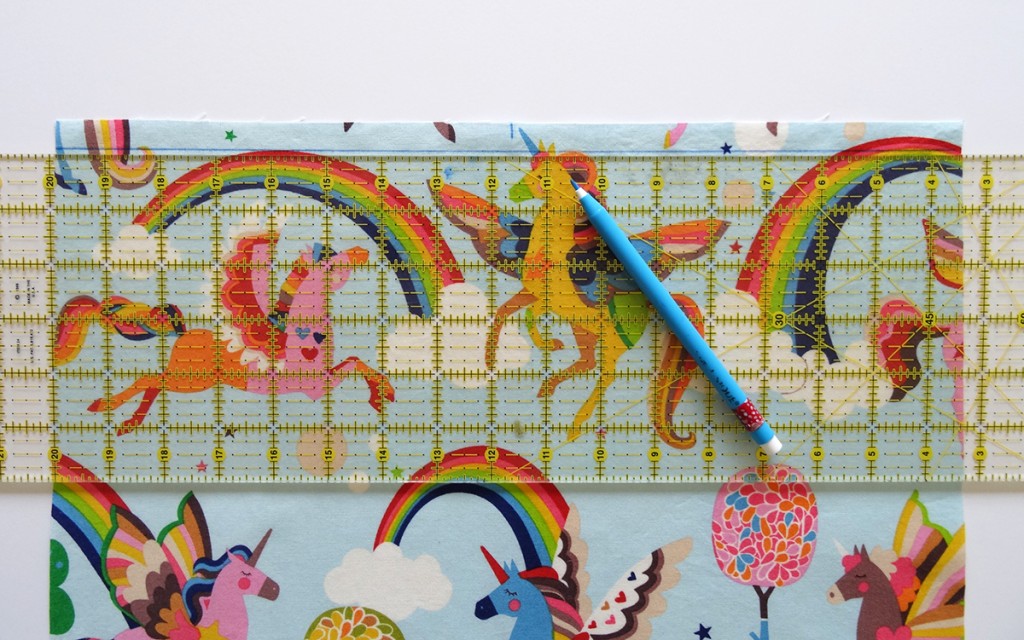
- Layer skirt front and back matching raw edges and one-way up fabric. fold panels in half, matching the raw edges. You will have 4 layers on the top right and a fold at the top left.
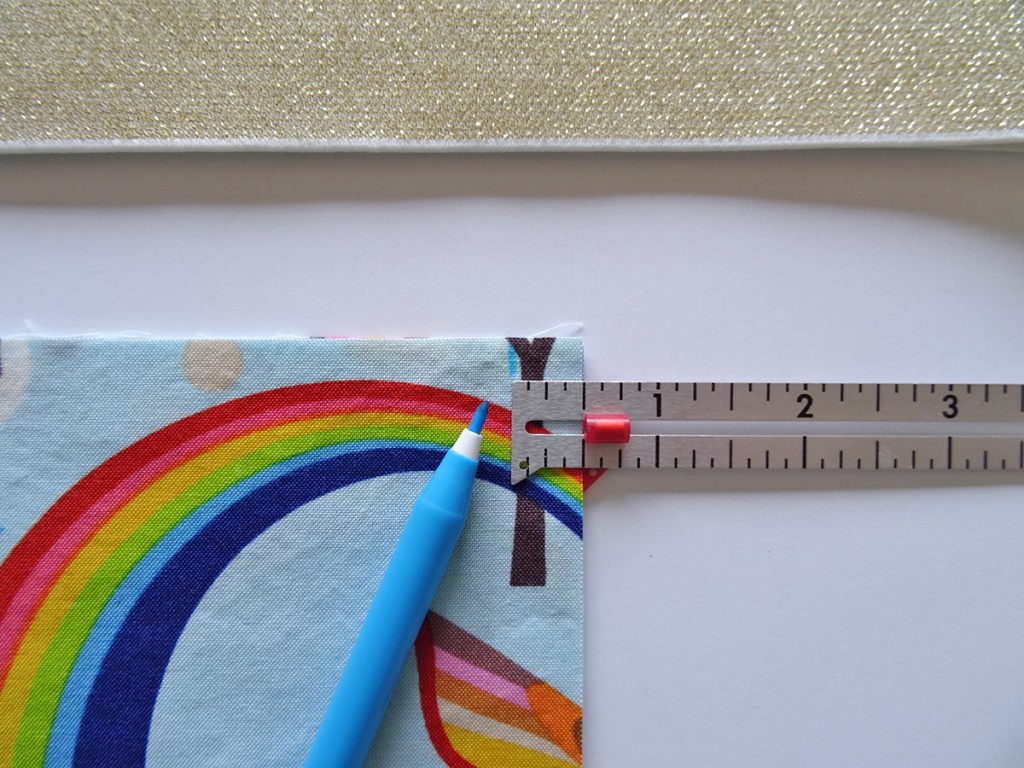
- Mark 1/2″ in from the top raw edge (not the fold!).
- Draw a straight line from the bottom edge of the skirt to the mark at the top raw edge of the skirt.
- Cut along the line.
Sew the Skirt:
NOTE: If you are using a woven fabric, finish all raw edges together using a serger, zigzag pinking shears.
Step 1: Mark the Skirt Front and Back
On the right side of the fabric, mark the center of each skirt panel and draw a line 1/2″ down from the top of both skirt front and back with a removable marker.
Step 2: Pin and Stitch the Side Seams
Place the skirt front and back right sides together, matching raw side edges. Pin and stitch with a 3/8″ seam allowance.
Step 3: Press the Seam
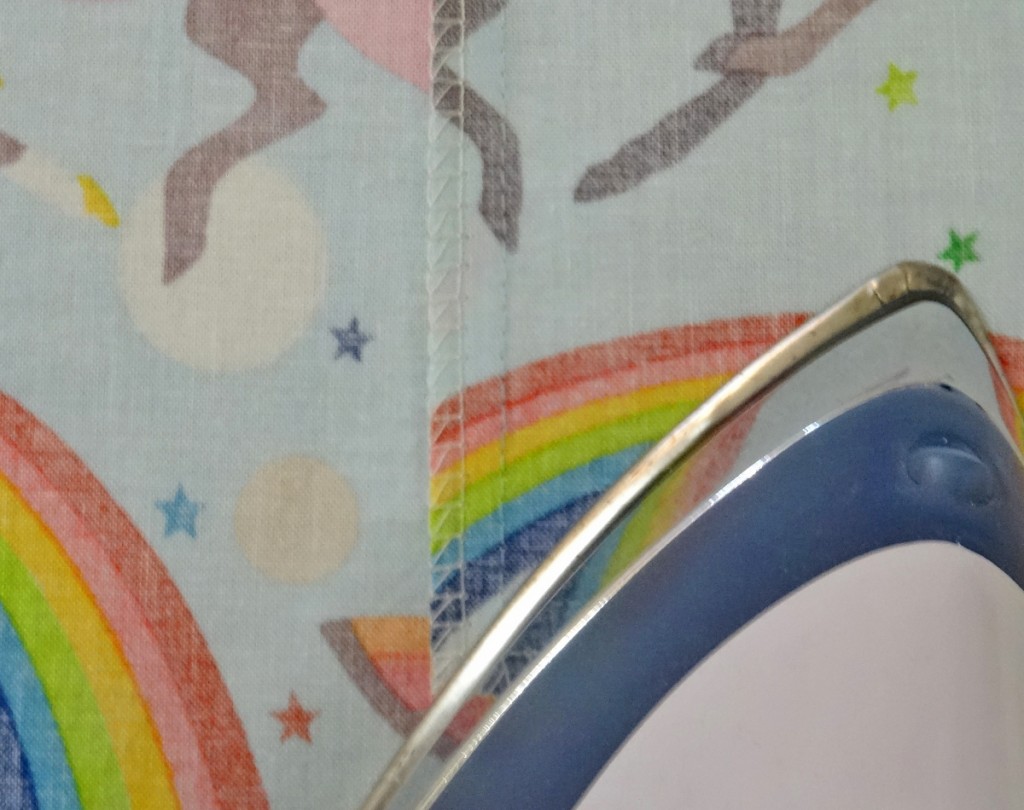
Press the side seams towards the back of the skirt.
Step 4: Prepare the hem (use either the knit or woven instructions)
Prepare a woven fabric: Fold the bottom skirt edge 1/2″ to the wrong side. Then 1″ again and press well.
Prepare a knit fabric: Fold and press 1″ once towards the wrong side (If you are using Stretchy Fusible Seam Tape, apply it before folding.)
Step 5: Pin and Stitch the Hem
Pin your hem on the right side of the fabric, matching side seams. Stitch close to the top edge of the hem fold with the right side of the fabric up on your machine. Note: Use a stretch stitch or a twin needle if you are hemming a knit skirt.
Step 6: Finish the Woven Fabric Edge
Woven fabric only: Finish the edges of the top of the skirt using pinking shears, a zig-zag stitch or a serger.
Step 7: Prepare the Elastic Waistband
Place the elastic right sides together, matching the unfinished ends. Stitch with 3/8″ seam. Press the seam allowance open. Stitch the seam allowance down in a box shape using matching thread.
Step 8: Mark the Waistband
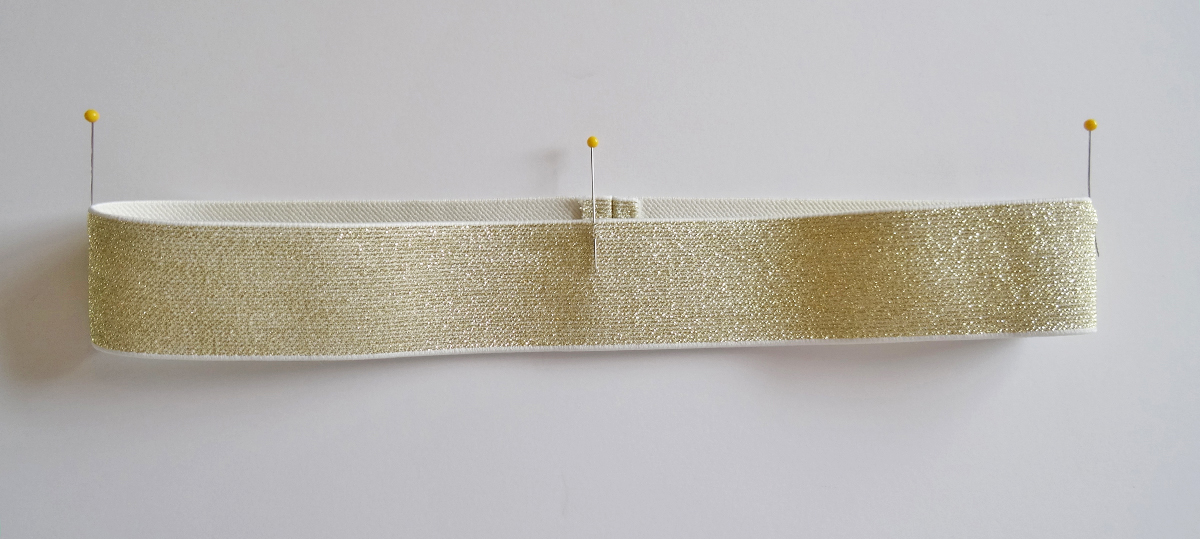
Mark the center front of the elastic by folding at the seam. Refold the matching center front and back to find and mark the side seams. Now the elastic is marked in quarters.
Step 9: Pin the Waistband
Line up the bottom wrong side of your elastic with the marked line on the top, right side of your skirt. Match and pin the elastic and skirt quarters with the elastic seam at the center-back of the skirt. Pin “sideways” all the way around, stretching the elastic to fit the fabric.
Step 10: Stitch the Waistband
Stitch the elastic to the skirt 1/4″ up from the bottom of the elastic with a zig-zag stitch in matching thread. Stretch the elastic to fit the skirt as you go.
Congratulations, you’ve made a Simple Springtime Skirt!
——————————–
Woven Fabric: Magic Rainbow Shine in Sky from Monkey’s Bizness by De Leon Design Group for Alexander Henry Fabrics from A Material Girl
Knit Fabric: Organic Blue Bows from Wonderland by Emily Isabella for Birch Fabrics from A Material Girl
Elastic: Dritz Metallic Waistband Elastic, Gold
Sewing Machine: Janome Skyline S9 (on loan from Janome Canada as part of their Artisan program)
by Sherri Sylvester | Apr 30, 2018
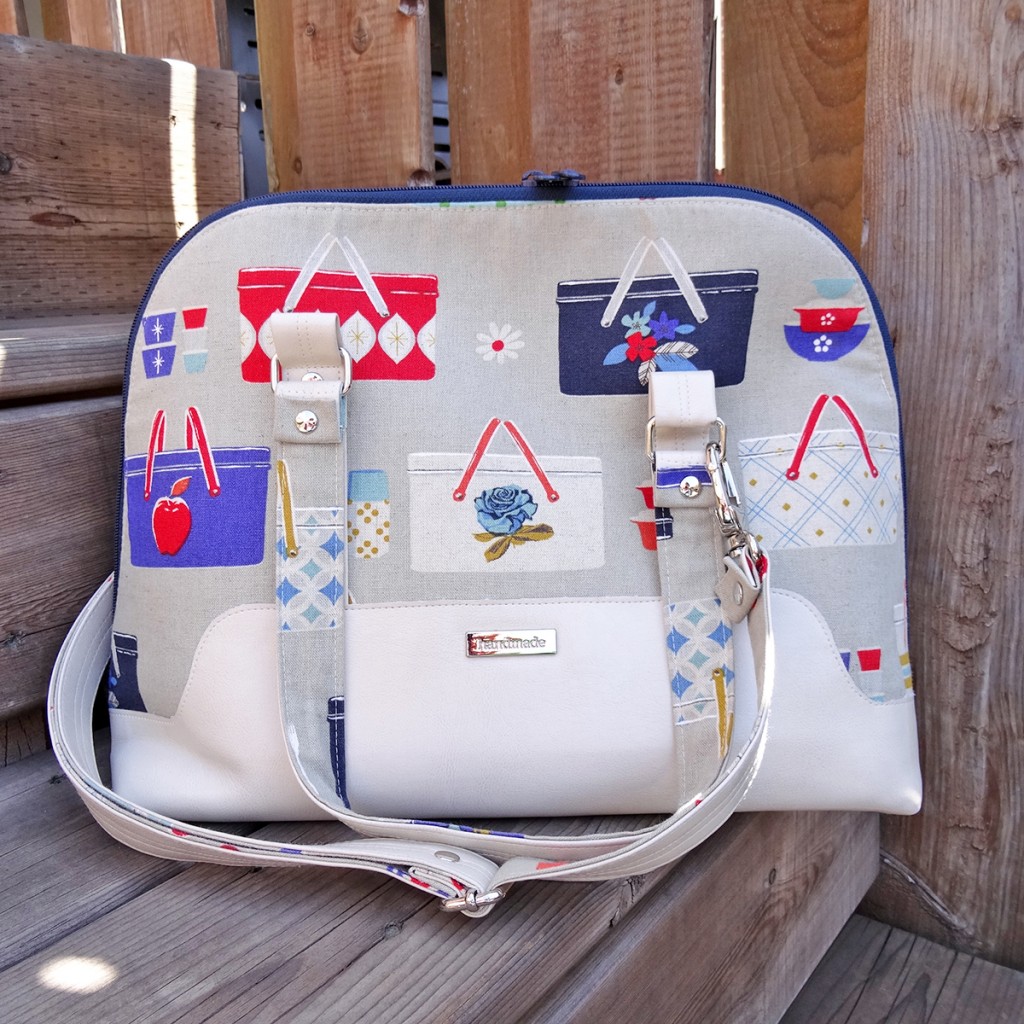
And what is that you ask? It’s another purse… (insert down-looking bright-cheeked emoji here, lol) Yup – of course, I needed another one after my long-wearing Chobe was finally looking a bit worse for wear.
Wanting, of course, to try something new I landed on the Boronia Bowler Bag pattern from Blue Calla. The shape was similar to many of the Coach and Kate Spade purses I’ve been seeing around, which was nice as I always aim to make things as professional as I can, so they don’t look handmade.
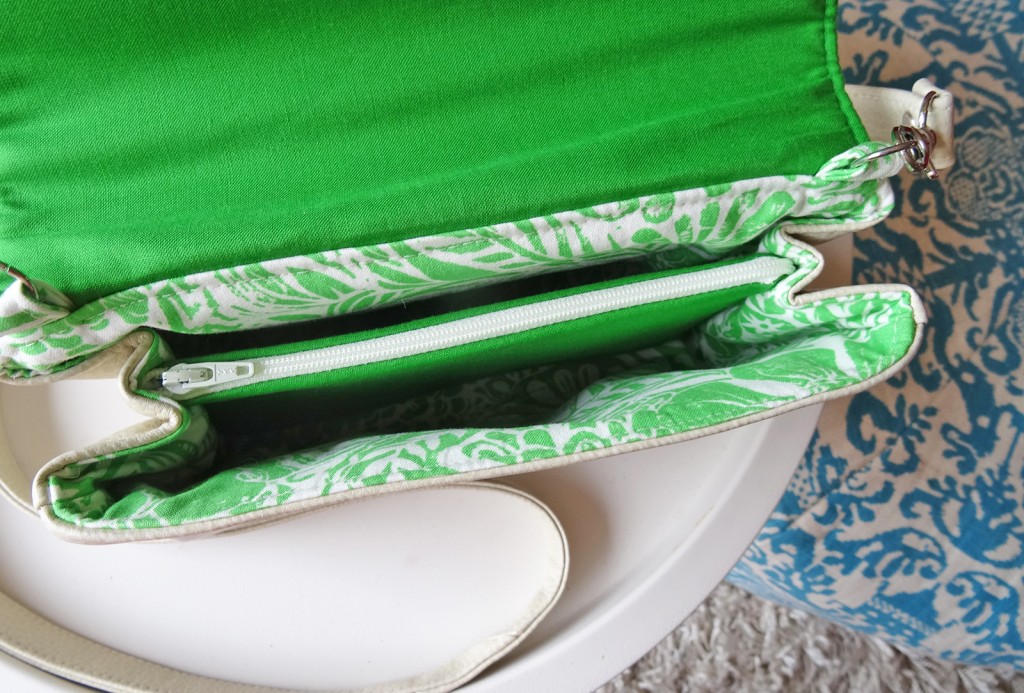
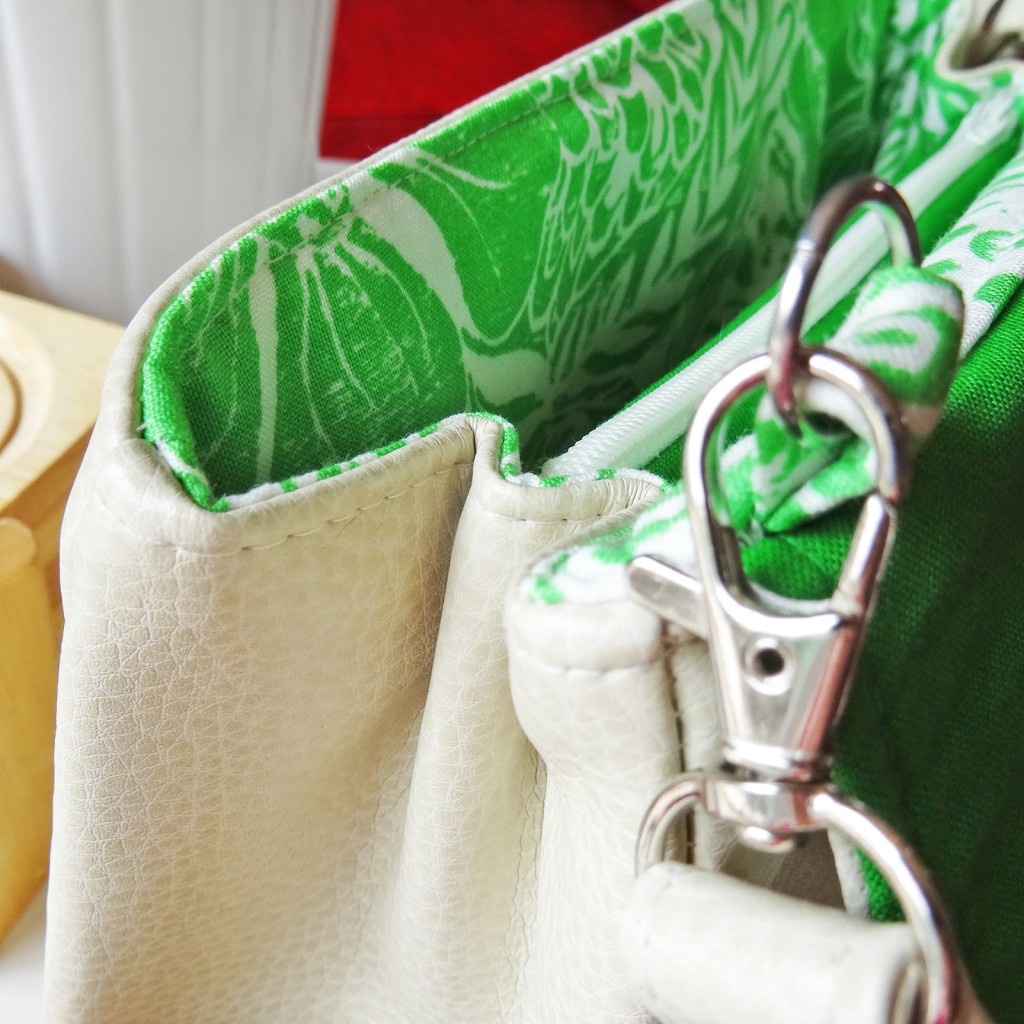
I took this bag to the Creativ Festival a few weeks ago and it was met with lots of interest. Everyone was especially impressed by the side gussets that hold all of your things in when the zippers are open. Very convenient! (You can see what I added to my fabric stash on Instagram.) I was able to visit the Janome booth and show them as well since I sewed the entire bag using my on-loan Skyline S9 machine.
Things I love:
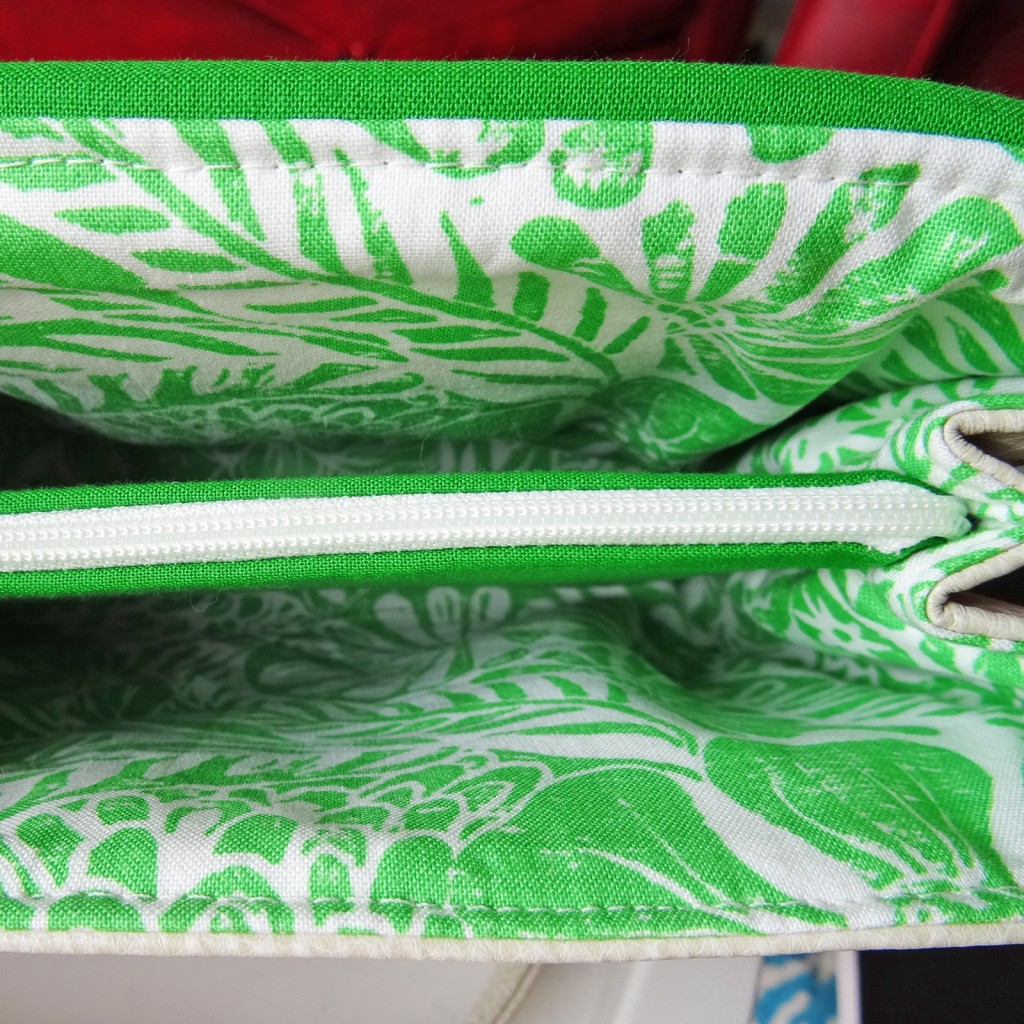
- The shape. The double zipper allows the bag to open up fully so you can actually find the things at the bottom of your purse.
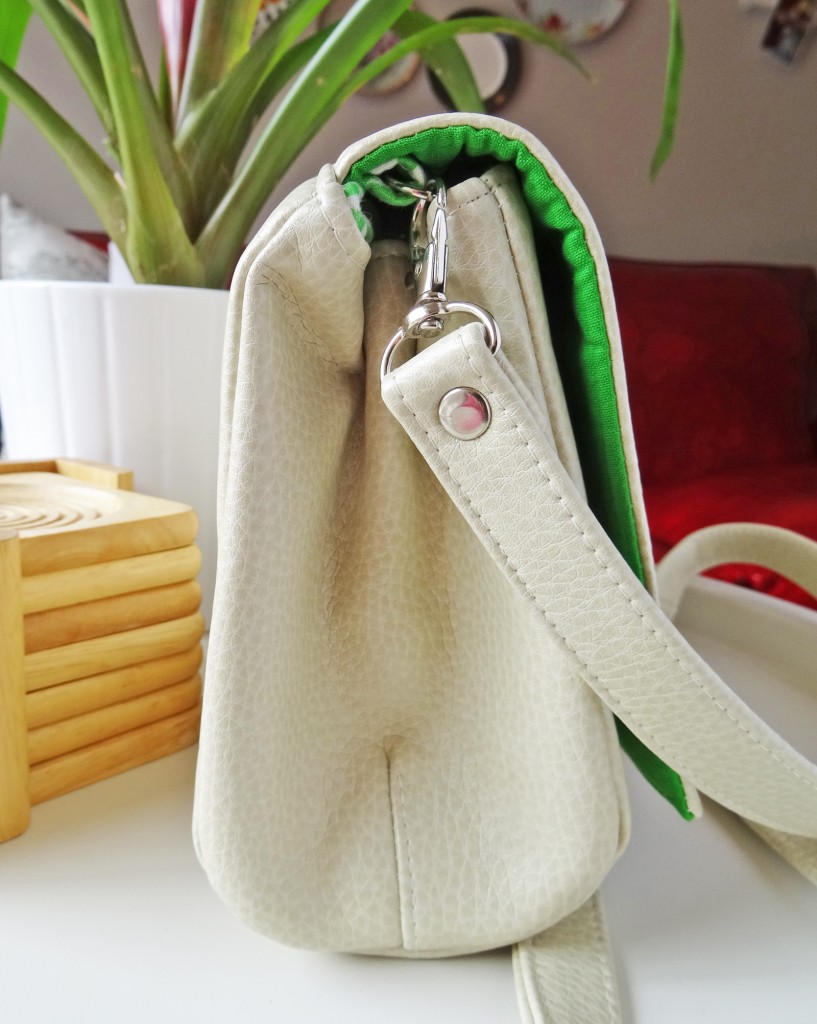
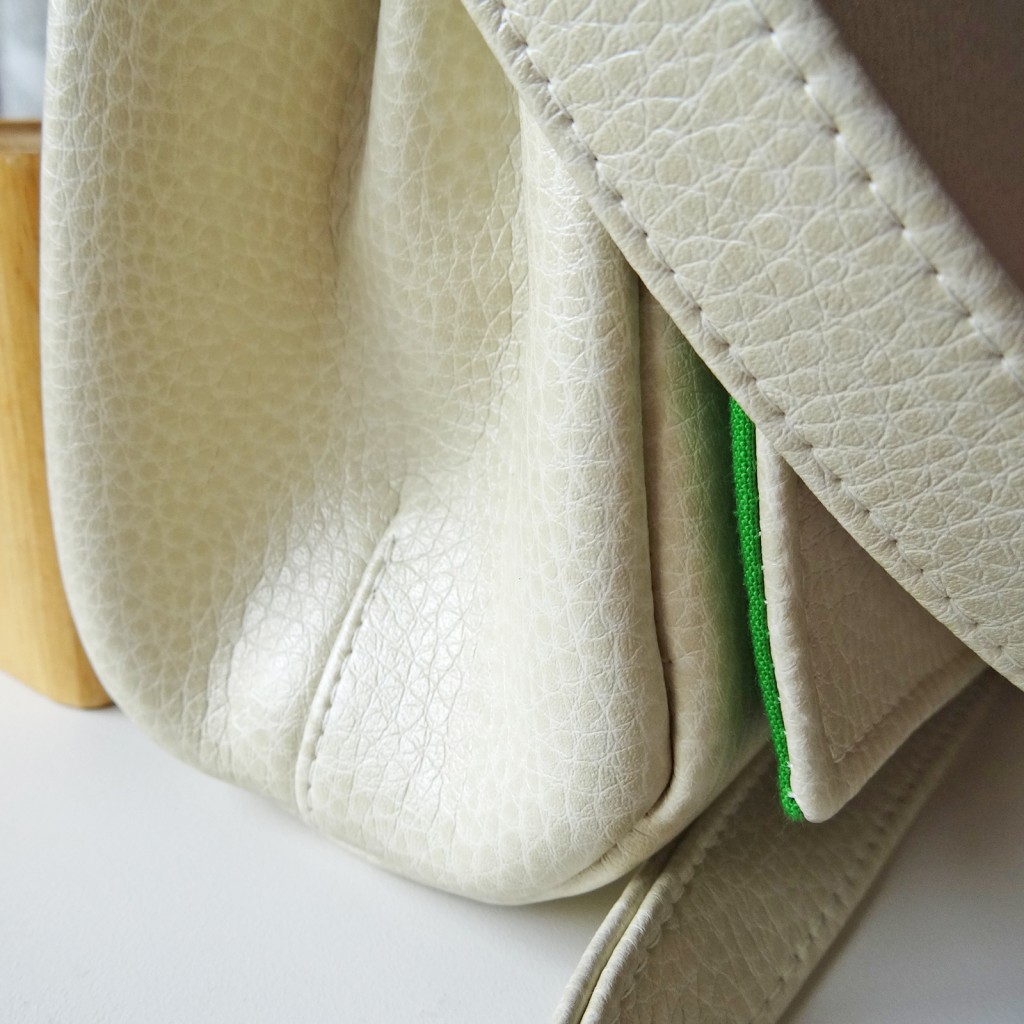
- The hardware. It’s so pretty! All of the hardware and the zipper were brought from Emmaline Bags. Online shipping is the best! I love the handmade tag and the purse feet make it all very professional.
- A simple sew. It was a fairly simple bag to make with a few things that took a little bit more time. It was not very fast – but making a good bag shouldn’t be. The construction was simple and easy to put together.
- Adding the selvage edge to the inside bottom of the purse – Have I mentioned that I love sewing?!
Things I changed:
- My sewing machine was needing a trip to the spa (read: a good cleaning!) so it was having trouble top-stitching consistently through many layers of vinyl for the handles. I added a fabric layer to the back – which looks super cool! And I also added fabric tabs on the ends of the handles to finish them. This made the handles thinner and so much easier to sew.
Things I’d change next time:
- In my opinion, the double straps should be at least 2, maybe 3 inches longer. I find they are very close to my armpit and am worried that heat mixed with sleeveless summer shirts will create trouble and a sweaty purse. They also barely fit over my winter jacket. I did make the removable crossbody length strap because I like the shoulder-free option and I use it that way the most.
- The bottom contrast piece does not have finished edges. I am finding the faux vinyl frays on the edges and it’s not wearing super well. I’d maybe use real leather or add a facing so the edges are finished.
Hope that helps if you’re thinking about making this bag. I really, really love mine and already have a fun Artisan project with
Janome Canada planned for later this year with it. ‘Cuz, of course, I need another one!
Have you made a purse or bag? Which pattern should I try next?!
Outer Fabric: Cotton and Steel Canvas Picnic Baskets from (now closed) Fabric Spot
Vegan Leather (read – vinyl): from my local big box fabric store
by Sherri Sylvester | Apr 13, 2018
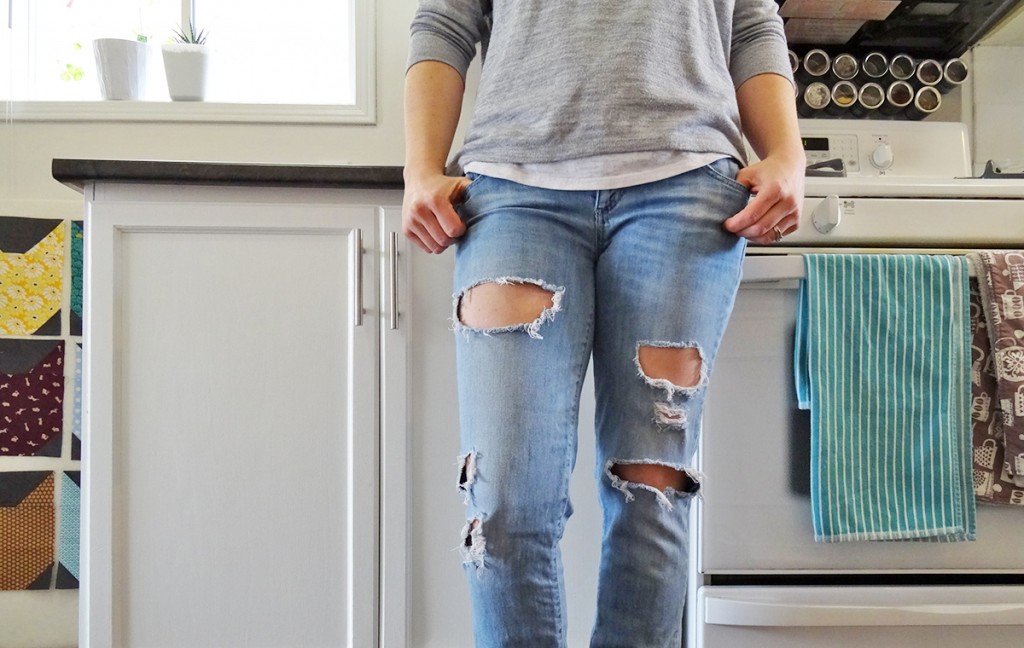
Last September I thought I’d up my jeans game. I have a pair that was getting very ripped and torn. Though I love this style, I don’t love that my pasty-white (and honestly, under-moisturized, #sorrynotsorrry) skin shows through so much.
Move forward about seven months (eep!) and I finally got back around to the project this week. Thankfully it is also very slowly becoming spring here in Toronto, and wearing these pants is becoming more viable by the day due to the climb in temperature!
This post is sponsored by Janome Canada.
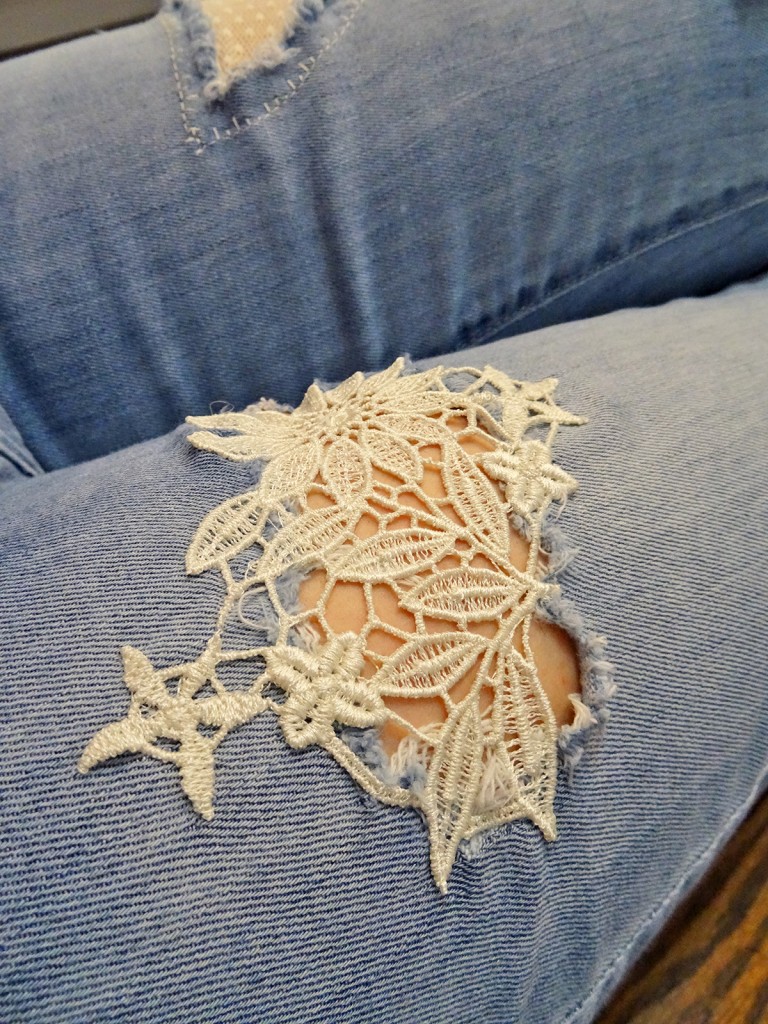
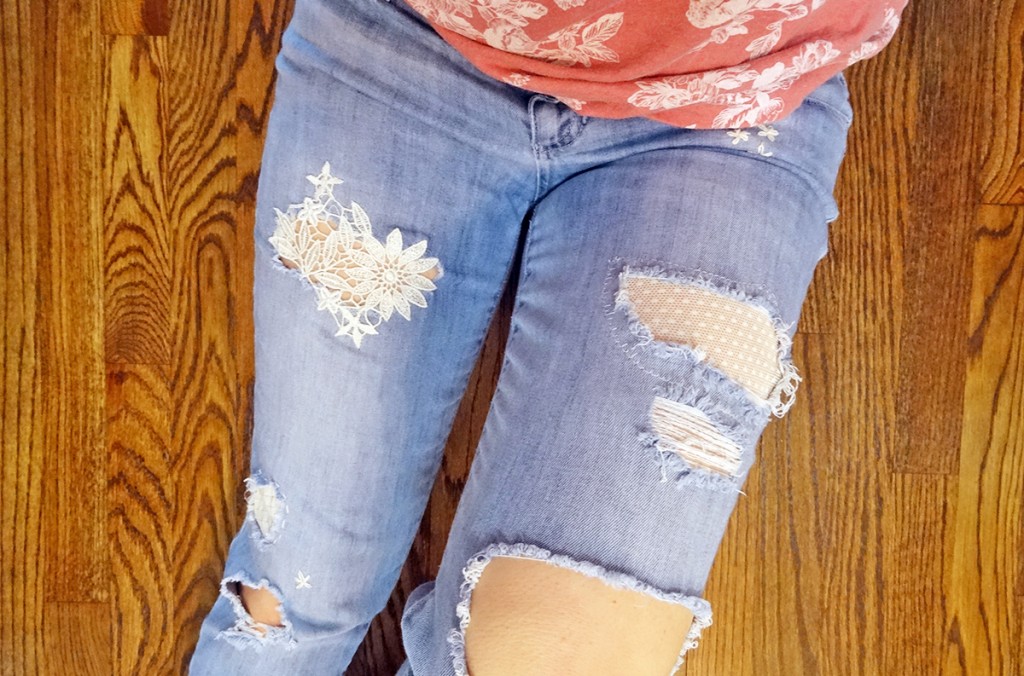
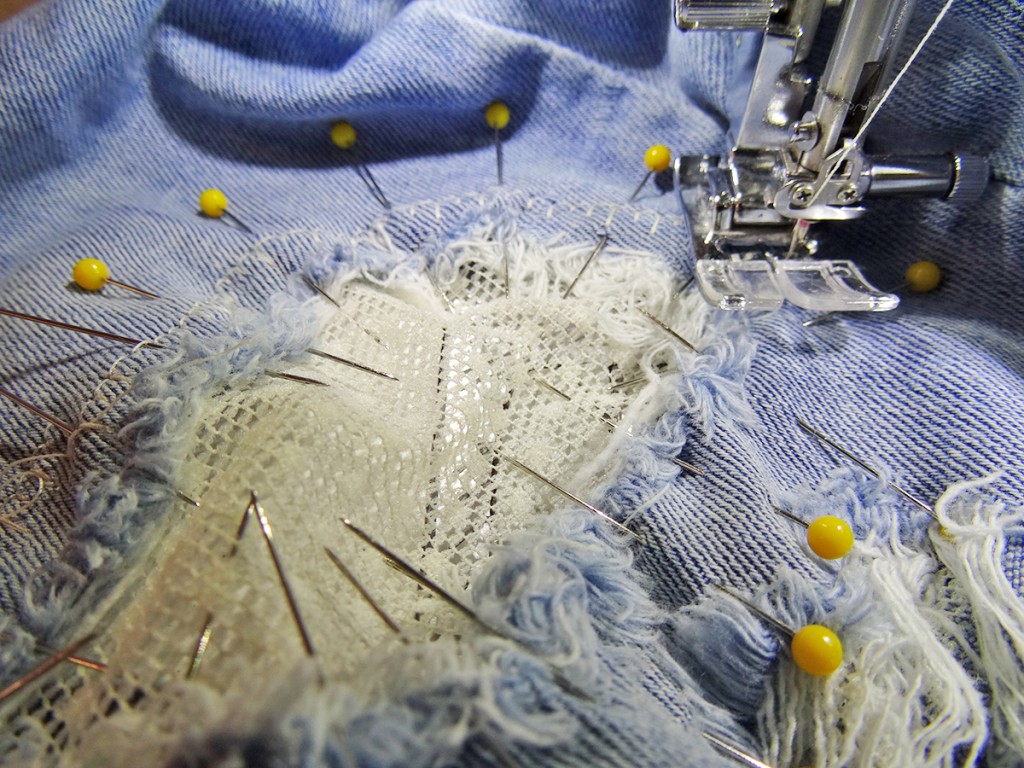
I recently discovered a thing called water-soluble stabilizer, and since Janome Canada was nice enough to loan me a Skyline S9 with embroidery capabilities (part of their Artisan program, in fall of 2016) I was in a position to use it to produce fun embroidered lace. Perfect to cover up, but not cover up, that skin!
It has become trendy – and I think, necessary – to mend and re-use clothing more often than purchasing new, and this is a great way to do it. I wrote about using visible mending to spruce up my favorite jeans a few years ago. And I’ve been trying to be more careful with my garment projects, so I produce things I’ll actually wear – in fabrics that will last over time.
How to Visibly Mend and Embellish your Ripped Jeans
My main focus here was to use the fun water-soluble stabilizer and a Janome Skyline S9 embroidery machine to show you what it can do. (#spoileralert) It can do a lot!
Hold on… if you don’t have an embroidery machine… you can still fix up your jeans! I’ve also added fabric, lace and hand embroidery to embellish the jeans even more… You can also reference my quick how-to jeans visible mending overview for more ideas.
How to make Embroidered Lace in 6 Steps:
Step 1: Press your Pants!
Press the area on your jeans that you’d like to fill to flatten any stray threads. Use a ruler and measure the general size of the hole. This is the size your embroidery needs to be. (TIP: Try the jeans on if they are stretchy, to ensure you have the hole the correct size.)
Step 2: Choose your Embroidery Design
My final design was part of a much larger file that came with the Janome Skyline S9. You will need a “Water Soluble Lace” specific file or the threads will not hold together when you remove the stabilizer.
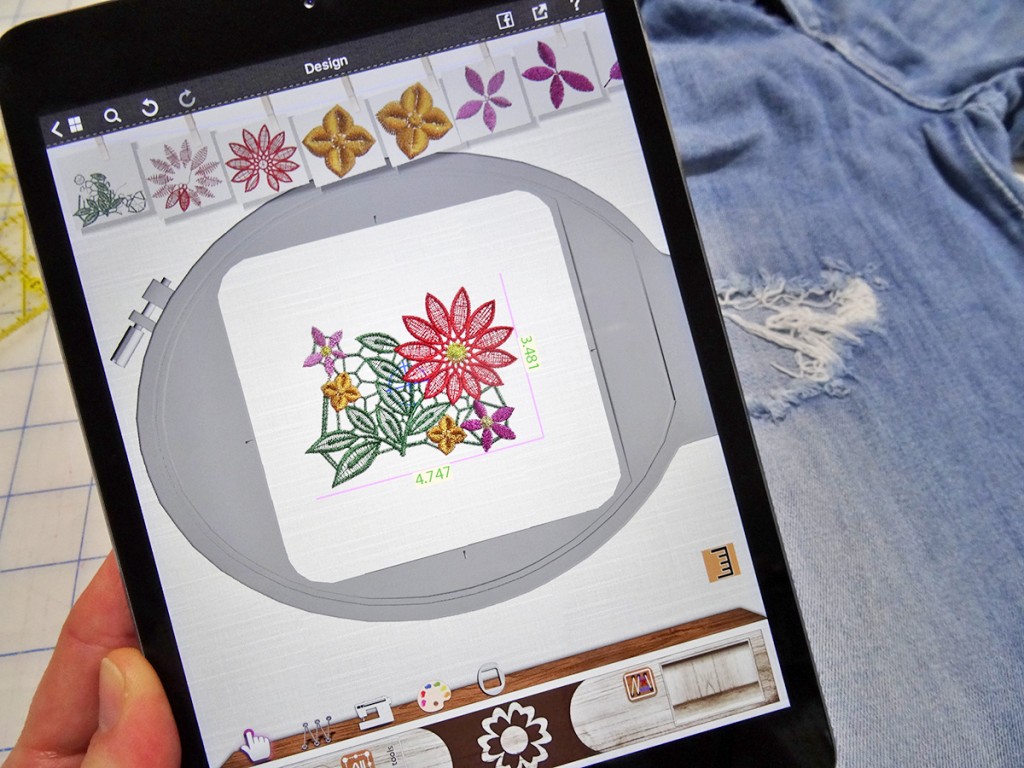
I used Janome’s AcuDesign app to edit the file and make it a bit smaller. It was so easy to edit it! Though it did take a while to delete all the unnecessary points.
Geeky aside: I sent the file back to the Skyline S9 over the my WIFI connection. So easy! And it makes my techie brain happy.
Step 3: Prep your Stabilizer
My Solvy stabilizer said to press a few sheets together between a press cloth to make a thick enough stabilizer. Follow your water soluble stabilizer manufacturer’s directions. Make the piece large enough to fit in your machine’s embroidery hoop!
Step 4: Choose your Thread
I chose to make this entire embroidery file in cream coloured thread. Make up a bobbin and thread your machine.
TIP: The bobbin and thread should be the same colour, since the back may show on the final lace!
Step 5: Embroider
I positioned my file using the uber-easy and accurate AcuSetter app on my loaned iPad mini. It is free and makes it so simple to put your embroidery where you want it. (More on how to use the AcuSetter app here.) In this case, I moved the design to the side so I could embroider a few more things in the valuable left-over space.
Start the machine and embroider your lace.
Step 6: Wash out the Stabilizer
Wash the stabilizer out of your lace with some warm water and lay it flat to dry. You can see a video of me removing the stabilizer on Instagram.
As a side note, more playing around with the water-soluble stabilizer led me to make these butterflies for my littles. The embroidery file is included with the Skyline S9 – and the girls love them.
How to Embellish Your Jeans in 4 Steps:
Step 1: Gather your supplies
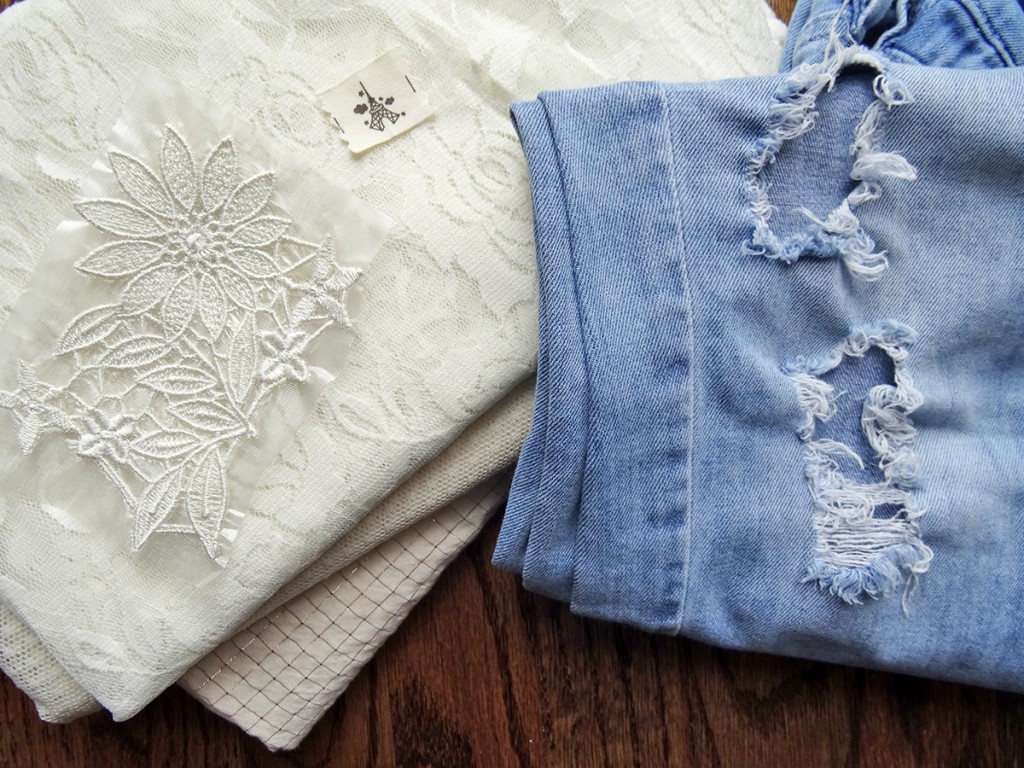
Gather your supplies. I wanted these jeans to have a neutral colour scheme – so I selected lots of cream from my stash. You could use coloured fabric of course, including all of your favorite hoarded scraps.
- ripped jeans
- embroidered lace
- pretty fabric scraps (prewashed/preshrunk)
- hand-sewing needle and thread
- sewing machine and your usual sewing supplies
Step 2: Put your jeans on!
If your jeans are stretchy, you will need to pin the fabric on while the jeans are stretched and on your body. That way they’ll fit when you are finished. #nobrainer
Step 3: Pin on the Fabric and Embroidery
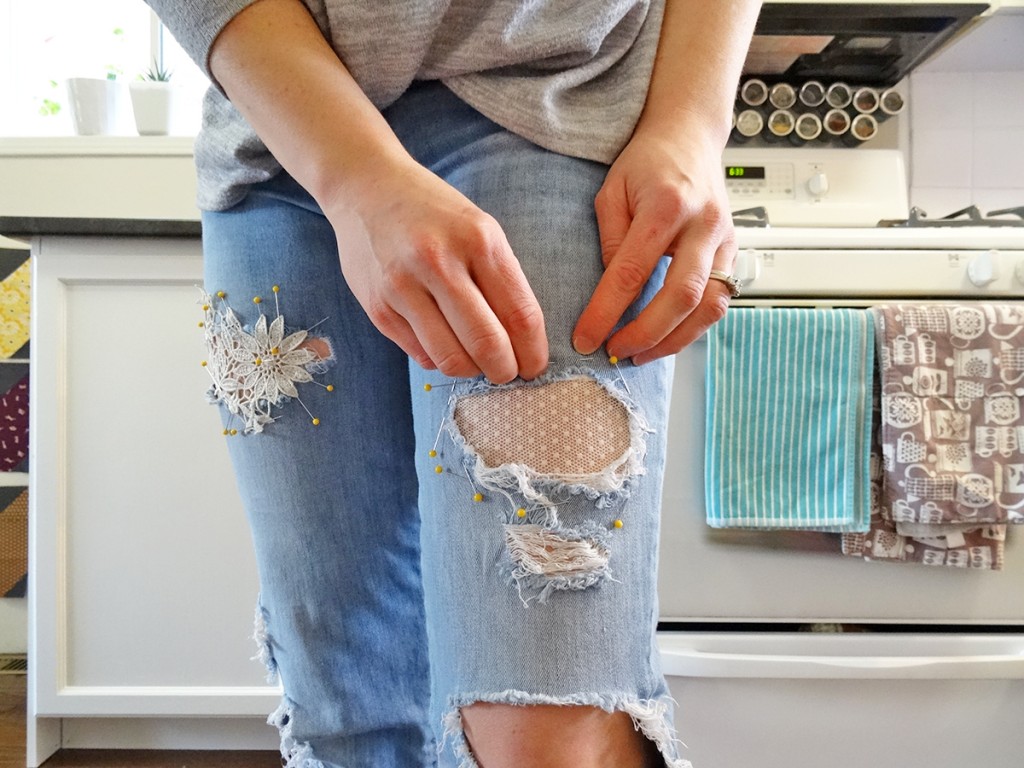
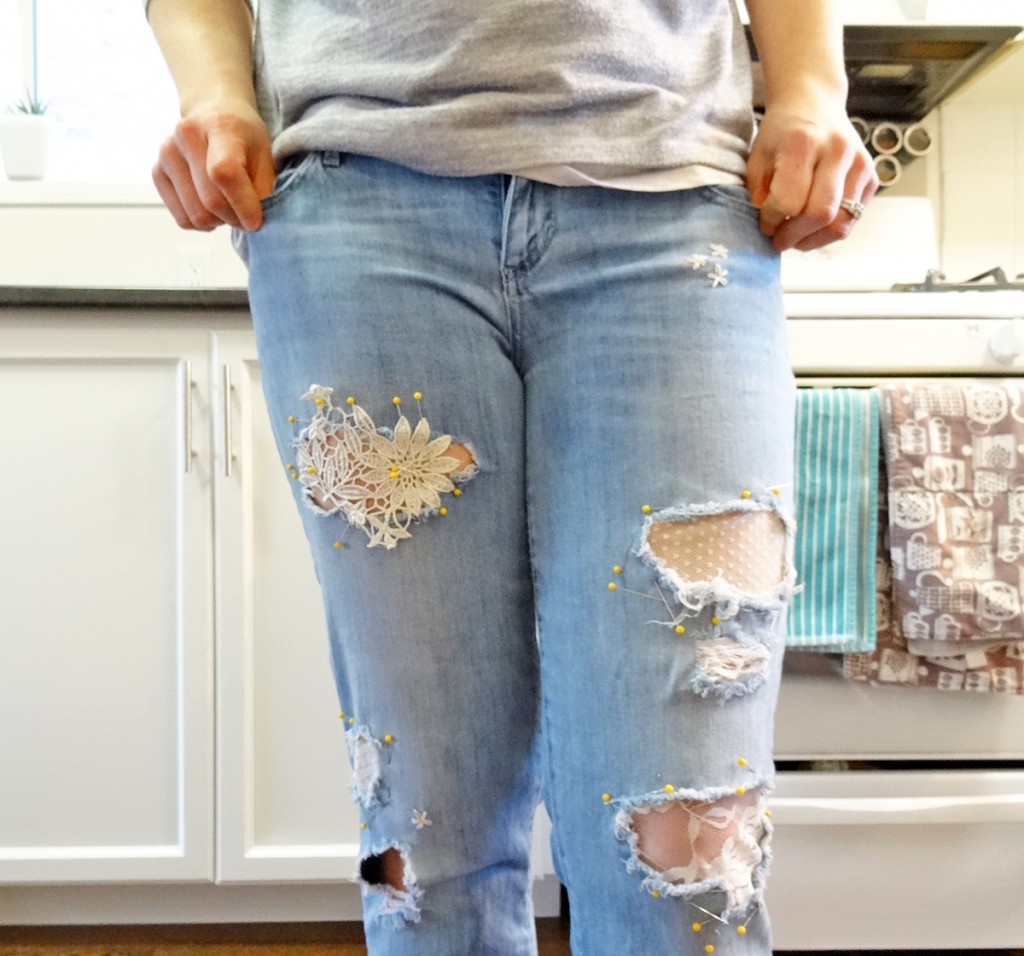
With your jeans ON, pin the embroidered lace over and/or under the appropriate rip(s).
Measure, cut and pin additional pieces of fabric that fit over the other ripped portions of your jeans. Place them under the holes, flatten them out and pin them on carefully – watch out for your skin! (P.S. If this seems like a terrible idea, ie: OUCH!, pin the fabric on flat, then try the jeans on to make sure they still fit.)
TIP: If you are using a woven fabric, it is a good idea to take a second to zig-zag, overlock or use pinking shears on the edges so they will not fray. I finished these edges using the Overedge foot M and an overcasting stitch on the Skyline S9.
Step 4: Stitch on the Embellishments
Hand-stitching: Chose a thread that matches or contrasts your jeans and stitch away – with the jeans off! You can use a thicker thread or even embroidery floss. Be creative! I chose to secure the embroidered with invisible thread to make sure the stitches couldn’t be seen.
Machine Stitching: I removed the extension table and inserted my pant leg onto the free arm. Then I chose a decorative stitch (Quilt Stitch #11) and moved the pants around to stitch it. The ruler stitch is a fun nod to sewing! You could do many stitches across the entire patch and back again. Or just use a matching thread and straight stitch.
Hand Embroidery:
Use embroidery floss to cover stains or small rips. I decided a nice set of daisies was a great embellishment to cover a small paint stain on these jeans.
I hope you love the result as much as I do! It’s fun to wear something unique that you love and put time into.
by Sherri Sylvester | Mar 29, 2018
Growing up, my family did a lot of tent camping. Every year we’d drive to our favorite spot for a week or two. As I got older we would book the same park and the exact same campsite. So many amazing memories were built during those summer trips!
Kelly Panacci (a lovely Canadian fabric designer!) designed a Road Trip fabric for Riley Blake Designs last year, and she graciously offered to send me some fat quarters. I couldn’t resist the vintage trailers and camping theme – so I chose a few I knew would match my parents’ home and remind us all of our camping trips. They received the quilt just this past Christmas.
Now that it has been a year, Kelly released a super-cute new line called Panda Love – in stores now – and she’s having a giveaway! We thought this would be the perfect time to show you something with her old line and introduce a new one. If you want to win some fabric (who doesn’t?!) – be sure to head over to Kelly’s brand new shop website. Read her blog for a mini-tour and GIVEAWAY happening March 30, 2018!
Quilt photos are fun and I happened to get some lovely winter photos of this one the day after a gorgeous snowstorm. The opposite of a summer camping trip – but the contrast is so pretty!
This quilt was going to be a copy of this Giant Vintage Star quilt. But it wanted to be it’s own thing, so I made a light/dark contrast HST quilt because making something twice isn’t as much fun! Most of the fabric is Kelly’s Road Trip line, and I added some solids to set it all off.
I quilted it myself with simple straight lines in a diamond pattern and machine bound it as usual using a sage green sheet as the backing. Nothing fancy – but it is finished and usable, which counts in my books!
See you here again soon. I’m madly sewing Easter dresses, nursing a broken baby toe (on my sewing foot, eep!) and preparing for company tomorrow, so I’d better go. Don’t forget to support our amazing Canadian talent – visit Kelly Panacci to win some Panda Love!
My helpful quilt holder and I!
by Sherri Sylvester | Feb 28, 2018
You know when you want to start doing something – ie: sewing your own purses… but you are concerned that you will love it too much, and then it will become an obsession?
And you won’t be able to stop… and then you will need all the patterns. And all the materials. And then your stash (which is already significant) will grow and grow… and take over your whole house?
That’s me… and I want to make all the bags! And, oh wait… sewing has already taken over the house anyhow…
I started sewing bags when I created the Forest Glen Satchel – my first “real” pattern. I made a Chobe (from Elle Puls) in 2016 and created the first purse of my dreams – perfectly slouchy with lots of room.
Fast forward a year and Swoon patterns kept coming up in my Instagram feed. I needed to make another bag! How could I justify buying another pattern when my Chobe was still going strong? How about for a gift?! Surely my mom could use a new cross body bag? So the justification (and new obsession) continues! (*lol, I think?!*)
All that aside, I do love making bags and have quite a few more that I have to photograph to show you. The process ticks all the boxes in my goal to sew as neatly and professionally as possible. I think my girls will be needing new purses soon so I can justify a few more?! (Their Sweet Talk Phone Bags are still great, but I should have used a bit of Scotch Guard on them – kids are hard on their purses!)
Find the Glenda Convertible Clutch Pattern review below…
Glenda Convertible Clutch Review
Things I Liked
- This bag is so cute! It has a timeless design and you can’t go wrong with that.
- I learned a lot of fun tricks in the instructions.
- It has great structure – this is probably helped by my using vegan leather for the exterior.
- I was super impressed that the Skyline S7 I had on loan sewed through all of the vinyl layers without any issue.
- It was fun to add a tiny piece of sewing fabric as the interior pocket lining – yay for moms that sew!
Things I Didn’t Like
- Honestly, nothing! The instructions were great and it turned out well.
Things I Changed
- I wanted a smaller bag – it’s actually quite long, despite how it looks in the pattern photos – so I removed 2″ from the width. Instead of 11″ wide, mine is 9″ wide.
- I also lengthened the strap to 50″ for a cross-body length.
Things for Next Time
- I think I would keep the smaller width next time as well. The wide width looks nice for a clutch, but seems very wide to use as a purse with a strap. (Plus, my pattern pieces are already taped in place at the new size!)