by Sherri Sylvester | Oct 16, 2013

Can I say I am soooo excited to have been asked to be on Abby’s pattern tour. I have been reading Sew Much Ado for at least 3 years now and love what she does. I’m sure you’ve seen her super-cute Mommy and Mia apron pattern (my version here), the Ruby Lou doll, and my all-time favorite diaper bag! But… today I get to talk about her great new pattern for girls. (And according to Max California – maybe boys?!)
The Skipper Top is a dolman sleeve pattern for girls sized for 6 months to 10 years. I’ve raved about dolman sleeve tops before, they go together super-fast because you do not need to set in a sleeve. Abby’s pattern does not disappoint in the style factor either. There are different sleeve hems, hem, neckline and pocket options – so you can make it over and over and never have the same result. As always, Abby’s photos and directions are super informative and easy to follow (geared for beginners). I like that she includes the finished measurements of each size – so you can gauge the ease and sizing better.
I also love that Abby has made this as a pdf pattern. Even though taping pages together takes a bit more time, I tend to sew as inspiration hits and I don’t like to have to wait for shipping! I also like the fact that I can print it out each time I need a new size, easy peasy! Speaking of sizing – this pattern is great. I did check out my kids’ measurement chart before I started, but it worked out that they both needed their ready-to-wear size Skipper Top. The length is great too – it’s on the long side – which I especially like the look of with the waistband and leggings.
As far as fabric, I decided to try and use up some of my stash – since I’ve now maxed out my new bookshelf space! I have mostly plain coloured knits and some stashed Heaven and Helsinki in different prints and colours. Since my youngest will still wear anything I figured this was a good time to cut up the adorable cat knit shirt that doesn’t fit her anymore. (no more toddler shirts, tears…) Since the solid pink was the only knit I had that matched, that was what we went with. My oldest has always been more selective (*cough* loudly opinionated *cough*) and so I let her have a go at choosing her own fabric. And that is how I gained two more pink shirts to add to the stacks around here!
I did manage (as usual, I know…!) to alter a few things on Abby’s amazing pattern. I thought it would be nice, needed to was obligated to add a skirt to my oldest’s shirt – because she would not wear it at all if I didn’t. Thankfully the forced creativeness turned into something I am really happy with. I added a gathered length of knit (double the width of my daughter’s waist measurement) when I stitched on the bottom waist band. Then I turned up the waistband toward the bodice (seam allowances pressed toward the skirt) and stitched it along the sides to hold it in place. For my youngest I added a bit more fullness to the shirt front with some gathers along the shoulder seam. Since she’s still got some toddler-chubs (love them!) fitted shirts don’t always look the best. I’ll be posting a tutorial on that tomorrow.
Enough about me! You are here to check out Abby’s pattern and I am here to tell you I love it! I have already seen what the first four stops on the tour have done (list below), and you can check out today’s other stop on the tour at Mad Mim. I have to say I am especially loving the shoulder patches on the Max California version! I may just have to spend about an hour (yup, it’s that quick to sew!) making one like it for my youngest. And I saw a great dolman sleeve sweater on my sister-in-law this past weekend that I’ve got to try… maybe for KCW next week?
I have to say, the only thing I am disappointed with on my shirts is that I wasn’t able to use quilting cotton for the pockets. When I first saw Abby’s women’s dolman sleeve top (The Seafarer) and now the Skipper Top – I thought that the quilting cotton allowed for a great use of different prints and patterns. Unfortunately because I matched the pocket to the shirt bands I needed to use a knit. Tip if you’re doing that – use medium interfacing on the pocket piece, it helps everything not to wiggle too much while you are sewing, and the top of the heart pocket might be a bit floppy without it as well.
Make sure (while you get distracted checking out the other Skipper Tops on the tour) that you eventually get back to Sew Much Ado to buy the pattern – you can get the Skipper Top here! I felt super professional when I stitched the (optional) 1/4″ clear elastic into the shoulder seams of these shirts – you can too!
Disclosure: I received this pattern free as part of The Skipper Top Pattern Tour. As usual, all opinions are my own.
by Sherri Sylvester | Aug 27, 2013
I made up a quick sunglasses case for myself at the end of July, and thought I would post it here as a tutorial. Turns out, the more I thought about posting it the more I thought that there must be a better way than the flat, very soft case that I made in about 15 minutes. It had no shape and no intrigue, and worst of all I don’t think it would do a spectacular job of taking good care of my sunglasses either! Since I’m super good at procrastinating (and really busy with the kids this summer) I gathered up all of the sunglasses cases that I could find and lined them up on my cutting table Sunday night. Too late into the night to mention, I came up with the Sunny Glasses Case! It is really simple to make, mostly because I’ve done all of the trial and error through 6 or 7 versions so you don’t have to!
Come #alongforthreadride! Follow Thread Riding Hood on social media for sneak peeks, tips and process photos. Hope to see you there!
Once you’ve finished one, you can likely make another in about 1/2 hour or less. Which makes it a super quick gift, and it can be made for almost anyone. Men, Women and children of all ages would enjoy a safe place to stash their sunglasses. Bonus, it doesn’t look like it only took half an hour to make (woot!) and – added bonus – you can use up some of your large scraps to make it! And, just in case you think I’m crazy posting a sunglasses case tutorial when Fall is approaching my part of the world, I do wear my sunglasses a lot in the winter. And these would make great stocking stuffers if you are inclined to start gifts now! As I was making these I came up with 4 useful options for making the case. Option 1 makes for a regular case with Velcro closure. Option 2 has a button & elastic closure and a swivel clip, this is so my oldest can attach it to her school backpack and (hopefully) keep her sunglasses unscratched and un-lost! Option 3 is mine, I added a magnetic closure to the flap. Option 4 is for my husband, who wanted it to be able to attach to his car’s visor. * Update: Don’t feel like sewing a Sunny Glasses Case yourself? Buy one from a licensed seller! Check out the sellers list. Are you a shop owner? You can buy a Sunny Glasses Case seller’s license as an instant download. *
This tutorial covers all 4 ways of creating the Sunny Glasses Case. Follow the main instructions for Option 1. The other options use the same directions with additional steps. These are listed below the directions for Option 1. You will need:
- 11″wide by 10″h scrap of your main outer fabric and lining fabric
- 10″x10″ scrap of fusible fleece
- 5″x9″ plastic canvas (I used size 7 mesh)
- The pattern pieces – Click on this link to download the printable pdf: Sunny Glasses Case pattern pieces
- Other Helpful Things: School Glue Stick, Point Turning Tool or Chopstick, Water Soluble (or other) fabric marker, Pins
- Option 1 & 4 Only – 5″ loop Velcro and 2.5″ hook Velcro
- Option 2 Only – Button Closure + Swivel Clip: Button, Hair Elastic or 4″ piece of Round Elastic, Swivel Clip with 1″ D-ring, Fabric for strap: 5″x4″
- Option 3 Only – Magnetic Closure: 1 Magnetic Snap
- Option 4 Only – Car Visor: 1 piece of 1″ wide elastic, 9″ long
Materials for Option 1
Before you begin:
- Print out all 3 pages of the pattern piece pdf on letter size (8.5″ x 11″) or A4 paper. Important: Do not select “fit to page” when printing, make sure you print at the original size. Once you have printed the pages, measure the 1″ test square on page 1 to ensure the pattern is the correct size.
- Cut Outer and Lining, Fusible Fleece and Plastic Canvas as per the pattern pieces. Make sure to line the pattern pieces up on the fold where necessary. I found the easiest way to cut the plastic canvas was to precut my pattern piece, trace the edges with a permanent marker onto the canvas, and then cut it out.
- If you want to piece your fabric together (I have added a small contrast piece on the closure edge of the flap), do this first and then cut your outer fabric. Topstitch after fusing your fleece for a “quilted” look.
- Mark the “Velcro” and “Flap” marks (as indicated) onto the right side of the Outer fabric with a water soluble fabric marker. Be sure to mark the “Flap” marking on each edge of the Outer fabric.
Cut Materials for Option 1
Option 1 – Velcro Closure:
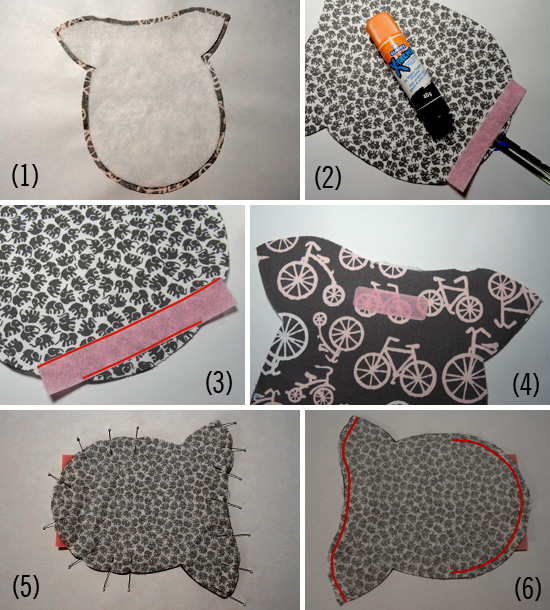
(1) Iron Fusible Fleece (centred) on the wrong side of your outer fabric. (2) Use your glue stick to glue the loop side of your Velcro to the rounded edge of the lining. Centre it 1/4″ above the bottom of the curve. (3) Stitch along both long edges of your Velcro, you do not need to stitch the short sides. (4) Round the corners of the hook side of your Velcro. Use your glue stick to centre it on the “Velcro” mark on your outer fabric. Stitch all 4 sides neatly. (5) Place your Outer and Lining fabrics right sides together. Pin around the curve between the “Flap” marks and the straightest edge (see photo). (6) With the fleece side up, use the edge of your fused fleece as a stitching guide. Do not stitch ON the fleece, stitch BESIDE it. Stitch the straightest edge from point to point. Stitch around the curve, begin at one “Flap” mark and end at the other. (7) Trim the excess Velcro & clip the curve where the Velcro is – you do not need to clip the entire curve. (8) Clip your seam allowance at both “Flap” markings. Clip up to but NOT through the seam threads. (9) Turn everything right side out through the openings. (10) Pin the straightest edge and top-stitch approximately 1/8″ away from the edge. (11) Pin the large curve between the “Flap” marks. Do not stitch – we will do this later. (12) Make sure the un-sewn seam allowances are lying flat on the outside (see photo). (13) Draw a line across the outer fabric between your “Flap” markings. Topstitch along the line. (14) Insert your plastic canvas between the lining and the fusible fleece. Centre it from side to side. It should be in approximately 1/4″ from each fusible fleece edge. Use two pins to secure the plastic canvas in place. (15) Almost done! With the outer right sides together, fold the bottom of the glasses case up. The point should meet up with the top of the “Flap” marking. Pin along the edge. (16) We are going to finish the case with a French Seam. Stitch a scant 1/4″ seam on both sides of the case along the raw edges. (17) Trim the seams you just finished to approximately 1/8″ on each side. Flip the bottom of the case right side out. (18) Finish the case by stitching around the edges with a generous 1/8″ seam. Start at the bottom on one side and end at the bottom on the other. Do not stitch across the bottom edge. Done! For Options 2,3 and 4, follow the Step numbers as outlined for each Option. Example: STEP (1). (2.1a)… means – follow STEP (1) above, then follow (2.1a) as outlined in the Option 2 instructions.
Option 2 – Button Closure + Swivel Clip:
My oldest picked the Monkey Bizness – Market Stall fabric used in her sunglasses case when I placed my latest Warp & Weft order. I love how it turned out, the print is just the right scale for this project! STEP 1. (2.1a) Make the strap. Iron your fabric in half lengthwise to make a 2″x5″ piece. Unfold and iron each edge into the centre, refold. Top-stitch each edge. (2.1b) Fold the strap around your D-ring. Stitch as close as you can to the ring – it might help to use a zipper foot. Set the strap & clip aside. STEP 5. (2.5a) Fold your elastic in half, centre it at the closure end of the case. Pin it between the outer and lining, 1/4″ in from the edge, with about 1/2″ of elastic (folded) on the “inside” of the case and the rest sticking out. (I have completed Step 6 in this photo) STEP 6, Note: Double-stitch over the elastic when you reach it. STEPS 8-14. (2.14a) Pin and Baste strap in place on outer fabric, centred as per the photo. Trim excess strap to match the seam allowance. STEPS 15-18. (2.18a) Place your glasses in the case and sew the button on where appropriate. Done!
Option 3 – Magnetic Closure:
STEP 1. (3.1a) Attach the bottom piece of your magnetic snap centred on the Velcro mark you made on the outer fabric. (3.1b) Attach the top of the snap to the lining 1″ away from the curved flap edge. Be sure to interface behind the lining snap. (I used a scrap of fusible fleece.) STEPS 5-6. STEPS 8-18. Done!
Option 4 – Car Visor:
STEPS 1-14. (4.14a) Centre your elastic piece across the fabric as shown in the photo. Baste the edges with a 1/8″ seam allowance. Trim the excess elastic. STEPS 15-17. (4.17a) Make sure the elastic is along the back of the case when you turn it inside out. This is important when stitching the next step. STEP 18. Done! There you have it! One (or 20!) easy, customizable gifts for everyone in your life. Take a minute to post a photo to the Thread Riding Hood Facebook page, we’d all love to see your creation!
Are you a seller that would like to buy a Licence to Sew and Sell the Sunny Glasses Case Pattern? If you are interested in selling cases made with this pattern you can buy a license here and receive an instant pdf download!
As usual, please feel free to use my patterns/tutorials for your personal projects and gifts and for charitable fundraising events. Please do not sell anything made with this pattern unless you have purchased a Seller’s License. Please contact me for more information: sherri (at) threadridinghood (dot) com
by Sherri Sylvester | May 20, 2013
Here we are, the last day of Spring Shorts Week. Due to the fact that my youngest got a lot of “photo shoot” attention last week, my oldest is now telling me that she will consent to wearing shorts if I make them for her – and that is amazing! So… we might end up with a size 5 pattern piece soon, I’ll be sure to link back to it on all of the tutorials.
This skirt is very useful if you have girls that love skirts but don’t yet know how to sit properly in them. The shorts are perfect. This skirt can go to the park and to church and still be appropriate in both places! Plus, because it is knit this skirt is super comfy.
Simple Knit Skirt with (under) Shorts
Today’s installment is a bit more twirly than the others, so I won’t be providing any tips on making these for boys. I will say, though, that my daughter’s skirt turned out a bit longer than I had intended – though I still really like it! I have included the measurements that I used for this size 3 skirt – so go ahead and shorten it a few inches if you’d like and don’t have a child around to measure.
You will need:
- knit material – yardage depends on the size of your pattern piece (read through the tutorial to make sure you have enough material for the pattern piece, skirt and ruffle and the casing)
- regular sewing machine (you do not need a serger to sew knits!)
- 3/4″ or 1″ non-roll elastic
- 8″ twill tape (ribbon) for the bow (match or contrasting your knit fabric)
- tissue paper, paper, or tear-away stabilizer
- ballpoint sewing machine needle (for sewing knits)
- pins/glue stick/scissors/matching thread/other sewing gear
- Shorts Pattern Piece – Make your own in any size: {How To} Make a Kid’s Simple Knit Shorts Pattern OR click on the following link to download the 5 page Size 3 printable pdf
Before you begin (if you are using the printable Size 3 pattern piece):
- Print out all 5 pages of the pattern piece pdf on letter size (8.5″ x 11″) or A4 paper. Important: Do not select “fit to page” when printing, make sure you print at the original size. Once you have printed the pages, measure the 1″ test square to ensure the pattern is the correct size.
- Cut or fold the pages on the outer gray lines and tape/glue the pages together, matching the letters in the gray half-circles.
Here we go!
Step 1: Follow Steps 1 and 2 in the Simple Knit Shortwith Heart Knee Pads tutorial to cut your under-shorts fabric and casing. (I pieced my fabric together because my old golf shirt (!) knit fabric was not large enough to cut the entire shorts pattern piece.)
Step 2: Follow Steps 12 and 13 (1) , 13 (2) in the Simple Knit Shortwith Heart Knee Pads tutorial to stitch together your inner leg seam and side seams. You can skip Steps 13 (3) and 13 (4), we will be adding a cuff here instead.
Step 3: Follow Step 3 in the Simple Knit Shorts with Oval Knee Pads and Easy Hem tutorial to cut your cuff bands.
Step 4: Follow Steps 9-11 in the Simple Knit Shorts with Oval Knee Pads and Easy Hem tutorial to apply the cuff bands to the bottom of your leg openings.
Step 5: (1) Now you need to cut your skirt fabric. Cut the length of the skirt to suit your child. Remember that the length does not need to include the casing – but does need to include about 1″ seam allowance. The size 3 pattern users should cut the length at 8.5″ high (this leaves room for the seam allowance) by 1.5 times or double the waist measurement of your child. My fabric (for the size 3 pattern) was about 56″ wide. (2) Sew your skirt fabric down the short side(s) to make it into a tube.
Step 6: Cut your ruffle fabric. My ruffle (for a size 3) is 2 1/2″ tall and about 80 inches wide. I pieced together 3 pieces of knit with a 1/4″ straight seam and then trimmed the seam allowance. Your ruffle should be about 1/5 times the length of your skirt fabric, by however tall is needed to be proportional to the size of skirt you are making. You do not need to add a seam allowance – we will be stitching this ruffle on top of the skirt.
Step 7: Ruffling your ruffle. (1) Change your sewing machine stitch to a long straight stitch. Ruffle the ruffle fabric by sewing a line about 1/4″ away from the top edge of your ruffle. (Note: I didn’t hem the ruffle because the knit won’t fray.) Some machines will ruffle the fabric if the tension is increased – unfortunately my machine does not do that. I hold the thread as it comes off of the spool to give it added tension and that works great for me. (Though you do need to make sure you can guide the fabric through the machine with only one hand!) (2) Stitch your ruffles into a tube, trim the excess seam allowance.
Step 8: (1) Draw a line with a water soluble marking pen 1/2″ away from the edge all the way around the hem edge of your skirt fabric. (2) Make sure your ruffle length matches the bottom edge length of your skirt. Adjust the ruffles as needed to fit. (3) Line up the top edge of the ruffle with the line you just drew on the skirt. Pin all the way around.
Step 9: (1) Change your sewing machine stitch length to a medium width zig-zag stitch. (2) Stitch the ruffle to the skirt by following your ruffling seam line. (3) Take a look at the wrong side of the skirt to make sure you caught the skirt hem all the way around when you were sewing.
Step 10: (1) Ruffle the top edge of the skirt (the same way you made the ruffle in step 7) and make sure the width matches the top of your shorts. Place your shorts inside the skirt. The shorts and the skirt are both right side out. (The shorts right side is next to the skirt wrong side.) (2) Pin the skirt to the shorts evenly along the top edge. (3) Baste.
Step 11: Follow Steps 14-21 on the Simple Knit Shorts tutorial to add the casing and twill bow. Treat the top of your basted skirt and shorts as one piece when following the steps.
All done!
Thanks for hanging out with me for Spring Shorts Week! If you do make any of these I would love to see them. You can post a comment on my Facebook wall and add a photo for everyone to see! I love hearing from you. Seeing the things you’ve sewn with Thread Riding Hood tutorials makes my day!
We’ll have to see if we can do this again next year. Maybe woven next time around? What would you like to have tutorials on?
by Sherri Sylvester | May 17, 2013
A very important reminder! Today (May 17th) is your last day to use your 10% discount code for Fabric Spot! Visit Fabric Spot to check out her fabrics, patterns and books. Click here (scroll to the bottom of the post) to find the discount code. (There is more exciting news about the Fabric Spot Giveaway at the end of this post!)
Now… Fourth day of Spring Shorts Week – need I say more? Here’s your tutorial!
Simple Knit Sport Shorts with a Lining
Okay… I tried not to say more… but I can’t do it! I LOVE how these shorts came out. I think they are my favorite by far, though yesterday’s are a close second and the photo shoot for tomorrow’s skirt was a blast (and involved ice-cream!) These look so professional and the lining works perfectly. They are a great length for a small child to run around in and the fancy curve on the back leg worked out really well to add some needed extra coverage!
Okay – Now you can have your tutorial!
You will need:
- Outer Knit material – yardage depends on the size of your pattern piece (read through the tutorial to make sure you have enough material for the pattern piece and the casing)
- Lining material – I used mesh similar to material that would be used for a sport jersey (yardage same as the outer knit)
- regular sewing machine (you do not need a serger to sew knits!)
- 3/4″ or 1″ non-roll elastic
- Front Bow: 8″ twill tape (ribbon) to match/contrast the shorts
- Side Stripes: twill tape (ribbon) in multiple colours (Size 3 pattern needs aprox. 20″ each of 3 colours)
- ballpoint sewing machine needle (for sewing knits)
- pins/glue stick/scissors/matching thread/other sewing gear
- Shorts Pattern Piece – Make your own in any size: {How To} Make a Kid’s Simple Knit Shorts Pattern (we will be altering the length to be shorter than the original tutorial) OR click on the following link to download the 5 page Size 3 printable pdf
Before you begin (if you are using the printable Size 3 pattern piece):
- Print out all 5 pages of the pattern piece pdf on letter size (8.5″ x 11″) or A4 paper. Important: Do not select “fit to page” when printing, make sure you print at the original size. Once you have printed the pages, measure the 1″ test square to ensure the pattern is the correct size.
- Cut or fold the pages on the outer gray lines and tape/glue the pages together, matching the letters in the gray half-circles.
Tips on Sewing Simple Knit Shorts for Boys:
- tie the twill tape in a knot instead of a bow
- paint on a freezer paper “sport” number like these
- top-stitch on a fake fly like these
- use a longer length and omit the rounded curve on the back leg
Here we go!
Altering the Pattern Piece (if you made your own pattern piece this way):
These shorts are much shorter than the {How to} Make a Kid’s Simple Knit Shorts Pattern if you followed the tutorial. To alter your pattern piece and make the Sport Shorts do the following:
- Measure the new length for the inseam on your child.
- Find the distance between your current hem and the sport short hem you’d like.
- Make a new line on the pattern piece by measuring UP from the hem evenly across the pattern piece.
- If the shorts are for a girl, draw a curve on the back leg half of your pattern piece. (Download and look at the size 3 pattern piece for an example.)
Step 1: Fold your fabric in half, make sure the full width of the pattern piece fits on the fabric! Important: Check the direction of the knit that stretches the most. This direction should be parallel to the top/casing and hem of the pattern – otherwise these won’t stretch the correct direction to fit your child. Cut out your fabric. If you have made your own pattern piece make sure you remembered to add a seam allowance before cutting!
Step 2: Follow Step 2 on the
Simple Knit Shorts tutorial to measure and cut your casing. You only need a knit casing, you do not need to cut casing pieces from the mesh lining fabric.
Step 3: Locate the front on each of your main shorts pattern pieces. If your knit does not have an obvious “right side” make sure you mark the outside of your material so you have two opposite leg pieces. (1) Fold each outer knit shorts piece right sides together and match up the inseam line. Iron the fold to mark the side of the shorts. (2) Line up your twill tape on the side of the shorts to see how you want it to look. (3) Grab your glue stick and glue your twill tape onto your shorts. Use the line you just ironed to centre it on the sides.
Step 4: (1) Stitch down both sides of each twill tape piece with a straight stitch. Because the tape is not stretchy and we are sewing down the “not as stretchy” direction of the knit you don’t need to place anything behind your fabric. (However, if your knit is very stretchy you may need to place some tissue/paper/tear away stabilizer under the fabric while you stitch.) (2) Trim any excess twill tape.
Step 5: This one is easy! Tie your short piece of twill tape in a bow (you can use a lighter to – CAREFULLY! – melt the ends of the tape so it will not fray) and check to make sure you have the things in the following picture (PLUS the twill bow that I forgot to photograph!)
Step 6: Follow Step 12 of the other tutorial (link) to stitch front & back centre seams. Stitch these seams together on the knit and the mesh lining.
Step 7: (1) Turn your knit fabric Wrong Side Out and the mesh lining Right Side Out. (2) Place the mesh lining inside the knit fabric matching all seams. Match and pin the hem raw edges of the knit and mesh lining (marked in the photo). Do not pin right to the ends. Leave about 1″ of the edge unpinned (Unpinned areas are marked A and B). (3) Stitch along the hem line as marked in red on the third photo. DO NOT STITCH right to each end. Begin and end about 1″ away from the edges of your fabric.
Step 8: Stitch the other leg bottom seam. (1) Open the fabric out as shown in the photo. Note that the seams begin and end 1″ from each end.
Step 9: Stay Stitching. This helps the lining not to show at the hemline.
- Turn your shorts right side out.
- Pin the seam allowance to the mesh lining.
- Mark the beginning and end of the seam you just stitched with pins. (A) and (B)
- Stitch close to the hemline on the mesh lining. Make sure you are stitching through the seam allowance. Start at your first pin marker (A) and stop at the second pin marker (B)
- Make sure you do not accidentally stitch through the other leg’s fabric as you are sewing.
- Stay stitch the other leg.
Step 10: Closing the inseam. Now we (magically!) stitch the inseam together and finish the shorts. Hold tight through this one – you can do it! Read carefully and follow the photos.
- Fold your shorts so the inseams are together.
- Fold back the knit fabric and secure it with a pin – do this on both the back and front of the shorts knit.
- Pin the mesh lining fabric right sides together, matching the centre seam line.
- Stitch the mesh lining fabric together at the inseam with a straight stitch and a 3/8″ seam allowance.
- Trim the seam allowance close to the stitching to reduce bulk in the lining.
- Open the shorts as shown in the photo, here’s how to stitch the knit fabric together. We need to pin it right sides together. Note where the 2 green pins are. Match up these edges right sides together and pin.
- The purple pin in this photo indicates where the fabric is starting to be pinned right sides together.
- Continue pinning the fabric together, it will curve around, be patient and match up the centre seams.
- Stitch the knit fabric inseam with a 3/8″ seam allowance and a straight stitch.
- Here’s what you should have. The 1″ spaces you left in Step 7 now come in handy. Push the knit inseam into the shorts through the hole. Hooray! You did it!
Step 11: (1) Fold in the seam allowances and pin the two openings in your hemline. (2) Stitch the hemline over the opening to close the seam. This is easiest with the lining side up on your machine so you can begin and end where the stay stitching seams are.
Step 12: (1) Match up the top of your lining and knit fabric. Pin all around. (2) Baste the top of your shorts.
Step 13: Follow Steps 14-21 on the Simple Knit Shorts tutorial to add the casing and twill bow. Treat the top of your basted lining and knit fabric as one piece when following the steps.
All finished!
Okay, so the “bad thing” happened and this week didn’t go as planned! I said we’d do this every day if it worked, but unfortunately I have too much on my plate tomorrow to post the last day, so… the Last day of Spring Shorts Week will be on Made by Me this coming Monday. Come on back for the Simple Knit Ruffle Skirt with (under) Shorts Tutorial.
And… Exciting Giveaway News! (
Due to technical problems that didn’t allow some people to comment – ack, technology!) You get a whole ‘nother week to
Enter the Fabric Spot Giveaway, HOORAY! The giveaway now officially ends May 24th at 10pm. Go and enter if you haven’t – yes, right now! You might get this fabulously lovely bundle of Tsuru in your mailbox – for FREE! That’s worth entering a comment in!
by Sherri Sylvester | May 16, 2013
Hi folks, we’re finally into Day 3 here at Thread Riding Hood Spring Shorts Week.
If you have been wondering where I was today, you need the Thread Riding Hood Facebook page! A photo of today’s shorts and a status update were posted last night. Like us and access “new post” updates, links to sewing related giveaways, a chance to hear from and comment with other sewing fans and important answers to questions like “Where is the third installment of Spring Shorts Week? I can’t wait to see what it is!” (PS. You also get sneak peeks of sewing projects before they are posted here! Shhh… don’t tell!)
Alright, enough of that! Here’s today’s tutorial:
Simple Knit Shorts with Oval Knee Pads and Easy Hem
It is possible that these are the easiest of this week’s shorts – though I am not sure, seeing as how tomorrow’s shorts use a lot less fabric (for girls) and don’t need a “proper” hem because they are lined. This pair of shorts does not have a “proper” hem either, instead it is replaced with a cuff that matches the oval knee pads. The really great thing about these shorts is that they are a bit more unisex than the others this week. I think these shorts would look perfectly comfy and cute on a boy – you’d just need to tie the twill into a knot instead of a bow.
You will need:
- knit material – yardage depends on the size of your pattern piece (read through the tutorial to make sure you have enough material for the pattern piece and the casing)
- contrasting knit for the oval knee pads, cuffs and casing
- regular sewing machine (you do not need a serger to sew knits!)
- 3/4″ or 1″ non-roll elastic
- 8″ twill tape (ribbon) to match/contrast the shorts
- old pair of pants with worn knees (to check where the knee pads should go)
- tissue paper, paper, or tear-away stabilizer
- ballpoint sewing machine needle (for sewing knits)
- pins/glue stick/scissors/matching thread/water soluble marking pen/other sewing gear
- Shorts Pattern Piece – Make your own in any size: {How To} Make a Kid’s Simple Knit Shorts Pattern OR click on the following link to download the 5 page Size 3 printable pdf
- Oval Knee Pad Pattern Piece – click HERE to download the printable pdf (in 3 different sizes)
Before you begin (if you are using the printable Size 3 pattern piece):
- Print out all 5 pages of the pattern piece pdf on letter size (8.5″ x 11″) or A4 paper. Important: Do not select “fit to page” when printing, make sure you print at the original size. Once you have printed the pages, measure the 1″ test square to ensure the pattern is the correct size.
- Cut or fold the pages on the outer gray lines and tape/glue the pages together, matching the letters in the gray half-circles.
Tips on Sewing Simple Knit Shorts for Boys:
- tie the twill tape in a knot instead of a bow
- paint on a freezer paper “sport” number like these
- top-stitch on a fake fly like these
Here we got
Again, this tutorial is based on the Simple Knit Shorts tutorial from earlier this week. It might be handy to have it available in an extra browser tab or printout.
Step 1: Follow Steps 1 and 2 on the Simple Knit Shorts tutorial to cut out your fabric and casing. Cut the casing from contrasting fabric that will match your knee pads and cuffs.
Step 2: Cut out your knee pads following the printable pattern piece. Choose an oval size from the printable pdf that best fits the scale of the shorts you are making. I have labeled the size I used as Size 3 – for those using the printable Simple Knit Shorts pattern piece. Give them a press if needed. (If you are wondering why there is a seam at the edge of my fabric, I was able to use an old t-shirt for the contrasting knit in these shorts.)
Step 3: Now we measure and cut the bands for the hem cuffs. (1) Cut a 2 1/2″ high piece of contrasting knit that is the width of your pant leg. (2) Stretch your newly cut band as far as it will stretch and cut off any fabric that stretches past the width of your pant leg. (The cut cuff band on the shorts fabric in the photo is the same length as the one I am stretching.)
Step 4: This one is easy! Tie your short piece of twill tape in a bow (you can use a lighter to – CAREFULLY! – melt the ends of the tape so it will not fray) and check to make sure you have the things in the following picture. (Oops – missed the bow.)
Step 5: Follow Steps 5 and 6 from the Simple Knit Shorts tutorial to find your knee pad placement.
Step 6: Grab your glue stick (wouldn’t be a Thread Riding Hood tutorial without one!) and apply glue to the oval shape. Stick it to your shorts fabric, use the mark you just made to centre it. (Make sure you have at least 1″ between the hem line and the cuff. You will need this space later to add the cuff.)
Step 7: (1) Use a water soluble pen to mark “quilting” lines on your knee pad. I used unevenly spaced straight lines in the opposite direction of my stripes. (2) Stitch (using a ballpoint needle) across your knee pad quilting lines, I used a thin zig-zag to make things more interesting – be creative! (3) Stitch close to the edge of your knee pads with a straight stitch. (4) Use water to remove your water soluble pen markings. Your knee pads are done! (Note: If you have very stretchy or thin knit you might want to place some tissue/paper or tear away stabilizer behind the knee pad while you sew it on – so stop it from stretching.)
Step 8: Follow Steps 12 through 21 from the Simple Knit Shorts tutorial to stitch the shorts together (and then come back!). You can skip Steps 13 (3) and 13 (4), we will be adding a cuff here instead.
Step 9: (1) Iron your cuff bands lengthwise, right sides out. (2) Unfold the bands, fold them the other way and pin them into loops. (3) Stitch them across the short ends with a 1/4″ seam allowance.
Step 10: (1) Re-fold the cuff band lengthwise where you ironed it. (2) Mark the pant hem and the cuff band evenly in 4 places. (3) Match up the seam in the cuff band and the inseam of the shorts. Match up the raw edges of the cuff band and the shorts hemline, pin the cuff band to the right side of the shorts. Match up your other 3 marks on the shorts and band, use them to pin the cuff band around the shorts hemline.
Step 11: (1) Stitch the band to the shorts with an aprox. 3/8″ seam allowance. Stretch the cuff band to the width of the shorts hemline between your pins as you sew. (2) You will end up with a wonky looking hem line! (3) Turn out your cuff – amazing! It looks so cute!
Hooray! You are finished!
And… another one tomorrow – Simple Knit Sport Shorts with a Lining! (or today, as I am about 15 minutes into Thursday right now!)
by Sherri Sylvester | May 14, 2013
Day 2 of Spring Shorts Week coming right up!
Simple Knit Shorts with Side Pockets
Today’s tutorial is largely based on yesterday’s shorts’ construction, you will be omitting the knee pads and sewing on side pockets instead. Use THIS tutorial for the bulk of the construction, so it might be nice to have it available for easy reference – but don’t worry, I will walk you through it!
These came out super cute, I’m really happy with them! I had an old t-shirt that worked perfectly for the pockets and I used some brown double-knit that was hanging around from another project.
You will need:
- knit material – yardage depends on the size of your pattern piece (read through the tutorial to make sure you have enough material for the pattern piece and the casing)
- contrasting knit for the pockets
- regular sewing machine (you do not need a serger to sew knits!)
- 3/4″ or 1″ non-roll elastic
- 1/4″ braided or knit elastic
- 8″ twill tape (ribbon) to match/contrast the shorts
- tissue paper, paper, or tear-away stabilizer
- ballpoint sewing machine needle (for sewing knits)
- pins/scissors/matching thread/other sewing gear
- Shorts Pattern Piece – Make your own in any size: {How To} Make a Kid’s Simple Knit Shorts Pattern OR click on the following link to download the 5 page Size 3 printable pdf
- Pocket Pattern Piece – click HERE to download the printable pdf
Before you begin:
- Print out all 5 pages of the pattern piece pdf on letter size (8.5″ x 11″) or A4 paper. Important: Do not select “fit to page” when printing, make sure you print at the original size. Once you have printed the pages, measure the 1″ test square to ensure the pattern is the correct size.
- Cut or fold the pages on the outer gray lines and tape/glue the pages together, matching the letters in the gray half-circles.
Tips on Sewing Simple Knit Shorts with Side Pockets for Boys:
- tie the twill tape in a knot instead of a bow
- Use tall rectangular pockets instead of pleated ones
- don’t use elastic on the leg hem, use a straight hem all the way around
- paint on a freezer paper “sport” number like these
- top-stitch on a fake fly like these
Step 1: Follow Steps 1 and 2 on the Simple Knit Shorts tutorial to cut out your fabric and casing.
Step 2: Cut out your pockets using the printable pattern piece. Also cut 2 Pocket bands that are 2″ tall by your pocket width (these will be cut shorter later, so if you are short on fabric read on and cut them when you do your “stretch test”).
Step 3: This one is easy! Tie your short piece of twill tape in a bow (you can use a lighter to – CAREFULLY! – melt the ends of the tape so it will not fray) and check to make sure you have the things in the following picture.
Step 4: Locate the front on each of your main shorts pattern pieces and lay them out. If your knit does not have an obvious “right side” make sure you mark the outside of your material so you have two opposite pieces (see photo).
Step 5: (1) Mark the pleats on your pockets with pins. (2) Fold the pocket in half right-sides together and mark where the 2 pleat pins line up. Also make a mark 1″ down from the top near the fold. (3) Stitch 1″ down the pockets at the pleat marking, stop when you reach your 1″ marking and back-stitch to hold it in place.
Step 6: (1) Fold the pleat open evenly on both sides of the stitching and pin it open on the wrong side of both pockets. (2) Fold your Pocket bands in half lengthwise wrong sides together and give them a quick iron to hold it in place. (3) Stretch the pocket band as much as it will stretch and cut the “fully stretched” length to match your newly pleated pocket width. (See the photo – the band I am stretching is the same length as the band above it when it is not being stretched.)
Step 7: (1) Stretch and pin the folded band evenly to the right side of the pocket. (2) Stretch and stitch the band to the top of the pocket with a 1/4″ seam allowance. Use a ballpoint needle and a thin long zig-zag stitch. (3) Open up the band and press the seam allowances down to the pocket side.
Step 8: Place the pocket on your shorts. If you are using the printable size 3 pattern, use the placement lines on the pattern piece. If you made your own pattern, centre the pocket on the centre of each shorts leg piece. (Again, make sure you have 2 opposite leg pieces!) The pocket is 2-3 inches above the hem-line.
Step 9: Stitch around your pocket, leaving the top “cuff” open. I used a double needle and stitched about 1/8″ away from the edge. These pockets have raw edges and won’t fray because they are knit. Back-stitch a little extra at the beginning and ending of your stitching so the pockets don’t tear out when they are used. Place tissue/paper/tear away stabilizer behind the pocket so your stitching does not stretch the fabric and cause a wavy seam line.
Step 10: Follow Steps 9 through 21 of the Simple Knit Shorts tutorial to finish these shorts.
Hooray you are done!
And… There’s more to come tomorrow – Simple Knit Shorts with Oval Knee Pads and Easy Hem!
Oh… and before I forget – don’t you forget to enter the giveaway from Fabric Spot. It’s over on Friday and you’ll miss out on that Tsuru! Go and get it!




 Simple Knit Shorts with Heart Knee Pads (+ size 3 pattern)


