by Sherri Sylvester | May 13, 2013
Welcome to Day 1 of Spring Shorts Week! Ready to go? Today is the full tutorial on how to make a complete pair of shorts. The rest of the week we will cover off different variations based on this tutorial. You can do this – and then you can make 4 more pairs based on the same pattern! They get faster the more you make, hooray for easy!
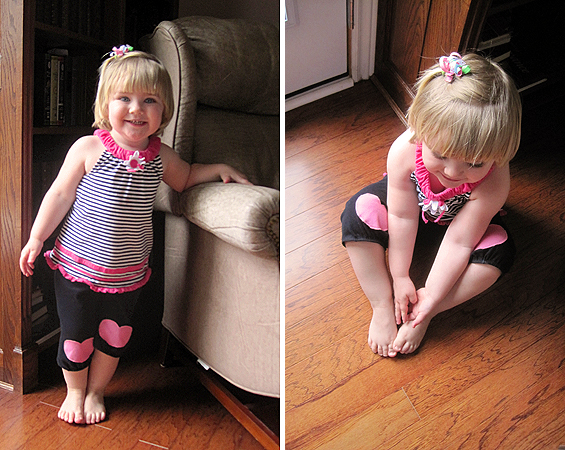
Simple Knit Shorts with Heart Knee Pads

You will need:
- knit material – yardage depends on the size of your pattern piece (read through the tutorial to make sure you have enough material for the pattern piece and the casing)
- contrasting knit scrap for the heart knee pads
- regular sewing machine (you do not need a serger to sew knits!)
- 3/4″ or 1″ non-roll elastic
- 1/4″ braided or knit elastic
- 8″ twill tape (ribbon) to match/contrast the shorts
- old pair of pants with worn knees (to check where the knee pads should go)
- tissue paper, paper, or tear-away stabilizer
- ballpoint sewing machine needle (for sewing knits)
- pins/glue stick/scissors/matching thread/other sewing gear
- Shorts Pattern Piece – Make your own in any size: {How To} Make a Kid’s Simple Knit Shorts Pattern OR click on the following link to download the 5 page Size 3 printable pdf
- Heart Knee Pad Pattern Piece – click HERE to download the printable pdf (in 3 different sizes)
Before you begin (if you are using the printable Size 3 pattern piece):
- Print out all 5 pages of the pattern piece pdf on letter size (8.5″ x 11″) or A4 paper. Important: Do not select “fit to page” when printing, make sure you print at the original size. Once you have printed the pages, measure the 1″ test square to ensure the pattern is the correct size.
- Cut or fold the pages on the outer gray lines and tape/glue the pages together, matching the letters in the gray half-circles.
Tips on Sewing Simple Knit Shorts for Boys:
- tie the twill tape in a knot instead of a bow
- switch the knee pads for ovals (coming on Wednesday!), or don’t put them on at all
- don’t use elastic on the leg hem, use a straight hem all the way around
- paint on a freezer paper “sport” number like these
- top-stitch on a fake fly like these
Here we go!
Step 1: Fold your fabric in half, make sure the full width of the pattern piece fits on the fabric! Important: Check the direction of the knit that stretches the most. This direction should be parallel to the top/casing and hem of the pattern – otherwise these won’t stretch the correct direction to fit your child. Cut out your fabric. If you have made your own pattern piece make sure you remembered to add a seam allowance before cutting!
(Lucky you, you can see my fancy pattern weights – empty kids paint containers filled with beans!)
Step 2: Now you need to figure out the size of your casing, follow the steps below and then cut 2 pieces that are “A” wide and “B” high. “A” should be along the stretchiest direction of your knit.
- Grab the fabric shorts piece you just cut and stretch the top as far as it will go, note the measurement – this is “A”. (photo 1) – My double-interlock knit stretched to 21″, but all knits are different
- Measure your elastic width and note it – this is “B”. (photo 2)
- Casing Length is: “A” + 1/2″ for seam allowances
- Casing Height is: “B” x 2 + 1″ for seam allowances
Step 3: Cut out your knee pads following the printable pattern piece. Choose the heart size from the printable pdf that best fits the scale of the shorts you are making. I have labeled the size I used as Size 3 – for those using the printable Simple Knit Shorts pattern piece.
Step 4: This one is easy! Tie your short piece of twill tape in a bow (you can use a lighter to – CAREFULLY! – melt the ends of the tape so it will not fray) and check to make sure you have the things in the following picture (PLUS the 1/4″ braided or knit elastic that I forgot to photograph!)
Step 5: Locate the front on each of your main shorts pattern pieces and lay them out. If your knit does not have an obvious “right side” make sure you mark the outside of your material so you have two opposite pieces (see photo).
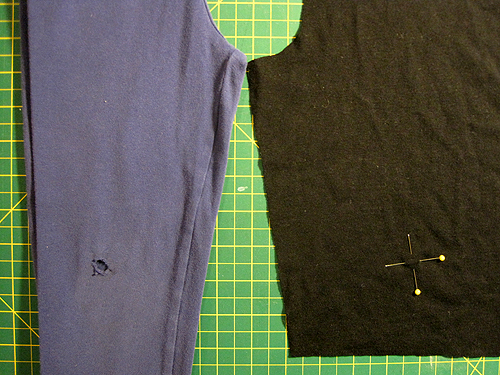
Step 6: Lay your old pants next to the new pants to see where to place your knee pads. This is a great idea from
Made By Rae (her step 3). I use two pins crossed at the centre of where I want the kneepads to go. (
If you printed the size 3 pattern, use the marking on the pattern piece.)
Step 7: Grab your glue stick (wouldn’t be a Thread Riding Hood tutorial without one!) and apply glue to the heart shape. Stick it to your shorts fabric using the mark you just made.
Step 8: Grab some matching thread and use a ballpoint needle to top-stitch close (1/8″) to the edge of your knee pad. Put a piece of tissue paper/regular paper (I used IKEA paper)/tear-away stabilizer behind the knee pad so it doesn’t stretch while you are sewing. Remove your paper/stabilizer and take a look at your cute kneepad!
Step 9: (1) Fold each pant leg fabric piece in half and mark the side with a pin. (2) Measure the width across the front pant leg. (3) Cut a piece for each pant leg that is a bit longer than half your “front leg” measurement. Make sure the elastic will stretch across the entire front leg. Example: The measurement across a size 3 front leg is 7″. I cut each piece of braided elastic to 4″.
Step 10: (1) Stretch and pin your elastic across the bottom of the front of the pant leg on each of your fabric pieces. (2) Thread some matching thread through your machine and sew across the elastic that is pinned to your front pant leg with a wide zig-zag. Stretch the elastic as you go so it reaches across the entire front pant leg. Repeat on the other leg. (3) The bottom of your front pant legs should each look like the third photo below.
Step 11: Now we finish hemming the shorts. (1) Turn up 1/4″ (or the width of your elastic) on the back pant leg and pin across until you reach the elastic. It is hard to pin this portion of the pant leg, so I don’t usually worry about it, but if it will help you to keep everything in place pin this up as well. (2) Stitch across the bottom front pant leg with a wide zig-zag stitch. Make sure to stretch the elastic to the width of the front pant leg as you stitch over it. (3) When you get to the non-elasticized part of the hem, switch your machine to a long straight stitch. Also, be sure to place a piece of tissue paper/tear away stabilizer under your fabric when you stitch over the back pant hem to keep it from stretching too much.
Step 12: Now we can stitch the pants together! (1) Choose a stretch stitch if your machine has one (1st photo), or use a thin, long zig-zag stitch. (2) Place your two fabric pieces over each other right sides together, matching up the front and back centre seams, pin. (3) Stitch the front and back centre (crotch) seams with an aprox. seam allowance of 3/8″.
Step 13: (1) Fold your pants so the inner leg seam is right sides together. Pin. (2) Stitch from one side of the inner leg seam to the other. When you come to the seam allowances for the centre seams fold one toward your presser foot and one away – to reduce the bulk where the 4 seams meet. (3) Fold the seam allowance at the bottom hem of each pant leg to the back and pin. (4) Stitch down the seam allowance about 1″ to keep it in place and neatly finish the bottom hem.
Look, You’ve made it so far – they actually look like pants now! We’ve just got the casing, elastic and bow left… you can do it! (Here’s a cute photo to keep you going!)
Step 14: Pin the top of your shorts to mark 8 even sections. (1) Place a pin on the front and back centre seams at the seam. Fold your pants so the front/back centre seams are together and place a pin at each of the side seam creases. (2) See the second photo – Match up the pins that are side-by-side (yellow pins) and place a pin in the crease that marks the half-way point between each set of pins (pink pin). (3) Your pins should look like the third photo.
Step 15: Take your casing pieces and stitch them right sides together into a large tube with a 1/4″ seam allowance. Fold the casing in half lengthwise and pin it together evenly at 8 points. Do this by following the folding technique that you used to mark the top of the pants in Step 14.
Step 16: (1) Pin the casing to the top RIGHT SIDE of your shorts matching your pin markings. Match up the seams in your casing to the side “seam” pin markers. (2) Mark a small 1.5″ section with different coloured pins to indicate where to leave an opening.
Step 17: Stitch around the edge you just pinned with an aprox. 3/8″ seam. Stretch the pant top fabric to match the casing length while you sew. Start and finish with a back-stitch, leaving the small space you marked open.
Step 18: (1) Thread your elastic through the casing, keeping it straight. When you have finished threading it through, pin the ends of the elastic together and check to make sure the elastic has not rolled while you were threading it through. Ensure the pants fit your child by trying them on and adjusting the elastic length. If you don’t have your child near (or they are sleeping!), compare the size of the waist to the pants you used to find the knee pad placement and make sure it is similar. (2) Stitch your elastic and cut off the excess.
Step 19: Pin up your opening and stitch it closed.
Step 20: (1) Mark your side seams with a pin. (2) Stitch over the elastic to further ensure it does not roll. Stitch from the top to the bottom of the elastic, only at the side seams.
Step 21: (LAST STEP!!) Stitch the bow onto the front centre of your shorts with a wide zig-zag (bar tack) over the “knot” in the bow.
Hooray – you are all done! Try those shorts on a small, cute someone… (If they are sleeping, try to wait until morning… I know… it’s hard!)
And… come back for tomorrow’s tutorial: Kid’s Simple Knit Shorts with Side Pockets!
by Sherri Sylvester | May 10, 2013
Here to announce… (drumroll please!) Next week is “Spring Shorts Week” on Thread Riding Hood! (But you already know that if you snuck a peek on Facebook!)
The plan is (if all goes as planned… !) to post a tutorial for 5 different versions of Kid’s Simple Knit Shorts – one on each week day – starting on Monday. I’ve got two of them sewn already – based on these ones I made for my daughter last week. The others are all planned and the fabric is waiting!
If you are going to sew along, you will need a pattern and that is what we are going to cover today. I know there are versions of “how to make a pants pattern” all over the internet, but maybe you will like mine the best?! This pattern has a separate casing that we will stitch on later, so that is not included in this drafting “how to”.
If you don’t want to draft this and your child fits in a size 3 you are in luck! I am going to post the pattern piece for a size 3 on Monday along with the first tutorial.
All the shorts will use the same basic pattern piece (that you can draft by following this post) and I will provide downloads for any additional pieces that are needed for each tutorial as we go.
Here’s how the week should shape up (I will update this list with links as we go):
You will need:
- large paper – freezer paper/tracing paper/newspaper (I use the large rolls of kids’ paper from IKEA)
- pencil(s)
- 1 pair of pants/shorts in the size you want to copy (more on this below)
- a pair of shorts or a measurement from the bottom of the casing on your kids pants to just under their knee
- long ruler
- scissors
Here we go:
Step 1: Fold your large paper in half, unfold and draw a line down the fold. Make sure the paper is large enough to draw each leg of the shorts when folded in half, remember they won’t be as long (see the photo). Mark the length of the shorts on your sample pants. The longest length needed for the tutorials coming up next week is just under the knee. Add 1″ for hem and casing allowances and you will be fine.
Step 2: Choose the pants/shorts you will use to make your pattern. Here are a few important things to keep in mind.
- I made a pair of these shorts last week that did not fit because the knit material in the pants I copied was stretchier than the knit I used to make the pants. Check the stretch on each (The direction that stretches the most will be going around your child) and make sure the stretch in the knit you will be using is the same or more than the pants you are copying.
- The shorts I am making the tutorials for are not meant to be tight fitting. I used a pair of woven pajama pants to make the pattern.
- If you need some information on knit materials go here. (There is a great description of the difference between woven and knit material in the 4th paragrah.)
- Oh, and make sure they fit your kid – I guess that goes without saying!
Step 3: Fold the pants (FRONT side out) in half along the seam lines. Make sure they look like the photo below. Line up the pant leg and the centre front “crotch” seam so they are roughly parallel to the line you drew in step 1. Line up the length measurement you found in Step 1 with the bottom of your paper. Trace along the inner pant seam and crotch seam up to the casing.
Step 4: Mark the bottom of the casing on the long straight line and on the line you just drew at the centre-front.
Step 5: (1) Use a ruler (ideally a quilting ruler to line everything up) to draw a line across your paper. Have the line cross through the corner made by the bottom of the crotch curve and the start of the inner leg seam. (2) The line should be at right angles with the long line you drew in Step 1.
Step 6: Label this half of the pattern “FRONT” and include the size and date and child it is for. It is good not to forget these things when you need it later!
Step 7: Fold the pants (BACK side out) in half along the seam lines. Make sure they look like the photo. Line up the pant leg and the centre back crotch seam along the other half of your paper so they are roughly parallel to the line you drew in step 1. The corner made by the back crotch curve and the start of the inner leg seam should line up with the line you drew in Step 5.
Step 8: Trace along the inner pant seam and crotch seam up to the casing. Make the centre back line parallel to the line you drew in Step 1 if you need to (see photo). Mark the top of the casing.
Step 9: Match up the casing lines with your ruler and draw a line across the top of the pants pattern.
Step 10: Add your seam allowances – I used 3/8″. There are two ways to do this. (1) Use a sewing guage or regular ruler to mark a seam allowance on all sides of your pattern except the hem. Now draw on your seam allowance using those markings. (2) Use this fancy trick from Pinterest by taping two pencils together. (BTW – this is found on my Pinterest board: Sewing Tips and Tricks, if you want to follow!)
Step 11: Mark the BACK on the back side of the pattern piece and cut it out all around the seam allowance you just drew.
Step 12: (1) Fold your pattern in half along the centre line. (2) Mark a straight line along the bottom hem edge at right angles from the centre line. (3) Cut the pattern on this line to even up the hem-line.
Hooray you are done! I can’t wait to share the tutorials next week, these shorts are really cute and easy to sew! I’m going to be making them for a girl, but providing tips so you can make them more boy-friendly, except for the skirt of course! As usual – let me know if you have any questions. Leave them in the comments or email me: sherri (at) threadridinghood (dot) com
AND! Not to ignore Mother’s Day – which is VERY important! (If I do say so myself!) If you want to check out my super-duper new and fancy re-styled Tutorials page – you just might find something your Mom would love! And might I suggest:
Hope you have a wonderful weekend! Happy Mother’s Day to all of you that are or are soon-to-be moms! I know my family’s got something planned – my youngest spilled the beans after I had been out at work – “Mommy… I can’t find your cards…?” Umm… “Someone must have hidden them, honey.” Secrets don’t work out so well when you are tiny!
by Sherri Sylvester | Mar 16, 2013
Today I have been busy making the fourth shirt – 2nd boy option – and it has NOT been my day. I have made so many mistakes sewing, and what was to be the easiest shirt has turned out to be a bit more complex than I had imagined. I think it would have been easier if I had planned to make it the way you see it (below) from the beginning! My original idea just looked boring when I was finished so I added in some more details – explaining the 2 photos in the “You will need” section!
Having said that I am SO HAPPY with the final results. It’s perfect for my 3 year old nephew, who happens to LOVE basketball. Grab your sewing supplies and fabric scraps and lets applique!
BBall Bunny Easter Tee
I’ve added a “read more” button here. Click below to access the rest of the tutorial.
(more…)
by Sherri Sylvester | Mar 15, 2013
Okay – third post is a charm? “Make Your Kids DIY Shirts for Easter” week has moved on to the boys. Today we have an appliqued bunny shirt inspired by Pinterest. Though isn’t everything nowadays?! You can download the free applique pattern pieces in the “You will need” list.
Mister Bunny Easter Tee
I’ve added a “read more” button here. Click below to access the rest of the tutorial.
(more…)
by Sherri Sylvester | Mar 4, 2013
This tutorial has been re-launched with a FREE pattern in sizes 18m – Adult with an updated tutorial and new, larger photos. Please enjoy the free pattern and follow Thread Riding Hood on Instagram, Facebook, Twitter and Pinterest for more inspiration! (Updated: 2017-10-01)
Get the FREE CAPE PATTERN PIECES in 4 Sizes ~ Click Here
For the sake of posterity (and cuteness!), here my two favorite original cape tutorial photographs.
You can also purchase the 18m-Adult Super Hero Cape PDF Pattern for any donation! (or click the photos to access the free version!)
The 16 page instant PDF download of this tutorial includes these extras:
- The full tutorial and pattern pieces, in a tidy and easily printed form.
- Cutting layout diagram and glossary of terms.
- Granny’s Sewing Basket – highlights Notes and Tips to make sewing this cape easier. ()
- Extra tips not included in this free tutorial.
- Check boxes, for those of you who love to get a sense of accomplishment when checking off each step!
Aside from these great features, you can choose to purchase the PDF to support this blog and help Thread Riding Hood continue in its goal to create more free content. Thank you for your support!
SUPER HERO CAPE PRINTABLE PDF PATTERN: available for any donation!
——————————————————————-
Would you like to sew and sell the Super Hero Cape Pattern?
Please purchase a Seller’s License in my shop and receive an instant pdf download!
by Sherri Sylvester | Feb 5, 2013
Quick note here – you all need to buy this! The Sew Fab ePattern Sale is on at Sew Much Ado (and other places I imagine). I found this yesterday and I am buying it! This is one amazing sale, I have been waiting for the perfect time to buy quite a few of these patterns – and it looks like I have waited long enough!
I actually looked up this exact pattern for kids pj’s from Peek-A-Boo Pattern Shop. I think it could easily translate into some wearable day-time shirts too. The Sidekick Suitcase has been on my list (and my pinterest) for a while – maybe now I can get up the courage to make them!
I ran into patterns by Figgy’s a while ago and am crazy about them. They actually have a bit of modern trendy style, and the photos and fabrics are really great! I like these pants (and shorts) in particular – but the open back on the dress – it makes the creative in me go nuts! Now, if I altered it to have an empire waist… and added few more ruffled layers on the bottom… While you are at it, check out her idea for the Figgy’s Kids Foundation.
Bought the patterns yet? Now sign up for the contest! (Scroll about halfway down the post.) There are more amazing things you can win than I know how to talk about. We could be here all day!
(Note: I am not getting paid to say this – I think it’s a great deal and want you to know about it too!)