by Sherri Sylvester | Oct 30, 2014

So my oldest says to me the other day… “Mom, this costume is perfect for us! Daddy likes Star Wars, I like Princesses and you like sewing.” She couldn’t be more right!
My husband is helping my daughter discover the world of Star Wars, with an appropriate amount of editing of course! This new found knowledge, along with my not letting them be Disney Princesses again this year, led her to Princess Leia. I hope you don’t think I’m too hard-hearted, but the commercialization of the whole Disney Princess thing can be a bit crazy. I also appreciate not re-creating another puff-sleeved ball gown every year! Trust me, they get their fill of playing princess at home – we’ve got an entire dress-up box of princess dresses that get used almost every day. Of course, now that Star Wars has been bought by Disney, I am redeemed – since Leia is a Disney Princess too!
This costume was relatively easy to make. It’s made from white knit fabric and a very sparkly silver belt. She even wore her rain boots for the second year in a row – perfect!
I used the tried and true Bimaa pattern. Though, in fairness, this has very little resemblance to the original pattern. I lengthened and widened the bodice, added a gathered skirt and cut straight , instead of tapered, sleeves. The hood was also lengthened, and I didn’t line it – because, it’s a Halloween costume and I ran out of white knit anyhow.
We attempted to make sock buns in her hair. Which (spoiler alert) looks super easy on YouTube – and I’m sure it is if you have done it 100 times. I’ve only made it to about 26 times so far – then we ran out of patience and attempted to wing it. Thankfully that lasted long enough for the photos!
When it came time for the photo shoot we had a small altercation over the use of props… since it seems that all she has available as a “true to the movies” prop is a blaster. Which led to a parental “Should we allow her to have a gun?” conversation. I’m sure I’ve got some of you on both sides of the argument… but since we had very little time to decide, (the sun and the rain were going down!) we decided we would skip the blaster for now. Her school won’t allow weapons when they wear their costumes on Friday anyhow, so that made the decision a bit easier.
I’m so excited about how it turned out. It definitely wouldn’t stand up to scrutiny from a hard-core Star Wars fan, since it’s in no way authentic – but it’s good enough for one night’s trick-or-treating! I’m excited to show you my youngest’s this week as well – and hint, she’s going to be something related to my blog name! Though, you may have already gotten a hint on Instagram. See you again soon!
Are you making or buying your Halloween costumes this year?
by Sherri Sylvester | Jun 9, 2014
Last week my church made some new t-shirts available in adult sizes. After my husband and I picked one up, I thought there must be an easy way to make them into dresses for the girls. So we brought home two extra-small women’s tees. Of course, once we got them home I needed more than just a dress to make them happy. Gray is “boring” apparently – we needed to add colour as well. I totally should have seen that coming!
A little research later and my great love of collecting coloured Sharpie’s has finally paid off. We spent a few fun hours colouring in all of the screen-printed lettering. I let them dry for 24 hours, (no idea if this is necessary, it just seemed like a good idea). Then I heat-set them in my dryer (inside out) on high for 20 minutes. After that I washed and dried them with a dark load of laundry, just to be sure the colour was permanent.
The pillowcase dress style is nothing new, but since I made them in a super-easy way and prevented the usual “knit stretching” fiasco with interfacing I thought I’d put up a little tutorial for them. I hesitate to call things easy too often, but seriously – this is easy! After the first one, I made the second in about 1/2 an hour. It left me wanting to take all of my small tees and turn them into dresses for the girls!
You will need a ballpoint needle for your machine – but don’t be afraid! They are easy to buy at your local sewing supply store. If you don’t know how to already, grab your manual (or look it up online) and find out how to change your needle. Once you have sorted out how to change it you will wonder why you haven’t done it yet! You can find out why you need to use a ballpoint needle here.
Ready to start?
You will need:
- one adult tee – it is best if the tee is not much larger around than your child & the “right” length for a dress or tunic
- one long knit or woven scrap 2″ wide by about 44″ long (or you could use ribbon)
- lightweight fusible interfacing (knit or woven is fine)
- ballpoint sewing machine needle
- matching thread, scissors, water soluble or other fabric marker, your regular sewing supplies
Here we go:
- Wash and dry your tee in a normal load of laundry. This will prevent it from shrinking after it is finished.
- Fold the tee in half, so the armholes seams match up. Take extra care to make sure all of the parts of the t-shirt are laying flat.
- Measure about 1/3 of the way down the armhole on the tee, in my case this was right under the neckline. You will need at least 2″ of un-printed area under this line if you want all of the wording on your tee to show. Mark a line across the tee, including the sleeves, at your measured point. Cut your tee across this line.
- Next, unfold the tee and open up the sleeve area. Cut each sleeve about 1/2″ away from the armhole seam. You will not be cutting the body of the tee, you will be cutting into the sleeve following the curve of the armhole seam. (see photos below)
- Fold each sleeve along the seam-line, so the 1/2″ of extra sleeve is tucked inside the armhole. This creates a facing (nice finished edge) for your dress’ armholes. Pin and stitch each side once or twice as desired.
- Cut two rectangles of fusible interfacing. They should be 1.75″ high each and as wide as the top edge of your shirt, just inside the armhole stitching. If you are using knit interfacing, make sure to cut the length of the interfacing along the direction of least stretch. Fuse the interfacing to the top of the tee. If you have done this correctly, the top of the tee will not stretch from side to side.
- Fold, press and pin each interfaced edge down. Line each raw top edge of the tee with the bottom of the interfacing to make a casing for your straps. This helps keep your casing an even width across the top. Stitch along the bottom edge of each casing about 3/4″ away from the folded edge. (sorry, this stitching is not pictured)
- Get your strap fabric. I used knit, so I also cut a piece of interfacing 1″ wide by the length of the strap fabric (again, the length is cut along the direction of least stretch).
- Fuse the interfacing to the centre of the 2″ knit fabric strap (if using). The strap should not stretch along the length if the interfacing was cut correctly.
- Fold each strap edge into the centre and press. I used the edgs of the interfacing as a guide for where to fold. The edges of the fabric tend to fold over where the interfacing starts. Your strap will be about 1″ wide with each edge folded to the centre. Fold the strap again, so the folded edges meet. Pin along the length of the strap.
- Stitch once on each edge of the strap.
- Use a safety pin to thread the strap through the casing front and back. Be careful not to twist the strap.
- Try the dress on your child and tie the strap in the correct position. Cut each strap about 5-6″ away from the shoulder knot. Knot the bottom of each strap to finish it.
- Pin the straps in place on each edge of the casing, making sure that the front and back “neckline” of the dress are the same width. Also make sure the straps are the same length before pinning.
- To permanently tack the straps in place, stitch over the casing and strap at each of the 4 ends of the casing – as indicated in the photo below.
And you’re done! I hope your little one enjoys her new summer dress. You can share your projects on Twitter and Instagram with the hashtag #alongforthreadride, or post them on the Thread Riding Hood Facebook page. And, of course, if you have any questions please be sure to contact me on any of the above or email sherri@threadridinghood.com. I’d love to hear from you!
by Sherri Sylvester | Mar 17, 2014
Wow – I feel like it’s been a while since I posted something on Monday. I’m so glad the weather is sunnier and we can all start looking forward to spring – if it decides to show up! Since it’s still pretty chilly here I made a little shirt over the weekend to hold me over until I can wear my summer things again. How is your corner of the world doing?
I think I have had this stripey knit since the fall – but of course I’m only getting to it now. It’s a lightweight sweatshirt fleece and is amazingly cozy. I’ve worn this shirt two days in a row now and there might be a third in it’s future since I haven’t had a run-in with a small set of sticky hands yet! Is that bad?! I could tell you I washed it in-between, but I suppose that wouldn’t be true… hmmm…
I’ve been eyeing the abundance of drop shoulder shirts out there. Especially in sweaters this winter. So I pulled out my self-drafted High-Low Chevron dress pattern to start and went from there. The new shirt is shorter and has almost no high-low hem, though I did make it about 2″ higher in the front – you can’t really tell. And obviously this shirt has long sleeves. The body of a drop shoulder shirt is actually quite similar to a dolman sleeve shirt, in fact I suppose it could be exactly the same, though my research tells me I am only half right. Apparently the drop shoulder shirt generally has a more structured underarm area that leads to the sleeve, where-as the dolman tee is usually looser and has a large armhole that continues to where the cuff is attached.
Anyhow… I have discovered that I love the drop shoulder for two reasons. First – it is really great for me because I have broad shoulders. I tend to have trouble buying fitted shirts because my shoulders just don’t fit. This means I gravitate towards raglan, dolman and now – drop shoulder – type sleeves. They don’t have a seam at the shoulder so I don’t have to worry about fit there. Second – they are super comfy, likely because they are mostly (exclusively?) made from knits! If there is anything I like it’s a comfortable top. I am most definitely not one of those people who will wear something uncomfortable because they are supposed to. (Though I think I tried to do that a lot to fit in in high school!)
I aimed to match stripes, but I purposely didn’t try too hard because I wanted the shirt to be more relaxed looking. I cuffed the sleeves and used my double needle to top-stitch around them and the neckline. I also used it to hem the bottom of the shirt, because I decided I didn’t want to add a cuff to the hemline because it would look too “casual sweater” and not so much “shirt”. The back of the shirt has a seam down the centre – which for some reason I did not photograph – sorry. The seam helps to shape the shirt and I really like how it looks. The extra seams add that extra little detail to make your shirt look more professional.
I am happy to tell you that these are really easy to make, since there is no “easing in” of a sleeve. The sleeve fits into the place where you would normally sew a cuff on a dolman tee and extends from there. I likely should make another one and show you – but that may have to wait until the fall when I will hopefully/maybe/possibly sew another one of these for myself! If you want to try it you can use the Dolman Tee tutorial I have written on how to draft and sew a dolman tee. Or you can get a great Dolman tee pattern from Sew Much Ado and add some sleeves. To add sleeves, I put the finished (no cuffs added) dolman tee on and measured from the armhole to my desired sleeve length along the inside/underside of my arm. Then I traced a sleeve from a sweater I like, marked the length from the hem of the sleeve up, made sure the armhole and top of the sleeve were the same size and sewed them together. Hmmmm… maybe not so clear unless you are super adventurous? Let me know if you want one and I will put the tutorial on my list.
One more shot of me being model-y with awesome squintey far-away eyes. (how embarrassing!) I must thank my husband (no relation to the previous sarcastic comment intended) for going out and taking these photos. It was -6 degrees Celsius out, that’s 21 degrees Fahrenheit, and he was kind enough to carry my coat so I could try to warm up between shots! Super chilly – but the outdoor pictures are so much nicer that it’s totally worth it. Oh, and let’s leave with this one… me staring at my shoes at dusk in a deserted area – with no purse, coat or hat in the middle of winter… Eek! I’ve got to think up some more realistic settings!
by Sherri Sylvester | Jan 16, 2014
As I was finding out that Project Run and Play was on again yesterday (and simultaneously finding out that I have at least 200 unread blog posts in my Bloglovin’ feed!) I was inspired to make this little dress by loosely using the PR&P theme “Winter Wonderland”. I have been wanting to make something with lace for quite a while, but I could never find the soft, stretchable lace I was looking for. Thankfully I was able to get some in Texas (from Hobby Lobby) while I was on vacation – and I think I should likely have bought more than 1 yard. It is really amazing to sew with!
I started drafting with the dolman sleeve Skipper Top from Sew Much Ado. From there things went off in their own direction! I added 3/4 sleeves, a front pleat and made it into an A-Line dress with a (barely there) high-low hem. I like that it is a bit Valentines’ themed, but could be worn any time of the year.
Details?! The sleeves are shorter out of necessity. I should have remembered that I made these shorts twice because the gray knit is not very stretchy and they were too small the first time. Some added width in the bottom of the sleeve would have been good. The front pleat was copied from an adorable dress that my sister-in-law bought for my oldest. It crosses over in the front, which is simple to do, but looks different from the traditional-style pleats I’ve seen lately. I love pleats – they keep the simple lines of the dress, but add that extra “umph” to the design. If you are interested in a tutorial on how to alter a pattern adding the pleat let me know.
From the top, moving on to the bottom of the dress. I ran across this knit heart dress tutorial from Lexi Made on the Sewing Rabbit yesterday as well. She did such a great job on these little dresses, and I got idea for the lace heart on mine from her tutorial. All of the lace in this dress is overlaid and sewn on because thankfully it doesn’t fray much. Though I did fold the shoulder lace under by 1/8″ or so along the straight edge before I sewed it on.
I think I am going to have to eventually make myself a sweater with the same fabric and lace. Different overlay though. I purposely kept the lace away from the front of the dress since that is where most 3-year-old spills happen! The whole thing took about 5 hours – including pattern drafting/cutting and chasing after the aforementioned 3-year-old. Not too shabby, I think.
Are you participating in this season of Project Run and Play? I think I may wait and see if inspiration hits to sew-along again this time. We’ll find out!
by Sherri Sylvester | Jan 8, 2014
I’m excited to let you know that I’m over on Fabric Spot guest posting a kid’s infinity scarf tutorial! These are so cute and my 3 year old loves that she can put it on herself. I also talk about the amazing organic knit Karen provided for the scarf. Check it out!
by Sherri Sylvester | Nov 21, 2013
Today we’re heading back into the folder of things I have photographed that I keep around for emergencies. It’s not a true emergency, but maybe a hiccup in bloggy terms. I have really not touched my sewing machine since last Friday so I don’t have anything new to post. I know – it’s crazy! I think I over-estimated my ability to do everything last week and then NOT crash this week! Anyhow, my daughter has also gotten the flu and so I have a little bit of an excuse.
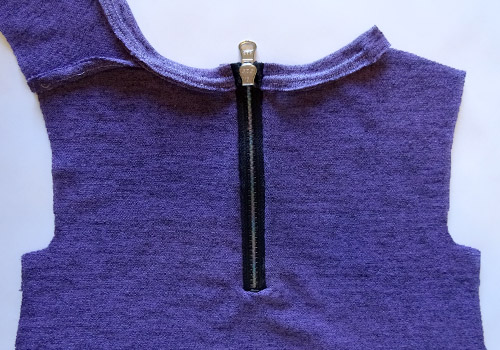
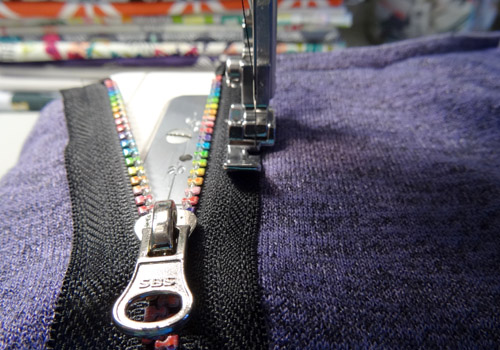
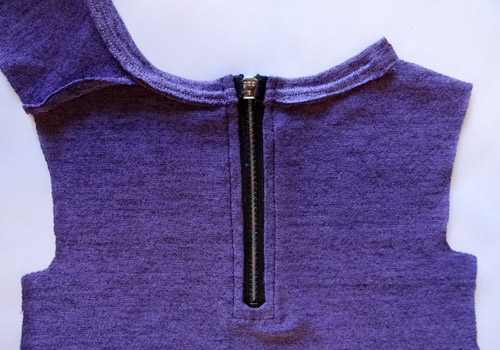
A while ago I posted my oldest’s Banyan Tee with an exposed back zipper. I have had these tutorial photos available since the post and was just reminded I should actually write the tutorial! I love this look. It’s fun, and adds a bit of designey-oomf to the back of a shirt.
You’ll need a zipper in the length you would like and a glue stick. Preferably an Elmer’s Extreme glue stick as I’ve found it works the best. The length of the zipper varies depending on the size of the shirt wearer. I used one about 8″ long with super-cool kid friendly rainbow coloured teeth. Since I made this shirt from scratch these instructions are on an un-constructed shirt. You could do this with a ready-made shirt, but the process is a bit more difficult because the shirt can not open out to be flat.
Here we go:
(1) Stitch together 1 shoulder and add the ribbing to finish the neckline.
(2) Mark a line on the centre-back – you can easily lightly iron a crease into it and then mark over the crease. (It might not look centred because you have not stitched the seam allowance on the second shoulder yet.)
(3) Place the zipper so the to of the slider matches up with the top of the collar. Mark the top of the bottom zipper stop on your centre line.
(4) Cut down the back centre line until you reach your mark.
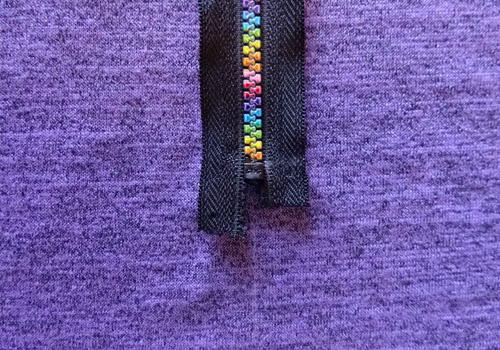
(5) Glue down the zipper tape that extends past the top zipper stop. Fold them over to the wrong side of your zipper tape and stick them down matching the sides of the tape. Make sure the tape stays clear of the zipper teeth.
(6) Turn the shirt over to the wrong side. Match the edge of the right zipper tape with the left edge of the opening you cut and glue it with the folded edge matching to top of the collar. Keep the glue within the 3/8″ seam allowance.
(7) Stitch the zipper with a 3/8″ seam from the top of the collar to the bottom of the zipper stopper along the right edge.
(8) Maneuver the zipper so the right side is laying against the right side of the shirt and the left side is attached to the wrong side of the left side of the shirt – matching the shirt and zipper edges.
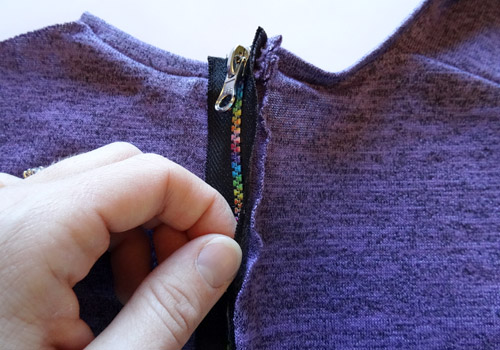
(9) Stitch the left side of the zipper from the top of the collar to the bottom of the zipper stopper. Turn the zipper to the outside using the opening at the bottom of the zipper.
(10) Peel apart the glued seam allowance and zipper tape.
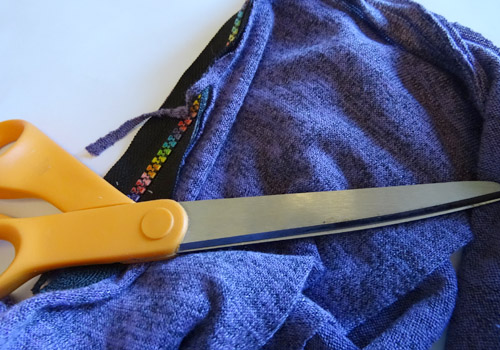
(11) Trim the seam allowance close to the seam.
(12) Glue both of the bottom edges of the zipper tape under in the same way you glued the top edges. Leave a little under the zipper stop.
(13) Top-stitch the edges of the zipper and across the bottom under the stopper.
(14) Here is a better shot of the stitching from the back.
All done! Take some fun photos and post them with the hashtag #alongforthreadride! I’d love to hear your thoughts on the tutorial. Could it be clearer? Would you do things differently? Thanks for the feedback!