by Sherri Sylvester | Jul 1, 2013
Happy Canada Day to all the Canadians out there! We are relaxing by the pool today and having friends over. Hooray for holidays!
I’ve never been happy with how small the zipper pull tab is on the regular zippers that you can buy at your local fabric store. Kids have a hard time pulling on them when I’ve used zippers on backpacks and pencil cases and the results don’t look as polished on clutches and bags.

The idea started when I was finishing a few things from last week’s list. I was working on the Gathered Clutch (Noodlehead tutorial here) that I was making for a teacher gift. I love how the strap on my own clutch attaches to the zipper – so I began thinking about how I could duplicate it. At first I thought I could add a jump ring to the original zipper pull… but wouldn’t it be better if the pull wasn’t there at all?!
Thanks to Google (gotta love it!) I found a tutorial on You SEW Girl that explains how to change the zipper pull on any zipper. She uses the wire cutting blades on a pair of pliers to remove the pull – why didn’t I think of that?! A trip to Michaels for some circular findings and a stashed swivel clip later I was good to go.
Now that I had changed one zipper pull I had to change another! The second teacher gift was an Open Wide Zippered Pouch with an iron-on vinyl covered lining. I clipped the pull right off of the zipper and sewed myself a new one. Hooray, so much better! I have to say I’m a bit addicted to this now and might be adding zippers to everything, just so I can change the pull. I love how it turns out!
Want to try it? Here is a quick tutorial on how to change a zipper pull. I will be posting how to add a wrist strap to the Gathered Clutch later this week.
Changing a Zipper Pull
You will need:
- two scraps of fabric for the pull – I used 2″ x 3″
- a zipper
- jump rings (chain findings) in two sizes – from the jewellery section of your local craft store (mine were 1/4″ and 1/2″)
- needle-nose pliers
- school glue stick
- fabric pen
Here we go:
(1) Cut the original pull tab from your zipper using the pliers (see this tutorial from You SEW Girl). (2) Pull away the small piece that is left. (3) Open a small jump ring using pliers and fit it onto the slider. (4) Attach a large jump ring to the smaller one. (5) Close the small jump ring using pliers. (6) You should have the pieces pictured.
(7) Place your fabric right sides together and fold in half so the short ends are touching. (8) Measure 1/2″ in on each side of the folded edge, Draw two diagonal lines to the raw edge corners. (9) Fold over all 4 short ends by 1/4″ and glue them down. (10) Cut along the diagonal lines. (11) Stitch along the diagonal lines with a 1/4″ seam allowance, pivot at the fold. (12) Grade the seam and clip the corners close to the stitching.
(13) Turn the Zipper Pull inside out, press, top-stitch the ends closed with a small seam allowance. (14) Wrap the Zipper Pull around the large jump ring on your zipper. (15) Unzip the zipper and stitch it on close to the jump ring. It is easiest to use a zipper foot. (16) All done!
Look at how great your new zipper pull is! And I”m sure you can think of so many more possibilities!
Come on back later this week for a tutorial on adding a strap and swivel clip to a Gathered Clutch.
by Sherri Sylvester | Jun 21, 2013
Today is the LAST DAY to enter the giveaway from Fridays Off Fabric Shop. Click on the blue banner above or this link to read about Alanna and her shop and post your comments to win a sweet Valori Wells fat quarter bundle!
I started my youngest daughter’s quilt a while ago… and then I finished the quilt top… and then I stopped. Mostly because I was not sure how to do the quilting. And, of course I was getting a bit ahead of myself as usual, because I hadn’t finished the backing yet! Thankfully I have a friend who has been doing some free motion machine quilting for her baby quilts. She suggested watching this video tutorial from Missouri Star Quilt Company. Thankfully (again) the tutorial is really good. I was able to feel confident enough to finally try my hand at a real project!
I had been eyeing the Herringbone Hot Pad tutorial ever since it popped into my email box from Sew Can She, so I figured this was a good project to start with. Unfortunately for me I suppose, the stipple pattern I quilted into this lovely straight line modern looking hot pad just doesn’t make sense. I would have loved to quilt the straight lines like Melanie does in her tutorial, but I needed a project, and I do still like how mine turned out.
For all of you who are seasoned quilters, I apologize for posting my beginner work! This is by no means a quilting blog – if it was you might see a post every 2 or 3 months, and it would likely take years to finish a quilt, I might not have any readers left by then! I admire everyone who can make quilts so quickly and I wish that were the case with mine as well. I will have to be patient for now I think. What tips and tricks do you use when you quilt?
I started out on a few (large!) test quilt sandwiches and then pieced my herringbone pattern and quilted it. The tutorial is great and has lots of photos. The self binding option is really nice for this size of project and I used this method on the Plays-Mats tutorial I posted a while back. I got to cut into my blue Oh Deer fabric and use some pieces that I have left from the year that I subscribed to the Pink Chalk Solids Club. I wish I had chosen an uneven number of colours though, my herringbone pattern looks a bit more like angled stripes.
I am super excited that the stipple pattern looks so great! I watched the half hour video and practiced for about an hour before I started, and it really does make a difference if you take a deep breath and slow down and try to “draw” your stipple with the needle. I did try to draw the pattern on and then stitch over my lines, but that was more nerve wracking than doing it freehand. I think that the truth about why it looks alright (for a beginner!) though, is that the pattern is super forgiving when it is seen all together. You don’t tend to focus on the bad spots. See if you can find the (at least) seven places I made a “corner” where it should have been a curve, and the one place I stopped and had to start again at the edge because I got stuck. See, bet you didn’t notice them all the first time round!
Have you tried free motion quilting on your home machine? What are your experiences? If you do it all the time, what tips can you (please!) share with the rest of us?
By the way, if you want to access the tutorial it is also pinned to my Sewing Tips and Tricks Pinterest board, just in case you want to follow!
by Sherri Sylvester | Apr 29, 2013
I love my daughter very much, and she loves rainbows – so, when I decided to make some (badly needed) reusable snack bags this weekend, it turned into a rainbow project. I think it started with a fat quarter of Anne Kelle Remix that I bought at the Creativ Festival on Friday last week. Somewhere between Anne Kelle and a random pile of scraps I dug out yesterday a tidy stack of snack bags (in rainbow order) ended up in front of my camera.
We Wilsons: the Reusable Snack Bag Tutorial
I made some snack bags a few years ago, and after searching high and low through snack bag tutorials I came upon this one by Laura from We Wilsons. It is the fastest and best tutorial I have come upon as yet. Laura has obviously put a ton of time into thinking through each step to make the bags fast and easy to put together. Her tutorial is easy to follow and she even provides a pdf download for it, so you can save it to your computer, or print it out easily.
I did things a bit differently than she did – some things to speed up the process and some to make them more “scrap friendly”! So I’ve decided to document what I did here so you can decide how you’d like to make yours!
First thing I do is line the bags with ripstop nylon. If you go to buy this you can ask the friendly employees at your local fabric store which nylon is the “ripstop” type. If you can’t find anyone to help you – look for the tiny squares on the fabric. Ripstop nylon is reinforced with a crosshatch pattern that regular nylon does not have. It is considered food safe and is FDA approved for use with food, just make sure you use the shiny side of the nylon as the “wrong side” when you are sewing it into the snack bag.
There are two other things I do when making snack bags for kids. (1) I cut my regular 3/4″ velcro in half lengthwise. The velcro sticks just fine and it makes the bags easier to open. (2) I add in a grosgrain ribbon tab on the top of the bags, again, making them easier to open because you can pull on the ribbon tabs instead of fiddling with the flat top of the bag. I add a 3″ piece of ribbon (folded in half so the tab is 1.5″ long) to the centre of each end before following step 2 of Laura’s tutorial. When I am sewing I like to double-stitch over the spot where the ribbon is, for added strength. It also helps to cut the ends of the ribbon with pinking shears so it doesn’t fray.
When I sew step 4 on the We Wilsons snack bag, I use one line of wide zig-zag stitching to attach the velcro instead of stitching around all of the edges. Because the velcro is half the width it holds just fine and makes the whole process much faster. I also like to attach my velcro with a glue stick before I stitch it, so it stays in place without pins.
Since I wanted to use up some of my scraps I decided to have 3 different versions of the bags. All of my bags measure 6″ wide by almost 5″ high when finished. Here are the measurements for how I get there. The labels on the photos are CUTTING measurements for the height of the pieces. The width of the pieces should be 6.5″ and all measurements include a 1/4″ seam allowance. If you have “one way up” fabric, use the “OR 2 pieces” size to cut your largest pieces. Once they are cut, stitch them together, you should end up with a rectangle roughly 6.5″ by 10.5″-11″ long. Go ahead and follow Laura’s tutorial.
Now, take your stack of snack bags and fill them up – your kid will have the best dressed snack around! I’ll be posting a review of the Creativ Festival later this week so you can see some of my new stash!
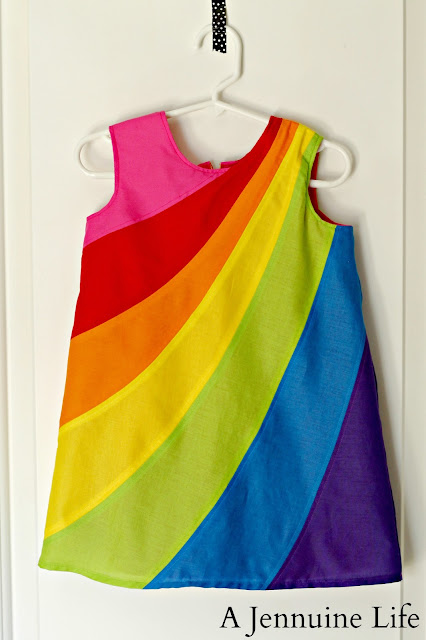
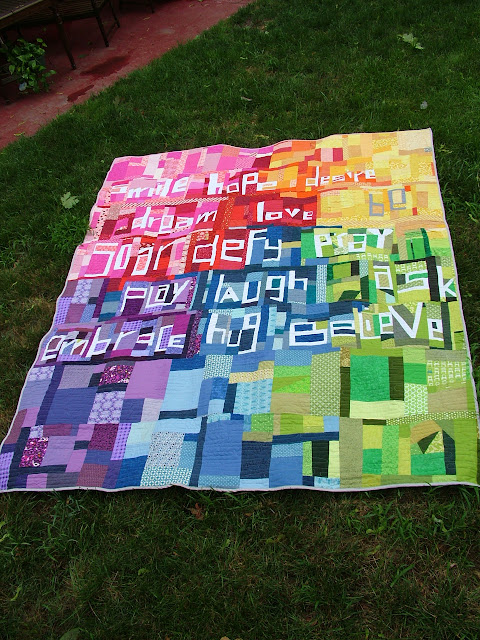
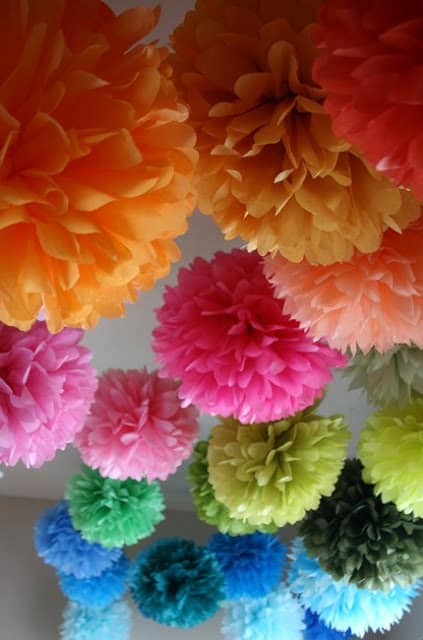
P.S. Just in case you need more rainbow inspiration. Here are a few more things I love:
Rainbow Quilt (photo: Made By Rae) |
Arden’s Rainbow Dress (photo: A Jennuine Life) |
Rainbow Improv Quilt (quilt: Kelli P, photo: Lazy Gal Quilting) |
Pom Pom Tissue Flowers (photo: Design Dazzle) |
by Sherri Sylvester | Mar 25, 2013
Happy Monday! Hope you all have had a great weekend. We had a very relaxing one, which is nice (and rare) around here! I’ve gotten a ton of quilt sewing finished this weekend. But I’ve got a lot more to do before Easter weekend. I promised two little girls they would have new dresses to wear to church on Sunday. There are going to be some late nights this week! So… that explanation given… I am pulling something from a while ago out to show you this Monday!
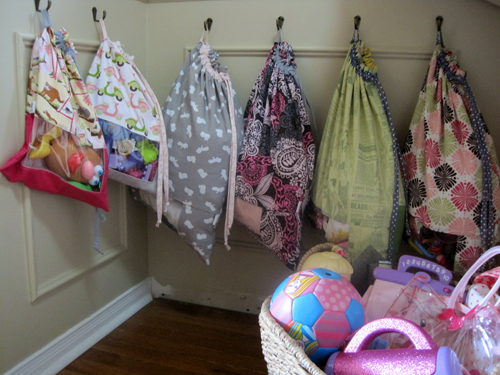
Make It Perfect – the Peek-A-Boo Toy Sack
These bags are amazing, and the tutorial is even better! Toni from Make It Perfect does a great job of explaining the process and the photos are really great and easy to follow.
The main thing that worries me when making a bag that uses plastic is that it tends to stick under the presser foot when you sew it. This bag is fully lined, and you never have to stitch over the plastic, making it quick and easy to make a lot of storage for your kids’ toys. They would also make an amazing new baby gift – just make one up and fill it with some handmade tiny cute things!
I made some in the smaller size (like the tutorial) and also enlarged the pattern to make a few bigger ones to fit some larger toy collections! I added a small strap on one side so that they hang up and a loop over the strings that tightens so they can stay closed. With those and some small hooks our toy corner on the main floor ends up looking pretty tidy. (Okay, who am I kidding, I moved a ton of stuff for this photo shoot! At least I have an idea of where the toys are supposed to go! Oh, and just ignore the missing piece of baseboard – it’s been that way for years!)
I used up some of the fabrics that I loved and/or loved and didn’t know what to do with – so now I can look at them every day, and that makes me happy! The bags do work really well, especially for small collections. Mrs Potato Head will likely never lose her purse again, and I think she looks pretty happy about that too!
If you are following me on twitter you would already know what happened yesterday. My seam ripper got a good workout on the quilt I’m making… but – I’m all finished with the quilt top. EEEeeee!!!! I’m only a little excited! I just need a sunny day to photograph it. Unfortunately there’s rain in the forecast and, though I may have to make up some sun myself, I will post a progress report mid-week. Come on back and see what I wrote on it!
by Sherri Sylvester | Mar 18, 2013
I made these bookmarks for my kids a while ago. We were having trouble keeping track of the latest chapter/story in their bedtime books. These work great and are a bit tricky for kids to remove – so they actually stay in the books! Since the elastic is wrapped around the book you (or your kids!) can pick the book up move it around without fear of losing your place.
The Scrappy Fabric Bookmark
These are great for using up all of your tiny cute scraps. I cut out some alphabet flannel I stashed and used that to monogram each bookmark. I’ve seen a lot of tutorials for different kinds of scrappy bookmarks – but the cute scrappy part is always hidden inside the book. With this type of bookmark the elastic is inside of the book holding your place and the cute scrappy part is on the outside of the book for everyone to see!
The concept is similar to the pocket bookmark I posted a tutorial for a few weeks back. Here’s a quick rundown on how to make them.
(1) Cut some scraps and stitch them together however you’d like to create a rectangle roughly the height of your book + 1/2″ all around. (2) Cut a piece of elastic that is the height of your rectangle. (3) Cut a lining/backing piece that is the same size as your rectangle. (4) Use medium woven interfacing to interface your lining/backing. (5) Place the scrappy rectangle and lining rectangle right sides together with the piece of elastic sandwiched between them. Pin the elastic ends in the centre of each short end of the rectangle. (6) Stitch around the outside edge of the rectangle with a 1/4″ seam allowance – leaving a 1.5″ opening on one side. Make sure to double stitch over the elastic when you get to it. This will reinforce the elastic so it won’t pull out. (7) Clip your corners and turn the bookmark right side out. (8) Iron in the seam allowance on your opening and topstitch all the way around the bookmark. DONE!
On a different note! You may (or may not) remember that we had another sewing club meeting a few weeks ago. As usual I didn’t have a chance to take photos (again, got to get better at that!). Thankfully a couple of the people who came were able to take photos of their finished library totes (tutorial by Noodlehead) and send them to me. Aren’t they cute! This is a really great project that didn’t take too long to make and everyone who showed up got to take a finished one home!
Love the fabric and colours on this one! The basketweave woven material on the handle looks really great!
This one is made out of super cute laminated cotton. What a great idea! Easy to clean and very durable. It is made extra wide to hold her daughter’s picture books at the library!
This is the one I made. It is made thinner to hold my daughter’s Awana book and vest. The pre-quilted material is fun to work with. It was nice to use up some of my stashed fabric too.
My daughter has just “lost” her afternoon nap. I suppose you can’t expect her to nap forever! I’m in the process of trying to teach her how to have a “Quiet Time” in her room, but for now she is sitting across from me while I post this. And, for the record, it has taken me about twice as long as usual to get to the end. What with potty breaks, stickers needing removed from their backing and her needing a colouring buddy! My new reality…. I have no hope… who could resist this face?!
by Sherri Sylvester | Feb 1, 2013
Alright, so, think back about 6 days…. Saturday…. right – you were on your computer super excited to check out the tutorial I promised and…. nothing, no new tutorial. I know, you were devastated… Sorry about that, Let’s try again!
Before we begin, my youngest daughter is on a kick that everything is Super Super SUPER { Insert Word Here}. So that is the inspiration for today’s title, kids are good for that!
I have seen tutorials for these online – so it’s nothing new. But I did photograph this thing like crazy, so it may be the most detailed tutorial out there now! Also, I have included instructions on how to fussy-cut your fabric so the part you want to see shows up where you want it when you are done!
Also, this is a super super SUPER good (I know, don’t wear it out!) project for beginners. It requires being able to cut squares and sew straight lines. It is even easier if you use a charm pack {Pre-cut 5″ fabric squares}.
You will need: 5 pieces of 5″ square fabric, iron, pins, sewing machine, scissors
1) Cut your fabric into 5″ squares – 4 for the front and 1 for the back. If you want to fussy-cut the square, make sure the image you want to show on the front of your finished coaster fits within an imaginary 2.5″ square in one of the corners (see the photo).
2) You should now have 4 fabric squares for the front and 1 fabric square for the back.
3) Iron the front fabric squares in half.
4) Now you should have this:
5) Start arranging your newly ironed rectangles together for sewing, place your first rectangle flat on your table with the ironed edge on the bottom.
6) Place the second rectangle on top of the first with the ironed edge to the right side.
7) Place the third rectangle on top of the second with the ironed edge on the top.
8) Place the 4th rectangle on top of the third and under the first (see photo) with the ironed edge to the left side.
9) You should now have a square again. The way the fabric looks now is how you will see it when you are finished. If you have fussy-cut your fabric, make sure your fussy-cut portion is showing where you want it. If not, move the fabric pieces around and follow steps 5-8 again until it is right.
10) Pin the backing square over your stack of rectangles, right side down. Pin all 4 corners and make sure all of the sides are even.
11) Stitch around the square with a 1/4″ seam allowance. Note to beginners: Stop 1/4 ” away from all of your corners with your needle down, pick up your presser foot, pivot your fabric, lower your presser foot and begin to sew down the next side.
12) Trim the corners of your coaster. This removes bulk and the coaster will have sharper corners when you turn it.
13) This is the hardest step to write down, but trust me on this one… See where the ironed edges of your fabric meet in the middle? Pull on one of the pieces and it will create an opening. Turn your coaster inside out through that opening… here’s a photo.
14) Now, push out all of your corners with a crochet hook, knitting needle, the end of your scissors, a pencil (be careful not to push too hard, they are pointy!).
15) Iron your coaster.
16) Done!
Now you can choose to make a whole set of colour-coded coasters for your family.
Line them up on the counter and never guess who’s glass was who’s again! Trust me, it saves a lot dishes, you don’t need to grab a new glass each time!