by Sherri Sylvester | Aug 27, 2013
 I made up a quick sunglasses case for myself at the end of July, and thought I would post it here as a tutorial. Turns out, the more I thought about posting it the more I thought that there must be a better way than the flat, very soft case that I made in about 15 minutes. It had no shape and no intrigue, and worst of all I don’t think it would do a spectacular job of taking good care of my sunglasses either! Since I’m super good at procrastinating (and really busy with the kids this summer) I gathered up all of the sunglasses cases that I could find and lined them up on my cutting table Sunday night. Too late into the night to mention, I came up with the Sunny Glasses Case! It is really simple to make, mostly because I’ve done all of the
 trial and error through 6 or 7 versions so you don’t have to!
Come #alongforthreadride! Follow Thread Riding Hood on social media for sneak peeks, tips and process photos. Hope to see you there!
Once you’ve finished one, you can likely make another in about 1/2 hour or less. Which makes it a super quick gift, and it can be made for almost anyone. Men, Women and children of all ages would enjoy a safe place to stash their sunglasses. Bonus, it doesn’t look like it only took half an hour to make (woot!) and – added bonus – you can use up some of your large scraps to make it! And, just in case you think I’m crazy posting a sunglasses case tutorial when Fall is approaching my part of the world, I do wear my sunglasses a lot in the winter. And these would make great stocking stuffers if you are inclined to start gifts now! As I was making these I came up with 4 useful options for making the case. Option 1 makes for a regular case with Velcro closure. Option 2 has a button & elastic closure and a swivel clip, this is so my oldest can attach it to her school backpack and (hopefully) keep her sunglasses unscratched and un-lost! Option 3 is mine, I added a magnetic closure to the flap. Option 4 is for my husband, who wanted it to be able to attach to his car’s visor. * Update: Don’t feel like sewing a Sunny Glasses Case yourself? Buy one from a licensed seller! Check out the sellers list. Are you a shop owner? You can buy a Sunny Glasses Case seller’s license as an instant download. *
This tutorial covers all 4 ways of creating the Sunny Glasses Case. Follow the main instructions for Option 1. The other options use the same directions with additional steps. These are listed below the directions for Option 1. You will need:
- 11″wide by 10″h scrap of your main outer fabric and lining fabric
- 10″x10″ scrap of fusible fleece
- 5″x9″ plastic canvas (I used size 7 mesh)
- The pattern pieces – Click on this link to download the printable pdf: Sunny Glasses Case pattern pieces
- Other Helpful Things: School Glue Stick, Point Turning Tool or Chopstick, Water Soluble (or other) fabric marker, Pins
- Option 1 & 4 Only – 5″ loop Velcro and 2.5″ hook Velcro
- Option 2 Only – Button Closure + Swivel Clip: Button, Hair Elastic or 4″ piece of Round Elastic, Swivel Clip with 1″ D-ring, Fabric for strap: 5″x4″
- Option 3 Only – Magnetic Closure: 1 Magnetic Snap
- Option 4 Only – Car Visor: 1 piece of 1″ wide elastic, 9″ long
Materials for Option 1
Before you begin:
- Print out all 3 pages of the pattern piece pdf on letter size (8.5″ x 11″) or A4 paper. Important: Do not select “fit to page” when printing, make sure you print at the original size. Once you have printed the pages, measure the 1″ test square on page 1 to ensure the pattern is the correct size.
- Cut Outer and Lining, Fusible Fleece and Plastic Canvas as per the pattern pieces. Make sure to line the pattern pieces up on the fold where necessary. I found the easiest way to cut the plastic canvas was to precut my pattern piece, trace the edges with a permanent marker onto the canvas, and then cut it out.
- If you want to piece your fabric together (I have added a small contrast piece on the closure edge of the flap), do this first and then cut your outer fabric. Topstitch after fusing your fleece for a “quilted” look.
- Mark the “Velcro” and “Flap” marks (as indicated) onto the right side of the Outer fabric with a water soluble fabric marker. Be sure to mark the “Flap” marking on each edge of the Outer fabric.
Cut Materials for Option 1
Option 1 – Velcro Closure:
(1) Iron Fusible Fleece (centred) on the wrong side of your outer fabric. (2) Use your glue stick to glue the loop side of your Velcro to the rounded edge of the lining. Centre it 1/4″ above the bottom of the curve. (3) Stitch along both long edges of your Velcro, you do not need to stitch the short sides. (4) Round the corners of the hook side of your Velcro. Use your glue stick to centre it on the “Velcro” mark on your outer fabric. Stitch all 4 sides neatly. (5) Place your Outer and Lining fabrics right sides together. Pin around the curve between the “Flap” marks and the straightest edge (see photo). (6) With the fleece side up, use the edge of your fused fleece as a stitching guide. Do not stitch ON the fleece, stitch BESIDE it. Stitch the straightest edge from point to point. Stitch around the curve, begin at one “Flap” mark and end at the other. (7) Trim the excess Velcro & clip the curve where the Velcro is – you do not need to clip the entire curve. (8) Clip your seam allowance at both “Flap” markings. Clip up to but NOT through the seam threads. (9) Turn everything right side out through the openings. (10) Pin the straightest edge and top-stitch approximately 1/8″ away from the edge. (11) Pin the large curve between the “Flap” marks. Do not stitch – we will do this later. (12) Make sure the un-sewn seam allowances are lying flat on the outside (see photo). (13) Draw a line across the outer fabric between your “Flap” markings. Topstitch along the line. (14) Insert your plastic canvas between the lining and the fusible fleece. Centre it from side to side. It should be in approximately 1/4″ from each fusible fleece edge. Use two pins to secure the plastic canvas in place. (15) Almost done! With the outer right sides together, fold the bottom of the glasses case up. The point should meet up with the top of the “Flap” marking. Pin along the edge. (16) We are going to finish the case with a French Seam. Stitch a scant 1/4″ seam on both sides of the case along the raw edges. (17) Trim the seams you just finished to approximately 1/8″ on each side. Flip the bottom of the case right side out. (18) Finish the case by stitching around the edges with a generous 1/8″ seam. Start at the bottom on one side and end at the bottom on the other. Do not stitch across the bottom edge. Done! For Options 2,3 and 4, follow the Step numbers as outlined for each Option. Example: STEP (1). (2.1a)… means – follow STEP (1) above, then follow (2.1a) as outlined in the Option 2 instructions.
Option 2 – Button Closure + Swivel Clip:
My oldest picked the Monkey Bizness – Market Stall fabric used in her sunglasses case when I placed my latest Warp & Weft order. I love how it turned out, the print is just the right scale for this project! STEP 1. (2.1a) Make the strap. Iron your fabric in half lengthwise to make a 2″x5″ piece. Unfold and iron each edge into the centre, refold. Top-stitch each edge. (2.1b) Fold the strap around your D-ring. Stitch as close as you can to the ring – it might help to use a zipper foot. Set the strap & clip aside. STEP 5. (2.5a) Fold your elastic in half, centre it at the closure end of the case. Pin it between the outer and lining, 1/4″ in from the edge, with about 1/2″ of elastic (folded) on the “inside” of the case and the rest sticking out. (I have completed Step 6 in this photo) STEP 6, Note: Double-stitch over the elastic when you reach it. STEPS 8-14. (2.14a) Pin and Baste strap in place on outer fabric, centred as per the photo. Trim excess strap to match the seam allowance. STEPS 15-18. (2.18a) Place your glasses in the case and sew the button on where appropriate. Done!
Option 3 – Magnetic Closure:
STEP 1. (3.1a) Attach the bottom piece of your magnetic snap centred on the Velcro mark you made on the outer fabric. (3.1b) Attach the top of the snap to the lining 1″ away from the curved flap edge. Be sure to interface behind the lining snap. (I used a scrap of fusible fleece.) STEPS 5-6. STEPS 8-18. Done!
Option 4 – Car Visor:
STEPS 1-14. (4.14a) Centre your elastic piece across the fabric as shown in the photo. Baste the edges with a 1/8″ seam allowance. Trim the excess elastic. STEPS 15-17. (4.17a) Make sure the elastic is along the back of the case when you turn it inside out. This is important when stitching the next step. STEP 18. Done! There you have it! One (or 20!) easy, customizable gifts for everyone in your life. Take a minute to post a photo to the Thread Riding Hood Facebook page, we’d all love to see your creation!
Are you a seller that would like to buy a Licence to Sew and Sell the Sunny Glasses Case Pattern? If you are interested in selling cases made with this pattern you can buy a license here and receive an instant pdf download!
As usual, please feel free to use my patterns/tutorials for your personal projects and gifts and for charitable fundraising events. Please do not sell anything made with this pattern unless you have purchased a Seller’s License. Please contact me for more information: sherri (at) threadridinghood (dot) com
by Sherri Sylvester | Aug 20, 2013
I made this dress a few weeks ago – I suppose almost a month ago now – and I’m having so much fun wearing it! Only one problem – I mis-measured the hem and it ended up a tad (read 3″!) shorter than I was aiming for on the “high” side of the hem. So, the photos without leggings are because I was inside my house… Ha!
The High-Low Chevron Dress
So far I have found the super-casual wide belt with red Toms look. The comfy (and my favorite!) 3/4 length leggings with no belt look. And the more dressy no leggings, skinny white belt look.
I started making this dress by tracing one of my favorite tees. To make the skirt I continued the side seam-lines down using my hip measurement as a guide, so it would fit properly. Thankfully it all worked out well in the end! I did have to try it on several times and get my husband to pin the back closed along the centre back seam so it had a better shape. I should have taken a photo, because one of my favorite parts of the dress (and the tee!) is the centre-back seam. I’ve seen a lot of shirts like this lately and it allows you to create better shape on a knit fabric top more easily.
The fabric is from my Hamilton shopping trip and was supposed to be another Dolman Sleeve tee. As I found out when I asked on Facebook, I’m not the only one who changes their mind when a better idea presents itself! I really like the print, the colours are so fun! The chevrons are super tiny and uneven and it adds a lot of movement to the print which helps make it fun too. I was shopping at Joe Fresh the other day and saw a similar print in a similar style. Hooray for me, I love it when that happens!
I’m hoping to make another one of these soon, with a bit of a lengthened front hem – so I don’t have to pull out the leggings to wear it. Though I do like the leggings because they make playing with my kids a lot easier!
Hi!
Our summer is almost over – only two weeks until school starts! Amazing – how did that happen again?! I’ve still got to do the annual overhaul of my oldest’s clothing and “drag” her to the mall to shop for a few things. Hopefully I have time to make her the lunch bag I have planned before she goes back. I’m also hopeful to use some of my stashed fabric to make her some new things as well. Do you make the kids in your life anything specific every year for school?
Before we end today I want to put in another shot of the AMAZING (did I mention, freehand silk screened, gorgeous!) fabric that Esmari from Warp & Weft is giving away. You can enter until this Friday (August 23) at 10pm by and following the directions in the giveaway post. (Update: Giveaway is over)
by Sherri Sylvester | Aug 16, 2013
I’m in the midst of (what seems like) turning our house upside-down. The kids’ playroom upstairs has now moved to the basement so they have a TON more space to run around. My sewing area and my husband’s office are moving from the basement to join forces in what was the playroom and right now it doesn’t look habitable! Hopefully by the end of the weekend?! In the midst of it all I’m super excited, I have wanted to re-organize my sewing things for a while now and this is the perfect time. I think I’m even going to put all of my fabric on mini-bolts as per this Smashed Peas and Carrots idea.
Now, back to the shorts. If you haven’t seen Monday’s post on how to shorten your shorts, I’m doing a mini 2-part series on pattern altering. Today I’m covering off how to widen or narrow the legs of your shorts. Before you use these instructions you might want to read through the first few paragraphs in the previous post. There are some good instructions on tracing and pattern paper, and an explanation of why I needed to alter the shorts pattern in the first place!
{how to} Narrow the Leg of your Shorts
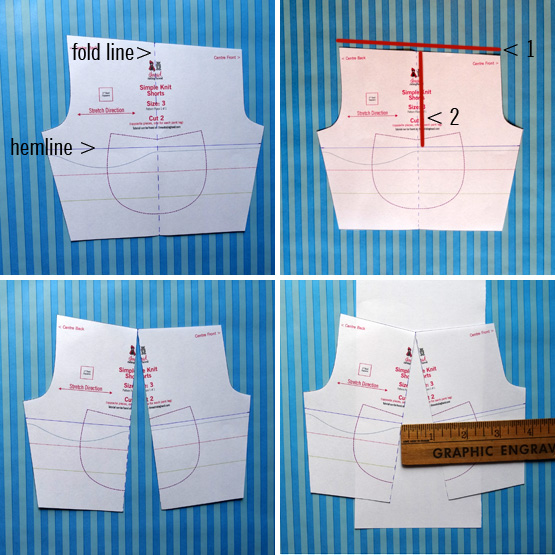
(1) Fold your pattern piece down the centre (along the side of the shorts), line up the hemline from one side to the other, the waist may not match up. I drew in the dashed line to show where the fold is. This pattern piece is already marked at the new hemline (see this post), I have not removed the excess pattern paper because we can use it later. (2a) Now we do some math. Measure around the shorts recipient’s leg where the hemline will be, and note the measurement as A. Measure the hemline on the pattern and call it H. (2b) Add ease (1″ for knits) and twice your seam allowance to measurement A – call this new number B. (2c) Subtract B from H and get measurement C (this number is the amount you need to remove from the pattern piece to narrow the leg of your shorts). (2d) Divide C in half to get D, you will use D to remove the same amount from both sides of the shorts. Now we can move on!
(3) Note down two measurements on your current pattern, for reference later – 1: From centre-front to centre-back (along the waist/top of your pattern piece) 2: Your side seam from top to (shortened) hemline, along the fold you created. (4) Mark D (in my case 1/2″) along the hemline of your shorts and on either side of your centre fold line. (5) Draw two diagonal lines from the top of your pattern at the fold line, through the D marking you made on the hemline, and continue to the bottom of your pattern piece.
(6) Cut along your diagonal lines ALMOST to the top of the pattern, leave a little hinge to hold the pattern together. (7) Tape the pattern piece back together along the line. (8) Straighten your hemline (a) and waistline (b) by lining up the edge marks of the current ones and drawing a line with your ruler. (9) Before you cut out your new pattern, use your noted measurements from Step 3, and measurement B from Step 2 to make sure they are correct. Your new waistline should match the old waistline measurement, the new hemline should match your new intended width (Measurement B), and the side seam measurement should match your old measurement from Step 3.
(10) Cut your pattern piece at the new hem and waist lines and you are done. Go stitch up some shorts!
{how to} Widen the Leg of your Shorts
(1) Fold your pattern piece down the centre (along the side of the shorts), line up the hemline from one side to the other, the waist may not match up. I drew in the dashed line to show where the fold is. This pattern piece is already marked at the new hemline (see this post), I have not removed the excess pattern paper because we can use it later. (2a) Now we do some math. Measure around the shorts recipient’s leg where the hemline will be, and note the measurement as A. Measure the hemline on the pattern and call it H. (2b) Add ease (1″ for knits) and twice your seam allowance to measurement A – call this new number B. (2c) Subtract H from B and get measurement C (this number is the amount you need to add to the pattern piece to widen the leg of your shorts).
(3) Note down two measurements on your current pattern, for reference later – 1: From centre-front to centre-back (along the waist/top of your pattern piece) 2: Your side seam from top to (shortened) hemline, along the fold you created. (4) Cut along the folded centre line ALMOST to the top of the pattern, leave a little hinge to hold the pattern together. (5) Find a piece of paper as tall as your pattern piece and a bit wider than measurement C. Place the paper under your pattern and use a ruler to measure width C between the hemline markings you created (in my case I added 1″). Tape the paper into the pattern to hold it in it’s new position.
(6) Draw a new hemline by lining the ruler up between the outside hemline markings. (7) Add a piece of paper as wide as your pattern piece under the waistline area and draw a new waistline by lining the ruler up between the outside waistline markings. (8) Before you cut out your new pattern, use your noted measurements from Step 3, and measurement B from Step 2 to make sure they are correct. Your new waistline should match the old waistline measurement, the new hemline should match your new intended width (Measurement B), and the side seam measurement should match your old measurement from Step 3. (9) Cut your pattern piece at the new hem and waist lines and you are done. Go stitch up some shorts!
All done, wasn’t too painful, eh? In reality what I did was a lot quicker. I knew from making the Skort pattern before that the legs were roughly 2″ or so too large around. So I cut up the centre of the pattern piece and overlapped the pieces (to narrow the leg) by about 2″. If you have not made the pattern before, however, it is not so easy, and it is better to follow the instructions above!
If you happen to have a two piece shorts pattern (as opposed to the one piece pattern we used above) you can remove the excess in a similar fashion. You will need to take in or widen the back and front pattern pieces. Take in or widen each leg by half of the the amount you need to change. Fold each front and back pattern piece in half and follow the instructions from there for each leg. (Let me know if you would be interested in a tutorial, and I’ll put one together.)
Hope that helps! We’ll see if another post comes up before Monday. It all depends on how far we get on the sewing room! Let me know if you have any questions, I’m always happy to help.
by Sherri Sylvester | Jul 17, 2013
I used to find turning fabric right side out, for things like straps and sashes, really tedious. Then I read this amazing tip from Made by Rae. She explains how to turn a tube of fabric right side out using a safety pin. The trick is – where you place the safety pin! This is AMAZING, and it’s so easy!
I find that this type of sash is the trickiest to turn because you need to stitch up one end of the tube before you need to turn it. I used this trick to turn some sashes when I made my girls’ Easter dresses this March, and I’m just blogging it now – a little late, but perfect for this series!
You will need:
- Your sash fabric, ironed in half lengthwise, right sides together
- A chopstick
- A safety pin
- Matchy thread, Sewing machine, etc.
(1) Make sure you have all your materials. (2) Draw a 45 degree angle on the end of your sash, start the angle in the corner on the folded side of the fabric. (3) Open the fabric and attach a safety pin near the fold – about 1” away from your angle mark. (I drew in the 45 degree line as an example, it will not be on the right side of your fabric) (4) Re-fold your fabric with the safety pin inside, stitch along the open side of the fabric (not the folded side!) and along the angled end (5) Trim along your 45 degree line. (6) Trim the corner to reduce bulk, don’t cut your stitches! (7) Use the safety pin to start turning the sash. (8) Turn the sash right side out. (9) Carefully push out the corners with your chopstick. (10) Press, you’re done!
How do you turn tubes and sashes?
Tomorrow’s Post: Sew Essential #7! Enter the giveaway here, I know you need some Tula Pink!
by Sherri Sylvester | Jul 15, 2013
Okay, I know I have talked about these pouches before – hmmm… lots! And I know that you already know that I love them – they make a great quick gift idea. But they also use a technique that I have found really useful, so that is why they are front and centre again today!
Noodlehead Open Wide Zipper Pouch
Funny thing, this blog started (1 year ago now) with an Open Wide Zipper Pouch, here. Since then I have posted a few I’ve made here and most recently here. That given, so far I have only made the smallest of the 3 sizes that Anna provides a tutorial for. As usual with Anna’s tutorials the photos are easy to follow, the directions are specific and everything looks super polished when you are done. I can’t say enough good about her tutorials and patterns. Try this pouch even if you have not installed a zipper in a project before. Her instructions make the process really simple and will leave you wondering why you hadn’t used them before!
Now, on to our technique.
Whenever I stitched something in the past that had to be turned right-side out, I was always irritated by the uneven edge that was left to stitch up, and it would take a long time to evenly fold the seam allowances to the inside.
I found that if I took a second to fold and iron the seam allowance before turning, the edge was already marked – without all of the extra fiddling and folding.
Here’s what I mean, using the Noodlehead Open Wide Pouch. The opening is in the bottom of the lining. (Sorry for the orange dots – it’s a bit hard on the eyes!)
(1) Fold the seam allowances open to both sides. (2) Iron them flat. (3) Turn the pouch, take a look at the precisely folded edges on the opening! (4) Match and pin your ironed and tidily folded edges. (5) Stitch close to the edge to close the opening. ~ Wasn’t that easy!
This also works on flat items, like the Super Hero Cape. Just fold both seam allowances up and iron (use lots of steam to get a good fold). Then turn and top-stitch or hand-stitch the opening closed.
Come back tomorrow for Sew Essential #5. (and click here (if you haven’t already) to enter to win some Tula Pink fat quarters!)
by Sherri Sylvester | Jul 5, 2013
I love the gathered clutch tutorial from Noodlehead. I’ve made several of them in the past and her instructions make a very polished project (as usual!).
Ever since I figured out how to change a zipper pull I have been extra excited about my zipper projects! I added a swivel clip and a strap to this one so that it would mimic my favorite clutch – I explain more about it in this past Monday’s post. I love how it turned out, here’s how you can to do it too!
You will need:
- swivel clip – mine has a 3/4″ D-Ring with a clip attached (I re-purposed one from a stashed luggage clip)
- jump rings (chain findings) in two sizes – from the jewelry section of your local craft store (mine were 1/4″ and 1/2″)
- Noodlehead Gathered Clutch tutorial and Materials
- Thread Riding Hood – Change a Zipper Pull tutorial
- needle-nose pliers
- school glue stick
- safety pin
Here we go:
(1) Follow Steps 1-5 from the Thread Riding Hood tutorial on how to change a zipper pull and put the zipper aside until needed for your Gathered Clutch (2) Follow the Noodlehead Gathered Clutch tutorial up until she gets to the “Assembling the Clutch” directions. (3) Cut a piece of fabric for your strap that is 14″ long by 4 times the width of the D-Ring on your swivel clip. (My D-Ring was 3/4″ wide, multiply by 4 = 3″ wide) (4) Iron your Strap fabric in half, unfold and fold the sides into the centre (5) Fold and glue down 1/4″ on one end of your strap. Refold the strap and iron.
(6) Top-stitch around the strap, start at the raw ends, stitch around the end you folded under, and finish at the raw ends. (I like using contrasting thread – but make sure you sew straight because every wobble with show!) (7) Fold the finished end of the strap around the D-Ring on the swivel clip. Stitch across the strap close to the D-Ring. (I find it easiest to use my zipper foot.) (8) Continue on following the Noodlehead tutorial until after you have top-stitched the zipper. (9) Pin the strap to outside fabric only on the “zipper pull” end of the clutch, halfway between the zipper and the front band (10) Open the zipper, fold and safety pin the strap in the centre of the bag so you do not accidentally sew it while assembling the clutch (11) Finish the clutch as per the Noodlehead directions.
My daughter made a “book” with all of her favorite things from Kindergarten and we added this to the clutch before it was gifted to her teacher. The colour choices assigned to me were her teacher’s “favorite colours” (as per my daughter!) – Purple, Pink and Yellow – I think she liked it!
I hope you are loving the zipper pull transformations as much as I am! What would you put a new zipper pull on? It would be fun to see some great zipper tutorials listed so we can all be inspired!

 I made up a quick sunglasses case for myself at the end of July, and thought I would post it here as a tutorial. Turns out, the more I thought about posting it the more I thought that there must be a better way than the flat, very soft case that I made in about 15 minutes. It had no shape and no intrigue, and worst of all I don’t think it would do a spectacular job of taking good care of my sunglasses either! Since I’m super good at procrastinating (and really busy with the kids this summer) I gathered up all of the sunglasses cases that I could find and lined them up on my cutting table Sunday night. Too late into the night to mention, I came up with the Sunny Glasses Case! It is really simple to make, mostly because I’ve done all of the


 This tutorial covers all 4 ways of creating the Sunny Glasses Case. Follow the main instructions for Option 1. The other options use the same directions with additional steps. These are listed below the directions for Option 1. You will need:

 (1) Iron Fusible Fleece (centred) on the wrong side of your outer fabric. (2) Use your glue stick to glue the loop side of your Velcro to the rounded edge of the lining. Centre it 1/4″ above the bottom of the curve. (3) Stitch along both long edges of your Velcro, you do not need to stitch the short sides. (4) Round the corners of the hook side of your Velcro. Use your glue stick to centre it on the “Velcro” mark on your outer fabric. Stitch all 4 sides neatly. (5) Place your Outer and Lining fabrics right sides together. Pin around the curve between the “Flap” marks and the straightest edge (see photo). (6) With the fleece side up, use the edge of your fused fleece as a stitching guide. Do not stitch ON the fleece, stitch BESIDE it. Stitch the straightest edge from point to point. Stitch around the curve, begin at one “Flap” mark and end at the other.
 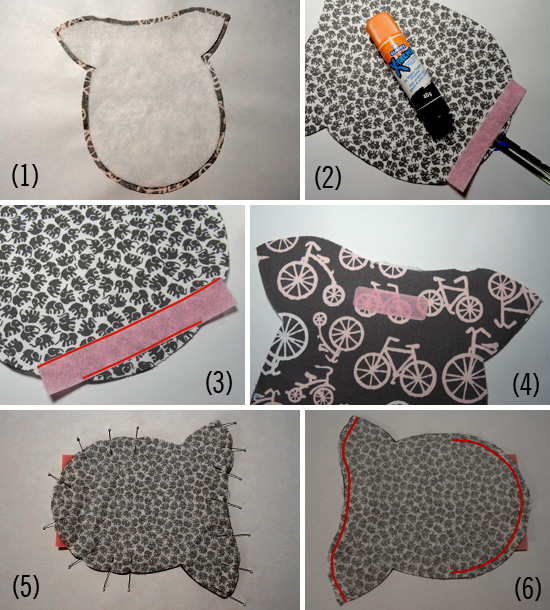 (7) Trim the excess Velcro & clip the curve where the Velcro is – you do not need to clip the entire curve. (8) Clip your seam allowance at both “Flap” markings. Clip up to but NOT through the seam threads. (9) Turn everything right side out through the openings. (10) Pin the straightest edge and top-stitch approximately 1/8″ away from the edge. (11) Pin the large curve between the “Flap” marks. Do not stitch – we will do this later. (12) Make sure the un-sewn seam allowances are lying flat on the outside (see photo). (13) Draw a line across the outer fabric between your “Flap” markings. Topstitch along the line.
  (14) Insert your plastic canvas between the lining and the fusible fleece. Centre it from side to side. It should be in approximately 1/4″ from each fusible fleece edge. Use two pins to secure the plastic canvas in place. (15) Almost done! With the outer right sides together, fold the bottom of the glasses case up. The point should meet up with the top of the “Flap” marking. Pin along the edge. (16) We are going to finish the case with a French Seam. Stitch a scant 1/4″ seam on both sides of the case along the raw edges. (17) Trim the seams you just finished to approximately 1/8″ on each side. Flip the bottom of the case right side out. (18) Finish the case by stitching around the edges with a generous 1/8″ seam. Start at the bottom on one side and end at the bottom on the other. Do not stitch across the bottom edge. Done!
  For Options 2,3 and 4, follow the Step numbers as outlined for each Option. Example: STEP (1). (2.1a)… means – follow STEP (1) above, then follow (2.1a) as outlined in the Option 2 instructions.
 My oldest picked the Monkey Bizness – Market Stall fabric used in her sunglasses case when I placed my latest Warp & Weft order. I love how it turned out, the print is just the right scale for this project!
  STEP 1. (2.1a) Make the strap. Iron your fabric in half lengthwise to make a 2″x5″ piece. Unfold and iron each edge into the centre, refold. Top-stitch each edge. (2.1b) Fold the strap around your D-ring. Stitch as close as you can to the ring – it might help to use a zipper foot. Set the strap & clip aside. STEP 5. (2.5a) Fold your elastic in half, centre it at the closure end of the case. Pin it between the outer and lining, 1/4″ in from the edge, with about 1/2″ of elastic (folded) on the “inside” of the case and the rest sticking out. (I have completed Step 6 in this photo) STEP 6, Note: Double-stitch over the elastic when you reach it. STEPS 8-14. (2.14a) Pin and Baste strap in place on outer fabric, centred as per the photo. Trim excess strap to match the seam allowance. STEPS 15-18. (2.18a) Place your glasses in the case and sew the button on where appropriate. Done!
 STEP 1. (3.1a) Attach the bottom piece of your magnetic snap centred on the Velcro mark you made on the outer fabric. (3.1b) Attach the top of the snap to the lining 1″ away from the curved flap edge. Be sure to interface behind the lining snap. (I used a scrap of fusible fleece.) STEPS 5-6. STEPS 8-18. Done!
 STEPS 1-14. (4.14a) Centre your elastic piece across the fabric as shown in the photo. Baste the edges with a 1/8″ seam allowance. Trim the excess elastic. STEPS 15-17. (4.17a) Make sure the elastic is along the back of the case when you turn it inside out. This is important when stitching the next step. STEP 18. Done!
  There you have it! One (or 20!) easy, customizable gifts for everyone in your life. Take a minute to post a photo to the Thread Riding Hood Facebook page, we’d all love to see your creation!