by Sherri Sylvester | Jul 1, 2013
Happy Canada Day to all the Canadians out there! We are relaxing by the pool today and having friends over. Hooray for holidays!
I’ve never been happy with how small the zipper pull tab is on the regular zippers that you can buy at your local fabric store. Kids have a hard time pulling on them when I’ve used zippers on backpacks and pencil cases and the results don’t look as polished on clutches and bags.

The idea started when I was finishing a few things from last week’s list. I was working on the Gathered Clutch (Noodlehead tutorial here) that I was making for a teacher gift. I love how the strap on my own clutch attaches to the zipper – so I began thinking about how I could duplicate it. At first I thought I could add a jump ring to the original zipper pull… but wouldn’t it be better if the pull wasn’t there at all?!
Thanks to Google (gotta love it!) I found a tutorial on You SEW Girl that explains how to change the zipper pull on any zipper. She uses the wire cutting blades on a pair of pliers to remove the pull – why didn’t I think of that?! A trip to Michaels for some circular findings and a stashed swivel clip later I was good to go.
Now that I had changed one zipper pull I had to change another! The second teacher gift was an Open Wide Zippered Pouch with an iron-on vinyl covered lining. I clipped the pull right off of the zipper and sewed myself a new one. Hooray, so much better! I have to say I’m a bit addicted to this now and might be adding zippers to everything, just so I can change the pull. I love how it turns out!
Want to try it? Here is a quick tutorial on how to change a zipper pull. I will be posting how to add a wrist strap to the Gathered Clutch later this week.
Changing a Zipper Pull
You will need:
- two scraps of fabric for the pull – I used 2″ x 3″
- a zipper
- jump rings (chain findings) in two sizes – from the jewellery section of your local craft store (mine were 1/4″ and 1/2″)
- needle-nose pliers
- school glue stick
- fabric pen
Here we go:
(1) Cut the original pull tab from your zipper using the pliers (see this tutorial from You SEW Girl). (2) Pull away the small piece that is left. (3) Open a small jump ring using pliers and fit it onto the slider. (4) Attach a large jump ring to the smaller one. (5) Close the small jump ring using pliers. (6) You should have the pieces pictured.
(7) Place your fabric right sides together and fold in half so the short ends are touching. (8) Measure 1/2″ in on each side of the folded edge, Draw two diagonal lines to the raw edge corners. (9) Fold over all 4 short ends by 1/4″ and glue them down. (10) Cut along the diagonal lines. (11) Stitch along the diagonal lines with a 1/4″ seam allowance, pivot at the fold. (12) Grade the seam and clip the corners close to the stitching.
(13) Turn the Zipper Pull inside out, press, top-stitch the ends closed with a small seam allowance. (14) Wrap the Zipper Pull around the large jump ring on your zipper. (15) Unzip the zipper and stitch it on close to the jump ring. It is easiest to use a zipper foot. (16) All done!
Look at how great your new zipper pull is! And I”m sure you can think of so many more possibilities!
Come on back later this week for a tutorial on adding a strap and swivel clip to a Gathered Clutch.
by Sherri Sylvester | Jun 17, 2013
Right off the top – I have a confession to make. I posted this shirt at the end of April for Made by Rae’s Spring Top Sewalong. I still love the shirt, the problem is I called it a “Wing Sleeve” shirt which is totally NOT what it is… this shirt is a Dolman/French sleeve shirt – so I apologize if I totally confused anyone! Now that is corrected (whew…) I feel better and we can get on with the tutorial.
Dolman Sleeve Tee
Oh, before I forget – If you have not signed up to win some fabric from the Friday’s Off giveaway yet, click here to enter! Alanna from Friday’s Off Fabric Shop is giving away an 8 fat quarter bundle! Giveaway ends June 21st, 2013.
I love how comfy these shirts are. Not having to set a sleeve in when sewing them is also a huge bonus! Adding sleeve bands and a hem band also helps the sewing process to speed along and minimizes any tendency for the knit material to stretch and ruffle when you don’t want it to.
This tutorial can be used to draft any size of tee, so long as you have a sample tee in the size you would like to make. You could even make one for a child or even a toddler – how cute would that be?! All you would have to change is the height of the arm and hem bands.
Will you be trying this tutorial?
You will need:
- sample Tee – a tee that fits you well
- knit fabric, must have the same amount of stretch (or more) than your sample shirt
- paper to draft your pattern – freezer paper, large roll paper etc.
- pencil/pen, ruler, paper scissors (NOT your fabric scissors!)
- ballpoint needle
- other sewing gear
Before we begin:
As I made the drafting instructions for this I kept referring back to the original dolman sleeve shirt that I used as a sample. I thought it might be helpful for you to be able to see the differences between how your tee looks laid out with the dolman sleeve. In this tutorial I trace the original shirt in blue marker and draft the new pattern in pink marker.
Here we go:
DRAFTING THE PATTERN:
Step 1: Pattern Paper & Sample Tee Tracing – (1) Make sure your paper is large enough to draft your pattern. You will need a piece that is as wide as half of your sample tee. You may want longer sleeves than your the sample tee, so keep that in mind. (2) Fold your sample tee in half, front side out. Place the front centre fold on the edge of your pattern paper. (3) Trace around the sample tee. When you trace the sleeve portion make sure that the top edge of the sleeve is laying flat to the paper. Don’t worry about making the underarm flat while you are tracing it, this part will change drastically from the original sample tee anyhow. (4) Trace and label both front and back necklines. (5) Mark where the shoulder seam ends and the sleeve begins (red circle).
Step 2: Mark Neckline – (1) Put on your sample tee and measure where you would like the edge of your neckline to be. I like mine to be a bit wider, more of a boat neck type neckline. (2) I marked a place roughly an inch over from the original neckline edge and freehand re-drew the neckline in pink.
Step 3: Draw (most of) the New Sleeve – (1) Draw a long line that follows the neck-to-shoulder seam at the top of your shirt. (2) Beginning at the mark where the sleeve seam begins (Step 1-5), draw a (roughly) 15 degree line to the edge of your paper. I used the 30 degree line on my clear ruler to estimate the 15 degree angle. It is not important for this to be exactly 15 degrees – don’t stress over it! (3) Measure the width of your sample tee’s arm opening, mine is 5″ OR Measure around your upper arm and divide the number by two to get your width. (4) Decide how long you want your sleeves to be. Remember you will be adding a 3.5″ arm band to the sleeve length you choose. Measure along the top of your shoulder to the ending spot for your sleeve. Try to keep your arm on the same angle as the pattern (15 degrees from the shoulder). This will help – but you may need to try on the shirt-in-progress later on to check the sleeve length. (5) Draw a line the width of your sleeve opening at right angles to your (last) line from Step 3-2.
Step 4: Draw the Bottom and Side Seam – (1) Decide on the length of your new shirt based on the hem length of the sample tee. Remember you will be adding a 3.5″ hem band to the shirt length you choose. Mark this length with a straight line. I wanted my new shirt to be a bit longer, so I straightened the sample tee length. (2) Measure the length between your sample tee under-arm seam and the new length marking. (3) Mark the halfway point on your shirt at the side seam (red circle). (4) Draw a straight line (at right angles to your tee length line) up from the bottom of your tee to the halfway point marking you just made. Continue to freehand this line to draw the curve so that you finish the underarm seam and the bottom of the sleeve. Refer to the “Before we begin” photo if you need to know how the curve looks in relation to your sample tee tracing.
Step 5: Finishing the Pattern – (1) At this point I cut out my pattern, but I wish I had not. It is best at this point to draw in your seam allowance. I didn’t and I forgot to add it when I cut out the pattern (boo me!). Thankfully it still fits, but the arms are a bit tight. (2) Cut out your pattern. Cut the back neckline and leave the front neckline on the pattern. When you cut out your fabric you can cut one of each. (3) Mark the centre front/back of the pattern as a “cut on fold” line (again, I should have done this) and the size and type of pattern on your piece so you know what it is later.
SEWING THE TEE:
Step 6: Cutting out the Main Shirt – (1) Fold your fabric and cut (with your pattern piece on the fold) one each of the front and back main shirt pieces. Your knit fabric should stretch the most in the direction that goes around you, from side to side on the shirt – NOT from top to bottom.
Step 7: Cutting the Hem Band – (1) Open up the shirt front and measure the width of the hemline. Your hem band should be cut to a few inches less than double this measurement + 1″ for seam allowances. Example: My hemline width measurement was 18″. I decided I wanted the band to be 3″ smaller than this (15″), doubled it to be 30″ and added 1″ for seam allowance to make the band 31″ long. (2) Cut the hem band 7.5″ high by the length you measured in step 7-1. Make sure the stretch in your knit goes along the width of this piece, not the height.
Step 8: Cutting the Arm Bands – (1) Refer back to the arm width measurement you used for step 3-3. (2) Same as the Hem Band, the Arm Bands should be slightly shorter than double the arm width measurement + 1″ for seam allowances. Example: My arm width measurement was 5″. I made that slightly smaller at 4″, doubled it to be 8″ and added 1″ for seam allowances to make the band 9″ long. (2) Cut two arm bands 7.5″ high by the length you just measured in step 8-1. Make sure the stretch in your knit goes along the width of this piece, not the height.
You should now have these pieces:
Step 9: Sew Side and Shoulder Seams: Place your front tee piece over your back tee fabric right sides together. Using a ball-point needle and a stretch stitch (or a long, narrow zig-zag) stitch the side seams and the shoulder seams. (marked in red). Use whatever seam allowance you added to your pattern in step 5-1.
Step 10: Hem the Neckline – Note: This seems a bit unconventional, but it worked to keep the neckline from stretching and ruffling when I hemmed it… does anyone have another way to do this? (1) Measure around the entire neckline. (2) Cut a piece of your fabric that is aprox 1/2″ wide and as long as your neckline measurement. Make sure the stretch goes in the opposite direction of your main fabric. I used the selvage, it was about 1/2 as stretchy as my main fabric. We’ll call this the neck band. (3) Stitch the neck band into a tube. Check to make sure it fits over your head. (4) Fold the neckline under 1/2″, pin the neck band under the folded edge as you go. Pin the seam allowances at the shoulder seams towards the back of the tee. (5) Stitch the neckline hem close to the edge of your folded hem with the neckband hidden inside. Stitch with the right side up and use a double needle or a long, narrow zig-zag.
Step 11: Arm and Hem Bands: (1) Fold all of your bands right sides together and stitch along the 7.5″ height with a 1/2″ seam allowance, make sure they are right sides together before stitching! (2) Fold all the band tubes in half with right sides out, so all of the long raw edges are matched up. The bands will be roughly 3.5″ high after folding. (3) Pin each arm band to the sleeve opening, right sides together, matching the seam on the tube with the underarm seam on your tee. Stretch the band slightly as you pin to match the length to the sleeve opening. (4) Mark the hem band and the tee hemline in 4 equal lengths with pins. Pin the band right sides together with the tee hemline, matching your marking pins and the band tube seam with a side seam on the tee. (5) Use a stretch stitch or a long, narrow zig-zag to stitch the arm and hem bands to your tee.
Congratulations! You have another piece to add to YOUR wardrobe. Go show it off!
Are you happy with how your shirt turned out? We would all love to see your tee, come on over and post a photo to the Thread Riding Hood Facebook page!
by Sherri Sylvester | Apr 22, 2013
Today I finished the first piece of clothing I have made for myself in a very long time. I made a few tops when I was pregnant with my second daughter that I wore quite a bit, but since then I have concentrated more on the kids.
I bought a shirt last Friday that I really like, it is sort of a wing sleeve shirt and has a boat neck, which works well on me because I have wide shoulders and this does not have a shoulder seam in it. Not having to set in a sleeve also makes it really easy to sew, which is part of the reason I decided to buy the shirt in the first place. I folded the new shirt in half, laid it on a piece of knit fabric, cut it out and stitched on the sleeve and bottom hem finishing pieces – Done!
Super Simple Wing Sleeve Shirt
I think I might make at least 3 more of these! I’m so happy with how it turned out. Made By Rae just finished her yearly Spring Top Sewalong and I missed it by 3 days, next year I will have to plan better! You can still see the flicker group by clicking on the button below.
The fabric is a piece of slightly sheer knit from the end-of-yardage pile at my local fabric shop. I’ve had it for at least a year now and am finally making a shirt with it. I can’t complain, the piece was likely around $3.00 – a shirt for that price? And it only took a couple of hours to sew – I’ve got to get me some more pieces of knit like that!
This is a really great project for a knit fabric beginner because it is so simple to sew up. The folded fabric on the sleeves and hem edge are a lot easier than stitching a hem, which can really be hard to do with knit fabric because it tends to ripple and stretch. There was just under a meter of fabric and so I barely squeezed the shirt out of it. The sleeves on the original shirt were a bit longer than on this one. But it is so comfy and I love the colours. Next time I make one I will have to post a tutorial.
I have to say, this was a strange post for me. Editing and choosing photos of my kids, husband and inanimate objects is so easy! Editing and choosing photos of myself is SUPER hard! I have discovered that looking at “posed” photos of yourself is like listening to a recording of your own voice. Apparently you don’t actually look (or sound) like what you think you look (or sound) like in your head as you walk around each day! As a result, choosing photos of someone that is supposed to be you, but doesn’t look quite right is pretty difficult!
Hope you all are having a wonderful beginning to your week. Come back on Friday for another Canadian Online Fabric Store interview. This one comes with a giveaway and discount code again! I’m really excited to share Karen’s store with you, she’s got a really great selection and amazing service! AND, she’s giving away a set of one of my most favorite fabrics! Have a great week – See you soon!
If you are wondering… My husband’s knee surgery went really well! Everything is progressing along much better than we ever could have expected. We even got to go on a trip to the park today with the kids, Hooray!
by Sherri Sylvester | Jan 14, 2013
I had to think really hard for what I was going to make my Father and Brother-In-Law for Christmas. They both love golf, but what to make that was going to actually be useful?
The Golf Towel
The idea for these towels came from a tutorial I found here. From there I basically went my own way. Though I think her idea of the corner is good, my husband – who also likes golf – thought it might not be so useful.
I used an absorbent bath towel with a chevron print for the back and some manly looking prints for the front.
These are super-easy to make in batches of 4 towels, or 2 of each as I did.
Mini Tutorial: 1) Cut your towel into 4 equal pieces (cut once lengthwise and once width-wise). 2) Cut your fabric to match the size of the towel quarters. 3) Place both pieces right sides together and sew, leaving a 3″ opening on one side. 4) Turn right side out, iron, topstitch close to the edge all of the way around (and closing the opening). 5) Add a large grommet in one corner and you are done!
Labeled and ready to gift!
by Sherri Sylvester | Jan 7, 2013
Today’s Made by Me Monday is one of my sewn Christmas gifts. This tote bag went to my mom. My sister got one as well, but I forgot to photograph it before it was wrapped.
The Go Anywhere Bag
Front View
This bag is super cute and large enough to hold a lot. I bought the pattern from noodle-head here. Anna also has a few other bag patterns on her patterns page – go check them out! I think the Sidekick tote looks really handy, and you can learn how to make a recessed zipper too!
Back View
I added a small detail with a clasp on the back of the bag because I didn’t have any magnetic snaps at home and didn’t like the look of adding velcro to close it. I think the clasp adds a nice touch and looks more professional anyhow. This way it stays closed but still has plenty of room on either side to reach in and grab your book/keys etc.
Clasp View
The fabrics are from a local shop near me. Both are Dear Stella prints. The green is Stella-2 and the flowered on is Stella-46. Funny thing is I didn’t realize I had put them together until I got home… no wonder they match each other perfectly!
by Sherri Sylvester | Jan 5, 2013
Now starts the fun! I can finally post some Christmas gifts that I made now that Christmas is over. This is the first, though you may have seen these before on my first blog post (ever!) here.
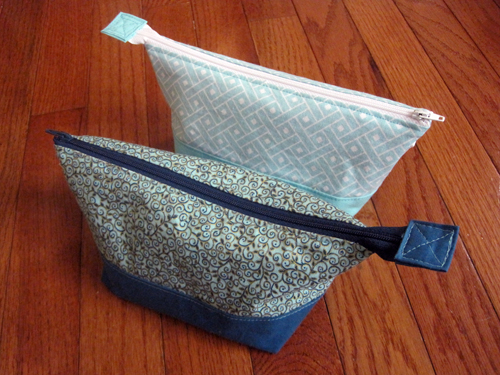
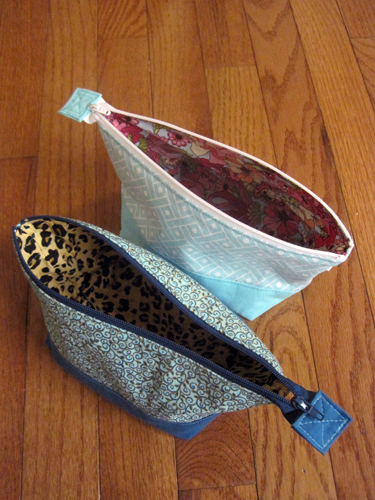
I made a few more Open Wide Zippered Pouches from Noodlehead and called them Makeup Bags. It was so much fun picking the fabrics. I especially like these two combinations.
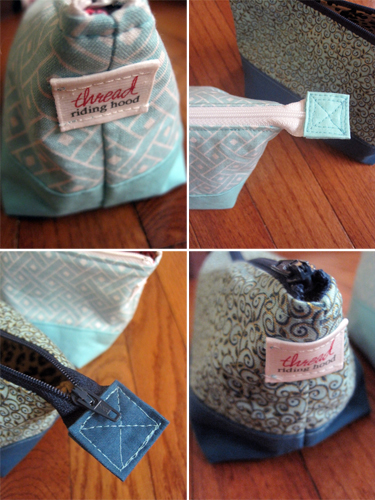
The little details on these really make them nice and give them a professionally finished look. I like the crossover on the tab, and adding a label to the end doesn’t hurt either!
I did actually end up making 4 of these, but 2 disappeared (to my daughter’s teacher and my favorite hairdresser) before I could photograph them. I went out and bought some tiny lotion/shower gel/candles to put inside. They are the perfect size for traveling.