by Sherri Sylvester | Dec 16, 2016
I have a general lack of Christmas pillows, so I’ve been trying to make one each year to add to my collection.
This pillow was designed to be super simple. Two square sides, some quilting, and an invisible zipper closure + pompoms for some fun! My husband isn’t sold on them (yet?), but the kids and I think pompoms are definitely the way to go.

I’ve been stashing the materials for this in a project bag since before last Christmas. Which (of course) is when I planned to make it. As usual – the number of ideas “to sew” were bigger than the time there is to actually sew them. Sound familiar?!
This year I decided to buy all of my gifts, save a few simple zippy pouches for the babysitter and our teachers. I am so much more relaxed, and (thanks to online shopping) we only need to find a couple more things! I really miss planning homemade ideas and sharing them. But to be honest – it’s pretty stressful since I am a procrastinator and never (ever) start early enough. (Plus, there are always birthdays to make up for it!)
I’m also happy to be part of Janome Canada’s series “12 Days of Best Loved Accessories“ and this pillow fits perfectly into my favorite! I have LOVED the AcuFeed Flex (dual feed) system on the Skyline machines I’ve been loaned.
The dual feed system works like a walking/even foot – but the top feed dogs are connected directly to the machine – so it’s more accurate. Since I’ve been using it I’ve haven’t had any bunching or shifting on my quilted projects – and they worked great when sewing the matching the plaid pattern on the seams of my new pajama pants.
The Skyline S9 (and some other Janome machines) include more than one width of the foot – so I have a narrow and a wide foot available to me. Plus a 1/4″ quilting foot, open toe foot and a zipper foot! Great for making sure everything moves along evenly!
I spray basted these layers together and quilted them in a grid pattern with creme thread. I marked a few lines and then used the quilting guide bar to keep them “even”. I prefer a slightly wonky look to my quick projects since I generally can’t keep the lines perfectly straight anyhow! After that, it was simple to trim the pillow into a square, add the pompom trim and zipper and done.
Hmmm… as I’m writing this I just realized there’s a gold shirt in a project bag that is due to be upcycled into a pillow as well… maybe next year?!
Are you hand-making your Christmas gifts?
Fabric: Riley Blake Designs “Lost & Found Christmas” by My Mind’s Eye, from Country Clothesline (out of stock)
by Sherri Sylvester | Oct 31, 2016
We’re big fans of the Disney movie Frozen over here.
Since we have two girls – so it’s hard to avoid! But, my husband and I are also impressed with the direction Disney has been taking in their movies lately.
Less “Princess + Boy = Happy Ending” and more “Princess/Girl + Bravery = Happy Ending”.
It’s a win-win for us and our kids. They get the princess story, and we get the more positive role model.
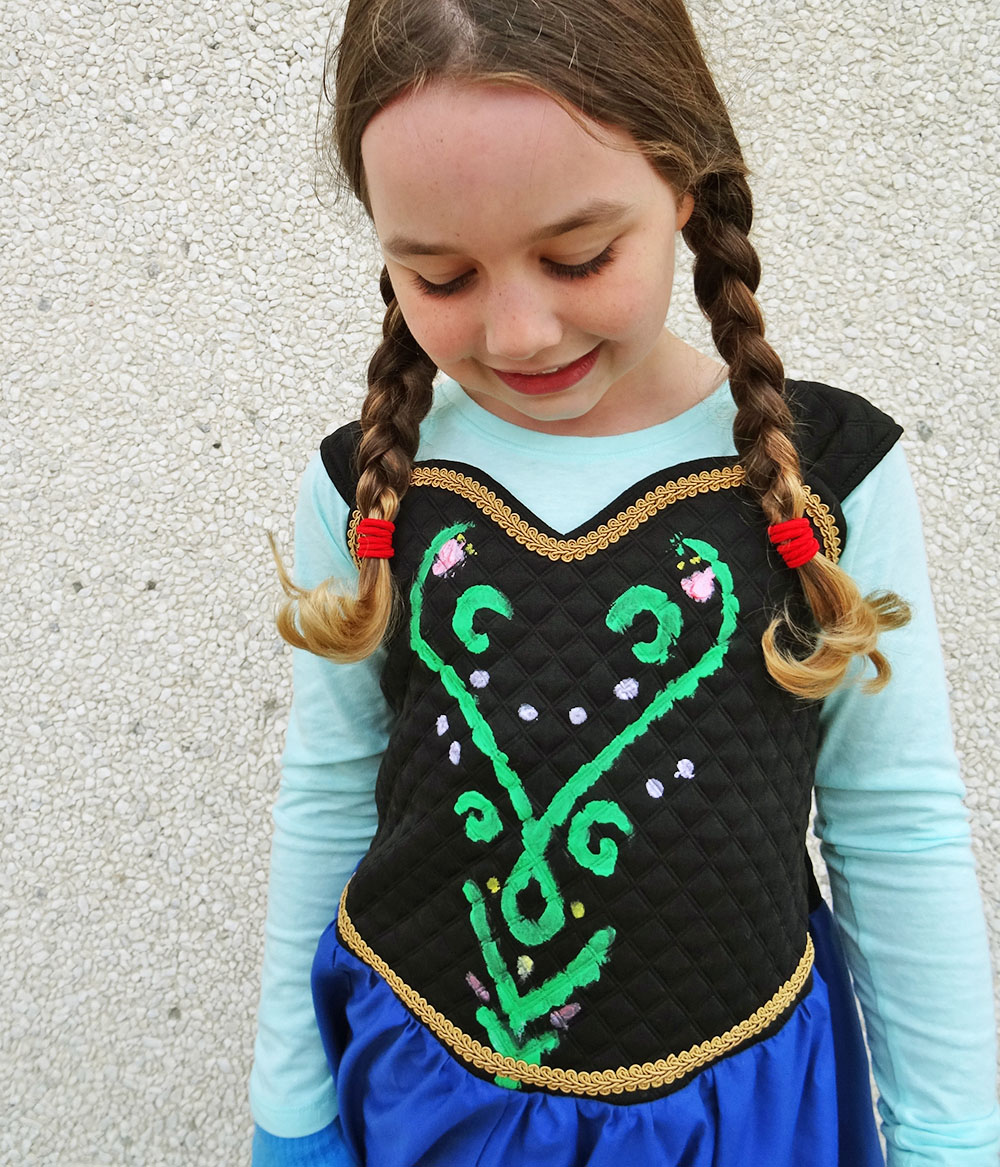
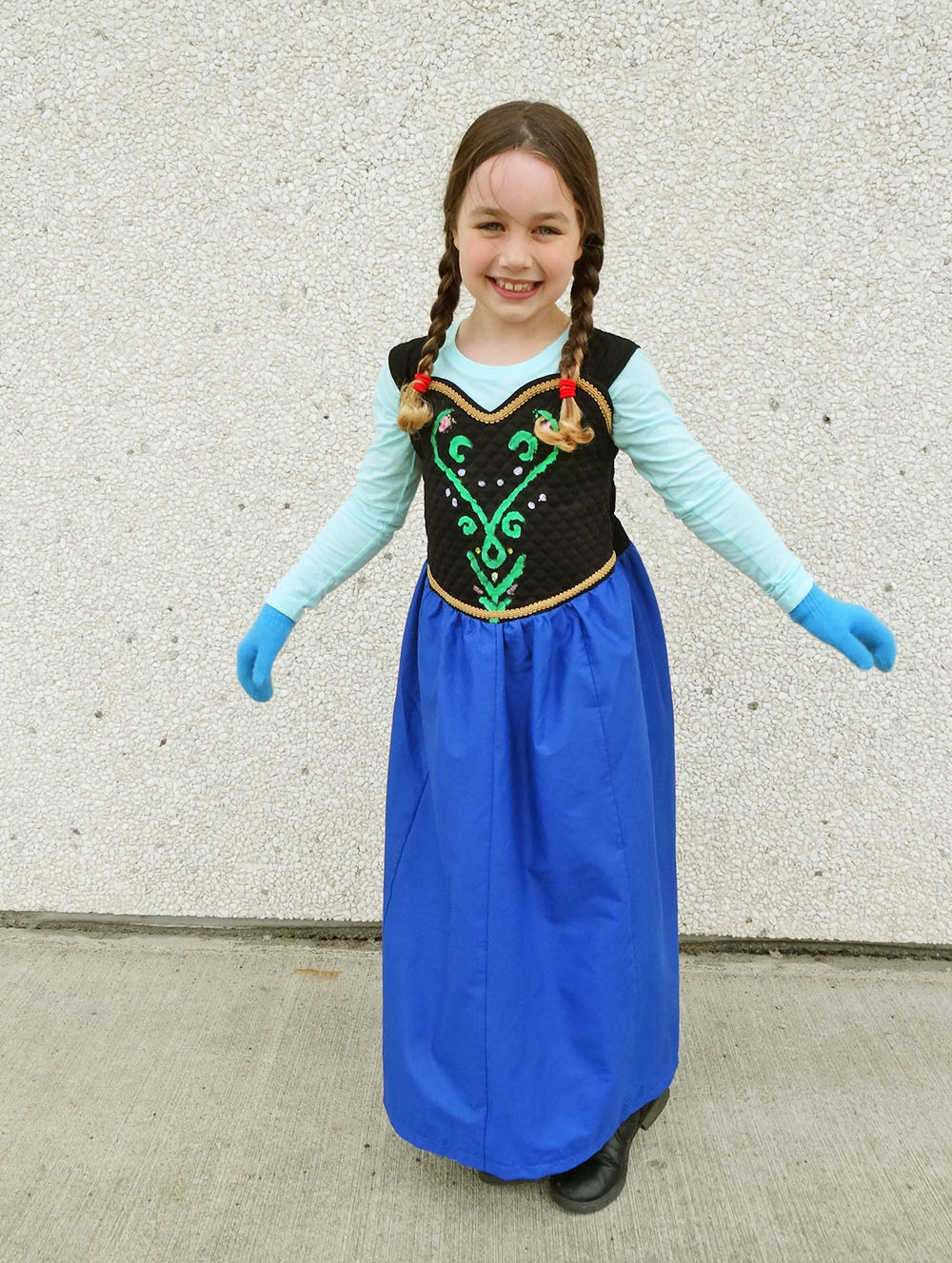
Earlier this year (think spring!) my oldest decided to be Anna for Halloween. No questions asked – this was happening. From here on in there was talk of being Anna. Especially as costumes started to appear for sale.
With my time being directed at getting ready for Creativ Festival, I didn’t think I could make costumes. But, even when face-to-face with the “perfect” Disney Store Anna costume my daughter decided that a mommy-made version was better. Awwww…. good for this sewing mama’s heart – and of course I could be convinced to make a costume!
I really am pleased this year – it’s a minimal effort, maximum effect kind of deal – like their Jake and the Pirate costumes. Thankfully it was also a quick one.
Here is a run-down of how I sped things up:
The Cape:
- Non-fraying and no-hem-needed Fleece for the cape
- Trim inspired by the Simon and Co – Simple Anna Costume tutorial
- Pattern: Cape from “Little Things to Sew” by Liesel Gibson (Same as this Little Red Riding Hood costume )
- KAM Snaps on the front instead of a tie.
- Cut a shorter duplicate of the top of the cape for the second layer.
The Hat:
- self-drafted using the hood pattern pieces from the “Little Things to Sew” Cape (see above)
- I placed our previously made cape inside-out on my daughters head and traced the general shape of the hat. Then transferred it to the pattern pieces, adding a facing to finish the edges.
- To get it to stay on, my daughter had the idea to use a headband – which easily slipped into the facing around the front of the hat.
The Dress:
- Bodice is based on the Annabelle pattern by Violette Field Threads (also made in my favorite blue chambray, and as Easter dresses)
- I had some quilted knit in my stash that was perfect!
- We put a blue ready-to-wear shirt underneath instead of sewing sleeves.
- My daughter drew and painted the “embroidery” herself using fabric paint.
- Skirt is sewn from broadcloth, with a bit of a “V” self-drafted into the front.
What about the little one?
She was happy to wear an Owl costume we found at the consignment shop. Easy peasy – photos later today on Instagram I’m sure!
Funny thing though. I wanted to wash it – being thrifted and all – so it went in with all the week’s socks and underwear. When I opened the washer – Surprise! I had a tub full of stuffing! The owl’s lining fabric frayed, leaving holes where a large bucket of stuffing escaped and mixed with my clothes.
After spending 1/2 hour cleaning stuffing off of socks and underwear I’ve learned my lesson – always read the label. This one says “Spot Clean Only”, of course!
What are your kids dressing as this Halloween?
by Sherri Sylvester | Feb 3, 2016
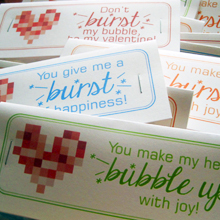
Today I’m posting a free school-approved non-food/candy Valentine printable! (Spoiler alert for all of our neighbors!)
These supplies are easy to find, so this project comes together super-fast! The erasers were 60 pcs for $1 from Target, the clear bags were 72 for $1 from my local Dollar Store. Sewing (or stapling) them on was simple, since I needed to make more than 70 of them. And I decided to use up my almost-empty thread spools and the fancy stitches on my Janome Skyline S5. My kids happened to like the heart stitch best, so we used it a lot.
The cards are designed in 7 colour-ways. A rainbow of colours, because I have girls – and rainbows always make things amazing. #rainbowtizeeverything Plus I wasn’t sure what to do about the boys in their classes. I suppose they will live with the frilly border and girl-centered eraser choices in blue or teal green!
Make sure, when sewing paper with your sewing machine, to use an old needle and replace it right after sewing these. (You might also want to clean the inside of your machine too!)
Supplies: Small clear bags, Sewing Machine or Stapler, Thread, Small Erasers, 4×6 Photo Paper or Cardstock
Instructions: Print as many cards as you need, cut them if necessary. Place the erasers in clear bags and attach them to the cards. Write names on them and DONE!
More Valentine Tutorials, Printables & Inspiration
by Sherri Sylvester | Dec 21, 2015
Update 2020-09-17: Since Craftsy is not available anymore – please find the tutorial on the Way Back Machine by clicking the link below:
Access the FREE ONE HOUR DOPP KIT TUTORIAL here.
______________________________________________________________
Needing a super-quick gift to sew up? This project suits the manly giftee in your life perfectly! Of course, we know how hard it is to find sewing projects for men – though or course you can make it for women or kids too.
It takes only an hour, including cutting – seriously – not kidding… You start with 3 large same-sized rectangles and 2 small same-sized ones. I was so happy when I figured out how to make it fully lined, no exposed seams and fat-quarter friendly! I hope you love it too.
This project posted up on the Craftsy sewing blog last Thursday, and I was thrilled to have someone already make a few for her grandsons. Yippee! Makes my day every time I see something posted that one of you has made from a Thread Riding Hood tutorial.
by Sherri Sylvester | Dec 11, 2015
Yesterday I introduced Meerkat Shweshwe and showed you how to draft a pinafore pattern in any size. Today’s tutorial tells you how to sew up a reversible pinafore using that pattern! (This post is sponsored by Meerkat Shweshwe. Thank you for supporting the sponsors that support this blog!)
This pinafore is made from two prints of Authentic Three Cats Shweshwe. You can find out more about this unique, high-quality cotton fabric and purchase yardage directly from Meerkat Shweshwe, a Canadian distributor of this South African fabric.
I also promised yesterday I’d tell you why my daughter’s doll (that my mom made, more on that next week!) has a matching reversible pinafore. When I was speaking with Meerkat Shweshwe’s owner, Céleste, she asked if I’d want to make a matching doll dress, and told me a story from her childhood. Her grandmother lived too far away for regular visits, so Céleste’s mother would send fabric and patterns to her grandmother so she could make dresses for Céleste and her sister. Her grandmother would use leftover fabric scraps to make a matching dress for their dolls. What a great idea! Such a special gift. I thought it would be super-cute to make one and my daughter is so happy with it!
How to Sew a Reversible Pinafore {in any size!}
Materials:
- Sweshwe yardage is calculated based on your drafted pattern pieces. You will need enough fabric to cut one set of pattern pieces for each side of the reversible pinafore. (See the sample cutting layout below)
- 2 buttons for the back closure, 1″ works well
- 1 length of ribbon for the back closure, 10″ is plenty
- matching thread suitable for top-stitching both fabrics.
How to determine Yardage:
I was able to make this size 6 Pinafore with pockets and matching doll dress from 1 1/2 metres each of 36″ wide (before pre-washing) Sweshwe fabric. Be sure to measure your pieces carefully, taking into account shrinkage from pre-washing and the width and length of your fabric. Don’t forget to take any one-directional fabric into account as well. The cutting layout below may help. (Note: I actually left myself a little bit less yardage than I meant to because my rough yardage draft had quite a bit more space. Make sure to order a little bit more if you want a less nerve-wracking cutting experience!)
Cutting your fabric:
- Pre-wash, dry and press your fabric.
- Cut the following pieces from each length of fabric:
- 1 Skirt Front
- 2 Skirt Backs
- 1 Bodice Front (on the fold)
- 2 Bodice Backs
- 2 Patch Pockets
Sewing the Reversible Pinafore:
Seam allowance is 1/2″ unless indicated otherwise. It is recommended that you finish all seam allowances to produce a longer-lasting garment. Options include: trimming raw edges with pinking shears, zig-zaging all raw edges or serging all raw edges.
Sew the Bodice:
- Align both matching Back and Front Bodice pieces at the shoulders. Stitch. Press seam allowances open.
- Fold the ribbon into a small loop – you will need about a 5″ length to do this. Pin it in the middle of the centre back on one bodice, as in the photo below. Make sure there is enough ribbon to go around your button and include the 1/2″ seam allowance. Baste with a 1/4″ seam.
- Align the two Back/Front Bodices along the neckline/centre-back edges, matching shoulder seams. Stitch.
- Trim/Clip the seam allowance along the curve to help it lay flatter.
- Turn the bodice right side out, press carefully along the seam. Double-check to make sure the button fits through your ribbon. (Do not top-stitch, we will do this in a later step.)
- Now we can stitch the armholes together, pay careful attention to the photos for help as you go. Lay the bodice flat on your work surface. Open the left side of the bodice so the fabrics are laying wrong side down.
- Roll/fold the right side of the bodice until it is centred on the seam that connects the left two reversible sides of the bodice.
- Fold the left side of the bodice around the rolled fabric, aligning the armhole edges. Pin, Stitch. Be careful not to accidentally stitch over the folded fabric.
- Clip/trim the seam allowance along the curve. Open the layers and pull out the folded fabric, turning the bodice right side out again. Press the stitched armhole well.
- Lay the bodice flat on your work surface again. Open the right side of the bodice so the wrong side is laying wrong side down.
- Roll the left side of the bodice into the centre of the right side, over the seam.
- Fold the right side of the bodice around the rolled fabric, aligning the armhole edges. Pin, Stitch, being careful not to stitch over the folded fabric.
- Clip/trim the seam allowance along the curve. Open the layers and pull out the folded fabric. Press the stitched armhole. Tada! You have almost finished the bodice.
- Open the sides of the front bodice and align them so they are right sides together with the back bodice side seam, match up the underarm seam. Stitch.
- Fold the bodice wrong pides together again and press well. Set aside.
Prepare the Skirt for Pockets:
- Stitch each matching Back Skirt to each side of the Front Skirt along the side seams (length of the pieces, from the drafting instructions). Press the seams open.
Sew the Patch Pockets:
- Press the top of the pocket to the wrong side by 1/2″. Turn the pocket over and press the folded top of the pocket over another 1″, this time to the right side.
- Stitch around the sides and bottom of the pocket with a 1/4″ seam. Turn the top of the pocket right side out and fold the sides and bottom following the 1/4″ seam. Make sure the seams don’t show on the front of the pocket.
- Top-stitch the top of the pocket 3/4″ away from the top folded edge. Repeat for all 4 pockets.
- Measure the width of the Front Skirt from seam to seam and divide by 3. Mark these measurements on the Front Skirt.
- Align the left/right edge of a patch pocket on each 1/3 measurement – closer to the side seam. Pockets should be about 5 1/2″ down from the top of the Skirt. (If your skirt is much larger/smaller, place your pockets where you would like accordingly.)
- Top-stitch around the sides and bottom of each pocket about 1/8″ away from the edge.
- Repeat steps 1-6 to attach the patch pockets to the other Front Skirt.
Sew the Skirt:
- Align the two sewn skirt panels right sides together, matching side and bottom edges. Stitch the sides and bottom leaving an 8″ opening somewhere along the bottom edge. Clip the corners. Make sure your pockets are aligned correctly!
- Press both edges of the 8″ opening 1/2″ to the wrong side.
- Turn right side out, neatly push out the corners and edges and press well. You will have a raw edge on the top of the skirts only. (Do not close the opening.)
Attach the Skirt and Bodice:
by Sherri Sylvester | Dec 10, 2015
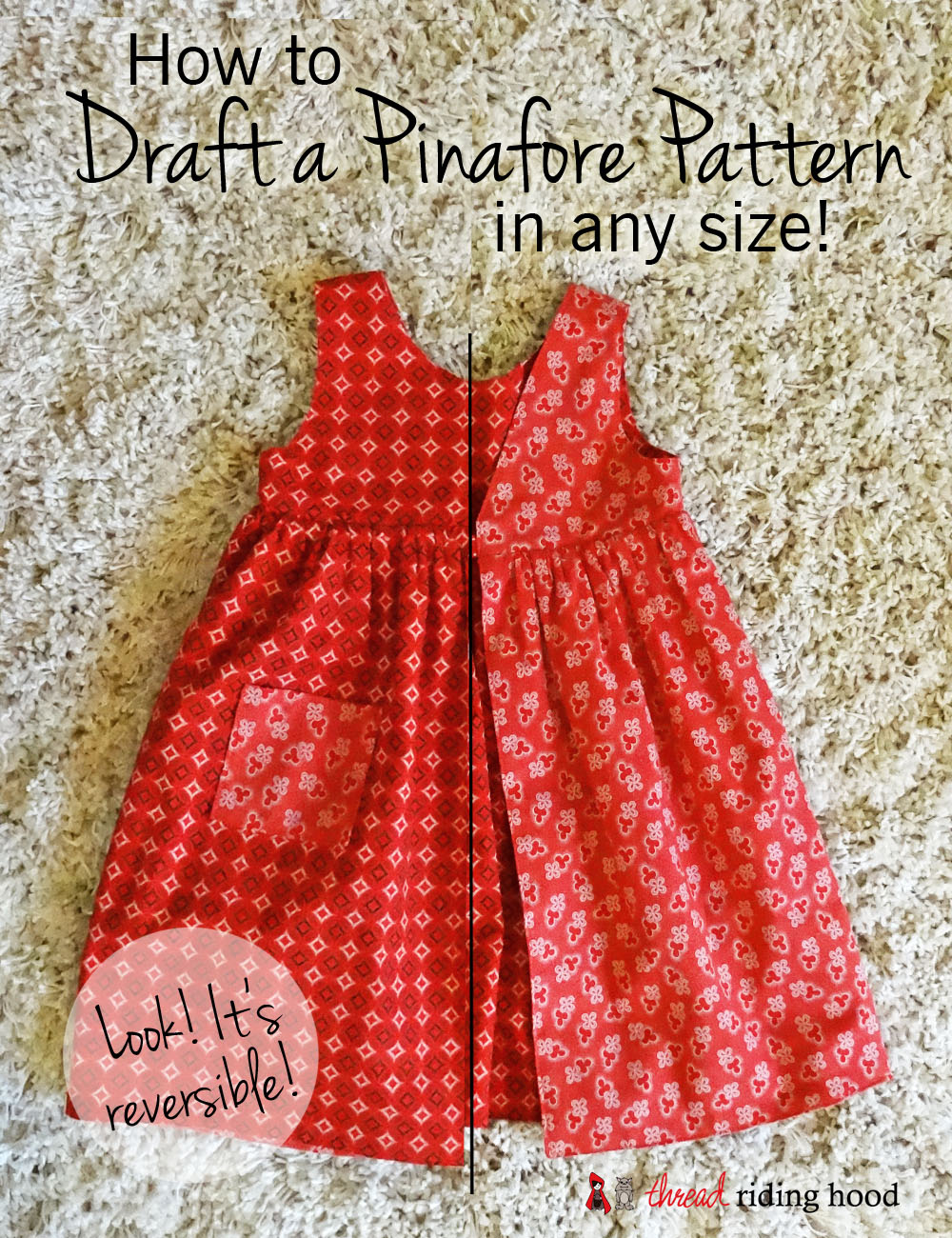
It’s a Shweshwe Holiday over here! This post is sponsored by Meerkat Sweshwe, who contacted me a while ago to see if I’d like to create something with their fabrics. I fell in love with the these red prints and we agreed they would be perfect for a holiday pinafore. (+ Come back tomorrow to find out how to sew a reversible pinafore, and hear the story of why my daughter’s doll has a matching dress!)
Before we get too far into the Pinafore tutorial – I know some of you are asking, “What exactly is shweshwe?” It’s a lot less complicated than it sounds! This fabric is 100% high quality cotton, produced in South Africa. It’s history is fascinating, and you can find out a lot more about where it came from, or get a condensed version in my earlier interview with Meerkat Shweshwe’s owner, Céleste.
This unique fabric is treated with starch, a traditional way of preserving it during long sea voyages. Depending on who you purchase it from it comes pre-washed or in it’s original state. I was curious to pre-wash it myself and my youngest and I had lots of fun doing it. The fabric started out very stiff and it smelled like a new box of crayons. First, we pre-soaked it in super-hot water, to remove the treatment. (Pushing it underwater with a wooden spoon is super fun according to the five year old!) Then I washed and dried it like I would a regular load of laundry and it came out super soft, just like any cotton fabric you’d use for a project. It is really nice to iron as well, very crisp and easy to press. And you can tell it is high quality – with a tight weave that will last. I tried to take a few before and after photos below so you can see the difference in the fabric.
Unwashed Shweshwe
Unwashed Shweshwe
Soft, Washed Shweshwe
I’m also excited to let you know that Meerkat Shweshwe just opened an online store! Their well laid out shop has large photos and lots of options. There is an opening special of 10% off everything in the store, until December 18, 2015! Use the promo code DOORCRASHER, minimum order $18 before tax and shipping.
If you ever get a chance to talk to Céleste directly take it! (at Creativ Festival maybe?) She is so passionate about these fabrics and their use, and it is so fun to talk to her because of it. You’ll have to ask her about her having a part in working to provide more jobs for South Africans by supporting the Da Gama Textile factory. I really appreciated talking to her and being able to work with fabrics that hold so much history!
This tutorial will show you how to draft Pinafore pattern pieces in any size. I will be finishing this series up tomorrow with a tutorial on how to use these pattern pieces to sew a reversible pinafore. It’s easier than you think – and my fashion-loving five year old really likes being able to choose (and change) her outfit so easily. I love the traditional look of a pinafore, and it adds extra warmth (and cuteness!) to a basic shirt/leggings in the winter.
This drafting tutorial requires a simple woven dress bodice pattern to use as a base, it works especially well with a bodice that has flutter sleeves or no sleeves. I have used the First Day Dress as my base to draft from.
This tutorial assumes your base pattern has a 1/2″ seam allowance. If your seam allowance is different, please be sure to compensate for that when drafting this pattern.
Draft the Pinafore Bodices:
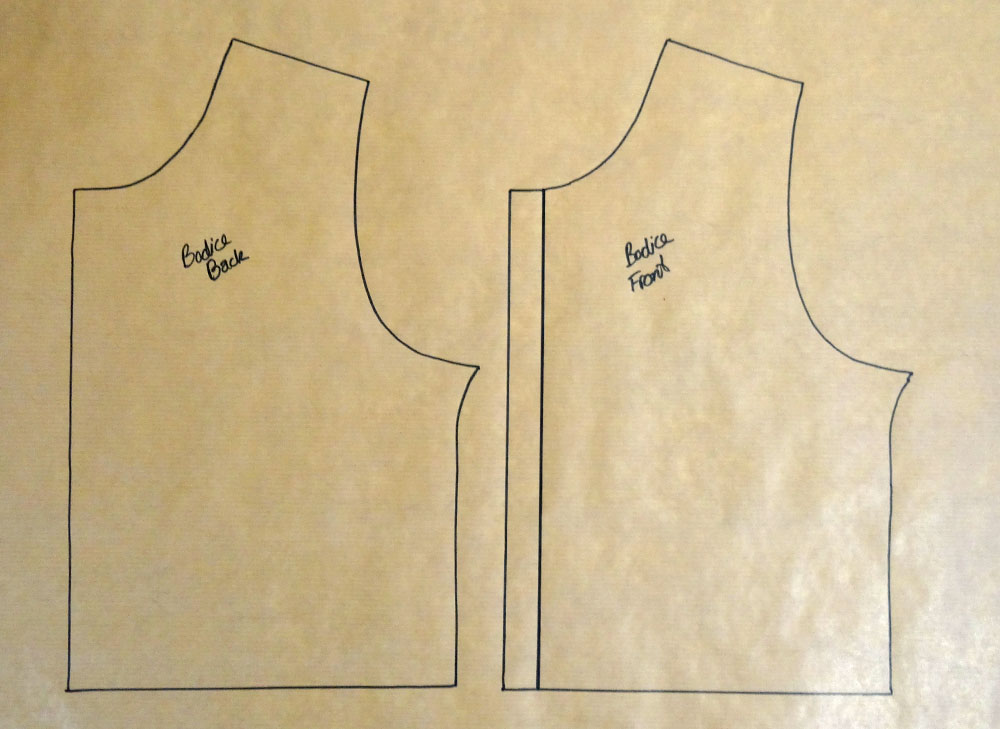
- Trace the bodice front and back onto a larger sheet of blank paper. Choose a bodice size that is generous, to allow for a shirt to be worn under the pinafore. I added 3/4″ to the centre of the front bodice to allow for even more extra room.
- We are drafting an empire waist pinafore. If your base pattern has an empire waist, skip this step. If not, measure 2-3″ (+ 1/2″ seam allowance) down from the armhole along the side seam and mark the empire waist as a straight line across the front and back bodice.
- Many pinafores have a lower rounded or square front neckline. If you would like to change it, mark the changes on your pattern piece. Remember, your neckline will be 1/2″ lower than your new marking because of the seam allowance. (Pink line below.)
- The back of the pinafore is also generally cut into a v-shape, which fits well with the button closure we will be using. Mark a line from the inside of the shoulder to about 2″ up from the empire waist line. Remember the actual pinafore will be 1/2″ smaller due to the seam allowance.
- Mark the centre fold, size, cutting directions and name on each pattern piece and cut them out. The Front Bodice is cut once on the fold, the Back Bodice is cut twice.
Draft the Pinafore Skirt:The skirt pieces are large rectangles. You will need one “Skirt Front” and two “Skirt Back” pieces. Follow the steps below to find the measurements for each one.
- Skirt Front and Back Length: Measure the length of the skirt in your base pattern + the amount you removed to make the empire waist + 1″ for seam allowances and hem. Example: My base skirt length 14″ + the 4″ I removed to make the empire waist + 1″ for seams and hem = 19″ Skirt Length.
- Skirt Front Width: Measure the width of the bottom of your drafted Front Bodice, double it to account for cutting the bodice on the fold, multiply it by 1.75 to add fabric for gathering. Example: My Front Bodice width was 7 1/2″, doubled is 15″, multiplied by 1.75 = 26 1/4″ Front Skirt Width (I changed this to 26″ for easy cutting).
- Skirt Back Width: Measure the width of the bottom of the drafted Back Bodice, multiply this width by 1.75 to add fabric for gathering. Example: My Back Bodice width was 7 1/2″, multiply by 1.75 = 13 1/8″ Back Skirt Width (I changed this to 13″ for easy cutting).
- Each final measurement for the Front and Back Skirt piece = the Length by the appropriate Width. Example: My Front Skirt was 19″ long by 22 1/2″ wide. My Back Skirts were 19″ long by 11 1/4″ wide each.
Draft the Pinafore Pockets:
- I used simple square patch pockets for each side of the skirt. Decide on a size you like and add 1″ to the width and 1 1/2″ to the height for hemming. Example: My finished pockets are 4″ wide by 4.5″ high. The pattern piece is 5″ wide (4″ wide + 1″) by 6″ high (4 1/2″ high + 1 1/2″).
Hold that thought. (and those pattern pieces!) Tomorrow I’ll be back with the tutorial on how to sew the pinafore! In the meantime, check out the variety of fabrics in the Meerkat Shweshwe Shop.