by Sherri Sylvester | May 6, 2016
This post was going to be a re-cap of the Spring Creativ Festival (which was amazing!) but instead I’m feeling inclined to talk about why the blog has been so quiet for the past few weeks. I’ve included a few photos of things I got at the show, because this is a sewing blog after all! Aren’t they pretty? I’ll do a proper re-cap (with a fun giveaway!) early next week.

Love these Japanese fabrics from Kallisti Quilts! I’m going to make something for me with them 🙂
Going backwards first, a few months before the Creativ Festival Janome emailed and asked me if I would like to do a trunk show. I was super excited and honoured that they asked, but also super (super) afraid! I had never talked anywhere before – much less on a stage, with a microphone, for 45 minutes – yikes! It took everything in me to say “Yes” and take the amazing opportunity. All the while trying I was trying to believe that you should do things out of your comfort zone to grow as a person.
In short…. I got the chance to find my passion and prove to myself that I am stronger than I thought!
Long story?
The whole thing began with the idea to name the talk “Be Brave and Sew”. This topic provided an amazing basis for me to discover what I really love to do. I am so grateful to Debbie from Janome for suggesting it. As I thought about what to say about my sample projects I found that a lot of them were beginner-based free tutorials I’d posted. Simple projects – the Fat Quarter Skirt, World’s Fasted Pencil Case, the Super Hero Cape. I wrote my talk around hopefully inspiring everyone to begin with simple things and move on to more complicated projects as they felt ready.
My youngest chose Wrap It Up from Fabric Spark for a new dress that goes “to the floor”!
I don’t have an easy going personality and push myself way too hard to be “perfect” in absolutely everything blog-related that I do. Of course as a result, I pushed too hard on this and spent so much time worrying about the unknown that I am still recovering 2 weeks later! (Hence the quiet blog.) I was absolutely exhausted – emotionally and physically – afterwards.
On the day of I was (quite literally) feeling sick. Thankfully I didn’t actually lose my lunch – but I was pretty much a wreck. I knew I was going to be “ok” once I got up on stage because I needed to be, but before-hand? Yikes… I was so grateful that my husband was there to help, he was able to talk me through my tears and nerves – love him so much for being amazing and supportive.
I got miked up (is that a thing?!) a few minutes early and was so excited to see my friend Lisa in the audience. It helped a ton to have a face I recognized in the audience. When I actually walked up on stage and started talking, I realized the mic wasn’t on, and it took a few seconds of inward-panic until I got it working. Despite the crazy start, the time flew by and amazingly ended on-time, even though I could have easily talked for a couple more hours.
After a rush of meeting so many great people that came up to say “Hi” (my favorite!), I got a few minutes to think and realized that I really actually liked speaking. This new revelation was so surprising to me! I started this blog thinking it would be “safe”. Somewhere I could express my introverted self’s love of sewing to the world without fear of interacting and actually talking to other humans. Through the past almost-four years I’ve found that humans are what I really actually want. Looking back I think I’ve become a lot less introverted as a result.
Saturday’s talk was so much easier in comparison. I got to meet a few more online friends in person (Yay!) and felt much more comfortable. I was able to relax a bit, hang out and talk to everyone and my kids even got to come visit as well! It just reinforced what I had learned the day before.
The passion part? The need to share what I love with others runs so deep. I fount out I am most passionate about doing my best to inspire sewers to sew more, and beginners to start. I want to help others understand that sewing is not scary or hard. That there is a solution to everything, it’s called practice (and a seam ripper!). I want everyone to sew with the next seam (or step) in mind – not the finished project that looks “too hard” – because with enough desire to learn, you can sew anything!
I am so grateful that I have been allowed to realize all of these things. I am already doing something I love to do by writing here, and now I can go farther with it. This blog is so much fun, but I would love to do more – and I’m realizing that I am ok at being a people-person too! I’m hoping a day comes when I’m able to do multiple sewing-related things – talks, workshops, writing here… and whatever else comes my way.
Last but not least…. I am so glad that I have been allowed to share space with this amazing creative community. I am so grateful that I’m literally in tears while writing this. You are all so kind to come back post after post. I have so many positive experiences to look back on and I’m so excited for where this is taking me.
I would be remiss not to especially thank Janome for taking a chance on inviting a newbie to speak. They truly have been so supportive, amazing and so nice to work with. Without them I would not have learned all of these things and I will carry that through the rest of my life for sure.
I wanted to write about my experience to hopefully inspire you to go farther in whatever it is that you love – it is never too late or too scary. And I hope all of you are granted the amazing gift I’ve gotten to find your passion in life. I hope I don’t sound high on myself, or sound like I think I’m the best at everything, because I’m not – I have just been allowed to learn about this part of me and I’m excited to see where it goes. Here’s to the future!
What do you think? What is your passion?
My youngest sewist was gifted this super cute fat quarter bundle from Fabric Please! She said Rita wanted to see a picture of her blue sewing machine, so here it is! I’ve got a mommy-daughter project all picked out for it 🙂
As a little P.S. for you since you are still reading! (Thank you!) I’ve gotten feedback that I am likely speaking once or twice more this year in the Toronto area. Yay! I’m so excited and hope that if you live in the area that you might be able to come out so I can meet you. 🙂
by Sherri Sylvester | Apr 14, 2016
We are talking about quilting on this last Sewing Diary entry. As most of you know, this blog doesn’t talk about quilting as much as I’d like it to! I’ve got grand plans for at least 7 different stacks of coordinated fabric in my stash – and those are only the ones I can think of off the top of my head! Of course, my first love is quick projects and apparel. But I have actually finished the occasional quilt, and will always own a machine with the capability to make quilted projects.
Today I’m sharing tips I’ve found helpful as I learn about piecing and quilting, link to some great quilty tutorials and I’m even going to share a potentially embarrassing mug rug I made. Yikes – taking “professional” photos of something I’m not terribly proud of is hard! #perfectionisoverrated?
Before we head into the post, here’s a re-cap of the Sewing Diaries posts, since, amazingly we are already at week 6 of 6! Each post covers a different topic, by the end you should now know your sewing machine inside and out! Plus I hope you’ve found a few tips and tricks on how to make it sew what you want like a pro.
Week 1: Unboxing Your New Machine Part 1/Part 2 ~ Week 2: Closures ~ Week 3: Heavy/Uncommon Fabrics~ Week 4: Knits (without a serger!) ~ Week 5: Embellishing your Projects (ie. Stitches and Machine Feet) ~ Week 6: Quilting/Piecing (today’s post!)
Disclaimer: A Skyline S7 has been loaned to me for the purpose of writing this series. As with all products I write about, I will always tell you my own honest opinion. I purchased and loved Janome machines long before they contacted me. Janome has not asked me to qualify my opinions in any way. Also, the fabric for this post was given to me by Fabric Spark. Thank you for supporting my sponsors!
Today’s main project is “the Herringbone Runner” – a table runner pattern from Carolyn Friedlander – in Carolyn Friedlander-designed fabric no less! The selection of fabrics are from her last few collections and were provided by my lovely sponsor, Fabric Spark. They have also put together kits for this runner so you can make one too! Her well-curated collection is always amazing to browse through, I know you’ll find something you love.
These fabrics play so well together and I’m really pleased with how the table runner turned out. It was a surprisingly fast project – about 6-7 hours. Four of those for the paper piecing alone, but not because it was hard, but because I was thinking way too much about making sure the colours were evenly distributed. My brain likes everything to be super symmetrical, so this was a stretch for me! The pattern includes a really great explanation of how to paper-piece and I love how precise the final product is.
This leads to my first quilting tip: Remember, sewing is your hobby. If it’s not fun, don’t do it! Don’t get hung up worrying about quilt police. Make something you love, following the way you want to do it and it will be perfect! Of course, like anything, if you want to be more knowledgeable about how to do your hobby that’s ok too. Here’s a great article I love from Sew Mama Sew about keeping your hobby fun.
Keeping all of this in mind, here are some important things you should know when learning about how your sewing machine handles piecing and quilting.
Check out your Feet:
Piecing a quilt can be done on any machine but you will need at least one type of special machine foot to quilt a project on your sewing machine. Take a look at the feet that came with your machine. If they are specific to quilting, look them up in the manual. Find out what they do so when you come across quilting lingo you know what it’s talking about!
The Skyline S7 is great for quilters with lots of extras including the AcuFeed Flex, several Free Motion Quilting Feet and a 1/4″ Piecing Foot. I have found that even basic Janome machines (my first SUV1122!) tend to come with an included Walking/Even foot, which is a huge bonus for beginners.
If you happen to have a Dual Feed option like the Skyline S7’s AcuFeed Flex (more about this foot in the Sewing Diaries: Week 4) or an Even/Walking Foot count yourself lucky! These feet are the key to producing an evenly sewn and quilted project. They move the top and bottom fabrics together, keeping all of the layers in line. When quilting, this lets you move the fabric around without accidentally creating sewing wrinkles in the unseen underneath layer.
Check your Tension:
Tension is especially important when quilting your pieced project because a layer of batting adds a lot of extra thickness. If you are using different spool and bobbin colours, it is especially important that the tension is set properly. The two threads need to cross in the middle of the quilt layers so they don’t show on the other side. I used cream bobbin thread to match the backing and multiple colours to match the top and the Skyline S7’s automatic tension did a great job. Find out about adjusting your tension in the Sewing Diaries: Week 3.
Have a perfect seam:
Find out how to sew with a super-precise 1/4″ seam allowance. This is so important! Without a precise seam you will not be able to follow most quilt patterns. A piecing foot comes in really handy for making sure you sew your seams accurately. The Sewing Loft has provided a great article about how to simply find your machine’s perfect 1/4″ seam.
Basting your Quilt:
I still find it tricky to figure out how to get large quilt layers straight and basted before quilting them. Generations Quilt Patterns has some great detailed information on how to
Successfully Layer and Pin Baste Your Quilt. Of course if you don’t mind watching for the quilt police and your project is smaller you can use straight pins. I have had good luck doing this and am too cheap (
so far) to buy curved quilting pins to make the process easier.
Machine Quilting
I generally tend to default to straight line quilting in my projects, just because it is simple and easy to do. Plus, there is little to no learning curve, which helps! Mark straight line on your project, attach a Dual Feed or Walking Foot and start sewing. If your machine happens to have a quilting guide bar attachment, even better. Mark one line on the quilt and follow your seams with the guide bar to continue sewing evenly placed lines. I used it on my table runner to help follow the herringbone lines with my quilting.
I also tried out the included knee bar while quilting as well. It’s works so well it’s disappointing that I sew standing up and can’t really use it properly. You would have laughed! I’m balanced on a bar-stool with my knee in the air working the thing. Great for my abs, though! And so easy to turn pivot at corners, move the bar to the right to lift the presser foot, turn the quilt, let go to release it and lower the foot again.
Free Motion Quilting
Here’s where I “show off” my lovely mug rug.
As you can see free motion is not as yet a skill I pull off easily! It does take practice, and the nice thing about the Skyline S7 is that it sets everything up automatically so a lot of the guess-work is taken out of the process.
Sew Mama Sew has some great Tips on Beginner Free Motion Quilting. One thing I’ve read that is not included in their list is to practice with a pencil and paper. I’ve found this really helpful when figuring out how to get the shape you want. Practice putting your pencil down on the paper and don’t lift it until the shape is finished, just like when your quilt is in the machine!
Clasp Stitches
I used a few of these automatic stitches on my mug rug to try them out. It’s like tying a quilt, only by machine. I can see this being really cute and a great alternative to all-over quilting. I like the star shape best, but couldn’t resist adding a snowflake or 3 since our “springy” April has been full of them!
Bind your project:
Ideally it is best to hand sew your quilt binding. And it does look nicer – but I usually don’t want to take the time to do it, so I machine bind my projects. So far I’ve been happy with the results, but I can see it being really relaxing to sit and hand-bind a quilt. I always use
Cluck Cluck Sew’s Machine Binding tutorial. It is well explained and easy to follow.
I hope you have enjoyed the Janome Sewing Diaries series! I have (of course) been spoiled rotten using the amazing Janome SKyline S7. It really is a fantastic machine. Great for advanced sewers and beginners alike. If you have any questions about your machine, please let me know and I’d be happy to help find answers for you!
Happy Sewing!
by Sherri Sylvester | Apr 11, 2016
Hi, how are you doing? Well, I hope? I feel like it’s been a rollercoaster of prep-work over here since I started the Janome Sewing Diaries. Can you believe it’s already the last week of the six weeks?! That means next week is the Spring Creativ Festival in Toronto!
I’ve been going to the Creativ Festival for quite a few years now. This year I was thrilled when Janome Canada asked me to present a Trunk Show once each day! I’m excited to pull out old and new favorite projects to show you and I’ve got a list of tips and tricks to share (and some sneaky things I do to save time!). My amazing sponsors have provided giveaways and exclusive discounts for show attendees! Plus, anyone attending the show can enter for their chance to win a Janome Skyline S7! Woo Hoo!
Best of all, I am really excited to get to meet Thread Riding Hood readers and say “Hi”. If you see me, please introduce yourself – I’d love to meet you. (Just look for the pink hair!) Now that it’s so close I’m ready – but so nervous! Normal-nervous, but nervous just the same. Getting up on a stage is not as natural for me as I’d love it to be! I’m so fortunate that the sewing community is full of lovely people – that makes it so much easier!
If you are in the Toronto area. I will be on the Fashion Arts stage starting at 2:30 pm on Friday and 9:30 am on Saturday. I can’t say enough about how fun it is to walk around these fabric-full Creativ booths with so many like-minded people. Plus, I’ve got “a few” things on my shopping list to look for!
Before I go back to Creativ prep… We have two giveaways that need some winners! Have a wonderful week. 🙂
Giveaway Winners!
Congratulations to both of our fabric bundle winners! I can’t wait to see what they will make with their new fabric. And a huge thanks to both my sponsors’ Canadian online fabric shops for providing these giveaways!
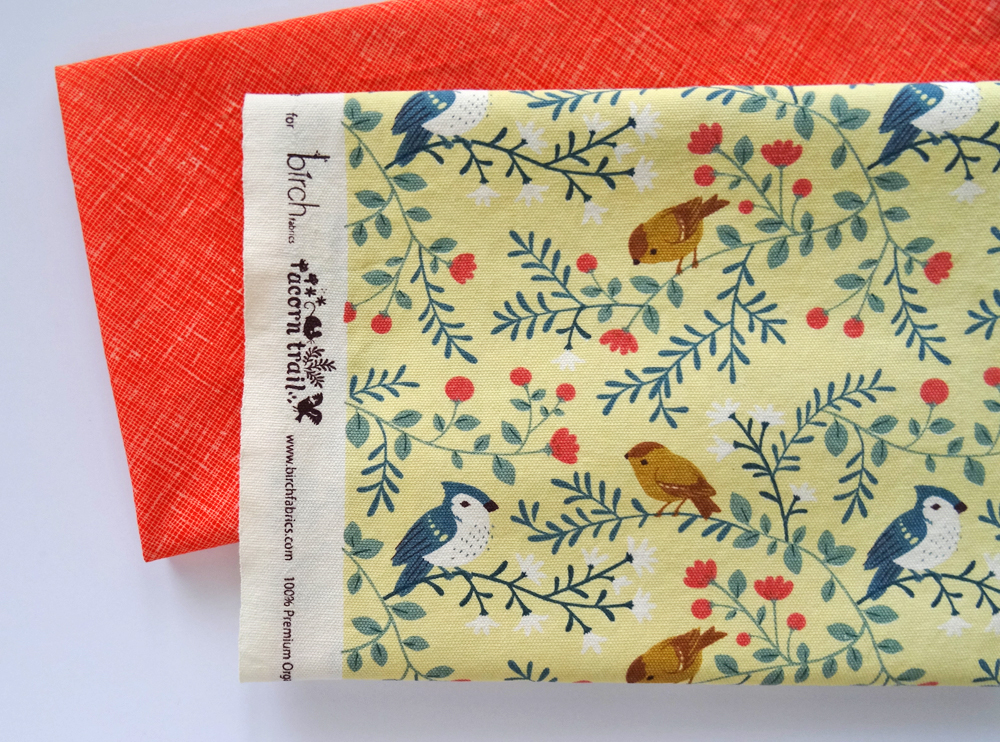
The winner of this lovely Acorn Trail organic canvas from Birch and Carolyn Friedlander Architextures Cross Hatch in Poppy combo from Mad about Patchwork is…
#518: Erin! Who won by visiting Mad About Patchwork on Facebook.
_____________________________________________________________________
The winner of this 9 Fat Quarter bundle of Michael Miller Cotton Couture Solids + a $25 Shop Credit from Zoey & Bean Fabrics is….
Entry #308: Michele! “I love the Sashing Stash fabrics in all the colourways! This fabric would be fun to play with!! Thanks!”
Don’t miss out! The Zoey & Bean discount code expires tomorrow, April 12th at midnight. Make sure you get 15% off your purchase with code: TRD15
by Sherri Sylvester | Apr 7, 2016
This past week I have been busy organizing, labeling and embellishing my projects. I’ve collected 9 ideas you can use with your sewing projects to make them more useful, or more fun! I’ve used the alphabet feature on the Janome Skyline S7 a lot for this week’s content. But I made sure to include several ideas that don’t require any special stitches at all – I hope you like them!
For my main project this week I wanted to make a couple of Fat Quarter Skirts. This tutorial is a few years old now and is so easy to make (and so cute to wear!) – a great beginner project. Perfect for embellishing, and using up any “spare” fat quarters you might have lying around! I added permanent shorties underneath these as well using this Add Shorts to the Fat Quarter Skirt follow-up post from last year.
The Fat Quarter Skirt PDF Pattern is Now Available!
Purchasing this fully tested skirt pattern gives you access to 5 sizes, child’s 2-6, to create a skirt that is 9-11 1/2″ (23-30cm) long. Expect lots of tips and tricks throughout, a glossary of terms, recommended best practices and instructions geared towards an absolute beginner. This pattern is truly a quick sew – allow yourself just 1-3 hours to finish, including your fabric cutting time. It’s also a great stash-buster, requiring only 2 fat quarters and a length of elastic… things you probably already have in your stash! To find out more about the pattern, click here.
Purchase the Fat Quarter Skirt PDF Pattern – $8.50 CDN
Thank you for your support!
Back to the post… Each skirt uses just 2 fat quarters, and my sponsor Country Clothesline was kind enough to provide this week’s fabric. These fabrics are just gorgeous together. They almost look like the came from the same fabric line! Country Clothesline curates a lovely country-inspired shop full of fresh and pretty fabrics. The butterfly skirt is a mixture of Kate Spain’s Aria in Begonia Butterfly and Bonnie & Camille’s Vintage Picnic Check in Coral. The floral one (my favorite!) is from Colette – Floral Leaf Paisley mixed with Tanya Whelan – Barefoot Roses in Pink Dot. The extra green on shown in the photos is from Tanya Whelan as well – Rosey in Green Plaid.
I thought it would be fun to add a book quote to one of the Fat Quarter Skirts using the Skyline S7 alphabet feature. It turned out so cute! Check out Idea #9 below for more details. (P.S. Do you know which book it is?!)
Disclaimer: A Skyline S7 has been loaned to me for the purpose of writing this series. As with all products I write about, I will always tell you my own honest opinion. I purchased and loved Janome machines long before they contacted me. Janome has not asked me to qualify my opinions in any way. Also, the fabric for this post was given to me by my sponsor Country Clothesline. Thank you for supporting my sponsors!
9 Ways to Embellish & Label Your Projects
Idea #1: Twill Tape Size Label – Three Ways!
- Cut twill tape to about 3″ long. Write the size using a fine tip fabric marker. Heat set the marker ink on high heat for about 30 seconds. Use pinking shears and/or Fray Check to seal the raw ends. Fold the ribbon in half. Sew into the back of your project.
- Follow the first method, but use your machine to embroider the size onto your twill tape. Make sure to use a stabilizer under your ribbon for a clean finish.
- Use your machine to write the size and any other embellishments (like a super-cute clothesline!) parallel to the ribbon edge. Remove excess stabilizer. Use pinking shears and/or Fray Check to seal the ends. Fold the ends under 1/2″ or so – I use a school glue stick to hold the ends in place. Sew across each short end to attach it to your project. You can also attach these over the side seam! Tip: Use bobbin thread that matches the outer fabric so the stitching is less visible. (Check out the blue Soleil Dress pictured + 12 tips for sewing knits in Week 4 of the Sewing Diaries.)
Idea #2: Decorative Ribbon Loop
Little ribbon tags are so cute and add a little extra to the side seam of your project.
Cut decorative ribbon to an appropriate length, depending on the ribbon pattern. Fold the ribbon in half. Insert the ribbon along the side seam of your project as it is being sewn. Be sure to allow for the seam allowance when you are aligning it – Ex. for a 1/4″ seam allowance, make sure the ribbon design is at least 1/4″ over from the raw edge of the ribbon.
Idea #3: Fancy Top-Stitching
Use a zigzag stitch (or another decorative stitch on your machine) to top-stitch, instead of always using a straight stitch. I chose a medium width zigzag for the Butterfly skirt.
Idea #4: Leather Labels
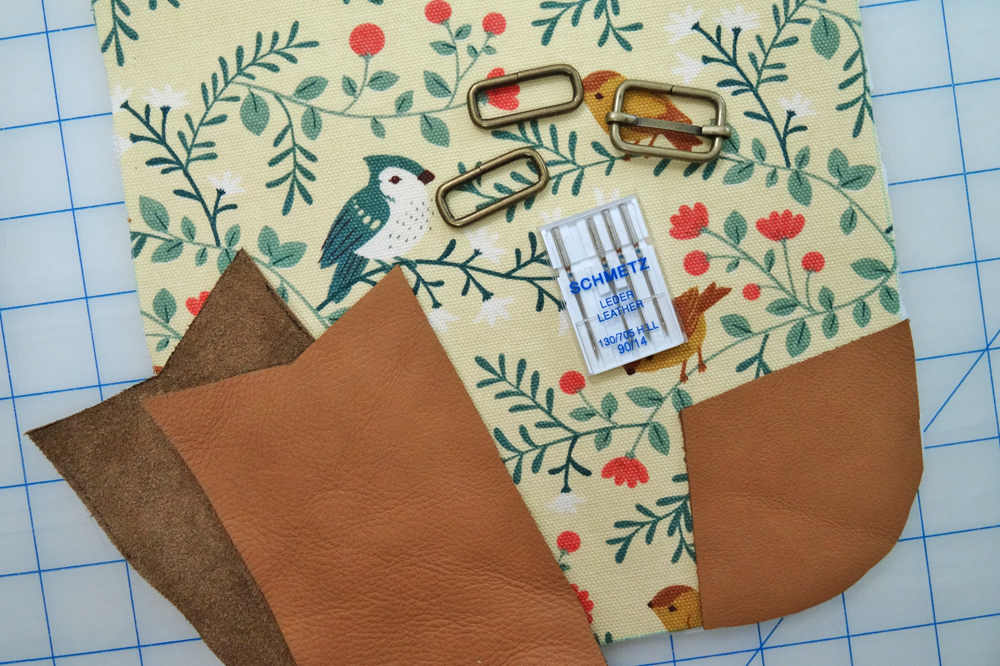
I could have made these for days! I used one in the Forest Glen Mini Satchel a few weeks ago and it was so easy. I didn’t even need stabilizer – and they look so professional. Plus it helps that the Skyline S7 went through this leather like butter! Remember that any holes you make are permanent, and use a leather needle for your stitching. Check out these tips for sewing thicker fabrics from Week 3 of the Sewing Diaries.
Idea #5: Custom Stitches
The Skyline S7 comes with a really fun feature – you can build your own stitches! The Stitch Composer loads onto your home computer and allows you to build the stitch, save it, and transfer it to the sewing machine through its USB port. I found a butterfly picture to use as a template and then traced my own butterfly stitch. Woo Hoo! I would love to try to make a Little Red and the Wolf using my logo when I get more time to play with it.
My first butterfly had something like 175 stitches in it, and only came out about a 1/2″ wide! Oops! You can see what this tiny butterfly looked like on Instagram.
I can’t get WordPress to upload the file directly. So if you have a machine that can accept .stx Stitch Composer files and would like the butterfly file, please send me an email and I’ll send it over to you!
Idea #6: Add Ribbon
An easy way to make a zigzag stitch a bit fancier is to zigzag over ribbon! Cut ribbon to the width of the panel you are making. Glue baste or pin the ribbon in place before stitching a wide zigzag stitch over it. Start and end your stitching with 3 or 4 straight stitches to hold the ribbon in place. I also sewed ribbon on with a straight stitch in an embellished skirt tutorial a few months ago.
Idea #7: Quick & Dirty Camp/School Name Labels
Create quick fusible name labels for everything your kids own!
Stitch names onto twill tape, I didn’t use stabilizer for this one because I wanted these to be super-fast. You can see they are slightly wonky but not too bad! Attach fusible web to the back. I love to use Steam-A-Seam (#notanad) because it is tacky and allows for easy placement and trimming. Press the fusible lightly to adhere it permanently to the label. Cut the labels apart and store them until needed. Then just iron them on! You can Fray Check the ends if desired – but the fusible should be enough to stop them from fraying. (The shirt is my oldest’s well-loved Extraordinary Girl shirt. Pattern from Filles à Maman.)
Idea #8: Printed Fabric Labels
Design and send a file to Spoonflower and have your labels printed! I ordereded these a few years ago on a knit fabric. This way they are easy to cut out with no need to hem because they won’t fray. You could apply fusible web to the back of these (as per Idea #7) and have simple- to-make fusible labels with your own design! Or you can buy a pre-made design and support a designer. #goodforyou!
Idea #9: Adding Text
I love the idea of personalizing a project with a fun quote and this floral paisley skirt just needed something from “The Secret Garden” on it! My kids love to plant flowers in the spring, water them (too much!) and watch them grow. I re-found my grandmother’s Ladybird Book copy of the book to go with the skirt so now we can read the abridged version together as well!
“However many years she lived, Mary always felt that ‘she should never forget that first morning when her garden began to grow’.” ― Frances Hodgson Burnett, The Secret Garden
- Type in a few words and test the width of your lettering. This is very general, since spacing depends a bit on how fast you are stitching! My machine works out to 5 or 6 letters/spaces per inch. So I would need about 22-27 inches for the quote + the length of my test text.
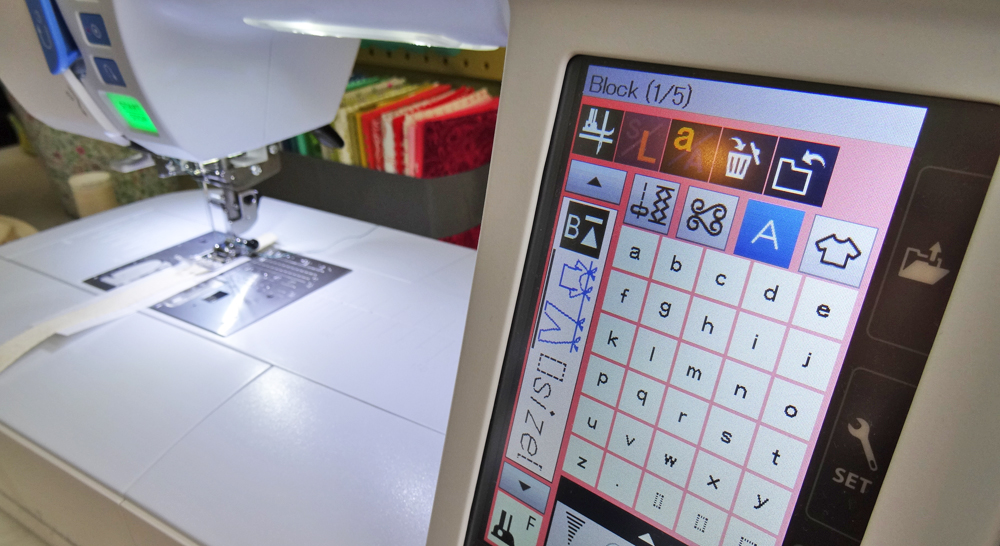
- Cut some twill tape double the width of the skirt panel. Enter the quote into your sewing machine. The Skyline S7 has a built in memory – so I stored the quote as 3 files in the machine. Double-check your spelling! This machine has a view screen where you can see all of the text all at once. Really helpful.
- Place stabilizer on the back of your twill tape. I used a glue stick very lightly to adhere the two together.
- Start stitching about 1-2″ in from the raw end. I used a slower speed and it took me about 25 minutes to stitch, open the next file, stitch, add leaves to fill the open space and double-check my work. Remove the excess stabilizer and cut/remove the threads between letters if desired.
- Sew one side of the skirt panel/contrast border together. Glue baste or pin the ribbon near the bottom and edge-stitch it on. I like using the over-edge foot that comes with the S7 to make my stitches really straight. The edge of the twill tape runs along the edge of the black divider on the foot and works to keep everything in place.
- Once the ribbon is sewn on, finish the other side seam and then finish the skirt!
I hope you found a few new fun ideas to use from this list! Next week we are going to talk about quilting. I’m looking forward to trying all of the piecing/quilting options on the Skyline S7. Plus I’ve been wanting to make the project I’ve chosen for ages now. Nothing like a deadline to get ‘er done. Have a great week!
by Sherri Sylvester | Mar 31, 2016
Knit fabric is really rewarding to sew. It stretches, so the fit doesn’t have to be perfect – and it’s so comfy. (That’s my favorite part.) It has a bit of a bad rep for being tricky to sew, but with a few tips you can conquer knits on any sewing machine that has a zigzag stitch – no serger needed!
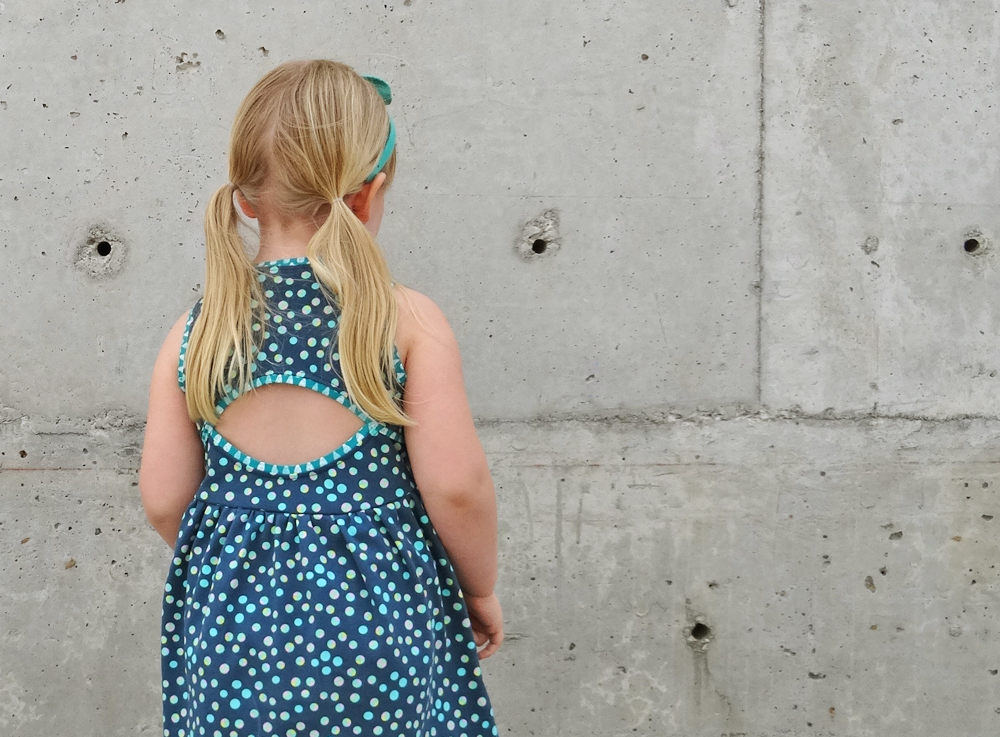
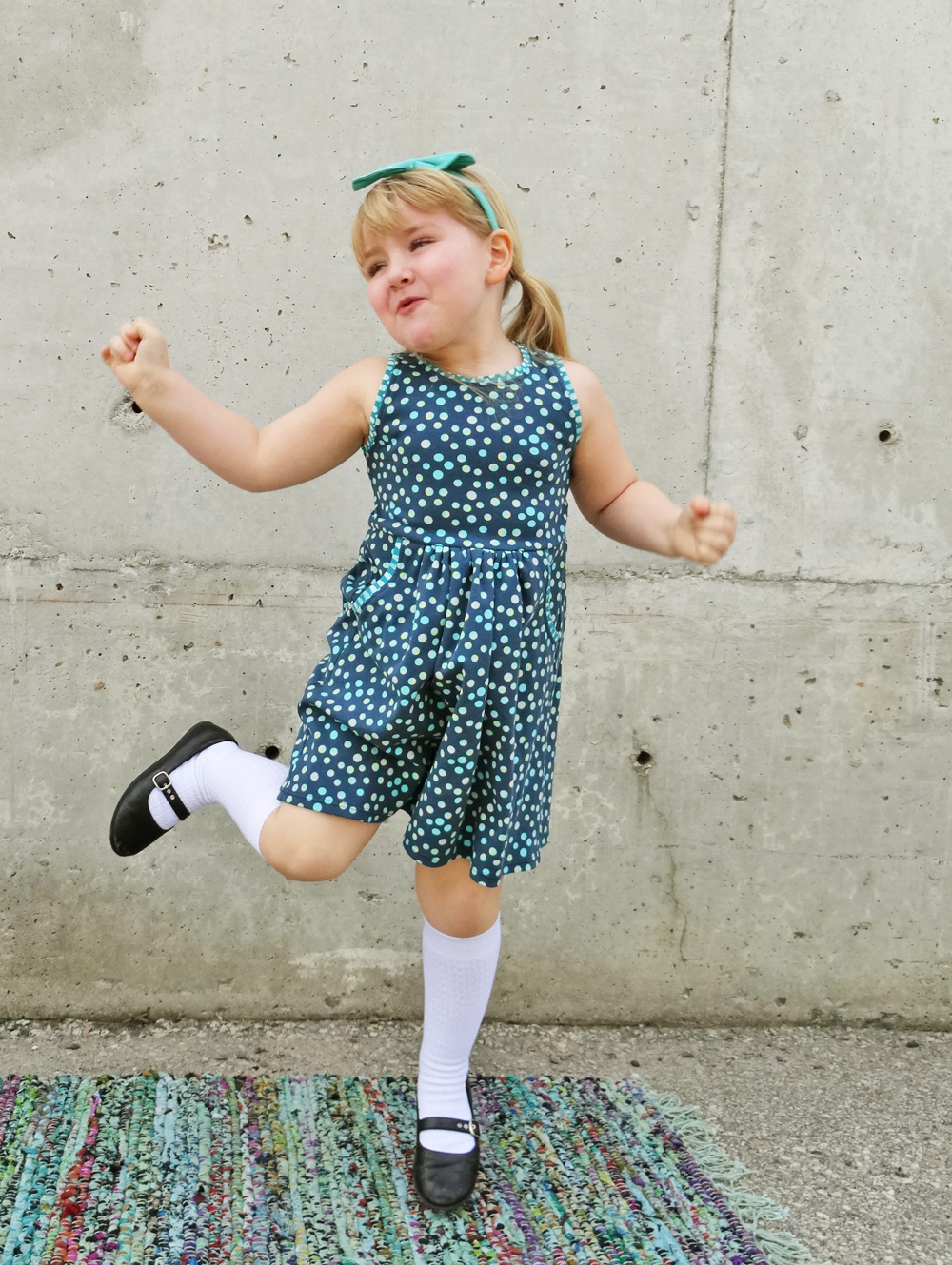
I learned a lot about sewing knits and hacked my old basic Janome SUV1122 like crazy to do it. Today’s post covers 12 Tips and Tricks for Sewing Knits that I’ve learned along the way, and how some fun features on the Skyline S7 help the process. Plus I got to make my youngest a really cute spring dress without my serger, entirely on the sewing machine!
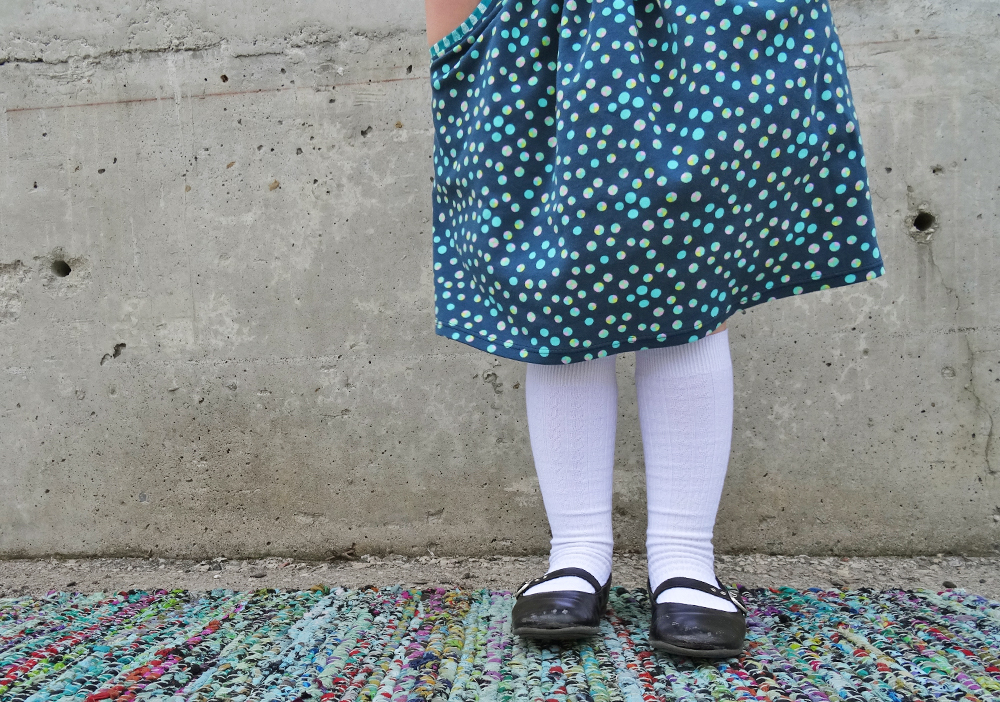
Yikes, this girl was hard to take photos of yesterday! Every photo is her dancing around – so much fun to look through, I should really make a collage for our hallway. I suppose that even though the weather co-operated by giving us a “lovely” 14°C – I think she was a bit chilly (and a little bribed with lollipops!)
Disclaimer: A Skyline S7 has been loaned to me for the purpose of writing this series. As with all products I write about, I will always tell you my own honest opinion. I purchased and loved Janome machines long before they contacted me. Janome has not asked me to qualify my opinions in any way. Also, the fabric for this dress was given to me for this post by my sponsor Fabric Please! Thank you for supporting my sponsors.
This week’s project was sponsored by Fabric Please!, a lovely online Canadian fabric shop with a growing selection of knits in both solids and prints. They were kind enough to indulge me when I asked to make a Soleil dress in blue for my youngest. I promised her one last fall and it’s finally getting (almost) warm enough to wear it outside.
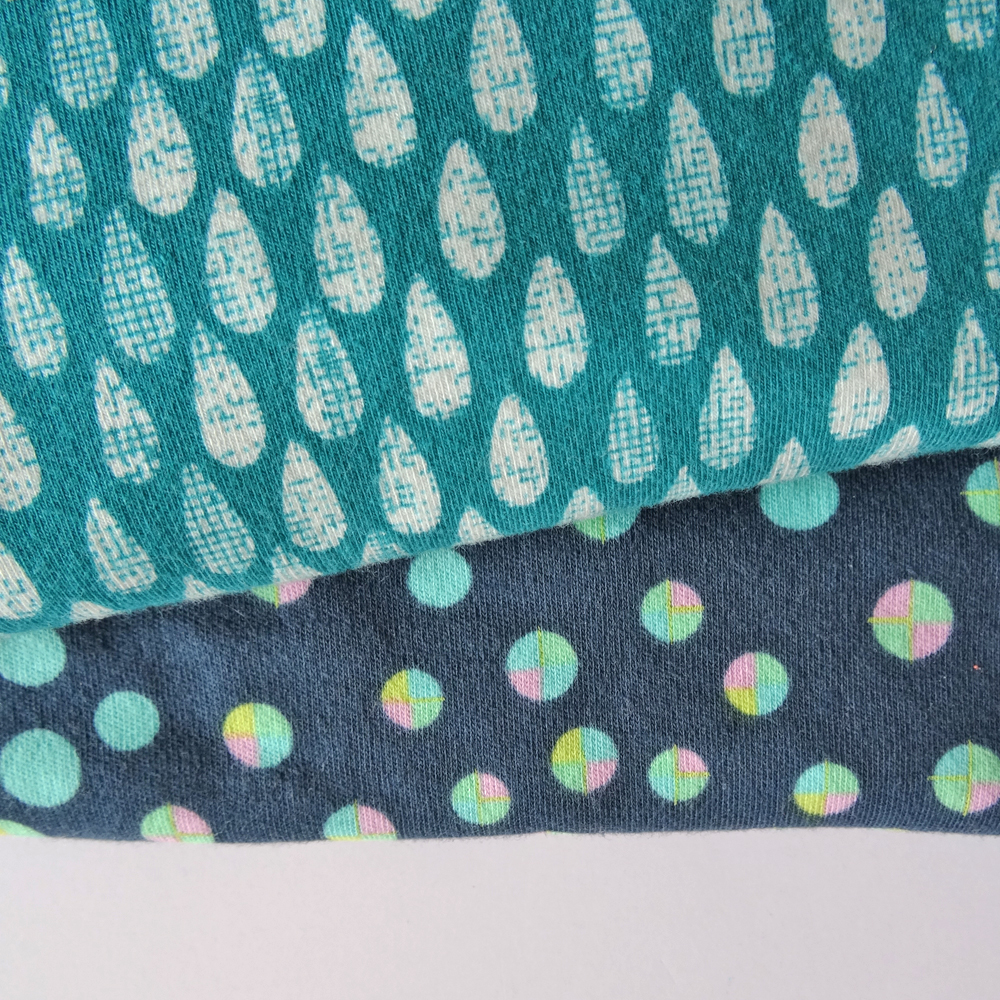
The main dot fabric is 100% cotton Glow, Quarter Moon by Amy Butler (*oooooh!*) and the raindrops, cotton/spandex Abundance Monsoon from Bonnie Christine (*aaaaah!*). I love how the two prints play off each other, they’re so fun in this dress.
12 Tips and Tricks for Sewing Knit Fabrics
Tip #1: Ballpoint/Jersey Needle
Make sure to buy ballpoint or jersey needles for your knit projects. The tips on regular needles are sharp and will cut tiny holes in your knits. I know from experience! A couple of machine washes and there will be little holes all down your seam.
Tip #2: Sew with a Stretch Stitch
If your machine has them available, choose a stretch stitch to sew with. This will allow your sewn seam to stretch with the stretch of the knit you are sewing. They tend to look like a lightning bolt (no’s 6 and 7 in the photo below). If your machine doesn’t have a stretch stitch, use a thin, long zigzag stitch or a triple stitch (no. 5 below) instead to allow the seam to stretch. The Skyline S7 has quite a few stretch stitches, numbers 5 – 10 and a knit stitch, no. 14 below.
Be sure to double-check your seam allowance when choosing a wide stitch (2nd photo below). The markings on your machine are based on sewing straight down the middle of the machine foot, but a wider stitch will sew to the left of that. Use your seam gauge and mark or find a new line to guide your correct seam allowance.
Tip #3: Dual Feed Device – Janome AcuFeed Flex
The AcuFeed Flex is a super-cool machine foot, and it’s the first time I’ve used a dual feed device. It is similar to a walking/even foot (next tip below), but is physically attached to the machine’s upper feed drive instead of just resting on the needle clamp screw bar. This means it is mechanically moving the top layer of fabric forward at the same speed as the feed dogs move the bottom layer of fabric forward. The results are so good! It totally eliminates the stretching you would normally get when sewing knits.
This foot is also great for seams in leather and oil cloth – both of which tend to stick to a normal presser foot. Matching plaids, quilting and seaming other slippery specialty fabrics is much easier because the layers of fabric are moving together. The dual feed can also be balanced with the dial on the side of the machine for when you are seaming two different types of fabrics and one feeds faster than the other.
Tip #4: Walking/Even Foot
This foot does a similar job to the AcuFeed Flex in Tip #3. A Walking foot is really helpful when sewing knits, and it is what I have used previous to the S7. The bar on the walking foot rests on the needle clamp screw bar, which feeds the upper layer of fabric at the same time as the feed dogs move the lower layer along.
To comment on it in comparison to the AcuFeed Flex – I do notice more stretching with the walking foot. The AcuFeed Flex is more accurate – likely due to it being directly attached to the machine’s feed drive. The fabric moves through together more mechanically with almost no slippage on the top layer of fabric.
Tip #5: Use a Twin Needle
Twin needle sewing seems complicated, but it’s not as bad as it looks! Two spools are fed down from the top of the machine and one bobbin thread stitches the bottom of the seam together. The threading path can be found in your machine manual. You can also read this post about double/twin needles and how to thread your machine, where I sewed pyjamas using my basic Janome SUV1122 a few years ago.
The twin needle stitch is really stretchy and a great option for sewing knits. It also looks really professional when used for hems and topstitching. You can get different widths of double needles. I like the one with a 1/4″ space for hemming. The 1/8″ one would be better for sewing seams.
Tip #8 – Overedge Foot
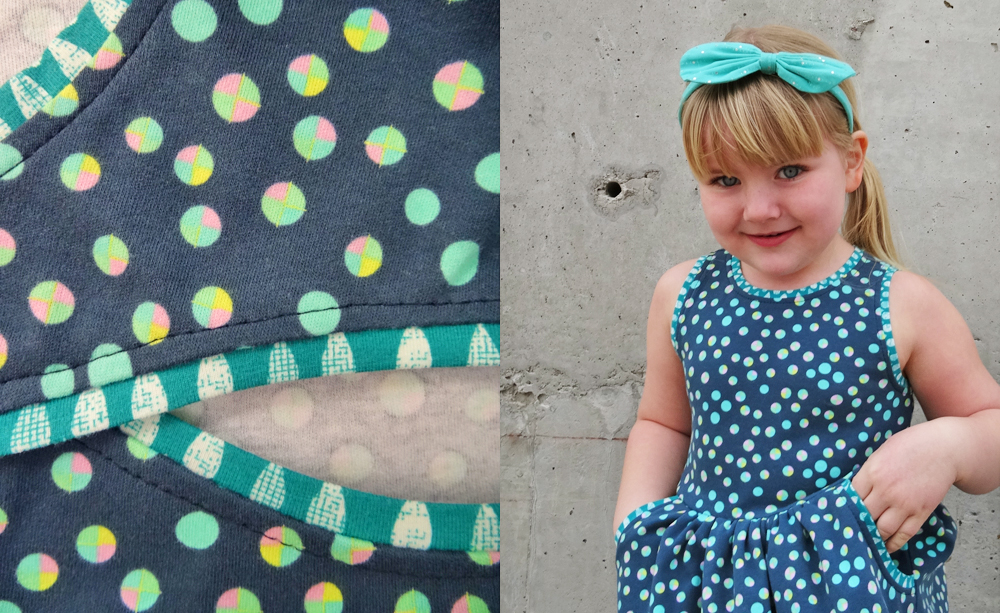
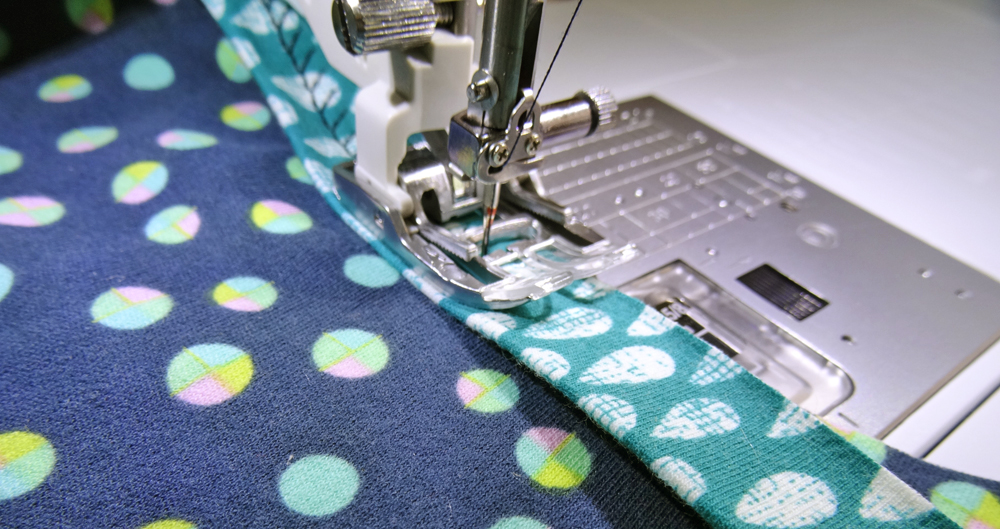
First off, my apologies for the fuzzies in this photo, oops! Moving on… This foot is great for making a serger-like overcasting stitch on both woven and knit fabrics. I used it to seam the dress’ pockets using the Knit Stitch available on the Skyline S7. The fabric runs beside the black bar on the foot making it really easy to stitch right along the edge of the fabric. You can see how it turned out in Tip #10 below!
Tip #9: Top Stitching and Edge Stitching
Straight stitches are not really recommended for sewing knits, because they don’t stretch with the fabric. However, I’ve successfully used them for topstitching with a few tweaks. (Though I’d still recommend a twin needle if the fabric is really stretchy.)
Make sure to lengthen your stitch. Instead of sewing with my general length 3, I used a length 4 straight stitch to topstitch this project. Also, it is good to slightly stretch the fabric while stitching to allow the final seam to stretch just a bit more.
Tip #6: Use Tissue Paper
If your knits are not behaving, you can place strips of tissue paper underneath (and over top!) of your seam while sewing them. Then remove the tissue once the seam is finished. This prevents the knit from being stretched by the presser foot pressure. I’ve used it a lot on hems for really stretchy thin knits.
Tip #7: Start off with a “Thread Handle”
This tip comes straight from the lovely Linda Pidzamecky, educational consultant for Janome. She gave me a really helpful tour of the Skyline S7 before I brought it home.
Starting a seam on knits can be tricky since the needle likes to bury the edge of the fabric into the needle plate. To stop this: Pull a longish spool thread out to the back of the machine, insert the needle into the fabric, and hold the thread gently while starting the seam. This has totally changed how I begin knit seams and it would work great for thin wovens and specialty fabrics as well!
Tip #10: Press and Starch
Thinner knit fabrics can tend to roll up on the edges making them hard to cut out and seam. To reduce this, use spray starch and a good pressing to unroll them enough to be able to cut out and stitch them more easily. Pressing also helps to reduce stretched seams. I stitched these two pockets below, then pressed the upper one flat with a bit of steam to show you the difference.
Tip #11: Change the Pressure of the Presser Foot
If your machine allows it, reduce the presser foot pressure to allow the knit fabric to slide through the machine with less stretching. Check your manual for how to do this and do a test seam to make sure the change in pressure will still feed the fabric through properly.
Tip #12: Use Clear Elastic
This elastic is genius! Zigzag baste it onto a seam in your knit project to reduce stretching while sewing and during wear. It is great on heavy seams like the Soleil dress waistline – where the heaviness of the gathered skirt might pull the waist seam down. It’s also great for shoulder seams in drop shoulder and dolman sleeves – again, to reduce the pull from the heavy sleeve.
Next week is going to be so much fun, I can’t wait! I’ve been collecting ideas about how to embellish your projects and I finally get to share them with you. See you then!
by Sherri Sylvester | Mar 24, 2016
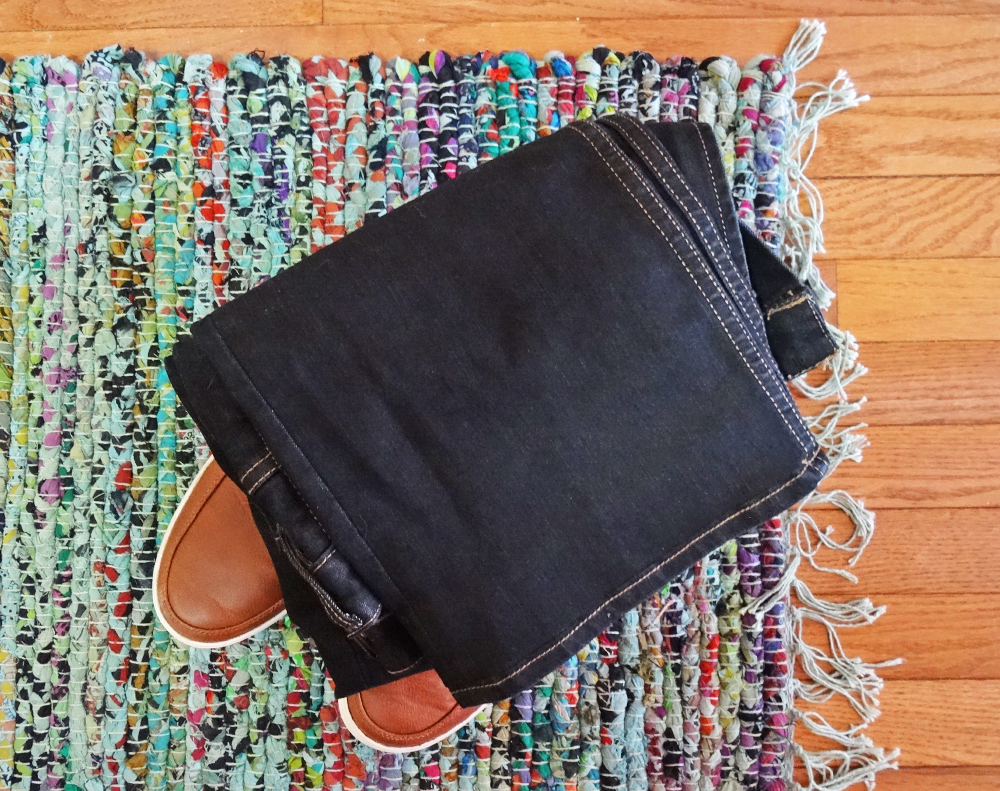
I hope you are enjoying getting to know your sewing machine! This week I worked with heavier fabrics, using the on-loan Janome Skyline S7 to sew layers of leather, canvas and denim. From a mini Forest Glen Satchel (it’s b-a-ack!) to the necessity of hemming jeans. Find 5 Steps to conquering tension and the thicker fabrics you want to sew, plus a link to a tutorial on how to hem jeans my favorite way. It’s so easy you might not even mind doing it! (P.S. There’s a giveaway! You have a chance to win the same fabric used for the satchel from Mad About Patchwork!)
As a side note, my husband has been waiting especially for this week because I avoid hemming pretty much everything over here. I have to give him tons of credit – he’s really nice about it, and I know rolling his jeans drives him crazy. Note to self: #mustdoabetterjob
Disclaimer: A Skyline S7 has been loaned to me for the purpose of writing this series. As with all products I write about, I will always tell you my own honest opinion. I purchased and loved Janome machines long before they contacted me. Janome has not asked me to qualify my opinions in any way. Also, the fabric for the mini Satchel was given to me for this post by my sponsor Mad About Patchwork. Thank you for supporting my sponsors!
5 Steps to Proper Tension when Sewing Thick Fabrics
If you want to sew thicker fabrics we need to talk about tension. It’s really important to know how to set the tension on your machine properly. Too tight, and the tension will cause puckers and gathering. Too loose, and the seam will not be strong – or may even fall apart. Surprisingly, also – there are quite a few issues that you can run into with thicker fabrics that look like tension problems, but are really related to other areas of your machine.
I chose to make a super thick canvas and leather layered mini Forest Glen Satchel to test the Skyline S7 this week. Lucky for it, it performed beautifully! This mini version of my satchel pattern has been in the works for a few years now and I’m finally on the home-stretch and hoping to re-release the pattern to include both sizes before the summer.
This mini Satchel is sewn from a gorgeous mix of organic Acorn Trail Canvas from Birch Fabrics and Carolyn Friedlander’s Architextures in Poppy. Both from my Canadian sponsor Mad About Patchwork. The two go so well together, plus the added leather details make it look super professional. I’m so proud of the finished product. My kids and I will be fighting over this one for sure!
The things that we’ve sewn in the Diary project so far haven’t really needed a tension adjustment. Sewing machines come set to an average setting that is also found in your manual and usually marked on the tension dial. However, when you are working with thicker and thinner/specialty fabrics you may need to adjust the tension to get the best seam possible.
Step 1: Read your manual. I know, I say it every week – but it’s the best first step. What does your machine manual tell you about tension and the type of fabric you are sewing?
Step 2: Make sure you are using the correct needle. Use a denim needle for denim, leather needle for leather etc. and make sure it is changed often.
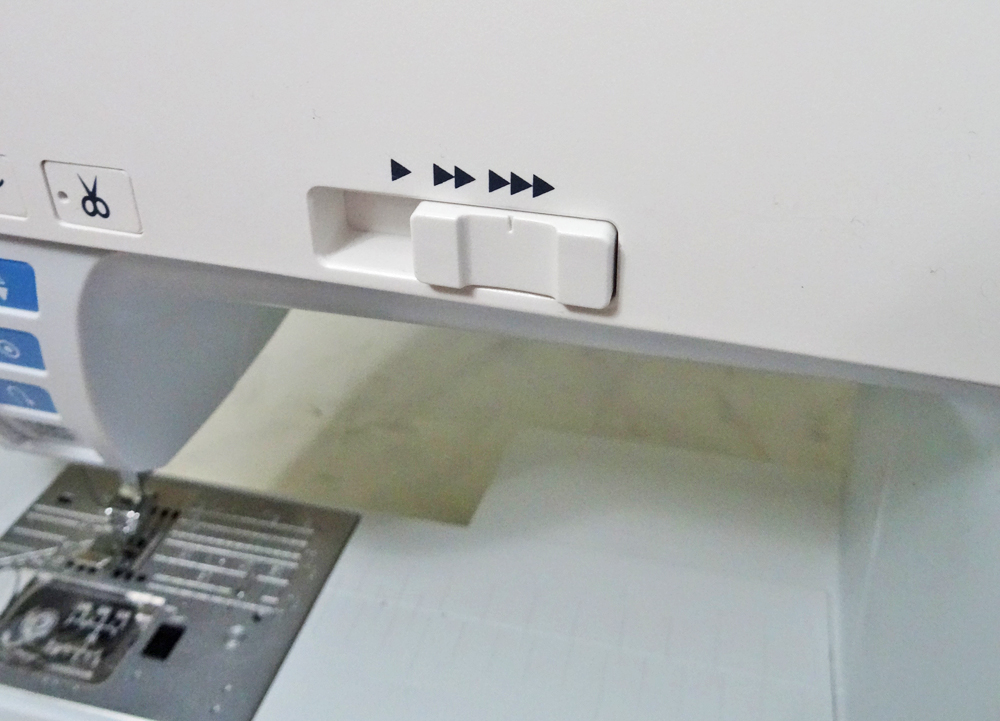
Step 3: Slow down. Make sure you are sewing at the correct speed for the fabric you are using. If you have a speed control slider like the Skyline S7 I’m using, notch it down a bit through heavier fabrics.
Step 4: Switch out your needle plate. If you have a straight stitch plate this can really help when sewing thicker or thinner fabrics. The plate has a small hole where the needle enters the bobbin area and will better support the fabric around the needle area as it is sewn, creating a cleaner stitch. The S7 has an included straight stitch plate and it’s really easy to change! I posted a video this morning so you can see it in action. #easypeasylemonsqueezy
Step 5: Check your thread. Make sure the thread you are using is recommended for your fabric type to avoid problems. I used regular polyester thread for the satchel and lots of other leather projects I’ve sewn and it’s held up fine. Do a little research to find out what’s best for you.
Now, make a test seam. Layer small scraps of the fabrics you will be sewing, including interfacing if needed, and stitch through them using the appropriate needle/speed/plate and thread. Try to pull them apart gently, if needed, to see how the bobbin and spool threads meet up. It’s easiest to see if you can do this with two different thread colours.
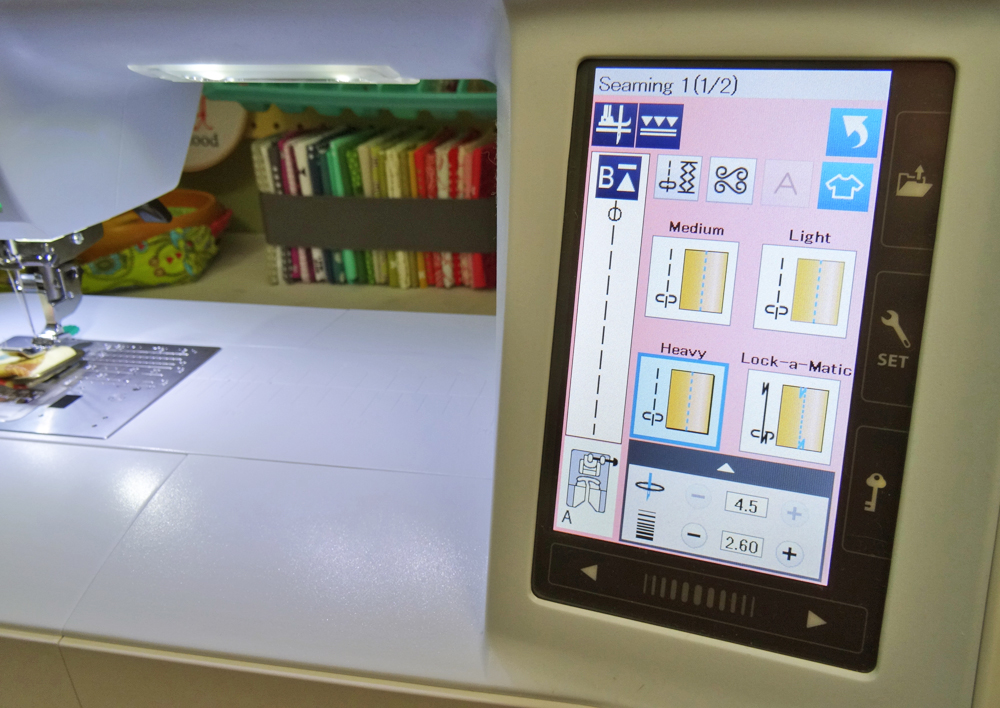
The photo above shows the test I made for the Satchel I sewed this week. Two layers of Canvas, two layers of leather and two layers of fusible fleece. The bobbin and spool threads meet right in the middle, and don’t seem to be pulling too little or too much. Granted, I may have cheated a little since the Skyline S7 has automatic computerized tension and a Heavy Fabric setting. Can’t complain about that!
What if your tension is not correct? Your machine will have a dial, button or screen where you can change the upper thread tension. Lower numbers loosen the tension, higher numbers tighten the tension. Here is a very simple guide on how to change your tension:
- Gathering or puckering? Your tension is likely too tight – loosen it by changing the tension to a lower number
- Loose or missing stitches? Your tension is likely too loose – tighten it by changing the tension to a higher number
Just like in science class – change one variable at a time. Don’t tighten tension from 2 to 9 all at once. Change the tension a few steps and test each one as you go to find the perfect setting for your machine.
Hemming Jeans
Hemming jeans saves you a trip to the tailor and some cash, sounds good to me! Especially now that you know how to adjust your tension for the thickness of the denim.
I generally hem my jeans leaving the original hem in tact. It took me about 10 minutes to hem my husband’s jeans last night, using the free arm on the Skyline S7 – all the more reason for me not to delay in the future! I can’t locate my original bookmark, but I did find one on my favorite fashion/sewing blogger’s site – Merrick’s Art. Here’s a tutorial on how to hem jeans while keeping the original hem. Of course there are more technically sound ways of doing this, but it works – and it’s quick – which is nice!
Mad about Patchwork has provided a discount of 10% off all orders until March 31, 2016!
Use the code TRH10 at the checkout to get your discount. Enjoy!
Mad About Patchwork is generously giving away a 3/4 yard cut of each of these gorgeous fabrics to one lucky sewist. I can’t wait to see what you will make with it!
This giveaway is open to everyone, internationally! From today (March 24th) until midnight March 31, 2016. Use the Rafflecopter widget below to enter – and if you don’t have Facebook to sign in with, just use your name and email address. There’s a “click to enter”, no social media login entry too!
a Rafflecopter giveaway