by Sherri Sylvester | Nov 18, 2016
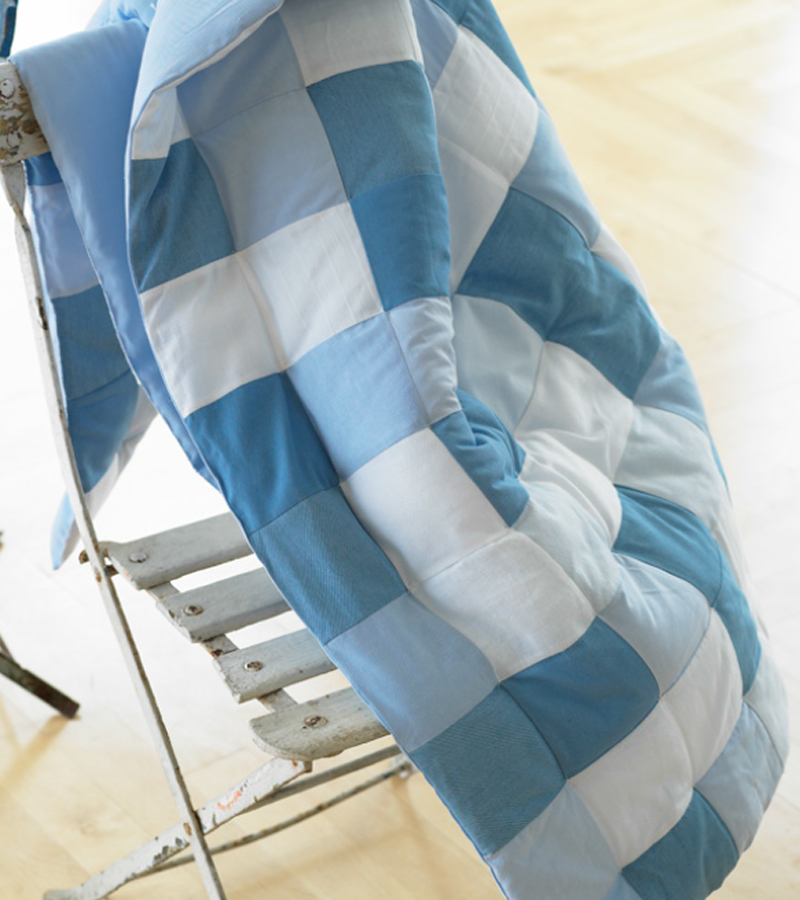
Up here in the (not so) frozen North, Canada is celebrating it’s 150th birthday next year. Lots of buzz is going around about this sesquicentennial celebration. (Try saying that 10 times fast!) There are quilting bees, specially designed fabric and this amazing red and white Canadian Block of the Month Sampler!

It is being run by my sponsor Sew Sisters Quilt Shop. Twenty amazing quilters designed these blocks, and I was thrilled to be asked to make one myself! (*check* Just adding quilt block designer to my resumé, hee hee!)
Actually, I am quite humbled to have been asked to be among this great group of designers. Just check out who’s involved!
Berene Campbell from Happy Sew Lucky ~ Brenda Miller from Among Brenda’s Quilts ~ Christine Baker from Fairfield Road Designs ~ Daphne Greig from Patchworks Studio ~ Elaine Theriault from Northcott Fabrics & Crazy Quilter on a Bike ~ Felicity Ronaghan from Felicity Quilts ~ Irene Dewar from Brambleberry Cottage Quilts ~ Jean Boyd from Patterns by Jean Boyd ~ Jennifer Houlden from Quilts by Jen ~ Kathy Schwartz & Lori Suss from Highway 10 Designs ~ Krista Hennebury from Poppyprint ~ Leanne Chahley from She Can Quilt ~ Mary Elizabeth Kinch ~ Michele Foster from Aiming for Accuracy Pattern Co. ~ M-R Charbonneau from Quilt Matters ~ Nellie Holmes & Christine Baker from Upper Canada Quiltworks ~ Sandy Whitelaw from Upstairs Hobbyroom ~ Sherri Sylvester from Thread Riding Hood ~ Stacey O’Malley from SLO Studio ~ Judy Baldwin from Sew Sisters Quilt Shop
You can register for the Canadian Sampler in the Sew Sisters shop. You’ll get the instructions for two 12″ blocks each month starting in January, and next October the instructions for how to finish it up in time for Christmas! Check out more about the sampler, and the block names and designers from the Sew Sisters blog.
by Sherri Sylvester | Nov 15, 2016
Hi there! I’ve been taking in the late-fall weather with a few books and detoxing my house from a month of neglect.
The lead-up to Creativ Festival was full of preparations, and while the event itself was fun, I needed to intentionally take time a bit slower afterward! There has been an overabundance of Creativ Festival talk here in the last month. And I promise we’ll get back to our more regular programming now.
My kids and I with a Janome #makerselfie after a long day!
I have scheduled post ideas all the way up to the end of January. (Eeep – trying to be organized!) They include lots of fun stuff that’s been sewn and waiting, new tutorials and Christmas things!
It’s hard to sum up my experience at Creativ Festival this year. Instead of my usual booth perusal and fabric stashing, I concentrated on my workshop, speaking engagements and emceeing Project Creativ Catwalk. Quite a step away from my usual behind-the-computer life – and I’m excited to be slowly learning how to get better at speaking. Even when they put me up on a huge stage riser!
Be Brave and Sew – Day 1. My daughter’s Easter dress is one of my most favorite makes.
Be Brave and Sew – Day 3. My wheeled Bluefig bag was perfect to transport everything for each show.
Yikes that stage was high!
I want to give a huge shout-out to the fabric shops that provided giveaways and discounts for everyone that came out to the Be Brave and Sew Talks. Sew Sister’s Quilt Shop for their super-cute Tula Pink Bundle. Fabric Please! for the Farm Fun Panels, Charm Packs and discount cards. And Meerkat Shweshwe for their great discount cards as well.
Fabric Please! a Canadian Online Fabric Shop. Check out the Moda Stacy Tsu Farm Fun Panel animals on the top shelf.
Sew Sisters Quilt Shop. LOVE that they covered their tables in quilty goodness! Check out their Tula Pink fabrics.
Meerkat Shweshwe‘s unique fabrics are imported from South Africa. Check out more details along with this free pinafore tutorial!
I’d be hugely remiss not to mention Janome – so much thanks to them for all of their support! They sponsored all of my events and introduced me to so many amazing people over the 3-day event. (Plus I love their machines!)
My Design Diva Apron in the Janome Maker Studio. Get the free pattern!
The Maker Studio had so many projects from the new M Series Look Book – and most are free tutorials/patterns!
Love this giant tomato pin cushion at the Janome Booth. It was about 10″ across!
Last, but not least… I am so thankful and grateful to my husband for his amazing support of this blog and everything I do. He came out every day to out postcards and giveaways, help with set-up and take-down, shuttle kids and props around and was kind when my tiredness and nervousness took over. I do not know what I would do without him. (Ok – gotta quit – getting teary eyed over here.)
I’m still taking it in and am sure all will come out in some sort of emotional post when it’s ready. For now, here are some more photo highlights of everything that happened.
Mona, one of my workshop attendees with her daughter’s new Fat Quarter Skirt!
Gorgeous quilts in the Lens Mills display – I really should have gotten some close ups of these!
Tamara Kate’s “Whatever the Weather” quilt is a free Sew Along on the Janome Life blog.
Rachelle from That’s Sew Venice thought to take a selfie of us. I never remember!
I love meeting blog readers! I happened to run into the lovely Irene, from Irene’s Studio on Day 2. I also found Melwyk from Magpie Makery and my friend Laura from Seams Sew Laura came to visit too!
Cynthia Frenette’s amazing Making Merry Quilt was on display at the Janome Booth. Get the free Mod Pods Matching Pillow tutorial!
Loveliness from Tamara Kate‘s booth where she was selling her fabrics. I had so many photos tried to only pick these three. It was so pretty!
by Sherri Sylvester | Oct 25, 2016
I am preparing once again for the event this past spring that had me crazy worried. I spoke at Creativ Festival for the first time in April, and, as it turns out – it’s terrifying the first time, easier the second time and much, much easier this time! #practicemakesbetter
But – it wouldn’t be fun without something new, right?! So I’m teaching a workshop and emceeing a super-fun event on Saturday. Eeep! Though it may sound otherwise, I am really excited for the new opportunities, and (as always), interacting with other creative people is my favorite.
If you are in the Toronto area, I’d love to see you there. The show starts bright-and-early on October 27 (Thursday morning) and runs until Saturday, October 29th at the International Centre. 3 days of exhibits, workshops, demonstrations and booths full of amazing crafting supplies. #petallthefabric!
Join me for my Fat Quarter Skirt Workshop, 9-12 Thursday morning. I’m so excited to teach this beginner-friendly workshop – and maybe addict more of you to the goodness of sewing! 😉 You’ll leave the workshop with a fully finished skirt for your favorite little girl, and a pattern for sizes 2-6 so you can make more of them! Register on the Creativ Festival website – click the “Feature Classes: Thursday…” button and find “Fat Quarter Skirt”.
I’ll also be presenting a Janome-sponsored talk called “Be Brave and Sew II” on the Fashion Runway Thurs and Fri at 2:30 and Saturday at 1:30. There will be sponsor giveaways and exclusive discounts – plus, lots of information to help you conquer your sewing bucket list!
I hope to see you there!
by Sherri Sylvester | Oct 20, 2016
Just back from a trip to the thrift store? Got 7 shirts in your closet waiting to be upcycled? Scraps from previous re-purposed items still to be dealt with? You’re in luck! Today is all about our last Maker Style – the Eco Expert! Projects include your personal Eco Expert apron, new repurposing projects to try, clever ways to use old clothing and how to make them unique.
This post is sponsored by Janome Canada.
How do you know if you are an Eco Expert?
Take my super fun short quiz to find your personal Maker Style! Don’t miss out on lots more great sewing inspiration, grab a cup of tea and sit down with the new M Series look book from Janome. I really enjoyed looking through it, the project tips and tricks are great and there are free patterns too!
Eco Expert Utility Apron (+ How I Shopped for Thrifted Fabric)
The Eco Expert apron is based on a tutorial from Sugar Bee Crafts. Their Utility Apron is easy to sew and requires minimal yardage – perfect for re-purposing your old or thrifted clothing!
I went thrift store shopping and found 3 skirts. All made from heavier fabrics, since I wanted this apron to be durable. The skirts I chose had various things I wanted to incorporate: denim – because of its durability, skirt tab – a fun detail to use in a new way, and great top-stitched seams – to add detail to the finished apron.
Always check to make sure they don’t have any stains or tears (though you could use that to your advantage too!). To save myself a bit of work I took the tutorial measurements and a measuring tape with me so I could be sure the skirts had enough fabric to fit.
Creative Up-Cycling (Anything is fair game!)
Here are a few ways you can use ready-to-wear clothing details to make your up-cycled project better!
|
Upside Down Hems: The tops of all of these apron pockets are the hems of each skirt. It was really simple to turn the skirt upside-down and cut the pieces out.The pink skirt had a bit of a curve to the hem and I was able to use that as a design feature! |
|
Everything Has a Purpose: The pink skirt had a cute faux-button tab on the waistband. I was able to remove it and re-sew it to the skirt side to use as a scissor holder! |
|
You Haven’t Seam it All: #seewhatIdidthere? Sorry for the joke – but the pre-sewn seams can add a fun detail to your up-cycling! I off-set all three skirt seams to add interest to the apron. Bonus: You won’t have to sew all that extra topstitching! |
|
Stitch it Again: On the topic of seaming things. I had to re-stitch the hem on the pink apron. It had a pleat in the back and to remove it, the hem had to be un-stitched.To make things more fun, I used my favorite “X” stitch that comes on the Skyline and M Series Janome sewing machines. Just grab the F or F2 Satin Stitch foot and stitch right across where the old hem was topstitched. |
|
Re-Use the Pockets: This is a common one. Take the pockets off your jeans and use them in your new project. Again, all that work cutting and topstitching is already done for you! A great example of this is to use one on the lining of my new favorite purse pattern – the Chobe. (Photo via Elle Puls, via Stitchydoo) |
|
Use Plain Space: Ok – this is stretching the use of “ready-to-wear details” a bit, but lettering is so fun! If you use some blank space to add a fun detail like the I did with the word “MAKER” here. Again, this alphabet is available on the Janome Skyline S7 I used to stitch this apron, and the new M Series machines.BONUS: If you have some pre-loved leather around, you can make a simple Leather Label too! |
You can find more ways to embellish your sewing in the Sewing Diaries: 9 Ways to Embellish and Label Your Projects.
Re-Purposing Projects to Try
I’ve found some great up-cycling sewing projects you can try. The quilts are the best since you can destash and a lot of fabric all at once! If you like these and want more, you can follow my UpCycle or Alter Pinterest board. (Made with Eco Experts in mind!)
Hope you had fun visiting today. What is your favorite Upcycling Project? Be sure to follow #alongforthreadride!
by Sherri Sylvester | Oct 14, 2016
Today’s post is all about giving our Workshop Wizards (including me!) the stuff their heart pitter-patters after. I’ve collected a round-up of fun stuff today – details about the Workshop Wizard apron, must-have tools for a Workshop maker space, and a new tutorial – how to use any sewing machine to make leather labels!
This post is sponsored by Janome Canada.
Workshop Wizards Rejoice! Today is all about you…
Pssst… If you haven’t found out what your personal Maker Style yet, click on the photo below to take the super-short fun quiz! And be sure to check out the new Janome M Series of sewing and serging machines – they’ve put together a gorgeous look book full of free stuff and maker inspiration!
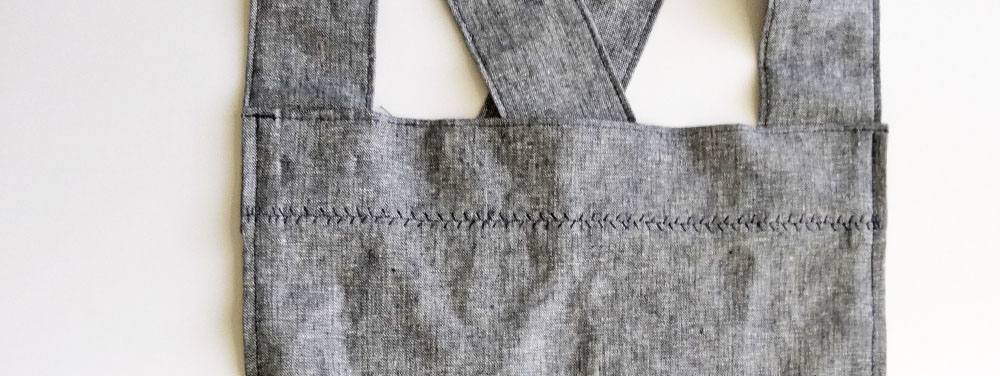
This is the Workshop Wizard’s Apron of Choice, and unlike last week’s new free pattern (the Design Diva Apron) there was no need to re-invent the wheel. The Cross Back Apron tutorial is free, and really straight forward. The seams are all fully finished, and it’s super comfortable to wear. Definitely going to keep your clothes clean no matter what you are doing!
Apron Details:
- Fabric: Indigo Essex Linen (#bestillmyfabriclovingheart!) This linen is gorgeous, easy to use and sew.
- Make it Yours: To make it more unique add a decorative stitch to the top of the pockets and the apron bib. Tip: To have the stitch to meet in the middle of the bib, sew in from each edge to the center! The Skyline S9 I have on loan from Janome also has a button that will automatically mirror the stitches – making this even easier!
- Watch Out! The Purl Soho tutorial calls for 55-60″ wide linen. Essex Linen and most quilting cottons commonly come it 42-44″ wide bolts. I purchased 3 yards for this and ended up squeezing the entire apron out of just over 2 yards.
- Pre-Measure: The apron straps are really, really (really) long to accommodate for for multiple sizes. I ended up cutting my 50″ straps down to 31″ each – #argh for the wasted fabric.
Must-Have Tools for the Workshop Wizard
You’ve got to keep your wizardy-self happy am-I-right? What better way than to stock a maker sewing space full of expected and unexpected things you can use to #makeallthethings.
Do you use an unexpected tool on a regular basis to make your sewing easier?
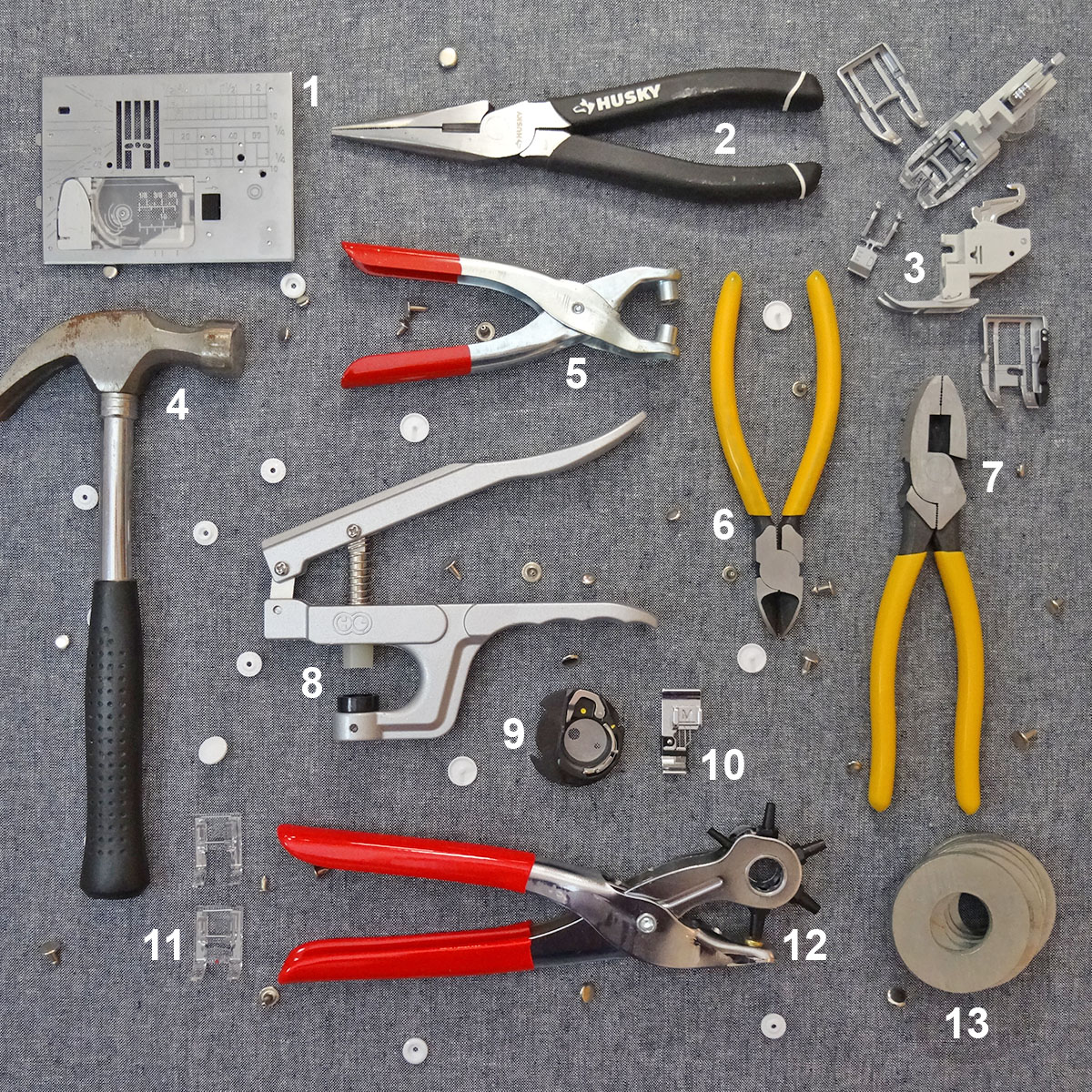
(1) Straight Stitch Needle Plate: For stitching absolutely every fabric that comes your way – no matter what. The small area under the needle is great for thinner fabrics, there’s less chance they get pushed down into the plate. (P.S. it comes with the Skyline S9.)
(2) Needle Nose Pliers: Great for messing around with all sorts of purse hardware. Especially good when Changing a Zipper Pull to suit your own needs.
(3) AcuFeed Flex (Dual Feed): This replaces the more common walking/even foot. It’s job is to feed the layers of fabric through the machine from the top and bottom. Bringing all layers through the machine evenly. Find out a lot more about the AcuFeed Flex with these tips for sewing knits and these quilting tips. (BTW – the Skyline S9 comes with multiple dual feed feet, including a quilting and zipper foot among others. You can basically sew everything with the AcuFeed Flex installed!)
(4) Hammer: This is my (politically incorrect) small “girl” hammer! It’s been used to apply grommets, snaps and eyelets. It’s also great when pounding thicker seams in leather so they are easier to sew.
(5) Eyelet Pliers: My mom gave me these pliers a few years ago. They are so nice and easy to use for applying tiny eyelets. I used some on my Quiet Book “Tie a Shoe” page tutorial.
(6) Wire Cutters: Similar to the Needle Nose Pliers, I most often use these when Changing a Zipper Pull. It’s really easy to snip off the small zipper pull that comes on most standard zippers. Or use them to cut up an old measuring tape and use it in this super cute coin purse!
(7) Pliers: These are really useful for removing KAM snaps. This handy list from KAMsnaps themselves has 6 ways to remove the snaps once they are on.
(8) KAM Snap Pliers: Used to apply KAM snaps. I just started using KAM snaps this year and it’s been fantastic – very quick and easy once you get the hang of it. While you are practicing, the number (7) tip is very handy!
(9) Bobbin Case: This extra bobbin case is used to increase thread tension over and above the automatic settings on the Skyline S9. It is meant for use during the embroidery function if you are not using Janome threads. It’s included it in the must-have’s because I think it’s pretty cool to be able to take apart and put your machine back together again. Fun, fun!
(10) Overedge Foot: This foot easily allows you to finish the edges of your fabric to prevent fraying. Good for Workshop Wizards who want to sew all the things – tricky loosely woven linen included!
(11) Open Toe and Regular Satin Stitch Foot: Sew all of the fun decorative stitches with these feet. Including the Leather Labels below! The open toe especially allows you to see what you are doing for precise stitch placement!
(12) Leather Hole Punch: Rivets are my newest fun thing! I first used them on this leather and vinyl Chobe Purse, and have so many more plans for other things. They are super simple to attach, and so professional. The hole punch makes it easy to install them. I am excited to use it when installing eyelets in the future as well.
(13) Heavy Duty Washers: I got these 2 1/4″ washers at the hardware store to use as pattern weights. I always meant to make them prettier with this tutorial, but obviously haven’t gotten around to it yet. #sewcrastination
How to Sew a Leather Label (on any sewing machine)
Leather labels look amazing! They add a super professional touch to your handmade projects, and they are surprisingly easy to sew! (If you’d like to know more about sewing with leather check out these tips and tricks.)
You will need:
- leather, faux leather, vegan leather or vinyl scrap
- leather sewing machine needle
- matching/contrasting thread
- sewing machine
- removable marking pen
- scissors/rotary cutter
- ruler
- Optional: Janome F Satin Stitch Foot or F2 Open Toe Satin Stitch Foot
- Optional: Scrap Fabric, Fray Check and Fusible Web (I recommend Steam-A-Seam)
Plan Ahead:
- Your machine will tell you what you can and cannot do. I will detail how to make several labels using the fancy stitches on my on-loan Janome machine, then follow up with labels you can make on any machine with a zigzag or straight stitch!
Sew a leather label with the Janome Skyline S9 Machine:
- Plan what you want your label to say and determine the general size of your label. No good making a 6″ long label when you only have 3″ of space for it! (TIP: If you like to plan, program and stitch the label onto fabric first for a general size gauge. The leather will feed through the machine differently though, and may be significantly shorter/longer.)
- Program the machine. Type in what you’d like the label to say or show. Check the preview to avoid making unnecessary holes in your leather with accidental stitches.
- Insert your leather needle, attach the Satin Stitch or ZigZag Foot and thread your machine. I used polyester Gütermann thread . The Skyline S9 has a fun automatic needle threader you can see in this video of the Skyline S7.
- Cut a straight edge. It is easier to keep the label straight with an edge to follow.
- Sew the label! Make sure it is straight by following the edge you just cut.
- Cut the label. If you are going to sew the label into a seam, be sure to leave the seam allowance amount above your stitching for easy placement.
- Optional Backing. If the back of your label will show and doesn’t look “pretty”. Cut a scrap of fabric and fusible web to the size of your label and fuse it to the wrong side of the leather to cover it.
- Repeat.This is so much fun!
Sew a leather label with a basic sewing machine:
- Set up the machine. Set your stitch length and width. TIP: If you like to plan, stitch the label onto fabric first for a general size gauge. The leather will feed through the machine differently though, and the stitches may be significantly shorter/longer.
- Insert your leather needle, Satin Stitch or Regular Foot and thread your machine. I used polyester Gütermann top stitching weight.
- Cut a straight edge. It is easier to keep the label straight with an edge to follow.
- Sew the label! Here are two ideas to use basic stitches and make a nice label. Make sure it is straight by following the edge you just cut, and be sure to tie off or fray-check each thread end so they don’t come out.
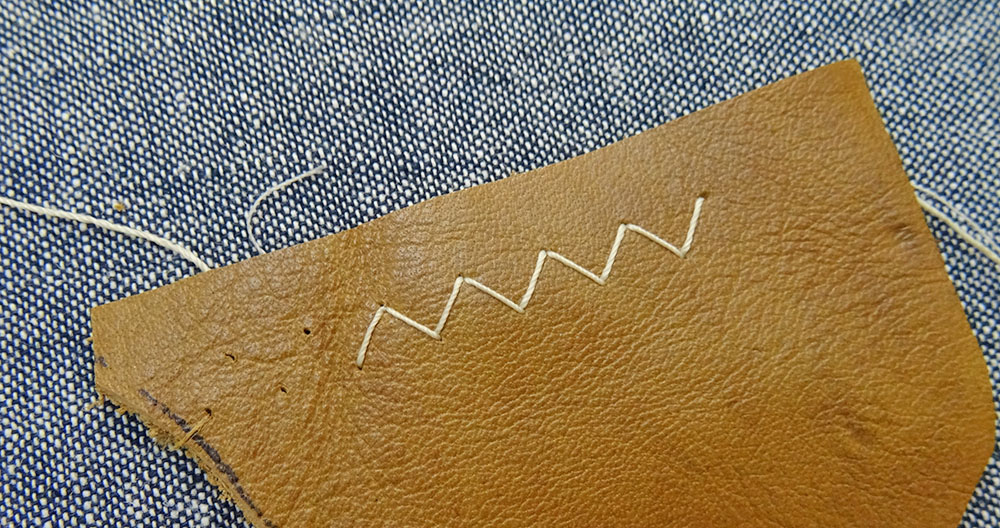
- X’s: (1) Set up and stitch a row of large zig-zag stitches in one direction. (2) Take the leather out of the machine and replace it with the stitching facing you. The needle needs to be directly above the left side of the stitch and beside the outer point of the zigzag. (I removed the machine foot for the photo so you could see the needle better.) (3) Stitch back to the other side! TIP: If your X’s are slightly uneven it adds to the handmade look of your label #embraceit
- Straight-ish: Pre-cut the leather and stitch angled or straight lines in groups from side to side. Different stitch lengths, thread thicknesses and colours look great too!
- Cut the label. If you are going to sew the label into a seam, be sure to leave the seam allowance amount above your stitching for easy placement.
- Optional Backing. If the back of your label will show and doesn’t look “pretty”. Cut a scrap of fabric and fusible web to the size of your label and fuse it to the wrong side of the leather to cover it.
- Repeat. This is so much fun!
Hope you had fun visiting today. Be sure to follow #alongforthreadride!
by Sherri Sylvester | Oct 7, 2016
October is Embroidery Month! Scary?… Embroidery sounded hard to me hard, and confusing, or at least made for people who put sayings or licensed characters on everything. Turns out it is so much easier than I thought – and fun to play with – which I found out since being loaned the Janome Skyline S9 sewing and embroidery machine. (P.S. Keep reading to get a free apron pattern and tutorial below. Or click on one of the photos to pin it for later!)
This post is sponsored by Janome Canada. I’m part of a group of Canadian Janome Artisans. Thank you for reading!
Coming Soon! In mid-November, I’ll be writing a more detailed series about embroidery – the Sewing Diaries: Embroidery Edition – tips/tricks and my honest newbie experience using one of these “scary machines”! (Including a list of things I should have done when embroidering this apron and didn’t…)
If the Sewing Diaries sounds familiar, it’s because this spring’s Sewing Diaries: Meet Your New Machine series was similar. If you haven’t read it, take a look. Lots of good general information about getting to know your machine, and how to sew almost anything on it!
Last week‘s installment of “What’s Your Maker Style?” included a super-fun short quiz where you get to choose your favorites from photos of sewing things to find out what your Maker Style is. If you haven’t tried it yet, click on the photo below! (Don’t worry, we’ll wait for you to come back!)
For all the Design Diva’s out there – this post is for you!
This apron was made to highlight the embroidery options available on the Skyline S9. Inadvertently, I also highlighted it’s sewing abilities. Since it is a 2-for-1 machine, and you can switch from sewing mode to embroidery mode with the touch of a button – literally! (On it’s pretty full colour touch screen, I might add… eeep!)
The original Design Diva Apron was made from a nice springy palette of magenta, florals and navy. The tutorial version is a little more autumn-friendly with a pretty wine coloured sash, boho pockets and navy skirt. Plus of course I made it more fun with lots of embroidery, including one of many exclusive Anna Maria Horner designs and my personal monogram. (Couldn’t resist!)
Design Diva Apron Tutorial
As usual, please feel free to use my free patterns/tutorials for your personal projects and gifts and for charitable fundraising events. Please do not sell anything made with this pattern. If you are interested in selling aprons made with this pattern, please contact me or leave a comment and I will make a Seller’s License available for purchase in my shop.
Sizing:
The Design Diva Apron is *almost* a full circle skirt of ruffled goodness, the wide waistband and wrap-around sash add to the fun! This free apron pattern is one-size-fits-many and all seams are finished with a simple French Seam.
The entire apron waist measures about 34″. The back of the apron is open to allow it to fit a greater number of sizes. The sash is about 118″ long and can be tied in the back, wrapped around the front to tie in a bow or a knot to fit the wearer best. This apron is about 21″ long.
Materials:
Quilting Cotton works great for this project, along with twill, linen and other lightweight woven fabrics. The materials listing is based on 42″ wide fabric (pre-washed) unless otherwise specified.
- 1 yard Main Apron Fabric
- 1 yard Sash Fabric
- 1/2 yard Pocket Fabric
- 4 yards Ruffle Binding (I used 1 1/2″ wide.)
- 1 yard 20″ wide Medium Weight Fusible Interfacing (ie. Pellon SF101 Shape-Flex)
- Matching/Contrasting thread for Edge-Stitching
- Removable Fabric Marker
- 2 Safety Pins
- Chopstick
- Your regular sewing supplies
- Optional: Embroidery Machine, stabilizer and thread for embellishment
Before you begin:
- Print out all 12 pages of the Design Diva Apron Pattern Pieces pdf on letter size (8.5″ x 11″) or A4 paper. Important: Do not select “fit to page” when printing, make sure you print at the original size.
- Once you have printed the first page, measure the 1″ test square to ensure the pattern is the correct size.
- Cut each page on the outer gray lines and tape the pages together, matching the letters in the gray half-circles.
Cutting:
- Main Apron: Fold your fabric in half, matching selvage edges. Cut one Apron Front on the fold, and 2 Apron Backs as per the pattern pieces. Be careful, the yardage is tight, buy an extra 1/2 yard if you are worried.
- Apron Pockets: Fold your fabric in half, matching selvage edges. Cut 2 of each pocket piece as per the pattern pieces.
- Sash: There are no pattern pieces for the sash. Cut 3 pieces of sash fabric 9″ x 40″ each.
- Interfacing: There are no pattern pieces for the interfacing. Cut 6 pieces of interfacing 4 1/2″ x 20″.
Let’s Sew!
All seams are 3/8″ unless otherwise indicated. Be sure to backstitch at the beginning and end of each seam to secure your stitches. Press liberally throughout to ensure a professional finished product!
Embroider the Apron (optional):
Machine embroider your apron as desired. I chose to use an Anna Maria Horner design supplied with the Janome Skyline S9 machine. And embroidered them using Janome embroidery thread.
It was hard to choose which designs to use, there are so many I like! In the end, because the apron has a circle skirt and drapes a lot near the bottom, I chose to use a simpler flower design, using colours that complimented the fabrics in the apron.
The back needed to be monogrammed, of course! I chose to use a 3 letter monogram for my initals – literally took me all of 2 minutes to program into the machine. Pretty addicting – I “need” to monogram all of our towels now!
Tips: Remember, the front will be sewn to the back at the side seams. Since it is a circle skirt, be sure to angle your design or it will not be straight when you wear it. Plan accordingly if you want to tie a bow at the apron front, some of your embroidery may be obscured by the sash ends. Also, depending on the wearer, the back may or may not be overlapped.
Prepare the Sash:
- Match and stitch all 3 sash pieces right sides together along the short edges. Press all seams open. You will now have a sash about 119″ long.
- Fold the sash lengthwise with long edges matching and wrong sides together. Press well. Open and fuse the interfacing to the wrong side of one half (4 1/2″height) of the sash length as per your manufacturer’s directions. Overlap the interfacing pieces by 1/4″ so they cover the entire sash. The interfaced side will be the front of the sash.
- Fold the sash along the center line and re-press if necessary. Mark a point 4 1/2″ in m the end of the long raw edge. Draw a line from this point to the corner of the folded edge. Cut along this line, creating the shape for the angled ends of the sash. Repeat for the other end.
- Fold the sash in half and mark the center point (yellow pin). Set aside.
Sew the Pockets:
- Match a Pocket Top right sides together with the pocket curve of the Apron Front. Pin and stitch along the small curve. Trim seam allowance in half.
- Flip and press the Pocket Top wrong sides together with the Apron Front. Top stitch the pocket with a straight stitch, or something fancier! I used an Heirloom stitch (#30) on the Skyline S9 to create a subtle cross-stitch in red along the edge.
- Fold the Apron Front out of the way and match a Pocket Bottom to the long outside curve of the Pocket Top with Wrong Sides Together. This will be the beginning of a french seam to finish the raw edges. Stitch the outside curve with a 1/4″ seam. Trim the seam allowance in half.
- Turn the Pocket Top and Bottom so they are Right Sides Together. Push out the seam and press well. Pin if desired and stitch the outside curve again, enclosing the first seam. You’ve now enclosed the raw edges and finished the French seam.
- Fold the pocket into place and baste the top and side edges with a 1/4″ seam to keep them in place.
- Repeat for the other pocket.
Sew the Side Seams:
- Match an Apron Back to the Apron Front at the side seam Wrong Sides Together. We will sew another French Seam to finish and enclose the sides of the apron. Pin and Stitch the Side Seam with a 1/4″ seam. Trim the seam allowance in half.
- Turn the Apron Front and Back so they are now Right Sides Together. Press well along the seam. Stitch again with a 1/4″ seam to enclose the raw edges. Press the French Seam towards the Apron Back.
- Repeat for the other side seam.
- Fold the apron in half to find the top center waistline. Press to mark it, or use a pin.
Finish the Hem:
- Sandwich the curved apron hem between the ruffled bias tape. Pin if desired. Stitch the tape beginning at the top of one Apron Back edge and ending at the other. Cut off any remaining bias tape.
Tip: This is another great place to use a fancy stitch if you’d like to. I used the same Heirloom stitch as I did to top stitch the pocket edges. This time in tone-on-tone white. It gives a nice hand-made vibe to the apron!
Attach the Sash:
- Measure out 19 1/2″ on each side of the center marking (green pin) you found on the sash. Mark each measurement (yellow pin). The area between these marks will be attached to the Apron along the waistline.
- Match the interfaced side of the Sash to the Apron Front with fabric right sides together at the center mark. Pin. Match the ruffled edge of an Apron Back with the 19 1/2″ markings you just made on the sash. Pin.
- Match and pin one side of the the sash to the apron waistline between the pinned areas. Repeat on the other side so the entire waistline is pinned.
- Stitch the pinned area from one side of the apron ruffle to the other. Open and press the sash away from the apron.
- Place a safety pin in each end of the interfaced area on the sash. This will make it easier to turn later.
- Place the apron right side up on the table with the skirt facing you. Roll the apron fabric up to the sash until you can see the waistline seam you just sewed underneath it. The rolled apron will be laying on the front half of the sash (interfaced). You may want to roll the fabric a bit at a time, since there is a lot of it.
- Match the sash sides right sides together at the center (enclosing the rolled apron) and pin.
- Measure 5″ on either side of the center pin and mark with another pin. The 10″ area between these two marks will be the opening and will not be sewn.
- Match and pin the remaining raw edges of the sash. Be careful to keep the rolled apron inside the sash and out of the way of the edges as you pin. You will now have a strange long fabric snake – it’s ok! We’ll make it look like an apron in the next few steps.
- Stitch along the pinned edges, leaving the 10″ opening un-sewn. Make sure you do not sew over the rolled apron! When sewing over the previous seam, try to sew just to the outside or directly on top of the seam, if possible.
- Clip the corners of the sash. Clip a large long triangle out of the end of the angle, to remove as much bulk as possible.
- Pull the apron out from the opening to turn the sash inside out. Use the safety pins to turn the sash ends. Be patient! It is a very long sash, but I promise – it will turn! Push out the angles with a chopstick. Push out edges and press well.
Finish the Apron:
- Press under 3/8″ along the sash opening. Pin.
- Edge stitch the sash, catching and closing the sash opening. I like to use my Janome blind hemming foot, just move the needle to the left and let the guide run along the edge of your fabric. Perfectly straight!
- Press the apron well, and you are finished. Enjoy!
——————————————————————-
I’d love to see your project! You can share your apron on Facebook, Twitter or Instagram (links below) using the hashtags #alongforthreadride and/or #threadridinghood. Thank you!