by Sherri Sylvester | Jul 24, 2013

Today we are talking about my bias tape maker. I love it! Handmade bias tape adds a bit of extra umph to your projects, and the colours and patterns (and the price!) sure beats the store-bought stuff! I used this batch of pink hounds-tooth 1/2″ bias tape to make a cute chevron Beach Robe. We gave it away to one of my daughter’s friends as a birthday gift on the weekend. On our side of the world all of the summer stuff is on sale, so you can get two cute beach towels for $4 each. Makes this project add up to about $10.00 (not including your time!).
There are lots of tutorials online for how to make your own bias tape. A couple of links: 5 Yards Continuous Loop method from one Fat Quarter or Using 1 Yard or 1/2 Yard cuts of Fabric Piecing Method. So today I have written a tutorial on how to finish off the ends when you are sewing double fold bias tape.
(1) Leave a 4″ tail of bias tape when you start sewing it onto your project. Stitch the bias tape on leaving a 2-3″ gap of un-sewn tape and another 4″ tail. (2) Fold one bias tape tail back on itself, make sure the fold is roughly half way across the gap you left. Iron with lots of steam. (3) Pin it to hold it in place. (4) Fold the other tail over to meet your first fold, iron with lots of steam to make a good mark. (5) Unpin your tape and unfold it. Pin your bias tape tails right sides together being sure to match up your ironed marks. (6) Stitch across the ironed mark to sew the two bias tape tails together. (7) Trim off your extra bias tape. (8) Refold the tape and pin it across the gap you left. (9) Finish stitching on your bias tape – Done!
What are your favorite bias tape projects?
Check it out – #14 – the last day of Sew Essential is tomorrow! It will be the last day to enter the giveaway!
by Sherri Sylvester | Jul 23, 2013
Today I’m talking about changing zipper pulls again, but… if you’ve seen it already don’t go away yet. I am also talking about a cute, quick gift idea you can make that (of course) includes a new zipper pull!
If you are brand new at Thread Riding Hood, I just discovered that it is possible to change the tiny zipper pull from your regular zippers to something customized, larger, more useful and more amazing looking! I have permanently stolen borrowed the needle-nose pliers from my husband’s toolbox to change all of my zipper pulls. I love this tip – so much that I want to include it in the Sew Essential list – even if it was posted only a few weeks ago. Check out the “Change a Zipper Pull” post for a full tutorial.
For the rest of you – check out fabric designer Aneela Hoey’s Oval Box Bag. This is a great little gift idea. It is just big enough to include a little something inside. She talks about the bag being a bit scary to make. But if you follow the directions, and look at the detailed photos you should be fine. Aneela writes everything out very well and give lots of direction. When you are done making the bag, you can use a scrap to change the zipper pull and voila! The perfect gift! I finally got to use the fabric I bought for this project at the Creativ Festival in May. This is a good fat quarter project – and you will definitely have lots of fabric left over.
I likely should have taken measurements so you would know how big it is when it is finished. I gave it to my mom for her birthday so she has it now and might be able to post measurements in the comments (Please?!) so you can estimate what might fit inside! Here are a few ideas. It would be a great little makeup pouch. For a seamstress it could be a sewing box for thread or a small hand sewing kit. If you made it for your kids they could use it to carry around their Hot Wheels or Littlest Pet Shop collection. It is sturdier than I thought too – I interfaced both the outer and lining fabrics with medium weight fusible. I think my favorite part of the Oval Box Bag is the handle – it adds the perfect little touch on top, and it is useful too.
Only two more days until the giveaway is over! Check out Sew Essential #13 tomorrow.
by Sherri Sylvester | Jul 22, 2013
I got a couple of Peek-a-Boo Pattern Shop patterns in the bundle I bought back in February. I just pulled out the Alex and Anna Summer PJ’s a few weeks ago to make some PJ’s for my oldest daughter. This pattern is really easy to follow and has sizes 6 months through 8 years – so it will grow a long ways with your child. The printable pattern pieces don’t take up much paper either. The only thing I don’t like about printing my own patterns is the amount of paper it takes to print all of the pieces. This layout is well thought through to save you time gluing and paper too!
I made size 6 shorts and lengthened the sleeveless top to make a nightgown. The sizing worked really well. The top is a bit big – but I was expecting that based on the sizing chart. The two pieces went together fairly quickly. I think it took me just over 2 hours to finish both pieces – and that includes matching the stripes. Though I did take a shortcut and didn’t hem the nightgown to save time. Since it is a knit it won’t fray anyhow. The knit came from my Ottawa Street shopping trip. At $4 a metre I think the total price for the pj’s comes out around $2 and I still have more to make another set. Can’t complain about that!
I usually use my stretch stitch when I sew knits, but I decided to try something different this time. I have had two different patterns suggest stitching the whole thing using a double needle recently (this one and the Heidi and Finn Skort). I was a bit wary of this because it seemed like overkill to sew two rows of stitching when I could just use one. To save time switching needles I decided to sew the PJ shorts almost entirely with my double needle and I am super happy with the results.
If you have not used a double needle before, check out the picture above. The top of your stitching looks like two straight stitch rows. The bobbin thread on the back view weaves between the two top threads and creates the stretch you need when sewing knits. I have a ballpoint double needle – because you should use a ballpoint tipped needle when stitching knits. A regular needle point is sharp and will cut through your individual fabric threads, creating tiny holes in your fabric. The ballpoint tip will push the threads aside as it goes through the fabric so they don’t get cut.
Here is a quick explanation on how to thread your machine to use a double needle.
(1) Grab two spools of thread and your double needle. If you don’t have two spools of the same colour you can quickly make a bobbin to use as your second spool. (2) Check out the top of your machine – you should have the option to use two posts. One for each spool. If you don’t have space for two spools check out your machine instruction book – I’m sure it will show you where to put them. (3) Put one spool on each post. (4) Thread the machine as usual – using one thread from each spool – they should both follow the same path through your machine.
(5) Get your double needle. It should have a flat spot on one side of the shank (the post above the plastic that holds the needles together). Remove your current needle and note where the flat spot is. On my machine it is at the back. Put your double needle into the machine with the flat spot in the correct place and tighten it. (6) Separate your two threads and thread one through each needle. My machine also has two hooks to hold the threads separate. One on each side where I change and tighten my needle. (7) Set your machine to a normal length straight stitch. Set your needle position so the double needle comes down in the centre of your presser foot – so you don’t break it by accident the first go ’round! I also set my tension a bit higher to 8 (normally it is set at 5) when I stitch with my double needle. Now, stitch – easy peasy!
Hope that helps! Try it – it’s easier than it seems and really does make stitching and hemming knits look more professional.
Come back tomorrow for Sew Essential #12. (and click here (if you haven’t already) to enter to win a bundle of Tula Pink fat quarters!)
by Sherri Sylvester | Jul 21, 2013
This is an incredibly simple tip today – but one that has made a huge difference in my sewing. So many times I work with fabrics that are the same on both sides. Sometimes these fabrics have nap, so keeping everything in the right direction and right side up is important. Enter stage right – the jar of safety pins! I put a safety pin at the top of each piece on the “right side” of the fabric. I usually put them on after I have cut out each piece and before I move the paper pattern piece – so as to make sure I have them in the right place. The only trick to this is when you are cutting through two layers of fabric. The “right side” is going to be different on each piece because you have opposite facing pieces once they are cut.
Simple, but worth it! If you want to be incredibly organized you can add a scrap of paper with the piece description and size (if you are making matching outfits). I’ve used this tip lately because I am in the middle of finishing up two more MADE Beach Robes for my daughters to wear when we visit the cottage in a few weeks. Nice thing is, cheap safety pins from the Dollar Store work well for this one because they don’t have to be incredibly strong to stay in one layer of fabric.
See you tomorrow for another Made by Me Monday pattern review and Sew Essential #11.
by Sherri Sylvester | Jul 20, 2013
Your everyday, super normal glue stick is a wonderful “pin replacing” sewing tool. If you have been around Thread Riding Hood even for a short while you’ll already know this one! I did a quick search for the words “glue stick” and here is the round-up. Check out how many ways you can use one. This list will have you raiding your craft supplies in no time!
(1) Attach a Zipper (2) Hold a label ’till you sew it on {Tote-able Towel: Step 20} (3) Attach Piping (4) Hold an Applique in place {Ruffled Easter Egg Tee: Step 16} (5) Attach Velcro {Reusable Snack Bag Review, Sew Much Ado Diaper/Tote a la Thread Riding Hood: Step 2}
(6) Attach Knee Pads and Ribbon {Simple Shorts with Heart Knee Pads: Step 7, Simple Shorts with Oval Knee Pads: Step 6, Simple Sport Shorts: Step 3} (7) Hemming {Change a Zipper Pull: Step 9} (8) My favorite! Keep your kid busy by recycling printed pattern scraps!
Have you tried using a glue stick when you sew?
Tomorrow – Sew Essential! #10. Only 5 more days to go until we announce the giveaway winner and a Sew Essential! Round-Up Post.
by Sherri Sylvester | Jul 19, 2013
One week down, one more week of Sew Essential! posts to go until I get to give away the gorgeous Tula Pink fat quarter bundle! You can enter the giveaway here.
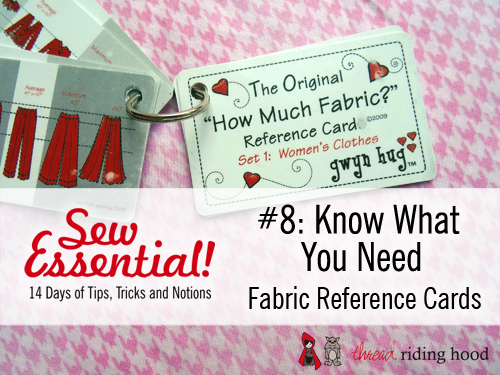
Have you ever gotten to the fabric store and found “the perfect fabric” for something, just to realize you didn’t know how much to buy? I did this so many times – and would then get home and be disappointed that I didn’t have enough for what I wanted to make. Either that or I would buy way to much and end up feeling wasteful – though having more fabric around is not generally a bad thing!
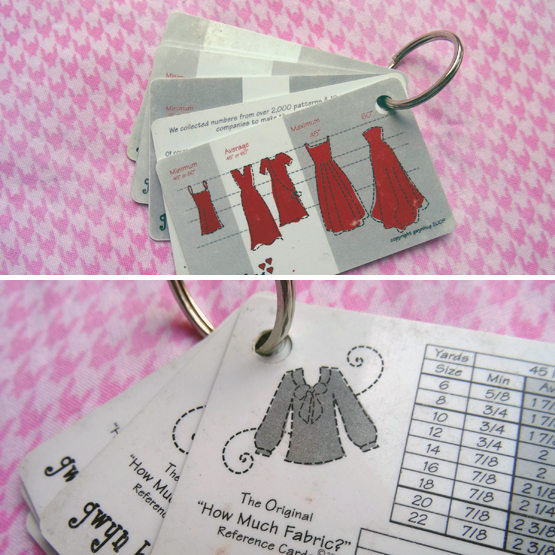
I got these Gwyn Hug Reference cards a few years ago and they have lived in my purse ever since. One side of the card references different types of clothing within a particular category – you can see the different dress options below. The other side of each card references different sizes and the amount of fabric you will likely need to buy for each type of dress. She also includes a handy “add this much” safety margin table – just in case you want to be extra sure you buy enough.
I have the “Women’s Clothes” card set from a few years ago. But I see that now she has Plus Size, Men’s Clothing, Babies and Toddler’s and Children’s Clothing sets. She has also expanded the options by having an e-book version that you can keep on your smart phone. I might have to get some more of these!
Which set of cards do you think you’d find most helpful?
Sew Essential #9 coming up tomorrow!