by Sherri Sylvester | Oct 18, 2013

Hi! We’re talking about customizing your patterns again today. There are so many things you can do if you know how… so – here’s another tutorial this week (previous one here) on how to help make any pattern into your own creation!
Adding gathers to a shoulder seam can do a few things. First – it will add extra width to the top or the whole bodice – especially nice if you have a fabric with a great drape, or if you need a bit of extra wiggle room in the width of your pattern. Second – it adds a nice feminine touch and a bit of visual interest to the shirt – especially if it is a straight-forward simple pattern.
Wanna try it?
You will need:
- bodice pattern piece – must include shoulder area (I used the Skipper Top from Sew Much Ado – pattern review here)
- paper the length of the bodice
- pen
- ruler or straight edge
Here we go:
(1) Determine how much of the neckline on your pattern piece will be taken up with the seam allowance and/or neckline finish – mark this on your pattern piece. This pattern, for example, has a hemmed neckline and a neckband finish. Since I was using the neckband 1/2″ from the seam allowance would be removed from the visible shoulder area.
(2) Determine where to put the extra width for the gathers.
- (2a,b) Because I used a dolman sleeve top it is not immediately obvious where the gathers should be placed because the sleeve has no shoulder indication. I measured my daughter and found about 2″ of room before her shoulder started. I decided to leave 1″ between my seam allowance mark from Step (1) and where the gathers would start.
- OR If you are starting with a set in sleeve pattern this is a much easier process. Because you know where the shoulder starts, draw a mark at the centre of the shoulder seam area.
(3) Determine how you would like the final shirt to fit.
- Do you need extra width in the top of the shirt only, or also through to the bottom of the bodice (say, to cover a toddler belly!)? For my daughter’s shirt I picked a size width that would cover her belly and added the extra width only to the top 2/3 of the pattern. I ended up cutting a size 5 width, with a size 4 everywhere else.
- Top only (Track A): (3a) Pick and mark a spot about 2/3 of the way down the bodice along the centre line – Draw a line from your Step (2) mark to this new mark. ** The area above this mark will have added width – so be careful with your choice! Do not place your mark too high or the fit of your sleeve and/or neckline will be off due to the extra width that only occurs around the top of the shirt.
- Through the whole shirt (Track B): (3b) If you like you can add width all of the way through the shirt by drawing your line from your Step (2) mark to the hem, parallel to the centre fold line. ** Be careful, the width you add will be doubled – once on each side of the shirt!
(4) Cut the line you just drew.
- Track A: (4a) If you followed Track A cut the line ALMOST to the edge of the centre seam. Leave a little “hinge” of paper.
- Track B: (4b) If you are following Track B you can cut your line all the way down the pattern.
(5) Determine how long you want the gathers to be. I decided to add in 1 3/4″ of extra space – though, I think looking back I should have only added 1″ because the added width distorted the top a bit much.
- Track A: (5a) Spread the top of the paper by the amount of gathering space you want to add. Tape another piece of paper underneath the entire area you just opened up.
- Track B: (5b) Spread the pattern pieces apart by the amount of gathering space you want to add. Tape them to another piece of paper the length of the pattern piece, matching up the hemline. Make sure they are evenly spaced all of the way along.
(6) Cut away the extra and even out your pattern lines.
- Track A: (6a,b) Draw a line from neckline point to sleeve point along the shoulder/sleeve seam.Cut along the line to remove the excess paper. Add in paper to straighten the bodice centre line. Tape the paper in and draw a line from neckline centre to hemline centre. Cut along this line.
- Track B: (6c,d) Draw a line from neckline point to sleeve point along the shoulder/sleeve seam. Draw a line along the hemline from side to side. Cut along these new lines to remove the excess paper and straighten your pattern lines.
- NOTE: If you have curved lines (say, at a hemline) eyeball a curve instead of straightening the pattern line.
YAY! You now have your new pattern piece!
(7) Cut out your pattern pieces as per the pattern instructions. * You may need more yardage if you are adding a lot of extra width.
(8) Line up your new pattern piece with the shoulder seam of your fabric. Now you will mark the area you will need to gather. (8a) Mark 1 edge even with one edge of your added width, I chose the right side. (8b) The gathers will need more space than the width you added, so mark 1/2″ to 1″ extra on the other side of your extra width, I added 1/2″ extra. Mark the other shoulder seam in the same way* If you do not have the room and are making a set in sleeve with a skinny shoulder seam, you can gather the whole shoulder seam. Or, distribute the extra amount by adding 1/4″ – 1/2″ on either side of the extra width instead of on one side only.
(9a) Make two lines of basting width straight stitches within your seam allowance area. (9b) Gather the area to match the shoulder/sleeve width of your back bodice and tie off the ends of the gathering stitches to keep them in place. Continue following the pattern instructions as written using your newly gathered shoulder!
I’d love to know how your project went. Post your project on Facebook and it might end up in a “You Made It” post on the blog! I’d love to hear if you liked this tutorial or any changes you might make.
by Sherri Sylvester | Sep 22, 2013
On Monday I told you I would post how I stitched over the vinyl on my Toddler Backpack super easily. And the secret is… I used this scrap-booking washi-esque tape that I found at a local dollar store.
It has a waxy, smooth surface on the papery tape and is not too sticky on the back. (Which is why I’m using it for my sewing, it wouldn’t hold anything to the wall for photographs!) I put a piece on the underside of the zig-zag foot that I use for my normal sewing, cut out the portion under the needle with a craft knife and… Voila! Even stitches – though it looks like I need to fix my tension a bit more!
I couldn’t resist adding some Koi by Rashida Coleman-Hale behind the plastic in this shot – the purple is gorgeous!
Of course, you could also go out and buy a Non-Stick (Teflon) foot for your machine – and a good explanation of one is found here. I agree with her last comment about risk, but was not pleased when I tried the scotch tape method – it was still too sticky to stitch evenly. It is possible that masking tape would work as well – but the waxy coating on the tape I bought is a lot different than the surface of the masking tape – so I don’t think it would be as good.
Have you invested in a Teflon foot? What do you think of it?
by Sherri Sylvester | Aug 16, 2013
I’m in the midst of (what seems like) turning our house upside-down. The kids’ playroom upstairs has now moved to the basement so they have a TON more space to run around. My sewing area and my husband’s office are moving from the basement to join forces in what was the playroom and right now it doesn’t look habitable! Hopefully by the end of the weekend?! In the midst of it all I’m super excited, I have wanted to re-organize my sewing things for a while now and this is the perfect time. I think I’m even going to put all of my fabric on mini-bolts as per this Smashed Peas and Carrots idea.
Now, back to the shorts. If you haven’t seen Monday’s post on how to shorten your shorts, I’m doing a mini 2-part series on pattern altering. Today I’m covering off how to widen or narrow the legs of your shorts. Before you use these instructions you might want to read through the first few paragraphs in the previous post. There are some good instructions on tracing and pattern paper, and an explanation of why I needed to alter the shorts pattern in the first place!
{how to} Narrow the Leg of your Shorts
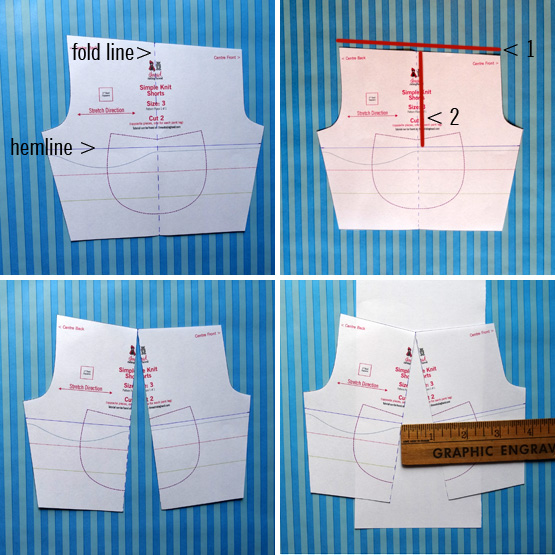
(1) Fold your pattern piece down the centre (along the side of the shorts), line up the hemline from one side to the other, the waist may not match up. I drew in the dashed line to show where the fold is. This pattern piece is already marked at the new hemline (see this post), I have not removed the excess pattern paper because we can use it later. (2a) Now we do some math. Measure around the shorts recipient’s leg where the hemline will be, and note the measurement as A. Measure the hemline on the pattern and call it H. (2b) Add ease (1″ for knits) and twice your seam allowance to measurement A – call this new number B. (2c) Subtract B from H and get measurement C (this number is the amount you need to remove from the pattern piece to narrow the leg of your shorts). (2d) Divide C in half to get D, you will use D to remove the same amount from both sides of the shorts. Now we can move on!
(3) Note down two measurements on your current pattern, for reference later – 1: From centre-front to centre-back (along the waist/top of your pattern piece) 2: Your side seam from top to (shortened) hemline, along the fold you created. (4) Mark D (in my case 1/2″) along the hemline of your shorts and on either side of your centre fold line. (5) Draw two diagonal lines from the top of your pattern at the fold line, through the D marking you made on the hemline, and continue to the bottom of your pattern piece.
(6) Cut along your diagonal lines ALMOST to the top of the pattern, leave a little hinge to hold the pattern together. (7) Tape the pattern piece back together along the line. (8) Straighten your hemline (a) and waistline (b) by lining up the edge marks of the current ones and drawing a line with your ruler. (9) Before you cut out your new pattern, use your noted measurements from Step 3, and measurement B from Step 2 to make sure they are correct. Your new waistline should match the old waistline measurement, the new hemline should match your new intended width (Measurement B), and the side seam measurement should match your old measurement from Step 3.
(10) Cut your pattern piece at the new hem and waist lines and you are done. Go stitch up some shorts!
{how to} Widen the Leg of your Shorts
(1) Fold your pattern piece down the centre (along the side of the shorts), line up the hemline from one side to the other, the waist may not match up. I drew in the dashed line to show where the fold is. This pattern piece is already marked at the new hemline (see this post), I have not removed the excess pattern paper because we can use it later. (2a) Now we do some math. Measure around the shorts recipient’s leg where the hemline will be, and note the measurement as A. Measure the hemline on the pattern and call it H. (2b) Add ease (1″ for knits) and twice your seam allowance to measurement A – call this new number B. (2c) Subtract H from B and get measurement C (this number is the amount you need to add to the pattern piece to widen the leg of your shorts).
(3) Note down two measurements on your current pattern, for reference later – 1: From centre-front to centre-back (along the waist/top of your pattern piece) 2: Your side seam from top to (shortened) hemline, along the fold you created. (4) Cut along the folded centre line ALMOST to the top of the pattern, leave a little hinge to hold the pattern together. (5) Find a piece of paper as tall as your pattern piece and a bit wider than measurement C. Place the paper under your pattern and use a ruler to measure width C between the hemline markings you created (in my case I added 1″). Tape the paper into the pattern to hold it in it’s new position.
(6) Draw a new hemline by lining the ruler up between the outside hemline markings. (7) Add a piece of paper as wide as your pattern piece under the waistline area and draw a new waistline by lining the ruler up between the outside waistline markings. (8) Before you cut out your new pattern, use your noted measurements from Step 3, and measurement B from Step 2 to make sure they are correct. Your new waistline should match the old waistline measurement, the new hemline should match your new intended width (Measurement B), and the side seam measurement should match your old measurement from Step 3. (9) Cut your pattern piece at the new hem and waist lines and you are done. Go stitch up some shorts!
All done, wasn’t too painful, eh? In reality what I did was a lot quicker. I knew from making the Skort pattern before that the legs were roughly 2″ or so too large around. So I cut up the centre of the pattern piece and overlapped the pieces (to narrow the leg) by about 2″. If you have not made the pattern before, however, it is not so easy, and it is better to follow the instructions above!
If you happen to have a two piece shorts pattern (as opposed to the one piece pattern we used above) you can remove the excess in a similar fashion. You will need to take in or widen the back and front pattern pieces. Take in or widen each leg by half of the the amount you need to change. Fold each front and back pattern piece in half and follow the instructions from there for each leg. (Let me know if you would be interested in a tutorial, and I’ll put one together.)
Hope that helps! We’ll see if another post comes up before Monday. It all depends on how far we get on the sewing room! Let me know if you have any questions, I’m always happy to help.
by Sherri Sylvester | Aug 13, 2013
I made this Tennis Skort for my oldest a while ago to match this one that I made for my youngest in May. I love this Heidi &Finn pattern, the sizing is great and they turn out really cute. This skirt is especially good because of the shorts that are built into it. It’s a perfect match for little girls that like to play modestly at the park and still wear skirts!
I did find one change I would have made to the first Tennis Skort, and that is to make the shorts’ legs a bit narrower. I found that they were very loose, not so good for the coverage I am looking for under a skirt. When I made this size I took in about an inch or so to make them more like a bike short, and was much happier with the final result.
When I asked you what to write about in this coming year, I got a reply from Jonquil looking for alteration tips – so, here we are! Today I’m sharing tips on how to change the length of a simple one piece shorts pattern (easiest step first!). In the next few days I will post how to make them wider or narrower around the leg. My original plan was to do them all today, but the summer (and the kids) are calling this week and my time was cut short. Do you find that the days seem to fly by more quickly when the weather is good?!
Altering a Shorts Pattern – Take 1
If you are going to alter a pattern, it is a good idea to print out an extra copy or trace the current one you are using – just in case you make a mistake! For this tutorial I have printed off a mini version of the pattern piece onto regular paper because it is easier to photograph. If you are tracing yours, freezer paper is a good substitute for regular paper if you have it around. It is light enough to see through for tracing, and the plastic coating makes your final pattern more durable. Because I do not want to compromise Heidi and Finn’s pattern, I’m using my size 3 simple knit shorts pattern piece for the sample photos. You can draft your own shorts pattern using this tutorial if you’d like. Even better, if you have one you’d like to change already just follow along below!
{how to} Shorten Your Shorts
(1) Measure your child, or a pair of shorts that fit, and note the length of the inseam you would like to alter the pattern to – This is “A”.
(2) Add the seam allowance and hem allowance (check your pattern instructions) to “A”. This new number is now “B”.
(3) Measure “B” length down from the crotch on your pattern piece and mark it. Do this for both the front and the back inseam.
(4) Draw a line across the pattern piece between your two marks. This is your new length line.
If you are altering the width of the shorts, do NOT cut off the excess length just yet. If you are stopping here, go ahead and cut along the line. Follow your pattern instructions to sew up your shorter shorts (now the perfect length!)
See you soon with more pattern altering instructions! What would you be interested in knowing how to alter when you sew?
by Sherri Sylvester | Jul 28, 2013
Thanks to everyone who entered the giveaway! I really appreciate all of your kind words and great ideas for this coming year’s posts on Thread Riding Hood.
Our winner, as chosen by Random.org, is: #16: Pam who said: “Thanks for the awesome giveaway! I love Tula Pink too. I would love to see some tutorials for quick-to-make gifts.” I’m sending out Pam’s Tula Pink Fat Quarter bundle along with a fun little surprise. You can get your own bundle .
If you didn’t win – don’t despair! I have a roundup of all of the Sew Essential posts here for you. Hopefully even just a few of these Tips, Tricks and Notions will make your sewing easier and faster! If you’d like something tangible, you can print out the free kids’ measurement chart from Sew Essential day #14, just from me to you!
by Sherri Sylvester | Jul 25, 2013
** This post and images have been edited as of February 2016 with an updated version of this chart. **
Alright – the last Sew Essential post is here, and just as the giveaway ends. I hope to be able to tell you who won tomorrow or over the weekend.
I thought, because again – I can’t give you all something in the giveaway, that I would do up a free printable that you can use instead! I like to keep track of my girls’ measurements – because sewing genius usually strikes me at night, when I can’t measure them!
These are called the “Measure-Me Chart” because whenever I measure anyone in this house for a project one (or both) of the kids immediately run over to me and say “Measure me, Measure me!”. Aside from the obvious benefits of being more ready to sew for the kids (or grandkids!), it would be fun (and useful) to keep a series of these, one every 4-6 months, and save them in their baby books.
Download the BOY pdf here: Sew Essential #14 – Measurement Chart Boy and the GIRL pdf here: Sew Essential #14 – Measurement Chart Girl. These print easily one to a page (click the “fit to page” option when printing) or you could print them 2 or more to a page if you want to save paper.
Of course, I would be remiss if I did not profusely thank my husband for drawing the super-cute illustrations for these printables. Aren’t they great?! I’ll be back tomorrow or on the weekend with a Sew Essential roundup.


 (5) Determine how long you want the gathers to be. I decided to add in 1 3/4″ of extra space – though, I think looking back I should have only added 1″ because the added width distorted the top a bit much.