by Sherri Sylvester | Nov 9, 2015
I’m not a big fan of darts. The clothing kind – not the throwing kind! Their construction can seem finicky. And lining up the dart legs drives the perfectionist in me crazy!

Enter stage left, the Citronille Jackie coat and the Pleated Pencil skirt. They have 6 to 8 darts each. #aaaaarrrrgggggh I figured there must be a better way than “fold in half to match dart legs” and came up with a needle & thread hand-basting option that makes my detail-oriented heart super-happy!
If you’ve been here long, you know that hand sewing of any kind is low on my priority list. So, if I propose doing it, the technique must be either: 1) Amazing or 2) Really, really quick. This technique fills both categories! (If I can say so myself?)
Speed up your sewing! Find out how to get perfectly matched dart legs the easy way in this Crafty blog post.
Thanks for checking it out! What do you think of this technique? Will you use it on your next project?
by Sherri Sylvester | Jul 20, 2015
It’s your last day to enter the 11 amazing Thanks to YOU Week Giveaways. Tonight (July 20th) at midnight EST they will close and tomorrow I’m so excited to find out who will win! (Winners will be posted later this week.)
I also really love the sewing tips that we got from our giveaway sponsors and thought they should all be in one place – just in case you skipped over them in your hurry to fill out the entry form! A lot of these are new-to-me tips, and I love learning something new, especially when it saves me time and brain power!
Which of these sewing tips is your new favorite?
| Bebe’s Sewing Tip: The majority of my quilts come from patterns I find in magazines or books. When I’m working on a pattern from a magazine (or book) I find it a pain to have to keep looking back and forth at a magazine/book that’s sitting on a table. I’m always losing my spot on the page or the page flips. Depending on how many different cuts I have to make I have two things that help me.
1) I use a recipe book holder to hold my magazine/book while I’m working. This stops the pages from flipping and I find it easier to look at instructions when they are upright. I also use those reusable “sign here” labels that are used for documents to keep my place on the page. As I complete a cut I move the arrow to the next one.
2) Depending on how many different cuts I have to do sometimes I transfer the cutting instructions onto a dry erase board and erase as I do the cuts. ~ Canadian National Fabric |
| Sylvia’s Sewing Tip: Remember those little reinforcements we used (back in the day) on our paper for our binders? Well, they are a great way to label your sewing machine bobbins, so you won’t forget which thread you have on which bobbin – you can find them at your dollar store or stationary store. ~ Country Clothesline |
| Rita’s Sewing Tip: Maintenance is key – sewing machine maintenance (cleaning, change needles), personal maintenance (Hydrate – drink water, move/stretch often), tool maintenance (change rotary blades). The maker is only as good as his tools! They need not be expensive – just in good working order. ~ Fabric Please! |
| Daryl’s Sewing Tip: My best sewing tip is to take on something you’ve never sewn before. If you’re a quilter – make a dress, if you sew bags – slip-cover a chair. There is so much helpful information on blogs like Thread Riding Hood, your hand will be held every step of the way, and sewing is one of the most transferable skills there is. It will open up a whole new world of creative opportunities.~ Fabric Spark |
| Jill’s Sewing Tip: I have a scrap piece of fabric that I ALWAYS start sewing on before I start stitching – to prevent that snarl of stitches underneath your work or even worse – the edge being eaten by your machine! ~ Fishskin Fabric |
| Marlene’s Sewing Tip: Press, don’t iron. Press once to set your seam, then either press the seam to either one side or open. Then press again from the front. Pressing means picking your iron up and moving it along the fabric, overlapping as you go. Don’t iron! Ironing — where you slide the iron in a back and forth motion across the fabric — easily stretches and distorts the fabric. And don’t wait until the end to press – press as you go. This is true whether you’re sewing a quilt, clothing or — well, actually anything and everything. ~ Flare Fabrics |
| Alanna’s Sewing Tip: When sew garments always sew up a muslin first, it’s time consuming but so worth it. ~ Fridays Off Fabric Shop |
| Pam’s Sewing Tip: Use the best thread you can afford. We tend to spend a lot of money on fabric, but forget that the thread is going to have to hold it all together. My favourite is Aurifil. ~ Mad About Patchwork |
| Nikki’s Sewing Tip: My favorite sewing tip, although technically not a “tip”, is to listen to audio books while you sew. I’ve listened to so many great books (everyone, you HAVE to listen to The Girl With All the Gifts) while sewing, and it makes sewing twice as much fun! ~ Seam Allowance |
| Judy’s Sewing Tip: When you need to keep colours sorted while sewing – why not look in your baking cupboard? I sort small pieces into muffin cups and strips onto cookie sheets. At the end of the day they can be tidied up easily just by stacking them up! (Works great for Lego projects too!) ~ Sew Sisters |
| Lisa’s Sewing Tip: Never be afraid to try something new, you will be surprised at what you can do! ~ Stay Home Fabrics |
by Sherri Sylvester | Apr 9, 2015
Have you ever fed elastic or ribbon through a casing, then run into trouble when you tried to pass the seam allowance? I know it’s “easy” to baste the seam allowance down or adhere them with fusible tape – but it’s even easier with this little trick from Granny! (Find out how this series started.)
Within all Thread Riding Hood patterns and downloadable pdf’s, I’ve included “Notes and Tips from Granny’s Sewing Basket”. Granny capitalizes on the story of Little Red Riding Hood and takes creative license in proposing that Granny loves to sew! Throughout the patterns, these Notes and Tips are included to make your sewing go more smoothly. This series includes tips I’ve found helpful in my personal sewing. Find them pinned here: “Sewing Tips & Tricks” Pinterest board.
When sewing pajama shorts I am always looking for “faster and easier” ways to make them. They get used a lot and the quicker they are to make the more likely it is that I will make more in the future! My elastic generally gets stuck in the seam allowance while I feed it through because I’m too lazy speedy to bother basting or fusing them down. It’s irritating and then I get to fiddle with it until I find the correct place to feed it through.
This time I used my school glue stick to temporarily glue down the allowances before stitching the casing. It holds them down just long enough to get the elastic through. Once the shorts go through the wash the glue will come out – but that’s after I’m finished! Perfect!
———————————————
CONGRATULATIONS to the winner of the Kaffe Fassett Charm Pack from Fabric Spark! Jo from the UK was the lucky winner as chosen by the random Rafflecopter widget. She was so pleased because she had already pinned the Charm Pack tutorial for my Spring Charming Throw Pillow – Hooray! Maybe she’ll make one?!
Would you like your own charm pack? Get one from Fabric Spark – Kaffe Fassett Woven Cotton Charm Pack in Light
Hope you’re having a great week! I’m off to the library with my little monkeys – getting some reading for the weekend. See you again soon!
by Sherri Sylvester | Oct 21, 2014
I’ve decided to start a new series that has been in the back of my head for a while. Every so often I am sewing or reading a blog and find a way to make my sewing simpler, easier or faster. I’ve always thought I should write them down, and what better way to do it than to have Granny share them with you.
Within all of the patterns and downloadable pdf’s I design, (+ more coming this week!) I’ve included a “Notes and Tips from Granny’s Sewing Basket”. Granny capitalizes on the story of Little Red Riding and takes a little creative license in proposing that Granny loves to sew! Throughout the patterns, these Notes and Tips are included to make your sewing go more smoothly. I thought it would be fun to continue the series here, and share these ideas as they come up in my personal sewing.
These tips are all graphics, so they can be pinned and are easy to keep around. I’ve also pinned them to my “Sewing Tips & Tricks” Pinterest board if you find it easier to follow them around that way instead.
A while ago I was sewing ribbon on the edge of a couple of pillowcases I made for my girls. I don’t use a lot of ribbon, but I’ve always found it tricky to get a perfect edge when sewing it on. This time though, I discovered that lining the ribbon up with the inside edge of the presser foot kept my seam straight and perfectly even. The trick is to find a presser foot in your supplies that allows the left edge to rest on top of your ribbon and the right edge of the presser foot to rest on your lower fabric. The depth of the presser foot rests beside the ribbon edge and they keep each other in line!
I have had quite a few projects this past week that it is a relief to get another post up for you all! I’ve been working on a few (brand new) patterns that will be available at the Creativ Festival in Toronto happening this weekend! I’m so excited and I get to share them with you later this week. Hooray! The Quiet Book post is coming up for this week as well, so we’ve got a great few days ahead. See you soon!
Reader Feedback: Do you use a lot of ribbon in your sewing?
by Sherri Sylvester | Jun 29, 2014
I managed to only post twice last week – oops. I finished a quilt in 5 days though, so it was necessary! I’m so excited – you can see some peeks of it on Instagram if you’d like. It’s not a complex pattern, or huge, or even “all-over” machine quilted (I tied most of it), but it’s finished and I love it! It’s actually my second quilt finish in as many weeks. The first one is photographed and ready, I’m just waiting for a good time to post it.
Friday was the last day of school for us, so I’ve got summer in full swing now, including my 2 year Blogiversary that is coming up really soon! I’m planning some fun stuff to thank you all, so stay tuned…
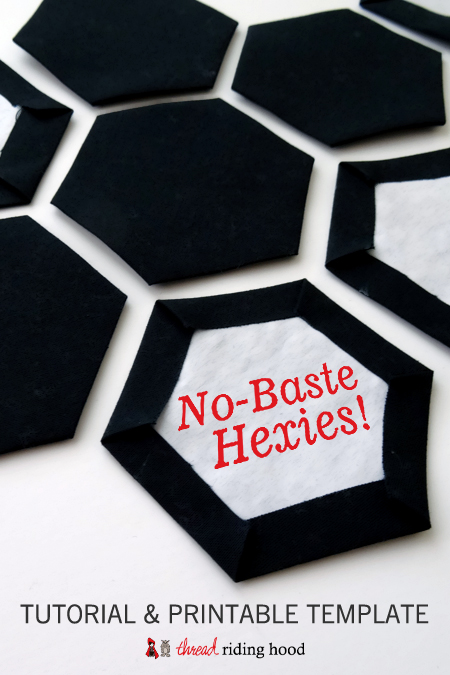
As part of my next Warp & Weft Sewing Society post I have put together a little tutorial as part of a larger tutorial for the quilt coming at the end of this week. I needed a few black hexies for a very mysterious part of the quilt (hee hee, you’ll have to come back to see it!) and I thought I would make my life a little easier. Turns out you can make these things without basting them! Instead of thread and a needle – you just need some freezer paper and an iron.
Now I know that the hand-sewn element involved in basting these hexies allows you to baste in the car, or make them as a “take-along” project. So, if you are one of those people I have a solution for you too. Instead of using an iron to adhere your freezer paper, try bringing along your hair straightener! The Riley Blake Instagram account posted this last week – and it would work perfectly. You could even use one of those outlet plugins in the car and make them on the road!
You will need:
Here we go:
Step 1: Cut the freezer paper to a size that will fit into your printer. I used a letter size sheet – so 8 1/2″ x 11″. I put them into the paper tray shiny side up, so my printer would print onto the matte side. Check which way your printer works before inserting the sheets. Now print out your hexie template. You can use the one I’ve provided in the “You will need” list or another one in the size you’d like.
Step 2: Cut out your hexie templates. This is not super fun, but it was a lot quicker than I thought it would be. I’ve noticed that there are pre-cut freezer paper hexie templates for sale online – so you could try that too.
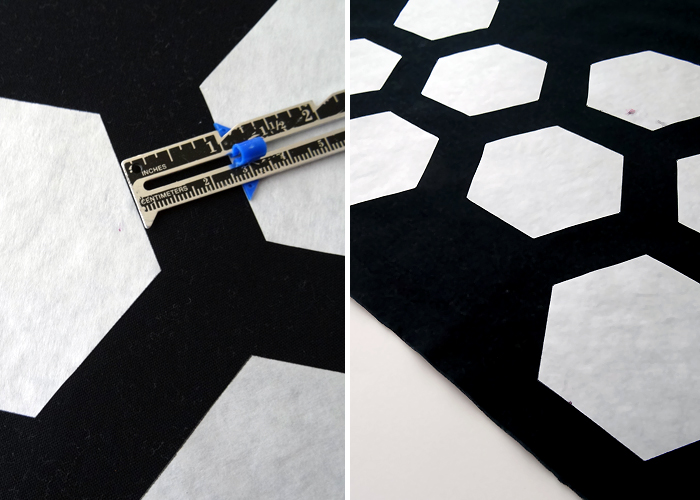
Step 3: Iron the templates onto the wrong side of your fabric, leaving at least 1″ of space between them. The space accounts for the 1/2″ seam allowance. Make sure the shiny side is DOWN, unless you want the paper to stick to your iron! The shiny side of the freezer paper is actually a thin plastic layer, so when you iron it, it temporarily sticks to your fabric. I use the heat setting on my iron that matches my fabric, in this case it was cotton. Iron just long enough to get the paper to stick.
Step 4: Cut out around your templates. Leave at least 1/2″ seam allowance around all edges of your hexies. This is the part that will get folded under and usually gets hand basted.
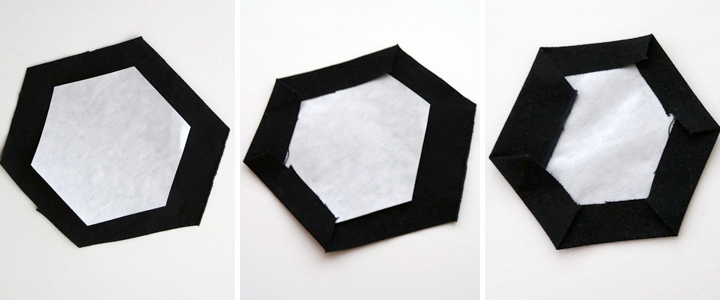
Step 5: Grab one freezer paper/fabric pair. Pull to remove the freezer paper and flip it over so the shiny side of the paper is facing up, centred on the wrong side of your cut fabric. Fold one edge of your hexie seam allowance over onto the freezer paper and iron it down. Easy peasy, it sticks to the plastic layer! Proceed around the hexie template folding and ironing each side down.
Step 6: When you are done, turn it over (paper side down) and give it a quick press with lots of steam on the right side, to secure the shape. (It might stick a little to your ironing board, but no harm done, just pull it off.) One hexie done! Repeat until you have enough to make your project.
When you want to stitch your project, just remove the freezer paper templates. Because the paper can be ironed multiple times, you may even be able to do this as you finish stitching them together. Anything to save cutting more templates, right?!
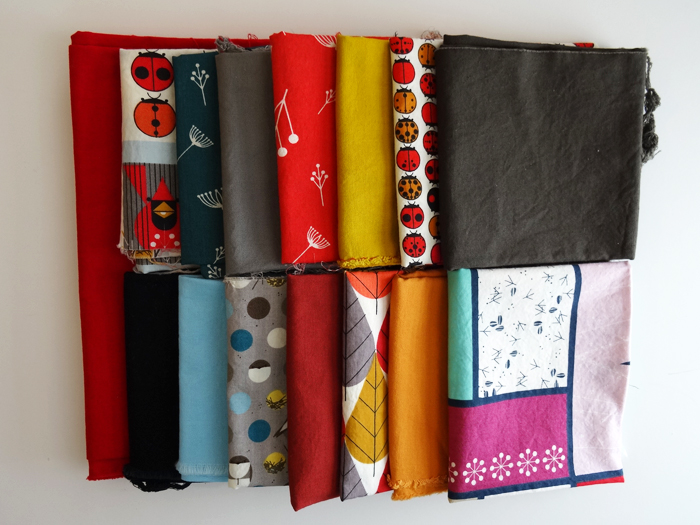
I feel that it is a little sad to be posting a tutorial with all of the hexies in black, they are so pretty when they are made in colour! Unfortunately, I needed black hexies, so that is what we get. Curious about the quilt much?! Here’s a little peek… I got to use Warp & Weft’s Charlie Harper Fat Quarter bundle. You’ll have to come back at the end of this week to check it out. I’m so excited to show it to you!
by Sherri Sylvester | Dec 29, 2013
I thought I would follow up my Cargo Duffle post with the zipper tutorial I promised. Especially since Kim asked for it – she wants to make a cargo duffle as well! This bag, by the way, performed beautifully on it’s maiden voyage via 3 differently sized airplanes. It is the perfect size to fit under the seat and leaves just enough space to rest your feet beside it. Letting you use whatever leg room you can get!
When I was buying supplies for the duffle cargo I was disappointed that I could not find a zipper that closed into the middle. Instead, all my local fabric shop had were zippers that met in the centre and opened at each end. I’ve been experimenting with zippers lately and have found that I am shortening a lot of them to fit my projects. So I thought, maybe I could flip the zipper slider around to open the zipper teeth in the opposite direction. I was pretty excited when it worked!
The only negative I can find to this process is that it won’t work on a metal zipper – at least not as far as I can tell. I was unwilling to pull my metal zipper apart because the teeth seem to be different on each side. If you take a look at the teeth on a plastic zipper (below) – they are symmetrical and will fit into the zipper slider in any direction – making the whole process of turning the slider around possible. I’d love to know if you’ve tried this and what your conclusions are.
What you need:
- plastic two way zipper
- pliers
- craft scissors
- craft knife
- sewing machine
- small fabric scraps to match your project
Here we go:
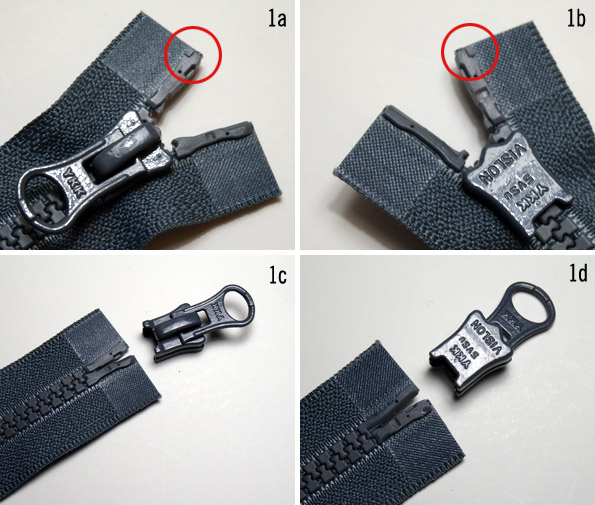
Step 1: (1a, 1b) The bottom of the zipper has two pins with stoppers molded into them (circled in red). Take your craft knife and carefully (Please!) cut off the two stoppers. This will allow your slider to come off the bottom of the zipper. (1c, 1d) Take note how the pieces look as you remove them.
Step 2: Without separating your zipper lay it right side up and mark the left and right pieces on the top – just past the top zipper stoppers. This will be hidden once you are finished, but I used my water soluble fabric marker anyhow.
Step 3: Remove the top zipper stoppers. (3a) I found the best way is to use some old scissors to cut through the stopper right beside the zipper tape. (3b) Once it has been cut the stopper will pull off with a bit of gentle tugging. Be careful not to cut the other teeth or the zipper tape!
Step 4: (4a) Both ends of your zipper will have the stoppers removed now. (4b) Lay the zipper pulls next to the zipper pin end in the correct order. Technical info: The wider end of the zipper pull allows the zipper teeth to be pulled in and fastened together. So the wide ends of your pulls should be facing each other together in the middle.
Step 5: Push the stoppers back onto the zipper at the bottom end, one at a time following the photos below. Open and close the zipper, being careful not to accidentally pull the zipper pulls off of the tape – since you don’t have stoppers at the ends anymore.
Step 6: To make a temporary stopper, put a bar tack near the end of the zipper teeth at each end. Set your machine to a zig-zag with “0” length and the maximum width. Stitch several (10-15) stitches in place. Make sure the width crosses over all of your teeth or you will have a broken needle! (Trust me – I know from experience…)
Step 7: I also covered the ends of my zipper so the bar tack would not show when I used the zipper in my cargo duffle. If your zipper is too long you will not need to do this because the ends can be stitched into the project.
- Cut 4 pieces of fabric wider than your zipper tape and long enough to reach from the end of the zipper to 1/2″ past where the teeth start. This length will be different for each end. You can also pick the longest length and make them both match.
- (7a) Place the pieces right sides facing at the edge of the teeth/bar tack.
- (7b) Stitch using a 1/2″ seam – be careful when stitching over the teeth. I usually turn the hand wheel and move the fabric around to avoid breaking my needle.
- (7c) Fold the fabric down over the end of the zipper and top stitch close to the folded edge of the fabric.
- (7d) Cut the edges from the fabric so it matches the width of the zipper tape.
All finished – now you can install it in your bag project!