by Sherri Sylvester | Mar 31, 2016

Knit fabric is really rewarding to sew. It stretches, so the fit doesn’t have to be perfect – and it’s so comfy. (That’s my favorite part.) It has a bit of a bad rep for being tricky to sew, but with a few tips you can conquer knits on any sewing machine that has a zigzag stitch – no serger needed!
I learned a lot about sewing knits and hacked my old basic Janome SUV1122 like crazy to do it. Today’s post covers 12 Tips and Tricks for Sewing Knits that I’ve learned along the way, and how some fun features on the Skyline S7 help the process. Plus I got to make my youngest a really cute spring dress without my serger, entirely on the sewing machine!
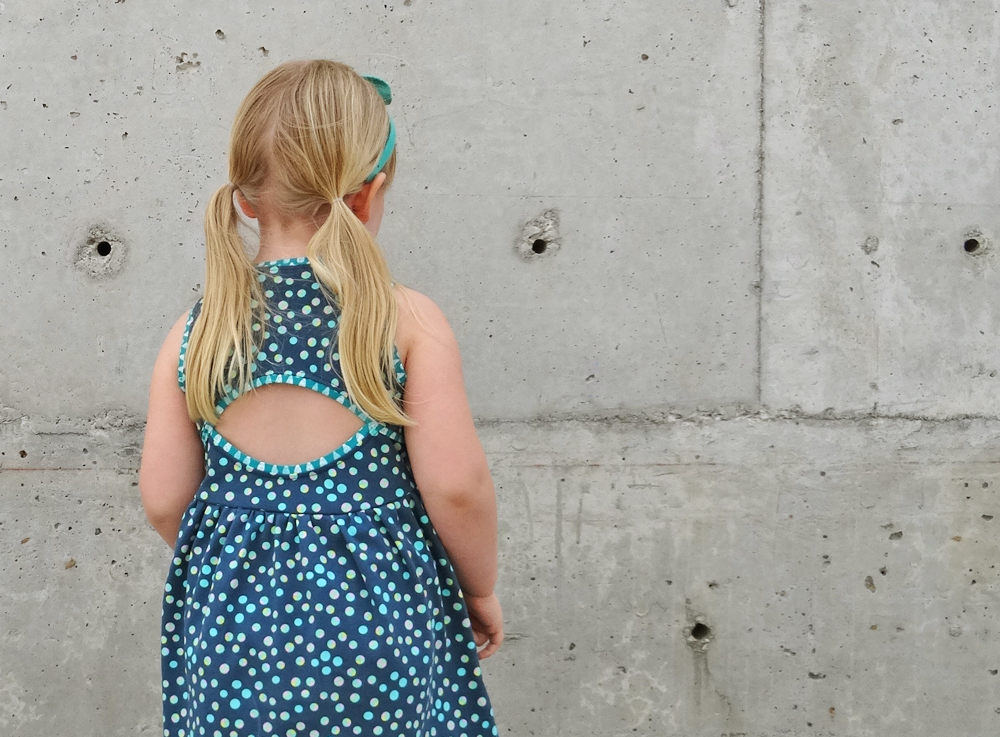
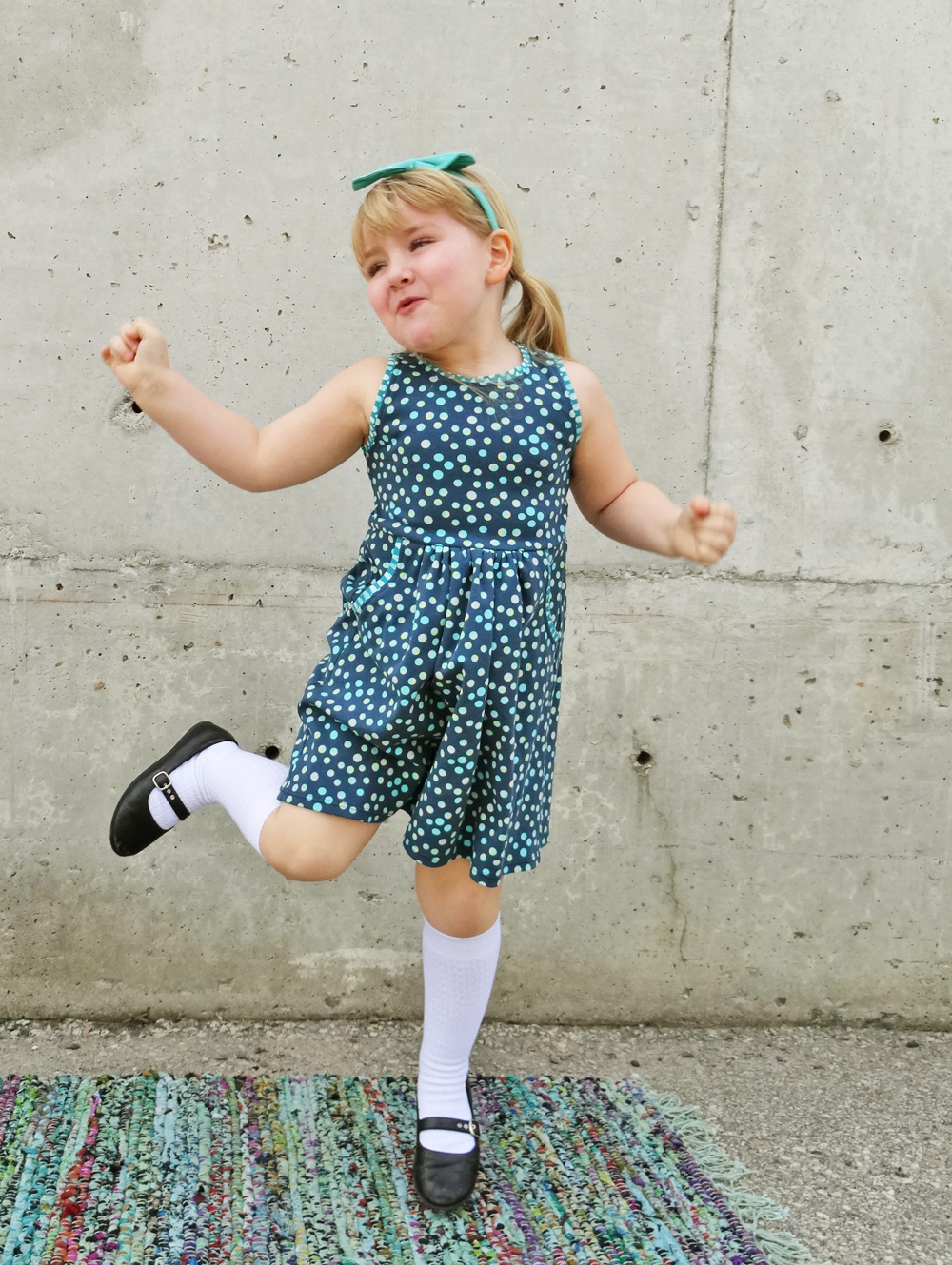
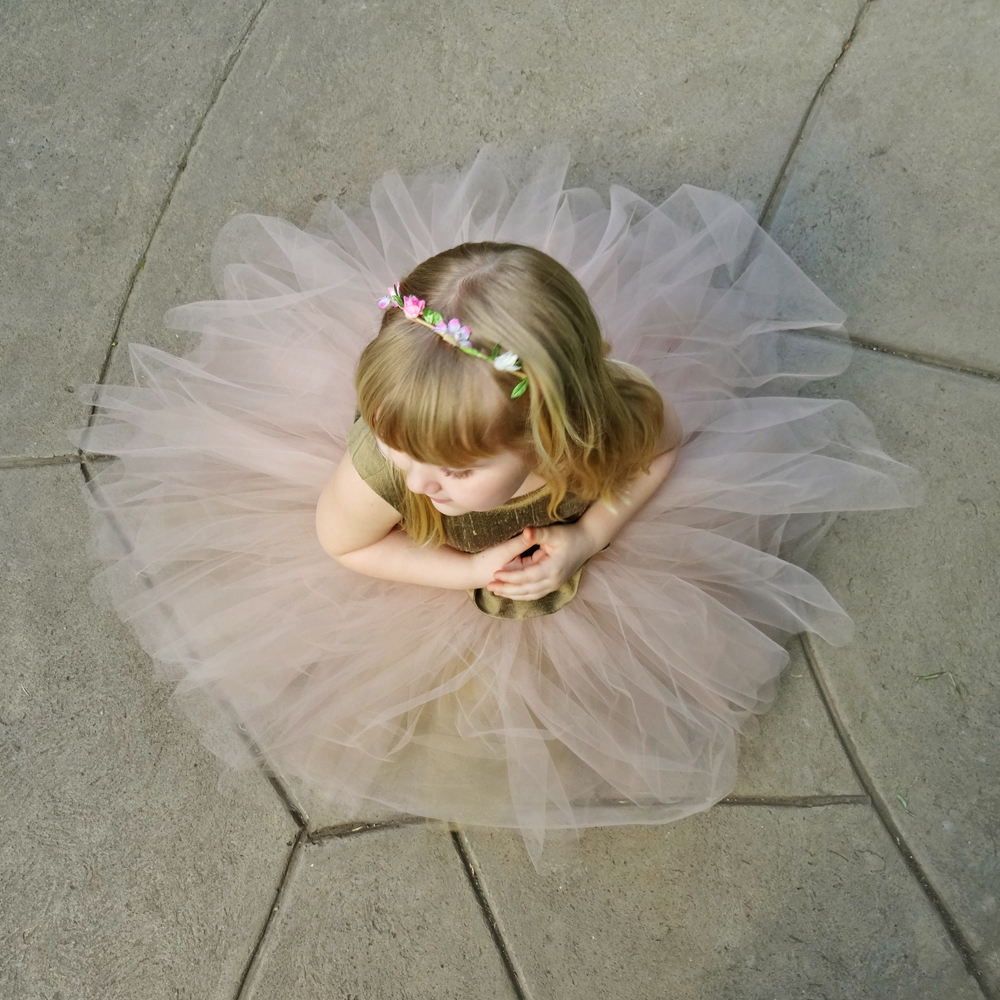
Yikes, this girl was hard to take photos of yesterday! Every photo is her dancing around – so much fun to look through, I should really make a collage for our hallway. I suppose that even though the weather co-operated by giving us a “lovely” 14°C – I think she was a bit chilly (and a little bribed with lollipops!)
Disclaimer: A Skyline S7 has been loaned to me for the purpose of writing this series. As with all products I write about, I will always tell you my own honest opinion. I purchased and loved Janome machines long before they contacted me. Janome has not asked me to qualify my opinions in any way. Also, the fabric for this dress was given to me for this post by my sponsor Fabric Please! Thank you for supporting my sponsors.
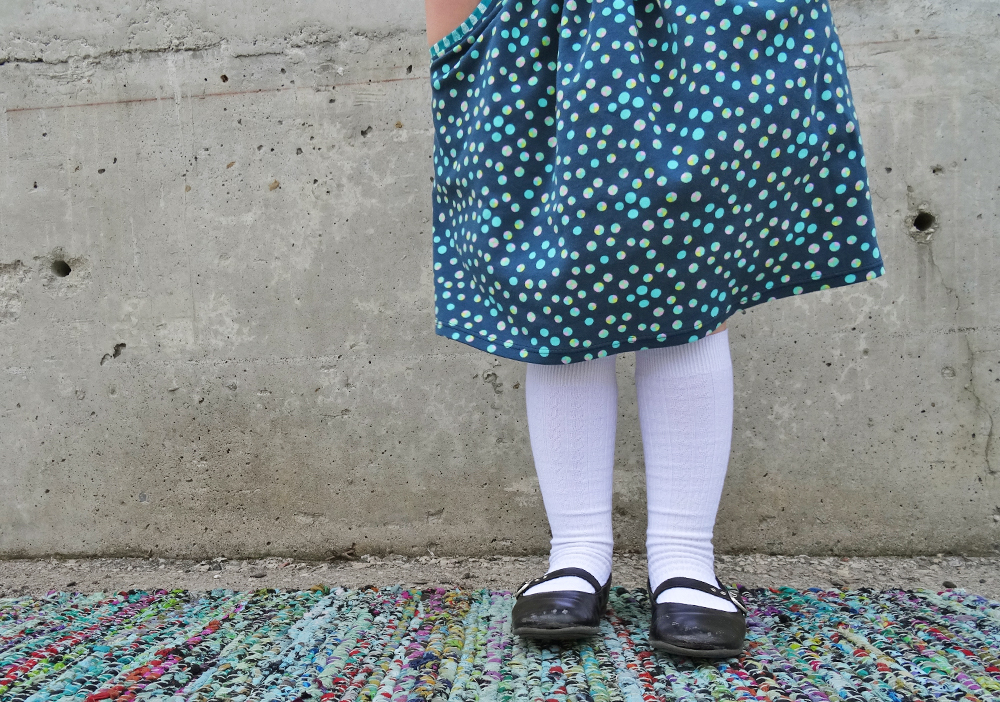
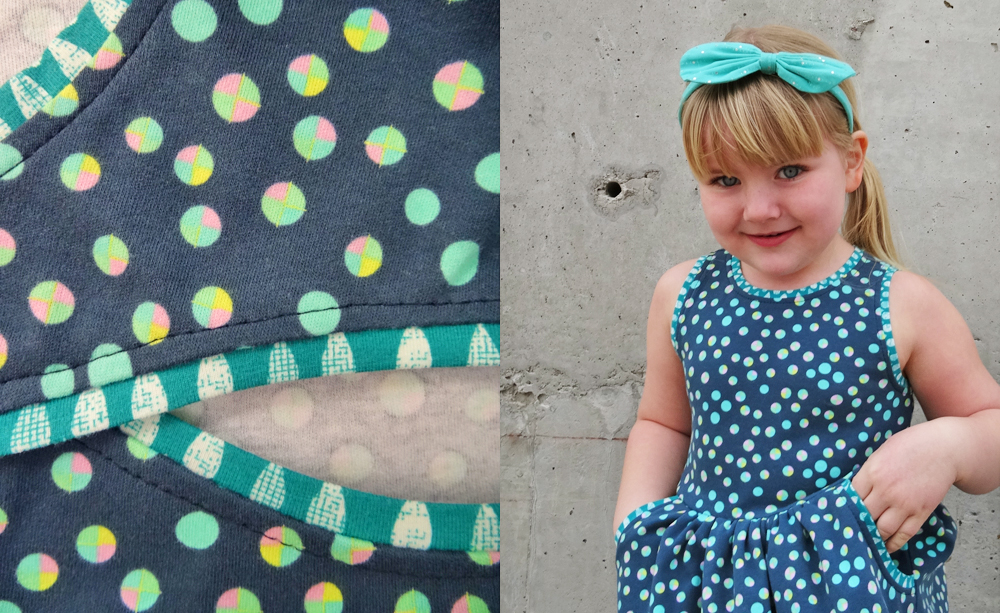
This week’s project was sponsored by Fabric Please!, a lovely online Canadian fabric shop with a growing selection of knits in both solids and prints. They were kind enough to indulge me when I asked to make a Soleil dress in blue for my youngest. I promised her one last fall and it’s finally getting (almost) warm enough to wear it outside.
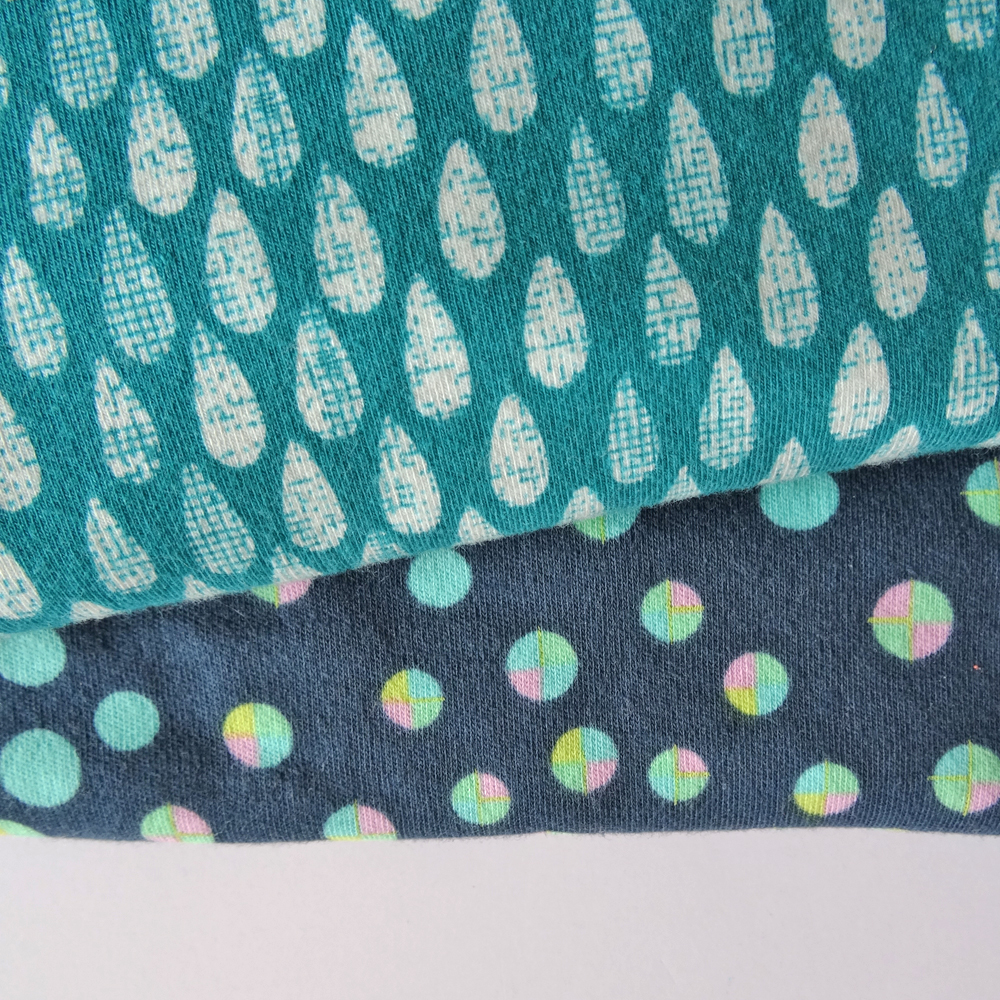
The main dot fabric is 100% cotton Glow, Quarter Moon by Amy Butler (*oooooh!*) and the raindrops, cotton/spandex Abundance Monsoon from Bonnie Christine (*aaaaah!*). I love how the two prints play off each other, they’re so fun in this dress.
12 Tips and Tricks for Sewing Knit Fabrics
Tip #1: Ballpoint/Jersey Needle
Make sure to buy ballpoint or jersey needles for your knit projects. The tips on regular needles are sharp and will cut tiny holes in your knits. I know from experience! A couple of machine washes and there will be little holes all down your seam.
Tip #2: Sew with a Stretch Stitch
If your machine has them available, choose a stretch stitch to sew with. This will allow your sewn seam to stretch with the stretch of the knit you are sewing. They tend to look like a lightning bolt (no’s 6 and 7 in the photo below). If your machine doesn’t have a stretch stitch, use a thin, long zigzag stitch or a triple stitch (no. 5 below) instead to allow the seam to stretch. The Skyline S7 has quite a few stretch stitches, numbers 5 – 10 and a knit stitch, no. 14 below.
Be sure to double-check your seam allowance when choosing a wide stitch (2nd photo below). The markings on your machine are based on sewing straight down the middle of the machine foot, but a wider stitch will sew to the left of that. Use your seam gauge and mark or find a new line to guide your correct seam allowance.
Tip #3: Dual Feed Device – Janome AcuFeed Flex
The AcuFeed Flex is a super-cool machine foot, and it’s the first time I’ve used a dual feed device. It is similar to a walking/even foot (next tip below), but is physically attached to the machine’s upper feed drive instead of just resting on the needle clamp screw bar. This means it is mechanically moving the top layer of fabric forward at the same speed as the feed dogs move the bottom layer of fabric forward. The results are so good! It totally eliminates the stretching you would normally get when sewing knits.
This foot is also great for seams in leather and oil cloth – both of which tend to stick to a normal presser foot. Matching plaids, quilting and seaming other slippery specialty fabrics is much easier because the layers of fabric are moving together. The dual feed can also be balanced with the dial on the side of the machine for when you are seaming two different types of fabrics and one feeds faster than the other.
Tip #4: Walking/Even Foot
This foot does a similar job to the AcuFeed Flex in Tip #3. A Walking foot is really helpful when sewing knits, and it is what I have used previous to the S7. The bar on the walking foot rests on the needle clamp screw bar, which feeds the upper layer of fabric at the same time as the feed dogs move the lower layer along.
To comment on it in comparison to the AcuFeed Flex – I do notice more stretching with the walking foot. The AcuFeed Flex is more accurate – likely due to it being directly attached to the machine’s feed drive. The fabric moves through together more mechanically with almost no slippage on the top layer of fabric.
Tip #5: Use a Twin Needle
Twin needle sewing seems complicated, but it’s not as bad as it looks! Two spools are fed down from the top of the machine and one bobbin thread stitches the bottom of the seam together. The threading path can be found in your machine manual. You can also read this post about double/twin needles and how to thread your machine, where I sewed pyjamas using my basic Janome SUV1122 a few years ago.
The twin needle stitch is really stretchy and a great option for sewing knits. It also looks really professional when used for hems and topstitching. You can get different widths of double needles. I like the one with a 1/4″ space for hemming. The 1/8″ one would be better for sewing seams.
Tip #8 – Overedge Foot
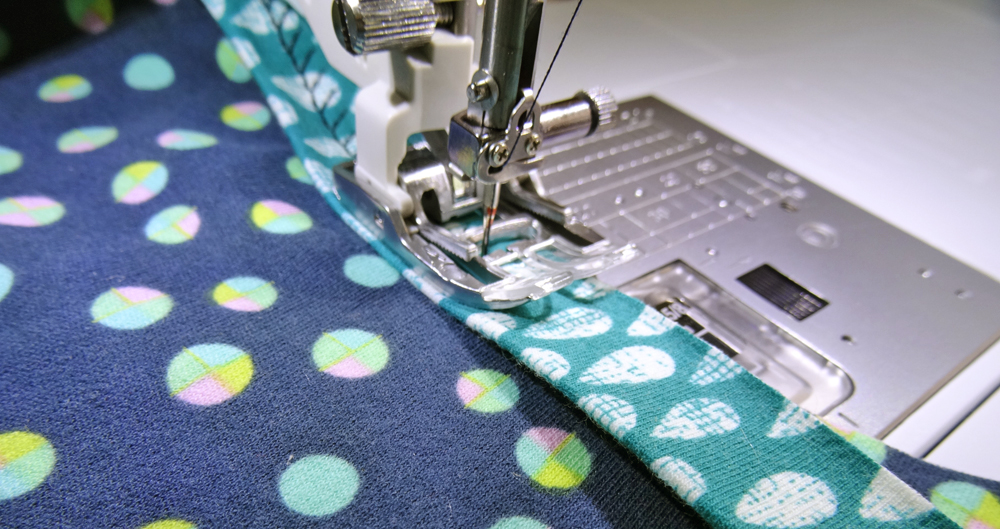
First off, my apologies for the fuzzies in this photo, oops! Moving on… This foot is great for making a serger-like overcasting stitch on both woven and knit fabrics. I used it to seam the dress’ pockets using the Knit Stitch available on the Skyline S7. The fabric runs beside the black bar on the foot making it really easy to stitch right along the edge of the fabric. You can see how it turned out in Tip #10 below!
Tip #9: Top Stitching and Edge Stitching
Straight stitches are not really recommended for sewing knits, because they don’t stretch with the fabric. However, I’ve successfully used them for topstitching with a few tweaks. (Though I’d still recommend a twin needle if the fabric is really stretchy.)
Make sure to lengthen your stitch. Instead of sewing with my general length 3, I used a length 4 straight stitch to topstitch this project. Also, it is good to slightly stretch the fabric while stitching to allow the final seam to stretch just a bit more.
Tip #6: Use Tissue Paper
If your knits are not behaving, you can place strips of tissue paper underneath (and over top!) of your seam while sewing them. Then remove the tissue once the seam is finished. This prevents the knit from being stretched by the presser foot pressure. I’ve used it a lot on hems for really stretchy thin knits.
Tip #7: Start off with a “Thread Handle”
This tip comes straight from the lovely Linda Pidzamecky, educational consultant for Janome. She gave me a really helpful tour of the Skyline S7 before I brought it home.
Starting a seam on knits can be tricky since the needle likes to bury the edge of the fabric into the needle plate. To stop this: Pull a longish spool thread out to the back of the machine, insert the needle into the fabric, and hold the thread gently while starting the seam. This has totally changed how I begin knit seams and it would work great for thin wovens and specialty fabrics as well!
Tip #10: Press and Starch
Thinner knit fabrics can tend to roll up on the edges making them hard to cut out and seam. To reduce this, use spray starch and a good pressing to unroll them enough to be able to cut out and stitch them more easily. Pressing also helps to reduce stretched seams. I stitched these two pockets below, then pressed the upper one flat with a bit of steam to show you the difference.
Tip #11: Change the Pressure of the Presser Foot
If your machine allows it, reduce the presser foot pressure to allow the knit fabric to slide through the machine with less stretching. Check your manual for how to do this and do a test seam to make sure the change in pressure will still feed the fabric through properly.
Tip #12: Use Clear Elastic
This elastic is genius! Zigzag baste it onto a seam in your knit project to reduce stretching while sewing and during wear. It is great on heavy seams like the Soleil dress waistline – where the heaviness of the gathered skirt might pull the waist seam down. It’s also great for shoulder seams in drop shoulder and dolman sleeves – again, to reduce the pull from the heavy sleeve.
Next week is going to be so much fun, I can’t wait! I’ve been collecting ideas about how to embellish your projects and I finally get to share them with you. See you then!
by Sherri Sylvester | Mar 21, 2016
Ummm… so maybe I went a bit overboard with this year’s Easter dresses! But before we get to that…
Last week was March Break with busy-ness and lots of fun. I was excited that we had a very manageable work week! It is SO encouraging for me that they are old enough to play more easily while I work. Less interruptions while “Mommy is working” means more efficient working hours for me and better-spent time with them!
Last week we managed to go to a Raptor’s D-league basketball game, take the kids out to Zootopia (super cute) and, after a warm photo shoot yesterday (thanks to the arboretum) we spent the day at the Royal Ontario Museum. Unfortunately, it has ended with a feverish little one in the house. Hopefully she will be feeling much better soon!
Back to Easter… these dresses are absolutely amazing, if I’m can say so myself! It’s not all of my hard work, but the pattern (and the girls!) that steal the show. These are made with the Violette dress pattern from Violette Field Threads. For the last two years I’ve gone to their patterns to make a special dress for each of the girls to wear on Easter Sunday. But I have to say, last year’s Annabelle dresses have nothing on these!
The construction is really simple, but I recommend that you save up your patience to sew them. I sewed two 9/10 width dresses and each one has about 43 yards of gathered tulle in the skirt! The gathering is a bit tedious, it took me about 3 hours to attach the first layer (there are 4 on each dress). Thankfully I learned and used a slightly faster way for the other layers and got through the last few more quickly – meaning about 45 min-1 hour each. I’ve collected a few tips from my experience below!
The fabrics I used for the bodices and peplums are super fancy “scraps” I had available in my stash. Pieces I couldn’t really make into anything else. My youngest is especially excited to tell everyone that hers is gold silk! The light teal one is a bit sparkly as well, but I’m not sure what the fabric is. It is really nice to work with, though and does not wrinkle easily.
The tulle was tricky because I couldn’t find an exact match for the bodice fabrics and had to get creative. Rose pink for the gold dress with one gold bottom layer, and mostly sparkly silver with one cream top layer for the teal dress. The lining is long enough that these dresses aren’t scratchy which is nice. I was worried the girls would complain about that.
I think I would make this pattern again, but maybe with a fabric skirt. The instructions for that are included and are a little less involved! This is a really cute dress though and I love the wider front neckline and lower back with two buttons. Only word of warning is keep your tulle away from anything stickery, like Velcro. My oldest now has a few holes in the top gathered layer that we are going to creatively fix before Sunday!
8 Tips for How to Sew Insane Amounts of Tulle More Quickly!
1) Leave plenty of time to sew. Be patient and don’t expect to rush. Each tulle layer takes between 1/2 hour and 1 hour to sew. Find a good podcast or Netflix show to distract you and JUST-KEEP-SEWING!
2) Clear off the work area near your sewing machine. Tulle yardage takes up a lot of space and it is not fun to stop and catch falling notions and collect small threads from your tulle. Trust me, they stick really well!
3) Fill at least 4 bobbins before beginning so they are ready . Then you won’t have to switch tasks or re-thread your machine as often.
4) It is helpful to mark the centre of the tulle before sewing so you can match up the gathering properly to the lining. It would be amazing to do this while you are buying the tulle, otherwise you need a really long hallway to cut it into lengths properly. It would be great to buy your tulle already cut and labeled in the various layer lengths if your fabric store will do that for you.
5) The layers are made up of a back and a front skirt piece. It is helpful to sew only one side seam before gathering. The second side seam can be sewn after the gathering stitches are sewn.
6) It was most helpful to use dental floss to gather the tulle layers. I used my rolled hem foot to keep the floss in the center of a wide zigzag stitch. You can even stop every so often to gather up the tulle behind the presser foot. This saves space and yards of floss. I tried to use ribbon this way, but the floss was really effective, strong and slippery to gather more easily. And of course, BONUS – your project will smell minty fresh!
7) I gathered with a 3/8″ seam allowance and then placed the tulle according to the edge (not the gathering seam). This way you can remove the dental floss before going on to the next layer.
8) Pin, Pin and pin again! The more pins you add when attaching the tulle to the lining, the easier it is to sew. I pinned the previously sewn tulle layer first, then added the new one above it and pinned the tulle down flat there as well. Really helpful when you are arranging so many layers inside of your machine.
by Sherri Sylvester | Mar 17, 2016
Do buttonholes and zipper installations get you feelin’ like “Where’s my Velcro stash again?” Even if they don’t make you to run in the other direction, chances are with a new machine (or an old one!) there’s something you don’t know.
Welcome to Week 2 of the Sewing Diaries: the Closures Edition. This past week I’ve been learning about how to make buttonholes and install a zipper on the Janome Skyline S7 that’s been loaned to me. I think it’s the second most important thing to learn on a machine – unless you are a quilter, in which case I suppose it is not as vital and you could skip this week. WAIT! What am I saying? I’m a blogger and writing is my paycheck! Rephrase: “Always – Read – Every – Word!” #noskippingallowed
Disclaimer: A Skyline S7 has been loaned to me for the purpose of writing this series. As with all products I write about, I will always tell you my own honest opinion. I purchased and loved Janome machines long before they contacted me. Janome has not asked me to qualify my opinions in any way.
Depending on how complex your sewing machine is, there can be a learning curve to how each manufacturer has set up each process. Once you have made a a few buttonholes and installed a zipper I promise they won’t feel so foreign! I’ve included a round-up of tutorials for both buttonholes and zippers below so you can feel confident. As always, it is best to always check your manual, because machines vary so much.
Sewing Buttonholes
I started sewing my girls’ Easter dresses, which have a total of 43 1/2 yards of tulle between them! (Insane I tell you! *edit: They are finished! See the Easter Dresses here.) Anyhow, they each require two buttonholes and so this was a good opportunity to learn how to do it on the Skyline S7. The above photo has a button sewing foot in it as well – but since the buttons I picked have curved edges it wasn’t a good time to try it. I’ll have to post the process on Instagram in the future.
There are a variety of ways machines are set up to make buttonholes, and some basic models don’t have buttonhole feet as an option. I’ve had experience using a SUV1122, 2030QDC, Skyline S5 and of course the S7. My experience being limited to Janome’s (since that’s what I always purchase and love) is that these models all have a similar One-Step Automatic Buttonhole process. The thing that differs is the number of buttonhole shape options – and how you can change their sizes and how precicely they are sewn. Options range from 1 straight buttonhole option on the SUV1122 to 10+ options on the Skyline S7 depending on how you set it up. We also have a New Home 1/2 size for my youngest without a buttonhole option. I’ve included a tutorial for machines without buttonhole feet in the roundup as well.
The Skyline S7 also has a stabilizer plate that I haven’t used before, but really enjoyed. It is used when a buttonhole is near a thick hem or other seam, to hold the area flat. I tried to compare buttonholes with and without the stabilizer plate for you. Unfortunatly, I think both of these buttonholes need the plate because the right side of the top buttonhole got a bit stuck and when I tugged on it it made some wide stitches. Oops… that’ll teach me to always use the stabilizing plate! #loveyourseamripper I re-sewed the top buttonhole and it looks great now. (Here’s a quick Instagram video of the S7 Buttonhole process.)
I’m hoping to finish the dresses (read: gather 23 1/2 yards of tulle, sew them together, repeat for a second dress… argh!) and take photos this weekend, but it snowed last year on Easter and this weekend is looking pretty chilly. I’m going to have to get creative with the location! (* edit – they are finished! See the Easter Dresses here.)
Buttonhole Tutorial Round-Up
Here are some tutorials, including a video and one that doesn’t need a buttonhole foot! Through reading these tutorials, I learned that you can use Fray Check on your buttonhole to make sure the inside threads don’t fray. #genius
Buttonhole Without a Buttonhole Foot ~ Manual 4-Step Buttonhole ~ Automatic One Step Buttonhole ~ Video, Automatic One Step Buttonhole
Sewing with a Zipper Foot
Choosing a zipper project for this week’s post was a no-brainer. I’ve been wanting to make another Cat-Eye Zippered Pouch for a while now. I had a peek at the hashtag #cateyepouch yesterday and it is so fun to see what everyone is making. I am so flattered that you all like my free pattern!
I went with the obvious and used Lizzy House Catnap cat fabric for my Cat-Eye pouch! I love the combination of this wrinkly dobby linen with the smooth quilting cotton and a bright zipper. This pouch is destined to be my Kindle cover since I think it’s my new favorite… though, they are all my favorites. Oh well – what good is it to choose anyhow!
There are so many ways to install zippers, and even different zipper types. The capabilities of the S7 far exceed what is needed for this pouch’s super-simple zipper installation. No matter what type you choose, there is a tutorial somewhere on the interwebs for it. And chances are your manual will cover off how to make it work as well. I’ve included 4 types of zipper installations in the tutorial Round-Up below.
Specifically on the S7 machine, you can choose a lapped or a concealed zipper from the LCD screen. My zip wasn’t exactly either one, so I chose the Lapped Zipper, Right Side stitch to move the needle to the correct position. LOVE not moving the needle over by eye! Of course you can set it up manually as well, the preset buttons just take the guess work out of the process. Changing the foot was simple. My Janome machines all have “Easy Change” feet – just click the foot in and out of the machine. I used to need a screwdriver and generic zipper foot with my previous SUV1122 because it’s default “easy change” zipper foot is one-sided and wider than I liked, not as convenient for sure!
Oh, and don’t forget, zipper feet are also not just for zippers. Sewing close to thicker edges and using it to install piping and pompom trim are just a few other things you can use it for.
Zipper Tutorial Round-Up
I’ve tried to narrow down this round-up to general use zipper installations. But, I couldn’t resist adding in the one on how to match your fabric, it really is easier than it looks!
Basic Zipper Installation ~ Lapped Zipper Installation ~ Invisible Zipper with Video ~ Exactly Match Fabric Across a Zipper Opening
I hope you’ve learned a lot today! I’m having fun because this series lets more of my passion for making sewing easy and accessible out into the world! Please let me know if you have any questions and I’ll do my best to help you out.
Next Week we’ll be talking about Sewing Heavier Fabrics. I get to make an oldie (but goodie!) Follow along on social media to find out what it will be!
by Sherri Sylvester | Mar 11, 2016
Welcome to the second installment of this week’s Sewing Diaries! Yesterday we talked about: 1) Unboxing the Machine, 2) Preparing to take care of it and 3) Learning what it can do.
Now we are ready to sew! Today we talk about getting the machine ready, two projects I chose to sew first, (and why!) plus a bonus tip and tutorial for them. (BTW, isn’t the Sewing Diaries logo amazing? It was made by fellow Janome Artisan and amazing graphic artist Cynthia Frenette for this project – #loveit! )
Meet Your New Machine – Step 4: Get Ready to Sew!
It is important to learn how to get a bobbin wound, thread the machine, and insert the bobbin correctly.
Again, this information is in your manual, or on your included instructional DVD. (Yay S7!) All of my Janome machines have had a similar thread path, but each has been a little different. I like to make sure I’m doing it correctly the first time because it’s harder to change once you’ve memorized it incorrectly! A tip when threading the machine: It is important to use a spool holder to hold your thread on the spool pin. Make sure it is the correct size, the S7 comes with large and small size thread caps. (For reference, I’ve used the small cap in the photo below.)
When filling the bobbin, note the correct winding direction for the thread in your manual. When filling it, most machines will stop once the bobbin is full, then you can cut the threads. The S7 includes 5 small cutters under the bobbin area for right before you wind it, and one for cutting the main thread once you are done. #noscissorsnecessary
When threading your machine, follow the path and be sure to pull the threads as indicated in your manual to ensure the tension discs are engaged. Don’t skip threading through that tiny hook right above your needle! Use a needle threader to thread the needle, or the automatic threader if your machine has one. I made an Instagram video of the advanced needle threader on the S7. It is truly amazing!
The bobbin should be inserted as per the manual again. Noting that it is especially important to insert it so it spins the way your machine wants it to. My Janome machines have needed the bobbin to spin counter-clockwise.
Meet Your New Machine – Step 5: Sew a Simple Project (or two!)
Alright, we are ready to sew now. I think the best way to start out is to make a simple first project without any closures, leave the buttonholes and zipper feet for The Sewing Diaries – Week 2. I decided to make two of my all-time most popular tutorials, The fat-quarter friendly Sunny Glasses Case and the Pretty Floral Divided Tote.
Both of these are really quick and satisfying projects. Good for confident beginners and advanced sewers alike. They allow you to use your new machine to make something useful and fun, while not having to reach for your manual with each step. (P.S. I changed a few things from both original tutorials, so I’m sharing a tip and a mini tutorial for them at the end of this post.)
I broke out my hoarded Mochi Dot linen for these, and some Paris fabric my mom gave me years ago. It’s so gorgeous I’ve been saving it for the perfect project (and I’ve got some left still, yay!) You can never go wrong with linen, canvas and polka dots!
Meet Your New Machine – Step 6: Plan to test your machine
One great way to test your machine is to tackle your mending pile. There is usually a varied selection of fabrics, lots of knits and wovens of different weights to work with. It even provides different situations such as mending a pant leg by using the free arm or fixing a ripped tee with an overcasting stitch.
The second way to test your machine is to plan several specific projects that use different features of your sewing machine. This is the way I am going to write the Sewing Diaries, since I’m sure you are not interested in seeing my mending pile. (I’m pretty sure I don’t want you to see it either!)
How to Choose Your First Projects
- Incorporate fabric types that you tend to already sew. Save the uncommon ones for another time, unless you bought your machine specifically to use it for an uncommon fabric you want to learn to sew.
- Incorporate feet that you will use all the time. Buttonhole, Zipper foot, Blind or Rolled Hem foot – sew a woven dress. 1/4″ Foot, free motion quilting feet – make a quilt. AcuFeed Flex, Overedge foot, zigzag foot – choose a simple knit top.
- Find projects that are simple or ones you’ve sewn before. Learning a new machine might be frustrating because you are not familiar with where everything is or how it works yet. Choosing a complex project will just add to your frustration and it would be so sad if you quit!
This process resulted in me writing the The Sewing Diaries Overview you found at the beginning of yesterday’s post. But, no matter what projects you choose, make sure your manual is on hand to help as you go along – you may need to know how to use a certain stitch, install the knee lift, or change the default height of presser foot for pivoting (Yup, the Skyline S7 can do that!).
I found out how to use one of my favorite features when I was checking the manual for something else, a tiny black button on the back of the S7 zigzag foot. If you push it in while lowering the presser foot it will lock the foot in a horizontal position. Meaning, if the front of the foot is elevated on some thick fabric, the back of the foot will stay elevated until you are past the beginning of the seam ! It helps your seam to begin smoothly when sewing thick or layered fabrics like the french seam on my Sunny Glasses Case.
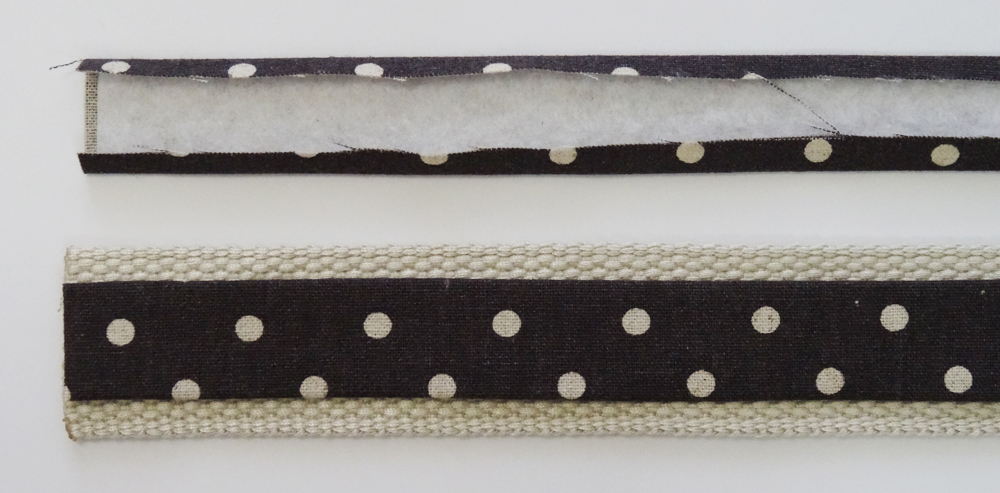
The Pretty Floral Divided Tote is made with just 1 yard each of outer and lining fabric. I had just a bit less than that, so I slightly shortened the pattern piece and also omitted using the lining fabric on the Straps. Instead I used 1 1/2″ webbing and sewed strips of outer fabric over the front to add detail. Here is a mini tutorial on how to make some yourself.
- Cut 2 OUTER Straps: 1 1/2″ x 21″, Cut 2 from Fusible Fleece: 7/8″ wide by 21″, Cut 2 pieces of 1 1/2″ webbing 21″ long.
- Fuse the Fleece to the wrong side of the Outer Straps, directly in the centre of each piece.
- Fold the Outer Strap fabric over the fusible fleece on both sides. Use the edge of the fleece as a guide.
- Glue Baste the Outer fabric to the centre of each length of webbing.
- Top-stitch the Outer Fabric on both sides about 1/8″ away from the edge to finish the strap.
Each time I make a Sunny Glasses Case I find a new and improved way of sewing it. I have been collecting tips for at least a year now and plan to post them sometime soon! For now, however, one thing that makes a big difference to the final product is a very simple step. Instead of only using Fusible Fleece on the Outer fabric, cut a second layer and fuse it to the wrong side of the Lining as well. The extra padding makes the case sturdier. It holds it’s shape better and looks more professional.
Thanks for checking out the first installment of the Sewing Diaries. I can’t wait to tackle learning about closures this coming week! They open up a whole new area of your sewing. Remember you can come #alongforthreadride anytime to see sneak peeks and project photos!
by Sherri Sylvester | Mar 4, 2016
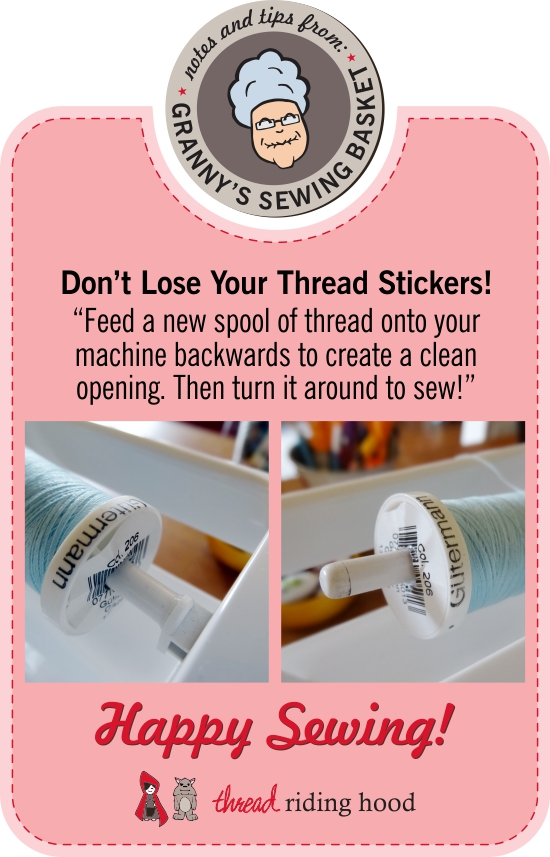
You know that little sticker on the end of your thread spool, the one with the colour number on it? It’s great, until you try to place it on your machine. The sticker comes off and gets lost, breaks unevenly or sticks to the spool pin making it hard for the spool to turn evenly. It’s easy to fix all that with this little trick from Granny! (Find out how this series started.)
Within all Thread Riding Hood patterns and downloadable pdf’s, I’ve included “Notes and Tips from Granny’s Sewing Basket”. Granny capitalizes on the story of Little Red Riding Hood and takes creative license in proposing that Granny loves to sew! Throughout the patterns, these Notes and Tips are included to make your sewing go more smoothly. This series includes tips I’ve found helpful in my personal sewing. Find them pinned here: “Sewing Tips & Tricks” Pinterest board.
I don’t like losing the stickers from the ends of my thread. Then the colour number goes missing and it’s more complicated to buy more or match spools.
To keep the stickers in tact and attached: place a new spool over the spool pin backwards or “sticker first”. Wiggle it around to get the sticker to stay on tightly. It also helps to even out the opening in the spool since part of the sticker is now stuck inside. Once you’ve done this it is easy to put the spool back on correctly. Make sure it spins properly! Replace the spool holder, thread the machine and go!
While you are getting your thread ready, maybe you’ve forgotten how to thread your machine? Head over to my latest (aptly named) Craftsy post, “How to Re-thread Your Sewing Machine in 4 Steps” and get that sorted out too!
I hope you have a wonderful weekend. I’ve got projects upon projects to work on and photograph for the start of a special 6-part Janome series coming next week! Head over to Instagram or Facebook if you’d like some sneak peeks ahead of time.
What are you working on this weekend?
by Sherri Sylvester | Dec 14, 2015
(Quick! Go get those empty wrapping paper rolls out of your recycling bin. You’re going to need them!)
I have recently thought it might be fun to post a series on Organizing Your Sewing Room. This is the second post in the series. The first one had a free label printable for organizing your fabric. Since I didn’t really introduce the series the last time, here goes…
I love being organized, (it’s one of our family goals for 2016) and my kids are old enough that we are going to aim high and see if we can get this part of our lives to work better for us this coming year. My sewing room, thankfully, has stayed pretty organized – but only because I’m the only one keeping it in order. And, of course, there is that box of random things under my desk – but we won’t talk about that right now!
I have been using empty wrapping paper rolls to organize supplies for a few years now. They are great for things you don’t want to fold – like clear plastic, vinyl or oil cloth. I really like that they don’t take up much space. You can store them in the end of a shelf, like I do. Or in an upright space, even a tall basket! If you don’t have any wrapping paper rolls handy, you can ask about free cardboard tubes at any fabric store. Sometimes they have empty tubes they would love to get rid of.
Here’s a quick guide, and how to keep what’s rolled up from coming unrolled!
1: Measure the roll to find how long you’d like it to be.
2: Cut it at your measured mark.
3: Roll your supplies – look, no wrinkles!
4: Secure the end with a large paperclip.
Hope that helps! I’ve got a long list of little tips on organizing, so I’ll be sharing more of how I keep my room tidy(ish) again soon!
What do you use to keep your “un-foldable” supplies handy?
And we have a winner!
I’m also really happy to announce that entry #329, Marilyn H. won the 12 Fat Quarter Lecien Bundle from Flare Fabrics! I can’t wait to see what she does with it! Be sure to use the discount code “THREAD15″ to save 15% on your order at Flare Fabrics until December 31, 2015!