by Sherri Sylvester | Mar 30, 2015

Winter is slowly leaving outside, but at least some Spring colour has come to my couch, disguised as a new throw pillow! This modern scrappy pillow tutorial can make a bright spot in your home too. And it’s made with a charm pack, so most of the cutting is done for you – just grab your favorite print for the back! (Scroll down for your chance to win this charm pack!)
If you’ve been reading here lately you’ll know about my recent obsession with shot cotton and yarn-dyed fabrics. So when my sponsor Fabric Spark suggested making a tutorial with one I didn’t hesitate to say yes! This charm pack contains 15 different light Kaffe Fassett solids, 30 charms in total – just enough for an 18″ throw pillow with a few left over! The different warp and weft colours add an extra layer of amazing colour when woven together.
If you live in the Toronto area, Fabric Spark will have the fabrics needed to make this pillow at the Spring Creativ Festival. I’m already planning for it and I’ve got a few more surprises up my sleeve! (By the way… Get the name of the pillow? Spring Charming, like Prince Charming? Ha, *groan* I know!)
This pillow really is simple to make, it doesn’t even have any matching seams. And it matches every colour scheme! This random-look layout lends personality and warmth, its colours are surprisingly structured and I’ll explain that in the tutorial! When working with any layout, though, it’s hard to know how things will turn out. I originally made this in rows and then loved it more in columns – so I turned it sideways before adding the envelope back.
—
Fabric Spark is giving away a Kaffe Fassett Woven Cotton Charm Pack in Light! This giveaway is open internationally and will run from March 30 – April 6, 2015. Use the Rafflecopter widget below to enter – and if you don’t have Facebook to sign in with, just use your name and email address. There’s a “click to enter” no social media login entry too!
a Rafflecopter giveaway
As usual, please feel free to use my patterns/tutorials for your personal projects and gifts and for charitable fundraising events. Please do not sell anything made with this pattern. If you are interested in making them for sale, please contact me and I will set up a license for it in the shop. Thank you!
Seam allowance 1/4″ unless otherwise noted.
You will need:
- 1 Kaffe Fassett Woven Cotton Charm Pack in Light
- 1/2 yard quilting cotton for envelope back ( I used Starcomb Silver from Parson Gray’s Curious Nature collection)
- 19″x19″ low loft batting
- 19″x19″ backing/muslin for quilted front (this will not be seen)
- matching thread for piecing
- matching thread for quilting
- 18″ pillow form
- square ruler, rotary cutter/scissors, pins/basting spray, removable fabric marker
- Optional: Walking Foot to use when quilting (if desired)
Sewing with a Charm Pack:
When I first approached a charm pack I was not sure how to properly sew with it because of the pinked (zig-zag cut) edges. Here are a few tips I’ve found along the way.
- This charm pack is cut to 5″ square. It has been cut so the outer point of each triangular cut marks the edge of the square. Measured from side to side between outer triangular points it will measure 5″. Cut and sew with that in mind.
- I also found that, for this pattern, it is easier to match and stitch edges that have been cut similarly. Match rotary cut edges and sew OR match pinked edges and sew. This may not be possible with all charm packs due to directional or one-sided fabric.
Cut your Fabric:
- Envelope Back: Cut 2 pieces 14″ high by 18″ wide.
- Charm Pack:
- Stack at least 24 of your charm squares in sets of 4. Use at least 1 of each colour. The colour placement will be “random”, so don’t worry about that for now.
- Cut a straight 90 degree line through each stack of 4 wherever you’d like. Use a ruler to make sure the cuts are square. Make sure to cut at least 1″ away from the left and right sides of the square. If you’d like similarly sized pieces, cut the squares closer to the centre. If you’d like a more scrappy varied layout, cut the blocks closer to the sides to get a variety of skinny and wide pieces in each colour.
Design on your Layout:
At first this part scared me because I wanted it to look a bit random, which I’m not good at! I found that arranging them by colour grouping helped me to have a bit of structure. If you look at my rows, you will see small groupings of green, blue, lavender/pink and orange pieces together. There is one grouping of each of these colours on each row, but the placement is varied from left to right.
- More Structured Option: Lay out 12 pieces side-by-side (matching edges) in a row that is about 24″ long. Lay out 3 more rows below it in the same way. Once you sew them together each should equal 18 1/2″ or more. (My rows were about 28″ long each before stitching & came to 24″ wide after stitching.)
- Random Option: As a quicker alternate option, stitch rows together at random (see sewing instructions below). You will need 4 rows aprox. 19″ long each.
Stitch your rows:
- Match the sides of each piece Right Sides Together (RST) and stitch with a 1/4″ seam until each row is finished. TIP: I like to place a pin on the left-most side of each row to help me remember which piece I’m working on.
- Press seam allowances open or to one side.
- Trim the top and bottom edges of each row if necessary to square them up. (I skipped this step, since my rows were fairly even.) TRIM SPARINGLY! If you cut more than 1/8″ from each long edge your rows will not be tall enough to create an 18″ pillow.
- Pin the rows together RST along each long edge and stitch one at a time.
- Press your seam allowances open or to one edge as you go.
Quilt:
- Press the pieced fabric well, making sure all seam allowances are properly pressed so it is as flat as possible.
- Trim the front to 19″ wide. Do not trim the height, it should be about 18 1/2″.
- Create a quilt sandwich. Place your muslin/19″ square backing Right Side Down. Centre the batting on top of it. Centre the pieced fabric Right Side Up on top of the batting.
- Baste the quilt sandwich layers together. Since this is a small project, I used long pins. You could also use curved safety pins or basting spray.
- Mark quilting lines, if desired. I made a centre line with my hera marker and then used the edge of my walking foot as a guide to stitch every 1/2″ from there.
- Quilt! It took me about 20 minutes to stitch straight lines 1/2″ apart with a slightly-longer-than-usual straight stitch.
Envelope Backing:
This is where I took a look at my quilted front and decided I liked the “rows” as columns, so I turned it before adding the backing. Decide which side is the “top” of your throw pillow before adding the backing so it is the correct way up!
- Trim your quilted front to 18″ square. If your quilting is not near the edges, baste them together with a 1/4″ seam.
- Find your envelope back pieces. Decide which piece will be the top & bottom of the envelope back.
- Hem the top of the envelope back: press the 18″ wide BOTTOM edge up 1/2″, then again by 1″. Stitch close to the first fold to hold the hem in place. Hem the bottom of the envelope back: press and stitch the 18″ wide TOP edge in the same way.
- Lay the 18″ quilted pillow front Right Side Up. Align the TOP envelope back to the top edge of the front, RST.
- Align the BOTTOM envelope back to the bottom edges of the pillow front, RST with the quilted front.
- Pin all edges securely. Stitch with a 3/8″ seam allowance. Trim the corners and finish the edges with a serger or zig-zag stitch.
- Turn your throw pillow right side out. Push out the corners and press the edges flat.
- Insert your pillow form and you are done. Check out your amazing pillow!
I’d love to see your project! You can share your pillow on Facebook, Twitter or Instagram (links below) using the hashtags #alongforthreadride or #threadridinghood. Thank you!
Disclaimer: The fabric used in this post was given to me by my sponsor, Fabric Spark. I always share my honest opinion about sponsored products. Thanks for reading!
by Sherri Sylvester | Mar 24, 2015
I am thrilled to let you know that I’ve been able to make a free tutorial for Cloud9 Fabrics! The Time Warp Tote is created using Jessica Jones’ Time Warp fabric line and Cloud9 Cirrus Solids. I love the amazing retro-look fabric.
This tote bag is a great size for carrying just about anything. Plus it’s got a great little pleat in the centre so you can add a little pop of colour if you want. It’s fully lined in a fun way, though it took me two tries and much seam ripping to sort it out!
Ready to make one? You can access the downloadable pdf on the Cloud9 Fabrics “Make it Sew” Project section. (Love the geeky reference there!)
Bark cloth is so soft and lovely to work with. It’s thicker than quilting cotton, but has a nicer drape than canvas or home decor fabric. Just make sure you finish your edges. It does tend to fray because of the loose weave. I can see an amazing retro set of curtains made with them too – the floor length ones, with the pleats at the top. *swoon*! Too bad Jessica did’t pick the colours to match my living room!
I’d also really recommend the Cirrus solids. Super soft as well and yarn dyed. So they look amazing too. I am loving the yarn dyed options lately. They really add an extra layer to the colour in the fabric. (P.S. The entire Cirrus Solid collection is currently available from my sponsor Fabric Spot.)
I’ve got another Time Warp Tote I am excited to show you, and it comes with a little tutorial! I’m 100% certain you’ll see another one after that. It is the perfect size for a gift and my kids’ teachers might be the lucky recipients of some canvas de-stashing by me!
I love working with Cloud9 Fabrics, they were amazing through the whole process. I was fortunate to be introduced to them through Esmari from Warp and Weft and Elizabeth Olwen, who’s Wildwood line inspired the Forest Glen Satchel pattern. (And I just saw on Instagram that she’s got a new line in corduroy coming out this fall!) I have to say once again that the collaborations and connections I’ve been able to make through sewing/blogging have been so much fun. The DIY community is so generous and kind. I am truly grateful to be a part of it.
by Sherri Sylvester | Mar 17, 2015
I have inadvertently ended up starting a Little Red Riding Hood fabric collection. I had a couple of these already and recently acquired a couple more. It’s interesting to me how many fabric designers have chosen to dedicate their lines to the little red hooded girl, and of course her wolf “friend”. I am (legitimatly, I think) obligated to like and buy these fabrics. Best stashing excuse reason ever!
I’m not sure what I’m going to do with them, but I would love to know if you have seen any other Red Riding Hood collections I should get!
Just for fun, I decided to see how much I could find out about my favorite fairy tale character from her fabrics…
- Red loves trees. I gather she is a nature-lover and enjoys spending time outdoors. Though, thinking more about it, the choice of background may be due to her living in close proximity to a forest…
- The red hood is a must. This, of course, is not rocket science. However, I did not know that she allowed patterned prints as well. Seemingly, dots are a thing.
- She likes dressing up. True to form (at least the form of the little girls I know) Red seems to prefer dressing in skirts or dresses. Colour does not seem to be as consistent in this case, however.
- Side Parted Hair. She seems to be liking the long hair with a side part. Though I am not sure about the exact cut, since it’s under the hood!
- Health matters. While most stories talk about Red’s basket containing cookies or baked goods, I also see that in one portrait she is carrying apples, and she’s standing next to an apple tree in another. Good for a varied, healthy diet!
- Red is not scared of the wolf. She is either oblivious to her peril, or knows the wolf personally and feels no need to flee. I am not sure I would be so brave, especially when surrounded by multiple wolves!
- The wolf is obsessed with Red. In all cases, the wolf is either following her (how creepy!) or walking/looking in her direction. In one case, with salt and pepper at hand!
- The wolf is a scientific anomaly. In three cases he is able to walk on two legs. In one case he has the ability to hold a fork and knife, without opposable thumbs. Yikes!
- Mushrooms are a key part of Red’s natural habitat. I am not certain if her grandma makes a mean Mushroom Risotto, or if they are even edible. I do know, that if you ever see a red mushroom with white polka dots Red’s home must be nearby!
- Might seem crazy what I’m about to say… Because, She’s happy! Red seems to be a generally happy person, since she’s always smiling.
Reader Feedback: Do you have a collection? What made you start it? (P.S. It doesn’t have to be fabric!)
Fabric Information (Top to Bottom): Into the Forest, Michael Miller fabric. Bought from Double Decker Fabric, unfortunately sold out. Riding Hood: Story White, Blend Fabrics. Bought from Canadian National Fabric. Little Red Riding Hood Aqua Main, Tasha Noel for Riley Blake. Bought from Canadian National Fabric. A Walk in the Woods, Aneela Hoey for Moda. Bought at Creativ Festival.
P.S. This is not a sponsored post. I just happened to get a couple of these fabrics from two of my awesome sponsors!
by Sherri Sylvester | Mar 14, 2015
Alright – poll? How much did you get sewn so far during Selfish Sewing Week? Me? ummm… a big fat Zero! But I did sew this Seafarer Top last weekend (with 3/4 sleeves, tutorial coming soon!) and I LOVE IT. It’s so comfortable. I think I may have worn it more than half of the days last week. And yes – I did wash it (at least once) in between!
I bought the Indie Sew Mini Spring Collection recently. It’s made up of the Sailor Top, The Marianne Dress and the Seafarer Top from Sew Much Ado. I fell in love with Abby’s girl version of the pattern – the Skipper Top – when I was on the pattern tour a few years ago. It was only natural to get the women’s top as well!
Here are a few things I love about it:
- This shirt is such a great easy wearing style.
- It’s easy to put together – with out any set-in sleeves you can stitch one up in about an hour.
- It’s knit, so easy wash and wear is not a problem.
- You don’t need a serger for this one!
- Since knits usually fit great the first time around, I don’t usually make a muslin for them. (YAY!)
I always get into conversations with people about the cost of sewing. It used to be that making clothing was more cost effective than buying it. Now, especially with the “fancy” quilting and organic cottons, this is not so much the case! However, on occasion I am happily surprised. I found the sweater knit I used in this top on sale for $5/metre. Since I used just over a metre, it technically cost me about an hour and a half, some thread and $6.00 for the fabrics – win, win, I’d say! And it seems to be washing well – and I’m hoping the fabric will hold up over time.
Thoughts on the pattern:
- It is a pdf pattern – easy to print out and tape together. No tracing involved!
- The steps are very clearly illustrated with clear, easy to follow photos.
- Abby includes professional tips, like adding clear elastic to the shoulder seams.
- There are lots of options – hemmed vs banded neckline, sleeves & hem. Optional Hi-Lo hem. Super-cute pocket.
Thoughts on the fit:
- Again, knits are easy to fit because they stretch – making a very satisfying project if you measure yourself correctly first!
- The length is purposefully long, and easy to lengthen or shorten.
- I made a small, based on my measurements, and it fits perfectly.
- Dolman styles can be up-sized easily to wear with a baggier fit, without any alterations to the pattern.
Things I might change next time:
- Grade the waist out to a medium so the hips are looser, but it really depends on how much stretch is in the knit I’m using.
- I’d love to try making more of a boat-neck shaped neckline.
- I might use some thicker sweatshirt fleece and re-print and cut a medium-large to wear as a comfy at-home shirt. (Who am I kidding, I’d likely wear it everywhere!)
I picked up a perfectly striped XL men’s shirt yesterday, so I’m hoping to make another one of these shirts soon, exactly the same as this one. That will bring the total of shirts I’ve made myself (that I can actually wear out of doors!) up to 4 in the past month or so. I’m pretty excited about that!
Reader Feedback: What have you made yourself lately? Hint: It doesn’t have to be clothing!
Disclosure: I had way too much fun making the photos on this post. You can relax now, there are no more unexpected silly photos. I promise to be more sane next time! Oh, and I did not receive this pattern or any compensation for this post, it’s just really great. And Abby is amazing too! Sew Much Ado is one of my all-time favorite blogs. (Gorgeous photos!)
by Sherri Sylvester | Mar 9, 2015
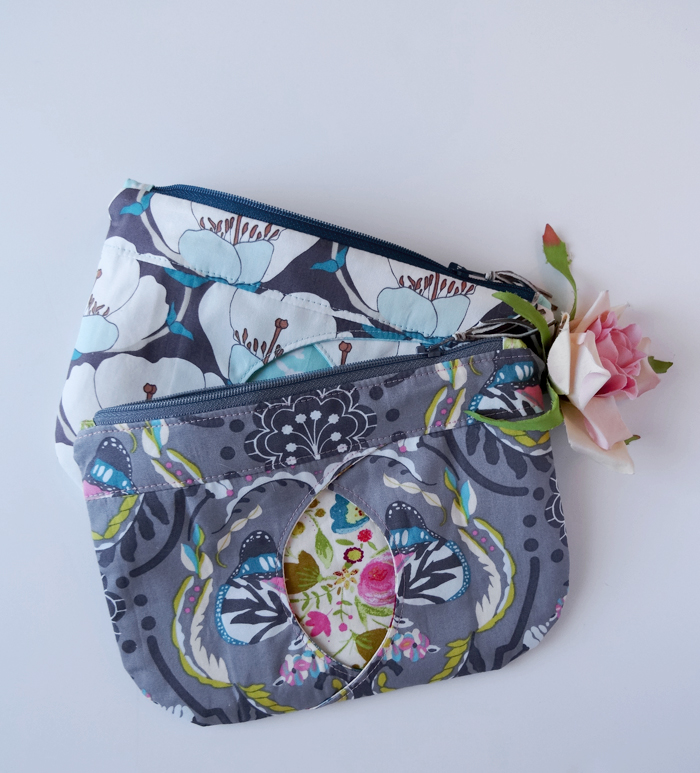
I’m excited to finally share a pouch pattern and tutorial with you! I figure all good sewing blogs generally have a free pouch tutorial and here’s mine. It’s high time after 2 1/2 years! My sponsor Double Decker Fabric supplied the fabrics for this project. Aren’t they gorgeous?! They are listed below if you’d like to get some with the discount she’s graciously offering as well. (Find it below!)
This pouch has been in my “ideas” envelope for a good long time now. The front curves form a unique area that frames your favorite fussy-cut fabric. There are so many possiblities for it! My husband says the shape looks like a Cat’s Eye – and that’s how it got its name.
The finished pouch is 8″ wide and 5 1/2″ deep. Perfect for those miscellaneous things you need to carry around. Pretty things like nail polish, jewellery and makeup, or useful things for jotting down ideas on-the-go! It would be a unique entry for one of those handmade #pouchswaps I see all the time on Instagram too. We’ve used ours already to hold markers and paper for the kids on a trip out for dinner.
* Update: Don’t feel like sewing a pouch yourself? Buy one from a licensed Cat-Eye Zippered Pouch seller! Check out the sellers list. Are you a shop owner? You can buy a Cat-Eye Zippered Pouch seller’s license as an instant download. *
I love the little leather tassel. It adds a bit of extra oomph to the design, I think! It’s easy, and you can add it to any zipper you like – not just this pouch. I’ve included a little trick for how to get the thick leather through the itty-bitty hole in the zipper pull at the bottom of the tutorial!
Head on over to Double Decker Fabric and use the code” march10″ to get 10% off your purchase (including sale items!) for the entire month of March. Discount expires Tuesday, March 31, 2015.
Double Decker Fabrics provided the following Art Gallery fabrics free of charge for use in this project. EMMY GRACE from Bari J: Painted Ladies Flutter, Budquette Dayspring, Knotty Rain (lining) WINGED by Bonnie Christine: Aves Chatter Shine, Nesting Blooms Cool, Wingspan Melon (lining)
——————————————————————————————————————
You can now purchase a 10 page instant PDF download of the Cat-Eye Zipper Pouch Pattern!
| Cat-Eye Zipper Pouch Pattern Sample Page |
This PDF includes:
- Granny’s Sewing Basket – notes and tips to make sewing this pouch easier! ()
- 7 tidy instruction pages with 41 high quality photos and 3 pattern pages
- Check boxes for each instruction & the materials listing, for those of you who love lists!
Aside from these great features, purchasing this PDF supports Thread Riding Hood. Thank you very much!
*NOTE: This link purchases the Cat-Eye Zippper Pouch PATTERN. If you are looking for the Seller’s License please find it in the shop.*
CAT-EYE ZIPPER POUCH PRINTABLE PDF PATTERN: available for any donation!
|
——————————————————————————————————————
HERE WE SEW!
As usual, please feel free to use my patterns/tutorials for your personal projects and gifts and for charitable fundraising events. Please do not sell anything made with this pattern. If you are interested in making them for sale, please contact me and I will set up a license for it in the shop. * Update: The Cat-Eye Zippered Pouch Seller’s License is now available!
Materials:
- 1 fat quarter outer fabric
- large scraps of fabric for pleat & lining
- 9″ zipper
- medium weight fusible interfacing
- scraps of 1/4″ ribbon or about 3″ x 1/2″ of leather for zipper pull (if desired)
- PATTERN PIECES: Free download, click here.
Printing the Pattern:
- Download the Pattern Pieces using the link in the Materials listing. Print out all 3 pages of the pdf on letter size (8.5″ x 11″) or A4 paper. Important: Do not select “fit to page” when printing, make sure you print at the original size. Once you have printed the pages, measure the 1″ test square to ensure the pattern is the correct size.
Prep:
- Trim and discard 3/8″ from the bottom of the Zipper Side INTERFACING (NOT the fabric!), to reduce bulk in the seam allowance. Fuse to each Zipper Side.
- Adhere 1 piece of Outer Back interfacing to wrong side of the Outer Back fabric. Set second interfacing piece aside.
Helpful Notes:
- If a more structured pouch is desired, you can add interfacing to the Front Inside Pleat, Lining and Outer Sides . Be sure to trim ALL SEAM ALLOWANCES (3/8″) off the interfacing before adhering. The added thickness makes it hard to stitch and the front does not lie flat where the layers come together.
- Note that you can top stitch both outer and lining together along the zipper side, but the top corners of the pouch will not lie as flat. I have made one pouch each way. I like only top-stitching the lining to the zipper tape best – it is cleaner and has nicer corners. This is what I have instructed in this tutorial.
- There is a 3/8″ seam allowance allowed throughout unless otherwise noted.
Here we sew!
Pouch Front:
- Place Front-Inside Pleat right side up. Match outer curve of both Outer Front Sides right sides together (RST) with the Pleat fabric. Stitch curves with a 3/8″ seam.
- Trim/clip seam allowance along the curve.
- Turn, press well & top stitch starting about 3/4″ from the ends of the curves. I like to leave a little bit of the Pleat fabric showing along the curve edge. It acts a bit like faux piping.
- Fold the Pleat fabric RST along the two marked lines. These were the side markings from the fussy-cut template.
- Lay the front sides and pleat over the Outer Back interfacing piece you set aside. With the Pleat folded, match the Outer Front Sides to the shape of the interfacing.
- Fuse interfacing as per manufacturer’s instructions. Press well.
- Cross the Pleat ends as desired (see photograph). Baste into place with a 1/4″ seam.
Finish Pouch Front/Back:
- Match bottom (un-interfaced) edge of a Zipper Side to the top edge of the Front Pleat & Sides RST. Match the edge of the second Zipper Side to the top edge of the Outer Back RST.
- Stitch with a 3/8″ seam. Press seam towards Zipper Side. Top stitch as shown.
- These pieces are now called BACK and FRONT.
Zipper Ends:
- Fold Zipper End in half. Top stitch the folded edge. Cut it in half to make 2 pieces that are 1″ square.
- Lay the zipper along the top of the Front or Back for easy measuring. Glue (use this trick!) or baste one Zipper End at each end of the zipper according to the length of the outer.
Install the Zipper:
- Fold the pouch pieces in half temporarily along the zipper edge. The Outer pieces should be RST. Match the Zipper Side edges and pin to prepare to sew the pouch sides.
- Unfold, refold and pin all edges so the Outers are RST and the Lining pieces are RST. The pins from the last step should hold the zipper teeth down on the lining side.
- Stitch the outer edges of the pouch with a 3/8″ seam, leaving a 4″ opening along the bottom of the lining. Take extra care and stitch slowly through the zipper tape and teeth. Once I am sure my stitching is straight I like to double-stitch over this area to make sure it is held securely.
- Clip or Trim the curved corners of the Outer and Lining with pinking shears. Grade or Trim the excess zipper length. Use Fray Check on the zipper tape if desired. Press the lining seam allowance up to prepare for turning.
- Turn the pouch inside out through the opening. Push out all corners/edges and press.
- Match the edges of the Lining opening. Stitch across close to the edge or slip-stitch by hand to close.
- Push the lining into the pouch.
Attach the Tassel:
- Cut a 3″ long piece of leather into 1/8″ strips, or gather two 3″ long pieces of 1/8″ ribbon.
- Thread an extra 6″ excess piece of ribbon or string through the hole in the zipper pull.
- Place the leather or ribbon strips through the loop in the excess ribbon.
- Gently tug and wiggle the leather/ribbon through the hole in the zipper pull using the excess ribbon.
- Remove the excess ribbon and thread the ends of the leather/ribbon through the loop on the right side of the pull. Tug the ends of the leather/ribbon until they are tight against the zipper pull.
Press the pouch again neatly and VOILA, You are finished, Enjoy!
I’d love to see your creations! You can share your projects on Twitter and Instagram @sherrisylvester with the hashtag #alongforthreadride or #threadridinghood, or post them on the Thread Riding Hood Facebook page.
Thanks for reading! Follow along to get more great tutorials and posts:
As usual, please feel free to use my patterns/tutorials for your personal projects and gifts and for charitable fundraising events. Please do not sell anything made with this pattern. Thanks!
Don’t feel like sewing a pouch yourself? Check out these Licensed Cat-Eye Zippered Pouch Sellers.
Are you a seller that would like to buy a Licence to Sew and Sell the Cat-Eye Zippered Pouch? You can buy a license in the shop and receive an instant pdf download!
Disclaimer: This post was sponsored by Double Decker Fabrics. They are also a Thread Riding Hood sponsor, I always share my honest opinion. Thanks for reading!