by Sherri Sylvester | Oct 28, 2014

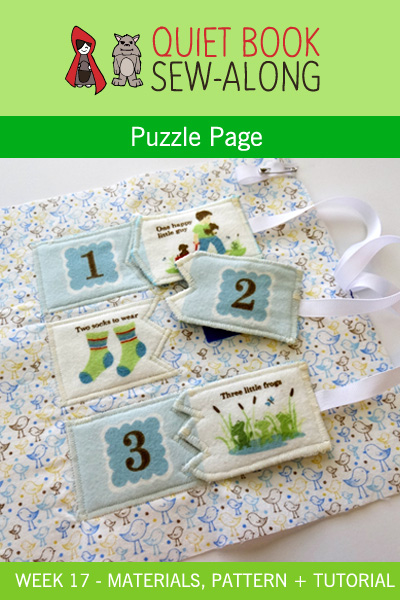
Here’s the next Quiet Book Page (for last week!). I should have known I wouldn’t be able to finish it last Saturday while Creativ Festival was going on. Ah – the nievity of thinking everything can be accomplished in minimal time! We’ve talked briefly about this page before, mentioning that it might be a good idea to find an appropriate fabric to work with. This Quiet Book page is found along with other information and tutorials links on the Sew Along page.
This is a favorite page as well – due mostly, I think, to the perfection of the fabric. The matching squares make it perfect for a puzzle. Of course you can match animal heads and tails or the front and back of vehicles. I also think it’s pretty funny that I still have yardage in the blue versions of both fabrics I used over 3 years ago now. Though I’m not sure if that’s a good or a bad thing! Although the puzzle piece size is mentioned in the materials listing, you will need to wait until the instructions to cut anything so it is cut out correctly.
You will need:
- Background Fabric: 1 piece quilting cotton exactly 9″x9″ square
- Page Interfacing: 1 piece exactly 9″x9″ square, medium weight fusible interfacing (you will have this from your Week 1 shopping list)
- Puzzle Pieces – Left Side: enough fabric to fit 3 pieces aprox. 2 3/4″ wide by 2″ high
- Puzzle Pieces – Right Side: enough fabric to fit 3 front pieces and 3 back pieces aprox. 2 3/4″ wide by 2″ high
- Fusible Fleece: 1 piece about 9″ by 4″
- Ribbon to attach puzzle pieces: 3/8″ grosgrain, 3 pieces 7″ long
- Velcro: Three 1″ pieces of both sides (hook and loop)
- Ribbon Tab: 3 1/2″ long for the side tab
- Removable Fabric Marker
Before we begin/Important Notes:
- When you are sewing this book it is good to remember that some of the edges will be covered after the book is completed and sewn together. 1/2″ on the top edge of your page and 3/4″ on each side edge will not show in the final project.
- Remember to use your iron liberally when you are sewing this book. It is going to be a work of art when you are done! Since it is thick and some of the pages will not be iron-able once you are finished with them it is advisable to take all of the care you can to remove wrinkles so they are not accidentally permanent in your final book.
- Fuse the 9″ square fusible onto your 9″ square background fabric before you begin.
Here we go:
- Use a removable fabric marker to draw a 5.5″ x 2″ rectangle around the area you will use for BOTH puzzle pieces.
- Draw a line down the centre of the rectangle, creating two pieces 2 3/4″ wide by 2″ high.
- Draw your notches as desired, I used the number of notches that matched my fabric numbering. You could put one or two notches on all pieces – be creative. Maybe the notches could be curved lines, or other shapes, like rectangles or half circles.
- Fuse an over-sized piece of fusible fleece directly behind the puzzle pieces. Cut out the two pieces with the fusible fleece attached.
- Cut a small piece of backing fabric for the puzzle piece on the right side. To use the cut puzzle piece as a guide, place it wrong sides together with the backing fabric, then trace and cut.
- Repeat steps 2-5 for the other pairs of puzzle pieces.
- Stitch the soft side of a piece of Velcro onto the centre of each piece of backing fabric. A glue stick is great for holding the small pieces on while you sew.
- Place the right side puzzle pieces wrong sides together with their backing fabric. (Another great place to use a glue stick!) Insert about 1″ of ribbon into the side opposite the notches, between the fabric layers.
- Stitch around the edges of the puzzle piece with a short zig-zag stitch. Double-stitch over the end where the ribbon is inserted to secure it.
- Place the puzzle pieces onto the background fabric as desired – lining up the notches.
- Stitch around the left side puzzle pieces to secure them.
- Place each right side puzzle piece and mark where the Velcro is located.
- Stitch the hook side of the Velcro onto the backing fabric in place as marked in Step 10, so the Velcro will line up when the puzzle pieces are placed correctly.
- Baste the three long ribbons side-by-side along the centre-right edge of the background.
- Fold the 3 1/2″ matching ribbon tab in half and use the small safety pin to attach it to your page so it does not get lost.
And you’re finished with another page. Only three more to go! See you back again later this week.
by Sherri Sylvester | Oct 10, 2014
Another week, another Quiet Book Tutorial. I love how these are turning out. I got to use my metallic star fabric here and it’s so much fun! My stack of finished pages is growing taller – how’s yours coming along?
You can customize this page with fun shoe laces from the Dollar Store and scraps of your favorite fabrics. As usual, I am always amazed when I break down the steps for these pages and they turn out to be 10 or 12 simple steps. That is the case with this page – quick and easy, not too much work for a great result! This Quiet Book page is found along with other information and tutorials links on the Sew Along page.
As a bonus, here’s a good page for those people looking to make these Quiet Book pages into other projects! It would make a great pillow for a tween or teen – just enlarge everything to about 150 or 200%. The shoe opens up at the top to become a pocket. If you are scared off by the eyelets, consider changing them into button holes.
By way of a “life update”, this week I had a child unexpectedly home from school on Thursday and a holiday today – so the Satchel pattern has been delayed again. Soon… very soon!
Ready to sew?
You will need:
- Background Fabric: 1 piece quilting cotton exactly 9″x9″ square
- Page Interfacing: 1 piece exactly 9″x9″ square, medium weight fusible interfacing (you will have this from your Week 1 shopping list)
- Shoe: fabric scraps
- 8 eyelets or small grommets
- Sole: leather or vinyl scrap cut to 3/4″ high by 4 1/4″ wide
- Ribbon Tab: 3 1/2″ long for the side tab
- Small Safety Pin
- Shoe Pattern Pieces -> Click here to download
Before we begin/Important Notes:
- Print out the pattern piece pdf on letter size (8.5″ x 11″) or A4 paper. Important: Do not select “fit to page” when printing, make sure you print at the original size. Once you have printed the pages, measure the 1″ test square to ensure the pattern is the correct size.
- When you are sewing this book it is good to remember that some of the edges will be covered after the book is completed and sewn together. 1/2″ on the top edge of your page and 3/4″ on each side edge will not show in the final project.
- Remember to use your iron liberally when you are sewing this book. It is going to be a work of art when you are done! Since it is thick and some of the pages will not be iron-able once you are finished with them it is advisable to take all of the care you can to remove wrinkles so they are not accidentally permanent in your final book.
- Fuse the 9″ square fusible onto your 9″ square background fabric.
Here We Go:
by Sherri Sylvester | Oct 1, 2014
Quiet Bookers Rejoice! We’re back on track and here is the latest Pattern & Tutorial. If you are new, you can find everything you need to know on the Sew-Along page.
This page is fun and helps with the ever-tricky task of learning how to fasten buttons. The little ladybug buttons both work so the flower can move around as desired. I drew on a few “flying” lines with a fabric marker to make everything more fun and add a bit of movement. This page is a tad feminine. If you need an idea for a boy, I have used rocket-ship fabric for the background in the past and attached the moon instead of a flower, the string was attached near the edge of the page.
Ready to go?
You will need:
- Background Fabric: 1 piece quilting cotton exactly 9″x9″ square
- Page Interfacing: 1 piece exactly 9″x9″ square, medium weight fusible interfacing (you will have this from your Week 1 shopping list)
- Flower: 10″ wide x 5″ high quilting cotton
- Embellishments: flowers, mushrooms, be creative!
- Bugs: 2 ladybug/bee/butterfly buttons
- Stems/Grass: extra-wide rick-rack, about 1/2 yard/metre
- Leaves: Green 3/8″ wide ribbon, less than 1/2 yard/metre
- Flower Pot/Dirt: 9″ wide by 4.5″ high brown scrap fabric
- Ribbon Tab: 3 1/2″ long for the side tab
- 5″ x 5″ piece of Fusible Fleece/Heavyweight interfacing for the flower
- Fabric marker (optional)
- Small Safety Pin
- Flower Pattern Piece -> Click here to download
Before we begin/Important Notes:
- Print out the pattern piece pdf on letter size (8.5″ x 11″) or A4 paper. Important: Do not select “fit to page” when printing, make sure you print at the original size. Once you have printed the pages, measure the 1″ test square to ensure the pattern is the correct size.
- When you are sewing this book it is good to remember that some of the edges will be covered after the book is completed and sewn together. 1/2″ on the top edge of your page and 3/4″ on each side edge will not show in the final project.
- Remember to use your iron liberally when you are sewing this book. It is going to be a work of art when you are done! Since it is thick and some of the pages will not be iron-able once you are finished with them it is advisable to take all of the care you can to remove wrinkles so they are not accidentally permanent in your final book.
- Fuse the 9″ square fusible onto your 9″ square background fabric.
Here We Go:
- Cut out your flower fabric. Also cut 1 piece of fusible fleece/interfacing and apply it to one flower piece. Place the two flower pieces wrong sides together and insert the rick-rack stem in between the layers at the “bottom” of the flower. Use a wide zig-zag or fancy stitch to sew the flower and stem together while finishing the edges. Double-stitch where the rick-rack is inserted to make sure it is securely attached.
- Make a buttonhole large enough for the bug button to fit through easily. When in doubt, make it larger, so it’s not as tricky for little fingers.
- Prep your flowerpot/dirt by folding it in half lengthwise and pressing it well.
- Lay your leaves/flowers and embellishments out on your background square. Cut several pieces about 4″ long from your 3/8″ ribbon to use as leaves. Also cut appropriate lengths of rick-rack for stems or grass as per your layout. The stems should be long enough to reach the bottom of your page. Make leaves by twisting and folding the ribbon so the ends meet. Place them under the stems with the ends hidden beneath the rick-rack. You can fray-check or (carefully) burn the ends so they do not fray. (Note: refer to the “Important Information” section to ensure your design is far enough away from all edges.)
- Mark the placement of the large flower stem, the flowerpot/dirt and the buttons, set them aside. Stitch all other pieces onto the background using matching thread and decorative stitches if desired. Ensure everything is securely stitched, just in case a child decides to chew on it!
- Stitch the leaves to your large flower stem carefully, leaving the bottom few inches free of stitching. These will be hidden underneath the flowerpot/dirt.
- Place the flowerpot/dirt over the bottom of your background. Stitch across the top with a tidy/decorative stitch. Stitch the sides and bottom with a basting stitch or use a glue stick to hold all of the raw edges in place.
- Attach your buttons very securely. I used embroidery floss and stitched each button at least 4 times, knotting each stitch individually. Again, small children might chew on this!
- Draw some “flying” lines with fabric marker near the bugs. Heat set them if possible, being careful not to melt the embellishments!
- Fold the 3 1/2″ matching ribbon tab in half and use the small safety pin to attach it to your page so it does not get lost.
See you next week with a new Quiet Book tutorial!
by Sherri Sylvester | Sep 22, 2014
So – you thought I’d never get back to the Quiet Book Sew Along? I know, I’m really not being consistent with these posts, I apologize. I seem to have treated it like a lot of other projects I take on – it gets done on time, but generally very close to the deadline! (Taking on too many projects and procrastination much?)
But, have no fear! We have exactly enough weeks left to finish by the end of November, I’m just going to change the format a little.
We’ve gotten through 6 pages (7 tutorials) – halfway there – so we have 6 pages left to make with 2 tutorials on finishing the book. Here’s a list what we have left to finish. Never-mind the names… I’ll come up with something better when I actually post them!
- Tie the Shoe
- Puzzle Match-Up
- Put the Teddy Bear to Bed
- Button the Flowers in Place
- Fasten the Belt Buckle
- Road with Cars
- Sew the Pages Together
- Sew the Cover & Assemble
The plan is to start next week or the week after with one page/assembly tutorial posted per week until we are done on the last week of November. In early December I am hoping to be able to post a pattern PDF of the entire Quiet Book. The tutorial will still be available, but the PDF will be much easier to follow and will have all pattern pieces and page instructions in one tidy place. Plus, it will look pretty! Bonus!
I hope you’ll forgive my tardiness and come back and sew the last few weeks. I’d love to post some finished projects here in December! Email me and we’ll sort it out.
by Sherri Sylvester | Jul 13, 2014
I love a good quiet book page with some movement and a fun learning opportunity! This abacus (of sorts) is not terribly accurate, but you can count each string’s beads and move them up and down as you do. I made the first version of this with actual beads, (which you can substitute if you want of course) but I’m so paranoid of someone’s child choking on a bead, that I’ve devised a way to (hopefully) make it safer by using scraps of vinyl or leather.
I’ve also omitted the numbering, since I was not satisfied with the quality and “professionalism” of my 80’s-esque puffy paint art on the beaded version! I think it also promotes parent/child interaction by creating an opportunity to play with the child and count the beads out loud. Wow – look at me, I sound like some sort of educational parenting expert now… so totally not the case in real life!
the “original” quiet book abacus page
I’m posting the materials and tutorial for this today because I’m on vacation this coming week – hooray! I’ve also got some secret plans for the week… so there won’t be room to post the proper Quiet Book post. What is it you ask? Come back Monday to find out! (Hint… it has something to do with the fact that my blog started 2 years ago on the 12th of July!)
How about making that Abacus page… just to stay busy so the curiosity doesn’t drive you crazy! (If you are just starting find all the information you need on this Sew-Along page.)
You will need:
- Background Fabric: 1 piece quilting cotton exactly 9″x9″ square
- Page Interfacing: 1 piece exactly 9″x9″ square, medium weight fusible interfacing (you will have this from your Week 1 shopping list)
- Top & Bottom of Abacus: 2 pieces of fabric, 2.5″ high by 7″ wide
- Abacus Strings: 5 pieces of 6″ long, 1/4″ wide, 100% polyester ribbon
- “Beads”: 3 small leather or vinyl scraps in different colours (approximately 2 3/4″ x 3″ each)
- Ribbon: 3 1/2″ long for the side tab
- Small Safety Pin
- Glue Stick
- Leather needle (if using)
Before we begin/Important Notes:
- When you are sewing this book it is good to remember that some of the edges will be covered after the book is completed and sewn together. 1/2″ on the top edge of your page and 3/4″ on each side edge will not show in the final project.
- Remember to use your iron liberally when you are sewing this book. It is going to be a work of art when you are done! Since it is thick and some of the pages will not be iron-able once you are finished with them it is advisable to take all of the care you can to remove wrinkles so they are not accidentally permanent in your final book.
Here’s how to make it:
- Interface the 9″ square background fabric with the 9″ square interfacing as per the manufacturer’s directions. (My background fabric is “Quote This” in Cherry from Double Decker Fabrics.)
- To cut your vinyl/leather into 30 rectangles, you first need to cut 2 pieces 1.25″ x 3″ high from each of your 3 coloured scraps.
- Place the cut vinyl/leather wrong sides together with their matching colours and glue a very thin (1/4″ max) line along each edge to hold them together.
- Once the glue has set, mark each pair every 1/2″, as in the photo below. Use a pencil for this, so the marks can be removed later. There will be a space at the end that will not measure 1/2″ – this is extra.
- Stitch down each edge of your leather/vinyl with a 3/8″ seam. ** It is important to treat each 1/2″ mark like it is the beginning or end of a seam. Back stitch at the beginning and before you reach the end of each 1/2″ mark. We will be cutting on the marks to make these beads, so you want your stitching to be strong and reinforced so the beads stay together. If you are having trouble stitching the vinyl or leather because it is tacky – try this trick.
- Cut each leather/vinyl rectangle 1/8″ away from your stitches on each side. This will create a 3/4″ wide rectangle.
- Cut each long rectangle along your 1/2″ marks to make your beads.
- Fold the ends of your fabric in 1/2″ and use a glue stick to hold them in place.
- Fold the fabric in half lengthwise and press, unfold and fold each side into the centre. You can use a glue stick to hold this in place, or just press it extra well with lots of steam.
- Prepare your abacus strings by melting each end of the ribbon over a flame. (I know you will be… but please be careful!) The melting will only work if your ribbon is 100% synthetic fibres. ** If it does not fully melt, it is not appropriate for use in a quiet book because the strings could fray over time (even when stitched) and come out, leaving the beads to be chewed on and potentially becoming a choking hazard.
- Use a glue stick or pins to adhere one side of one of the folded fabric strip to the background fabric, 2″ down from the top. Adhere the other one to the bottom centre, 2″ up from the bottom. Make sure there is a 4″ gap between the strips. Leave the strips open so we can place the ribbons between the folds.
- Line up the strings so they are equally spaced along one of the fabric strips. I used a glue stick to hold them in place. The ribbons are long on purpose to make them more secure. Place the excess ribbon inside the folds of the fabric strip. Make sure the bottoms of the strings are inside the bottom folded fabric strip as well, but do not pin or glue them in yet.
- Pin/Glue the top fabric strip shut. Stitch around the edge of the fabric, catching the ribbons. Also stitch through the centre 2 or 3 times to reinforce your stitching and make sure the ribbons never come out. **Please, again, be careful when using beads and small objects around children. I cannot be held responsible if anything happens… and I want to be extra certain that this page is safe!**
- Place the beads on your strings. I have separated them out to make the numbers 1 through 5. A skewer helps to get the ribbon through the bead.
- Insert the bottom edge of each ribbon into the fabric strip and follow steps 11 and 12 again to close up the bottom of the abacus.
- Fold the 3 1/2″ matching ribbon tab in half and use the small safety pin to attach it to your page so it does not get lost.
All done! And we are half way through our Quiet Book pages! 6 down, 6 to go… Thanks for sewing along! Please check the
Sew-Along page for a list of all the tutorials + ways you can share your book. As usual, please let me know if you have any questions: email sherri@threadridinghood.com or leave a comment.
** As usual: This tutorial is for personal or charitable use only. Please do not sell items made with the Quiet Book Sew Along posts. If you wish to sell these please contact sherri@threadridinghood.com for information on how to purchase a license. Thank you!
by Sherri Sylvester | Jul 7, 2014
Here is the tutorial to go along with the materials listing and description for the Telephone Quiet Book Page. (If you are just starting find all the information you need on this Sew-Along page.)
Before you begin, get the items you will need for the telephone page from the materials post.
You Will Need: (in addition to the materials list)
Before we begin/Important Notes:
- Print out the pattern piece pdf on letter size (8.5″ x 11″) or A4 paper. Important: Do not select “fit to page” when printing, make sure you print at the original size. Once you have printed the pages, measure the 1″ test square to ensure the pattern is the correct size.
- Print out the dial pad number printable. It is set to print in a 4″x6″ page, so it is easily printable on a larger sheet. Be sure to follow the directions for flipping or not-flipping the image before you print it. Also, be sure to print only the colour of dial pad that you want. I have included white, blue, pink and yellow. You can easily do this by only printing the page with the colour you’d like to use.
- When you are sewing this book it is good to remember that some of the edges will be covered after the book is completed and sewn together. 1/2″ on the top edge of your page and 3/4″ on each side edge will not show in the final project.
- Remember to use your iron liberally when you are sewing this book. It is going to be a work of art when you are done! Since it is thick and some of the pages will not be iron-able once you are finished with them it is advisable to take all of the care you can to remove wrinkles so they are not accidentally permanent in your final book.
Here We Go: