by Sherri Sylvester | Dec 7, 2015

I love having a theme with a deadline to sew for, it brings out all kinds of crazy-creative in me and today’s project is no exception. I’m thrilled to be part of Making Merry with Janome today! Since Janome Canada is my sewing machine sponsor, they’ve let me borrow a beautiful Skyline S5. (Squeee!)
This Janome machine truly makes my sewing more merry all on it’s own. But this blog hop is about Making Merry by sewing at Christmas, so I decided to create a Christmas-themed table runner, since our family didn’t have one yet. Now we do and I love it! The tutorial with printable pattern pieces is included below so you can make one too.
These quilted 14″ placemats can be used for a table setting or laid out in a row as an interchangeable table runner. I prefer to use them in table runner style to save myself the mild heart attack of letting my kids eat cranberry sauce over them! Of course, you could make just one to decorate a small round side table as well. If you are a little bit adventurous, you could even turn the circle applique into a round pillow. How cute would that be?!
All of the fresh and pretty fabrics I used for this project were provided by my blog sponsor, Country Clothesline. Their uniquely curated fabric selection is full of gorgeous florals, vintage reproductions, dots and stripes. Plus you never know what else you’ll run into! Apparently I like dots, since three of the 4 fabrics in this project have them. Find them all here: Red Dot, White Dot, Grey Dot, Wintery Blue.
As usual, please feel free to use my patterns/tutorials for your personal projects and gifts and for charitable fundraising events. Please do not sell anything sewn with this pattern. If you are interested in making this item for sale, please contact me and I will set up a license for it in the shop. Thank you!
Materials:
- 1/2 yard each of 3 pre-washed fabrics (to make 3 placemats)
- 1/4 yard (or fat quarter) for hanger applique
- one 14.5″ square of quilt batting per placemat
- fusible web for applique (this one is my favorite!)
- 1/2 yard backing fabric (enough for 3 backing pieces)
- matching thread for applique
- removable fabric marker
- fusible interfacing to layer under applique if colour shows through (I used this between blue/white stripe)
- optional: walking/even foot is desirable for quilting
- optional: basting spray (or pin baste)
- CLICK TO DOWNLOAD: Christmas Ornament Placemat Pattern Pieces, 5 page pdf
Printing the Pattern:
- Download the Pattern Pieces using the link in the Materials listing. Print out all 5 pages of the pdf on letter size (8.5″ x 11″) or A4 paper. Important: Do not select “fit to page” when printing, make sure you print at the original size. Once you have printed the pages, measure the 1″ test square to ensure the pattern is the correct size.
- Cut the pages on the outer gray lines and tape/glue the pages together, matching the letters in the gray half-circles. Once you are finished, cut out each pattern piece.
Cutting your Fabric:
- Use the cutting layouts below to cut each pattern piece. ** Be sure to cut as indicated to leave room for the bias cut binding strips.
- Cut 3 bias-cut binding strips to match each main ornament fabric (as shown below)
- Cut one 14.5″ square of low loft batting per placemat
- Cut one 14.5″ square of backing fabric per placemat
- Cut fusible web for each stripe and hanger pattern piece you need
- If desired, cut fusible interfacing to place between the stripe and the main ornament fabric. This helps a darker main colour not to show through a lighter stripe.
Preparing to Sew:
- Piece the three bias strips together to make one long strip. Fold the bias strip in half lengthwise and press well. Set aside.
- Layer your main fabrics. Place the backing right side down, layer the batting on top, layer the main ornament circle over the batting right side up. Spray baste if desired, or pin baste later on.
Sewing the Applique:
- Place the stripe and hanger correctly on the ornament circle following the red/dashed lines on the pattern piece. Adhere the fusible web.
- Pin baste layers together (if not spray basted earlier)
- Use an applique/blanket stitch to stitch around both fused pieces. (Skyline S5 Stitch #37: 3.5 wide, 3.0 long, AUTO tension)
Quilting the Placemat:
- Mark all light grey quilting lines from the pattern piece onto the ornament and hanger, including the hanging loop. I found that my hera marker worked well – I placed the paper template over the fabric and marked each line, then traced them with a water soluble fabric marker for better visibility. You can also use dressmaker’s carbon and tracing wheel, or even cut the pattern pieces on each line and trace around them to mark each one.
- Stitch the Quilting line on the hanger with the applique/blanket stitch.
- Quilt all other lines with a straight quilting stitch, leaving hanging loop to the next step. (Skyline S5 Stitch #01: 4.5 wide, 3.5 long, Tension at 3)
- Use a contrasting thread and small zig-zag to stitch hanging loop. I had some grey-tone embroidery thread on hand that I used. (Skyline S5 Stitch #11: 2.0 wide, 0.2 long, AUTO tension)
Binding the Placemat:
- Trim excess backing and batting, following the edge of the main ornament circle.
- Apply the bias binding as desired. I like to machine quilt my bindings and use this tutorial as a guide. ((Skyline S5 Stitch #01: 8.5 wide – brings needle to 1/4″ from edge of even foot, 3.0 long, AUTO tension)
Remove all fabric markings, press if desired, and you’re done!
——————————————————————-
I’d love to see your project! You can share photos on Facebook, Twitter or Instagram (links below) using the hashtags #alongforthreadride and/or #threadridinghood. Thank you!
Disclaimer: Janome Canada is my sewing machine sponsor, you can read more about why I love Janome machines from earlier this year. Country Clothesline is a blog sponsor and provided the fabrics for this project. I truly love each of their products and always give my honest opinion. Thank you for supporting this blog’s amazing sponsors.
by Sherri Sylvester | Oct 1, 2015
Ever since I made four more Noodlehead Cargo Duffles at Christmas last year I’ve been wanting to make some for my girls. They would be perfect for overnight stays at Grandma and Grandpa’s house. And how cute would it be to go on vacation with some too! I’ve recently been looking for the pattern yardage information and it reminded me that I meant to post this yardage-saving information earlier this year. Oops.
Moving on! When planning to make my family their Cargo Duffles, I wanted to do it as cost effectively as possible. When all the pieces were laid out, I noticed that the Cargo Duffle pattern yardage can be reduced quite a bit if you are careful! Of course, if you like having extra fabric around, Anna’s suggestions are just fine – and leave you room for error. Always a good way to go!
If you are looking to save fabric and use up some smaller cuts, the cutting layouts below work great and save you an entire yard of fabric. I would recommend that you are VERY careful when using the Exterior Main cutting layout (see below). It fits absolutely perfectly into a 1/2 yard cut. This leaves no room for error, or pre-washing/shrinking even! Make sure that whoever cuts your yardage is precise – and that the print is on-grain or not obvious – so if it is not straight it won’t look wrong when you make the bag.
Note: These cutting layouts do not include measurements. These are available in the free Cargo Duffle Pattern by Anna from Noodlehead. All other measurements in the pattern should be used as they are noted in the original Cargo Duffle Pattern. These layouts do not include the binding and canvas, interfacing etc.
Hope it helps! Let me know if you have any questions. One day I’ll make some for my girls… (I hope!)
Have you made an Overnight-Style Bag before? What is your favorite one?
Other useful Cargo Duffle related posts I’ve written are here:
by Sherri Sylvester | Aug 8, 2015
I’ve been thinking about making my Grandma a quilt for a few months. When my mom was visiting in July it seemed like the perfect time. It would go a bit faster, (Thanks Mom!) and three generations could work on it – my mom, myself and my kids – as a gift for the 4th generation, my grandma! I picked a quick quilt pattern and we set to work.
My kids sewed at least one of the seams each, my mom cut and helped me with piecing and we basted it together. Then my parents had to leave and it sat for a little bit while I scrambled to put together a 5 year old’s birthday party and pack us up for 5 days away. Everything got finished last Thursday and I’m so excited to send it off! While I write this the girls are hard at work making a card for their Great Grandma – one they’ve never met, since she lives on the other side of the country.
I’ve always wanted to make a Giant Vintage Star Quilt. It seemed easy enough and fast enough that it was do-able and wouldn’t end up as one of my WIP quilts – I’ve got too many of them that are sooooo close to finished. I should really get on that! Turns out it was perfect. We sized the squares down from the fat-quarter-friendly 18″, to 14″ so as to accommodate the fabric available (more on that later). Turns out it is a great lap size anyhow, finishing at 65″ square. I was even able to quilt it myself.
The fabric for this project was all in my stash and already pre-washed. Of course good, because we were in a hurry! The white was a lightweight set of curtains, I think – that came with the same fabric I used for these Easter maxi-dresses. I was going to use it to make this set of blocks, but since it was needed here plans changed! I did order some white not too long ago from Double Decker Fabrics (now closed) and it will stand in for the other project. (Oh, and the label was from Double Decker as well!)
The top is Spring Bloom fabric by Bella Caronia – scraps from these self-drafted dresses for the girls. I ended up with quite a bit of fabric left over since I needed extra for fussy cutting. I over-estimated a bit since it was my own pattern and I didn’t want to run out! Turns out it was perfect, just enough fabrics for exactly creating the star on the quilt. My mom was amazing and scrounged like crazy when she cut the pieces. In the end we only had to piece one of the large triangles!
The backing fabric is super soft Art Gallery Fabric, Jeni Baker “Dreamin Vintage” from Fabric Spark. It was originally going to be a top for me, but when I saw it with the Spring Bloom colours it was perfect. The border (again, scrounged from scraps and even cut off grain to get enough pieces!) sets it off perfectly. Don’t tell, but I think the back is my favorite! The cream background on the Dreamin’ Vintage adds so much warmth! (It’s sold out now, since I bought it last year, but you can check out her other vintage inspired fabrics here!)
Now that it is done, it’s into the mail and me holding my breath that it gets there. Not that I don’t trust the postal service… but it’s a bit nerve wracking! And it has to travel across the country and over a border…. ack!
Reader Feedback: Have you sewn a generational quilt?
Disclaimer: Fabric Spark provides fabric to me at a discount, and I in return link to their shop when I post related projects.
by Sherri Sylvester | Jun 22, 2015
I love when a long, planned project is finally finished. These Diamond String quilt-as-you-go pillows have been on my to-do list for so long now. Amazingly, two great reasons came at the same time so I could justify making a new project!
First, I wanted to use my Fabric Please! blogger bundle to make something, because I love the colours together! Second, PillowCubes contacted me to see if I wanted to review their pillow inserts. (P.S. Enter for a chance to win the blogger bundle until June 23, 2015.)
So…. Pillow fabric + Pillow Insert = Obvious obligation (*wink*) to make the tutorial you’ve been dying to try!
I’ve got a mini tutorial later on with the measurements for making your own 12″ x 16″ Diamond String pillow, but first a word about PillowCubes. When I first looked at their site I wasn’t sure what to expect. A pillow insert is a pillow insert, is a pillow insert, right? For my sample, I checked the list and ordered an Eco-Friendly 12×16 insert. May as well save the environment as much as possible!
When my sample arrived in a Flat Rate envelope I was amazed it would fit in there – turns out they are vacuum sealed to save space. Once opened, the pillow puffs up to its normal size. I love that the pillow is:
- made of good quality unbleached cotton (Less chemicals)
- stitched and edge-finished on 3 edges, the 4th is folded
- and the filling is distributed evenly and out to the corners
- the recycled filler is soft, and fluffy, just like it should be!
All in all I’m really pleased with the insert and I’m especially happy that it is Eco-Friendly. Though, they do have Polyester Fill, 3 types of Down Fill and Synthetic Down, if you’d like more options.
I also really like that you can save quite a bit of money ordering by the “cube” – a box of pillow inserts! If you don’t think you’ll use that many inserts, share with a couple of friends. Or get a box and use your stash to gift throw pillows to everyone this year. (Get a discount below!)
PillowCubes are American Made and ship from the US, they also ship to Canada and Internationally. My order (to Canada) arrived in only 9 days!
Use the discount code: ThreadRidingHood10 to get 10% off your first PillowCubes order. This code never expires! Use the discount code to purchase a sample pillow, a pillow cube or a custom order!
I always dread sorting out the math in my quilty projects, so I thought I’d write out the measurements I used below in case you want to make one too. It perfectly fits a 12″x16″ PillowCube insert!
- Cut 4 pieces of low loft batting as your foundation pieces – 7 1/4″ x 9 1/4″ (these are purposely oversized)
- Create your quilt-as-you-go Diamond String blocks. This tutorial was really helpful, use the batting as your foundation instead of muslin.
- Trim the blocks to 6 3/4″ x 8 3/4″ and stitch them together with a 1/4″ seam.
- Cut 2 backing pieces – 13″ x 13″ – for the envelope back. Hem the inside edge of each piece.
- Layer the pillow front with the envelope backs aligned to each side (hems in the centre). Baste the layers together.
- Bind the edge using your favorite machine/hand stitched binding method. You will need about 70″ of 2 1/2″ wide binding.
Now, just add your PillowCubes insert! Here is the easiest way to place your pillow form into the cover:
Reader Feedback: What is your favorite pillow cover tutorial?
Thanks for reading. Follow along and join me for “thread ride”!
Disclaimer: This post is sponsored by PillowCubes. I recieved a sample product and compensation for this post. I promise I will always write my own opinion and never review anything I don’t love myself. View our privacy policy.
by Sherri Sylvester | Apr 28, 2015
I’m tired y’all! I had an amazing weekend at Creativ Festival – but I think the amount of time and energy I put into getting everything ready is now showing – I haven’t even unpacked or pre-washed any stash yet! I’m going to post a review of the weekend, but first I’ve got a quilt for you. (And, if you are expecting an email from me about the weekend I’ll hopefully get it out tomorrow!)
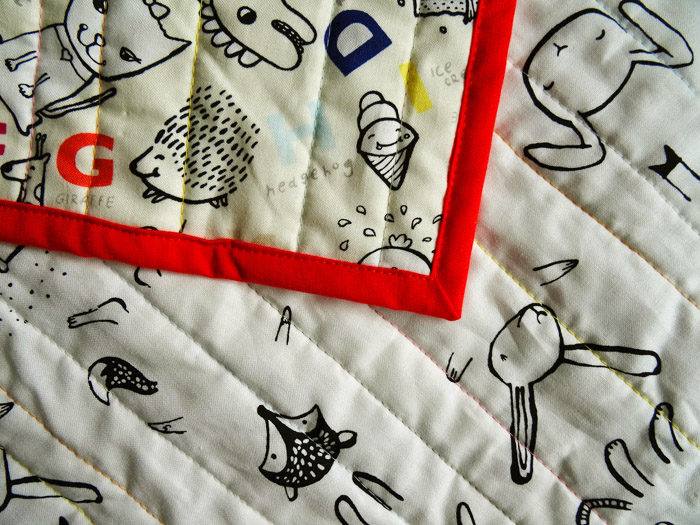
This is one of the projects I made in collaboration with my sponsor, Fabric Spark – for use at Creativ Festival. It’s a blanket/play mat made using the Wee Gallery collection from Dear Stella. I’d already fallen in love with the front “Dress Me” fabric when Daryl suggested making this quilt for the show. (I’ve got a yard stashed away from when Daryl first listed it!)
After I got the kit I was totally smitten with the backing fabric – Wild – Alphabet! Would you believe it’s even got a “N is for Narwhal” on there? (If you are looking for the “Dress Me” fabric, this little quilt did its job and now Fabric Spark is sold out of the “Dress Me” print. You can still get Wild – Alphabet here. *EDIT: Apparently Daryl is all sold out of the Alphabet as well.)
The quilt is made using the free “Dress Me Up!” Tutorial by Modern Handcraft on the Dear Stella blog. It’s such a cute idea! The only thing I changed is to use coloured thread for the quilting. In an effort to make it unisex, I used pink, blue, orange, yellow, gray and cream – generally matching the colours on the Alphabet backing – but lighter. I had a false start with a few quilted lines in bright pink and darkish blue that “showed up” too much for my liking.
Using wool felt for the character’s clothing is such a great idea. My oldest has already been designing clothes for them with the left-over felt. I’ve never used wool felt before, and I was so pleased with the quality and feel of the pieces provided in the kit. You can get wool felt from Fabric Spark as well – they have wonderful names like “Pea Soup”, “Vanilla Latte”, “Fresh Linen” and “Bluer than Blue”!
I learned a good lesson from this quilt as well – a quilt does not have to be hard, or even pieced! This whole-cloth quilt was so simple to make – and the end result is so cute! My favorite part is the coloured quilting. I didn’t even use any fancy quilting thread.
My new motto more often needs to be “Simplify Your Projects” and “Done is better than Perfect”!
Your Turn! What is your favorite sewing motto?
Disclaimer: I received this quilt kit at no cost in exchange for it’s use at the Fabric Spark booth during Creativ Festival. All of my opinions are my own and I won’t take on projects I don’t believe in. Thanks for reading!
by Sherri Sylvester | Mar 7, 2015
Oof! I’ve found it so hard to stop and blog this week! I’m in a mood to just sew, sew, sew and not stop. I’ve made a muslin of the Sailor Top and Bess Top, started finishing my quilt, worked on my CBC logo pillow… Tonight I’m trying to sew up a quick Seafarer top, after I blog this of course (and I know, it’s late here!). Anyhow – the purpose of this post is to show you some pretty fabric and prod myself into getting started on yet another project (see below) – ‘cuz that seems like a good idea too!
For two months now I’ve been aiming to follow along with the Simple Simon and Co. monthly block tutorials. Since I’m a newbie at quilt blocks I figured it would be useful to practice making some of the more common ones. And, since I’m a creative person with too many “good” ideas, I’ve been trying to do that since January!
The good thing is, though, that I picked out a group of fabrics right away to use for this. I’m hoping that I can make 2-4 of each block and then put them together at the end of the year to make a semi-random quilt top. Who knows, maybe I’ll even get it quilted before Christmas?! (Just don’t hold me to it!)
The farther I get into these tutorials, I’m finding that it is a super-beginner friendly process. January – Half Square Triangle (HST) Block. February – Rail Fence Block. March – Square Block. Maybe too beginner-friendly for me? Not sure, but I’m excited to see what comes out at the end of the year. It’s very mysterious not knowing what’s coming next month!
I pulled out the Tula Pink fat quarter bundle I got from Fridays Off Fabric Shop at Creativ Festival in November 2013! Some solids and a few stashed fat quarters got added in as well. I happened to have a large cotton tablecloth that was gifted to me in a box of random fabrics to go with it. I’m excited to use the white throughout the quilt, I love how it makes the colours brighter.
So my quilt “sampler” will be a random bunch of fabrics from all over the place sewn from a bunch of random quilt block tutorials! If you are looking for something a bit more advanced, Caroline from Sew Can She has posted monthly blocks as well. You can find her tutorials within the others she has written, look for the words “Classic Quilt Blocks” on the photos.
I’m off to sew… again! I really hope to have lots of clothing for myself soon. It would be great to have a more handmade wardrobe!
Reader Feedback: Do you sew a lot of clothing for yourself? Do you have a favorite pattern you’ve used a lot?