by Sherri Sylvester | Mar 4, 2015

Wow – it’s been a long week! I feel like I haven’t been back at my computer in ages. I’ve used this time away to think about lots of things that are going on over here and re-calibrate. It’s been nice to plan a bit about how best to move ahead. Don’t worry, I’m not going anywhere – things have just been a bit disorganized lately. I’d like to be scheduling things early instead of writing them at the last minute.
I’ve written up a mini tutorial today! A few people have asked for the measurements I used to make my girls’ Cargo Duffle Backpacks last year.
Before we get to that I wanted to congratulate the winner of the Meerkat Shweshwe Fat quarter bundle! This unique fabric was so well received – I was excited to introduce it and hope you like it as well. The winner of the bundle was Erin A. – who already received it, despite it’s being mailed yesterday! You can head over to this post to find out where you can get the fabric and to find out more about it.
I wasn’t too sure how much to include in the mini tutorial. So I’ve taken some straight forward photos of the bag, and listed the measurements and a few simple instructions below. I can’t put in a full tutorial, since I’m not making another one at the moment, so I’ve left quite a bit up to your interpretation. Please note that the photos are of a bag that’s been used for the past year and a half, so please excuse wrinkles and threads. I’ve also included lovely shots of my super hurried inside binding (yikes, how embarrassing). Lucky you! #justbeingreal
The construction is basically the same as the Noodlehead Cargo Duffle, free pattern from Robert Kaufmann. I’d recommend that you have experience sewing one before tackling this. Either way, please use your intuition, judgement and sewing experience to help you take these measurements and sew up a backpack of your own! I am always available for questions – so don’t hesitate to ask. Just click the envelope button at the top of the blog to email me, or find my email address in the “About” section.
Helpful Notes:
- Please use the photos as reference. Especially if you use the “Extras” section.
- Use the Cargo Duffle seam allowance, as noted in the instructions.
- Cut the batting smaller all around, as noted in the Cargo Duffle instructions.
- The width of the zipper gussets should be trimmed (once sewn) to match the width of the bottom gusset as noted in the Cargo Duffle instructions.
- Gusset length measurements are approximate. I’ve re-measured the bags, but without making another one I can’t confirm that the measurements I wrote down when I made them originally are correct. If the gusset loop doesn’t fit around your bag, un-stitch it where the zipper gusset connects to the bottom gusset and adjust it as necessary to fit.
You might find these other posts I’ve written helpful for the construction:
A note about the “lining”:
- This bag does not have a true lining. I have simulated a different inside print by cutting an extra layer of fabric (the “lining”) and layering it over the canvas before quilting the layers together. My goal was to cover the canvas with something a bit more fun! Of course, you can leave the canvas interior as is – it looks great too.
Main Piece Measurements:
- Front/Back: (Cut 2 Outer, Batting & Canvas, Optional: Cut 2 Lining) – 12″ wide x 15″ tall
- Exterior Bottom Accent: (Cut 1 Outer) – 12″ wide x 2.5″ tall
- Bottom Gusset: (Cut 1 Outer, Batting & Canvas, Optional: Cut 1 Lining) – 5″ wide x 28″ tall/long
- Zipper Gusset Sides: (Cut 2 Outer, Batting & Canvas, Optional: Cut 2 Lining) – 2.5″ wide x 22″ tall/long
- Front Pocket & Flap: (Cut Outer/Lining/Interfacing for each) See printable pattern pieces in this “Add a Pocket” post OR Add a zipper pocket (change the width to fit the backpack)
- Straps: Make as per the original Cargo Duffle, add strap adjusters etc. as desired
- Binding: about 3 1/2 yards of double-fold binding (1/2″ wide)
- Zipper: 24″ or longer (See how to change the direction of your zipper pulls in this post.)
Extras:
Handle: Cut 2 aprox. 6″ x 1.5″ in outer and interfacing
- Stitch the two pieces right sides together, leaving an opening. Turn, press the seam allowance along the opening to the inside. Stitch on the back-top zipper gusset after finishing the bag.
Luggage/Name Tag: Cut 1 Outer 5″ wide x 3″ tall, Cut 1 Clear Vinyl 4″ wide x 2.5″ tall
- Stitch vinyl to outer on 3 sides. Finish edges of tag backing with a zig zag or pinking shears. Stitch to the inside-back of the backpack or mesh back (if using) Note: stitches will show on back of bag/inside of the mesh
Mesh Back Pocket: Cut one layer of a zippered mesh laundry bag to 15″ x 12″ (same size as the back of the bag). Baste to the backpack back before stitching the gusset. Finish stitching when finishing the gusset and adding the bias tape.
Water Bottle Pocket(s): Cut 1 piece 8″ wide by 8″ high for each pocket.
- Hem the bottom edge & gather to 5″ to match the gusset width. Match the width of the top edge to the 5″ gusset by applying fold-over elastic to the top edge (or create a casing and insert 1/4″ elastic). Stitch the bottom of the pocket to the gusset at the bottom corners of the bag. Stitch before the gusset is sewn to the front/back. (Note: stitches will show on the outside of the gusset) Baste the sides of the pocket to the gusset. Finish stitching when stitching the gusset to the front/back and adding the bias tape.
I hope that helps! I love these bags and we’ve used them so much that the bottom gusset is wearing through on the corners. Time to make some new ones perhaps?! (Or maybe try something new this time!)
by Sherri Sylvester | Feb 9, 2015
Good Monday to you! About a month ago Stay Home Fabrics and I planned a tutorial for you, and little did I know that the shop would get a new owner before it got posted! So, today I get to introduce the new owner and give you a cute (and easy) quilted dish mat tutorial. Disclosure: The fabric I’m using was given to me by Stay Home Fabrics for the purpose of creating this tutorial. This is a sponsored post, and my opinions are always my own. Thanks for reading!
If you haven’t made a dish mat before, trust me, you need one! This dish mat is simple with a pieced quilted top and a bath towel as the absorbant backing. I have made tons of these and been using them for years now. It’s perfect for drying the “almost dry” dishes coming out of your dishwasher – and great when you are hand washing as well! Plus, it’s way more absorbent than a tea towel and you can customize it in the perfect fabric to match your kitchen.
When I was playing around with ideas for quilting this dish mat, I was inspired by the look of plates on a plate rack, or lined up on a wall. The Joel Dewberry, Antler fabric would make fabulous plates, don’t ya think?! That inspired the round-ish “plates” lined up in rows with solid sashing between. I made this dish mat extra large because I always have tons of plastics coming out of the dishwasher that need a little extra drying time. This will hold all of them! Hooray! (P.S. This would also make a super-cute table runner. Just piece a few end to end for the front and use batting and backing instead of the towel for the back!)
Before we get to the tutorial, I’d like to introduce the new owner of Stay Home Fabrics, Lisa Sali! And, before we get to her bio, I am 100% certain you want to know that they are offering FREE SHIPPING on all orders placed between Feb 9 and midnight on the 11th!
I am happy to say that Stay Home Fabrics is not moving far, Lisa is located only 10km away from where Lindsay (the previous owner) was living! Here’s a bit about Lisa…
My name is Lisa Sali and I am the proud new owner of Stay Home Fabrics. I am married and have 3 wonderful kids. Sewing has been around me my whole life. Now that my babies aren’t babies anymore I have realized that sewing is something I really enjoy doing; from seeing how different colours and prints go together, to finding the right pattern, all the way through to seeing the final result of a project.
When the opportunity to purchase Stay Home Fabrics arose my husband and I were very excited! As existing business owners we saw the importance of keeping the company located in Saskatchewan. It is also an opportunity for me to do something that I truly love to do while still being able to stay home with our children when they aren’t at school.
I am looking forward to getting to know customers new and old and continuing to provide high quality materials in great colours and patterns delivered right to your mailbox. As always if there is something you would like to see on the website please feel free to contact me and I will do my best to find exactly what you are looking for. Stay tuned to both the website and Facebook page as there will continue to be great promo codes and bundles available.
Now that you know more about Lisa, you can head over to the shop and get some fabric for your new quilted dish mat? (Maybe one of the 45 new Art Gallery prints they just stocked!)
Details:
- Final Size: 30″ x 21.5″
- Use 1/4″ seam allowance throughout, except for binding
- Press each seam right after sewing it.
- Press seams open or to one side.
- This tutorial assumes a bit of prior quilting knowledge, but, if you have a good 1/4″ seam you should be fine!
Materials:
- 1 Fat Quarter Quilting Cotton (or large scraps) Joel Dewberry, Birch Farm – Antler in Damask for 2 plates
- 1 Fat Quarter Quilting Cotton (or large scraps) Hexagon Fabric for 1 plate & 1 partial plate
- 1 Fat Quarter Quilting Cotton (or large scraps) Joel Dewberry, Prism in Egg Blue for 1 plate & 1 partial plate
- 1/2 metre/yard Quilting Cotton Joel Dewberry, Birch Farm – Horse Blanket in Burlap for 1 plate & binding
- 1/2 metre/yard Quilting Cotton Freespirit Solid for plate corners & sashing
- 1 regular size Bath Towel for the backing
- matching thread for piecing
- matching thread for quilting (bobbin to match towel)
** Pre-wash your fabric & towel if desired. I decided to wash the towel and fabric together because I know this dish mat will get a lot of washing! And I wasn’t sure how much the towel would shrink – don’t want to ruin all that hard work!
Cut the following pieces:
- A – 5 fussy cut squares for plates – 8 1/2″ square
- B – 2 fussy cut rectangles for partial plates – 5″ wide by 8 1/2″ tall
- C – 24 squares for plate block corners – 3″ square
- D – 1 horizontal sashing strip – 30″ wide by 2 1/2″ tall
- E – 2 horizontal sashing strips – 30″ wide by 2 1/4″ tall
- F – 2 vertical sashing strips – 1 3/4″ wide by 8 1/2″ tall
- G – 5 vertical sashing strips – 2″ wide by 8 1/2″ tall
- 3 strips for dish mat binding – 2.5″ tall by width of fabric (at least 40″)
- 1 towel rectangle – 33″ wide by 24″ tall (this is over-sized and will be cut down after quilting)
Here we go. First, let’s get the fussy parts out of the way so we can get to the exciting part!
- Binding: Piece the three binding pieces together end to end, using a 1/4″ seam allowance. You should have a piece of binding just a bit less than 120″ long. Fold in half, matching the long edges and press well. Set aside.
- Prep the small squares: Draw a pencil line diagonally from corner to corner on the wrong side of each of your small 3″ squares.
Piecing:
- Place a 3″ square in one corner of a large 8.5″ square, right sides together, as per the photo below. Stitch along your marked line. Trim off the corner of both squares leaving a 1/4″ seam allowance. Press open or to one side.
- Repeat 3 more times, once for each corner of the square. Press well.
- Repeat steps 1 and 2 for each of the 4 remaining 8 1/2″ squares. Square the blocks up slightly if necessary.
- Use the 4 remaining 3″ squares to make the 8.5″ x 5″ partial plates. Make sure the corners are stitched on the left or right sides based on where the partial plates will be in the final layout.
- Lay your pieced plates out on a large surface, as they will be in the dish mat. Place your vertical and horizontal sashing strips as indicated in the drawing/photo below. Refer to the cutting layout above and letter designations in the cutting list to make sure each piece is correctly placed.
- Piece the vertical sashing between each plate to make the rows.
- Now add the horizontal sashing to finish piecing the top.
- Press well. Square to 30″ wide by 21.5″ high if necessary.
Quilting:
- Centre on towel with wrong sides together. Pin baste to secure. Every 4″ or so worked for me. I should be using curved safety pins… but since I don’t have any, these will do!
- Quilt through all layers as desired. I stitched straight(-ish) lines every 1 1/2″ across the width of the top. Match top thread to top and bobbin to towel.
- Cut the excess towel to match the edges of the pieced top. Square up the quilted fabric and towel if necessary.
Binding:
- Bind as desired, or use these instructions to attach via machine binding.
And you’re finished. Go dry your dishes in style!
by Sherri Sylvester | Jan 18, 2015
Happy Monday to you! After the 4 Cargo Duffles from last Monday and the Handbag last Wednesday + the book giveaway (open until Monday Jan 19th at midnight!) Seems it is a good idea to follow up last week’s inadvertent “bag week” with the Cargo Duffle Zipper Pocket tutorial I promised. Plus it seems like a good time to let you know who won the last giveaway!
This pocket was created out of a need for something quick and secure. While making four of these duffles I figured it would just take too long to make the folded and stitched and lined cargo pockets the original pattern calls for. I also am not very good at attaching snaps – so avoiding that seemed best as well!
This pocket is created to work well on any bag that has a separate bottom base. The separate base covers the bottom raw edge of the pocket. All of the other raw and zipper edges are finished. The front of the pocket is lined and the ‘back” of the pocket is the bag’s front outer fabric. You could fold the bottom raw edges of the pocket under before stitching and use it on any other type of bag as well.
Before I get too far, I want to let you know who won the Sew Sister’s Quilt Shop giveaway from last week. The fortunate winner is Beth T. She’s going to get 10 fat quarters of Tim Holtz Eclectic Elements in the mail soon! Thanks so much to Sew Sister’s for the giveaway and of course congratulations to Beth! What a nice surprise!
On to the tutorial!
You will need:
- One 12″ zipper
- One 13″ piece of 1/2″ double fold bias tape
- Outer Pocket: One 13″ x 6.5″ piece of quilting/cotton or similar
- Lining: One 13″ x 6.5″ piece of quilting/cotton or similar
Here we go:
- Place the outer fabric right side up. Open the zipper and align it along the top (long) edge of the outer edge with the zipper slider down. Pin/Glue in place. Baste if desired.
- Align the lining fabric right sides together along the top edge of the outer and zipper tape. Pin/Glue in place.
- Stitch along the top edge, through the lining/zipper/outer with a 1/4″ seam allowance. I used my regular machine foot and moved the needle as far as it can go to the left so as to avoid changing to my zipper foot!
- Once sewn, open up the lining and outer so they are wrong sides together. Press the edges next to the zipper tape.
- Sandwich the unfinished side of the zipper tape inside of the bias tape. Make sure it is at least 1/8″ away from the zipper teeth on both sides. I use glue to keep it in place before sewing. You can also use pins.(There is no need to finish the ends of the bias tape.)
- Stitch the bias tape close to the bottom edge.
- Fold the bias tape to the lining side on the open end and pin the zipper along the top edge so the teeth stay aligned in the next step.
- Fold the outer and lining right sides together and pin along the short edge.
- Stitch the pinned short edge with a 1/2″ seam allowance. Be careful when stitching over the zipper teeth. Back-stitch well at the corner. Trim the corner to reduce bulk.
- Close the zipper at least half way. Fold the zipper in half wrong sides together and pin the end to keep the teeth aligned in the next step.
- Fold the outer and lining right sides together and pin along the short edge. The zipper teeth should be facing the outer pocket fabric.
- Stitch the pinned short edge with a 1/2″ seam allowance. Be careful when stitching over the zipper teeth. Back-stitch well at the corner. Trim the corner and zipper tape to reduce bulk.
- Turn the zipper and pocket right sides out and push out the corners.
- Mark the placement of the Cargo Duffle exterior bottom accent piece. Align the zipper pocket in the centre of the Front so the bottom edge will be 1/2″ under the exterior bottom accent piece once sewn.
- Open the zipper and pin the bias tape in place.
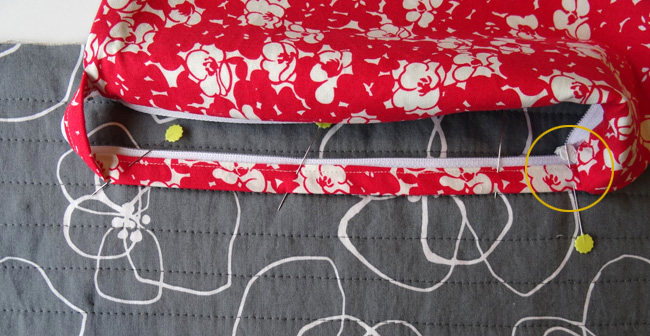
- Unpin the pocket outer and flip it up to access the bias tape. Pin it in place at the far right side (pin is circled), being careful to keep the bias tape straight. I used my quilting lines as a guide.
- Fold the Front over so the pocket bias tape lays flat more easily and pin the opposite end in place.
- Stitch the bias tape along the top edge, next to the previous line of stitching. Folding the Front of the Cargo Duffle as you sew so the bias tape and pocket lay flat while you are stitching.
- Re-align and pin the pocket in place. Stitch the short sides of the pocket up from the bottom to about 1″ under the zipper. I stitched across and back down as well to secure the pocket better.
And you’re finished! Stitch on the Exterior Bottom Accent and continue with the original Cargo Duffle instructions to finish your amazing bag.
by Sherri Sylvester | Jan 12, 2015
This is one of those projects – the ones you envision during a spark of inspired genius towards the end of the summer and say (to no one in particular) … “Hey, do you know what would be awesome? I should make 4 Cargo Duffles for my family for Christmas!” Then you email them right away and ask for their favorite fabrics, but it takes you until October to order the fabric, of course. After it arrives and is pre-washed (just in case), everything sits through sewn Halloween costumes, your oldest’s birthday party, your wedding anniversary weekend away, Christmas shopping… until finally – on the 12th of December – you finally realize that you are going to have to start!
I’m sure you have had this happen to you before?! Thankfully I finished them up in time to mail out on December 23rd. A little late – but finished. And my family loves them and they have already been put to good use. So now I can share them with you! (I got most of these fabrics from my sponsor Fabric Spark, a linked list of fabrics is located at the bottom of this post. The others were from my stash or from Warp & Weft, which has recently closed.)
These bags were so much simpler to make this time around! I still love my first Cargo Duffle – in fact it is one of my most favorite projects. As usual, making something the second (or 5th time around) you know what you are doing already. I got to use my zipper tutorial again – the one that explains how to change a double zipper so the sliders meet in the centre, instead of finishing at the ends. I had forgotten how simple it was to do!
To make my life a little easier, I substituted a large zippered pocket instead of the pattern’s two cargo pockets (tutorial coming soon). It is my own design and all of the edges are finished inside. The zipper creates a fully closed pocket – so I feel more confident filling it! I also used strapping instead of sewing the handles – which made me a little sad, since the handles look amazing sewn – but speed and time was of the essence!
I’ve also been asked to post the measurements for the Cargo Duffle Backpacks I made in 2013, so that will be coming soon as well. They use the same construction as the duffle bag, but with different measurements. The girls still use them a lot and the Ann Kelle fabric is just so cute! I recently made new serged-edge Beach Robes for the girls using the Ann Kelle Girlfriends mermaid fabric – perfect! You can see them here on Instagram.
I hope you are having a great start to your week and I’ll see you again soon!
Fabrics: (top to bottom, see photo below)
- Parson Gray – Empire Felucca, Indelible -Spirodraft, Kona Cotton (likely Charcoal)
- Lotta Jansdotter – Blomster (out of stock, similar here), Kona Cotton (stashed mystery colour), Essex Yarn-Dyed Linen/Cotton – Black
- Ghastly Forest – Mist, Essex Yarn-Dyed Linen/Cotton -Flax, Stashed Black Denim
- Tula Pink – Foxtrot Shade, Tula Pink – Moonshine Swarm Fern, Stashed Black Denim
- Bias Tape: Parson Gray – Empire Fishnet, Ghastly Bramble – Tea Stain, Stashed Red
by Sherri Sylvester | Sep 17, 2014
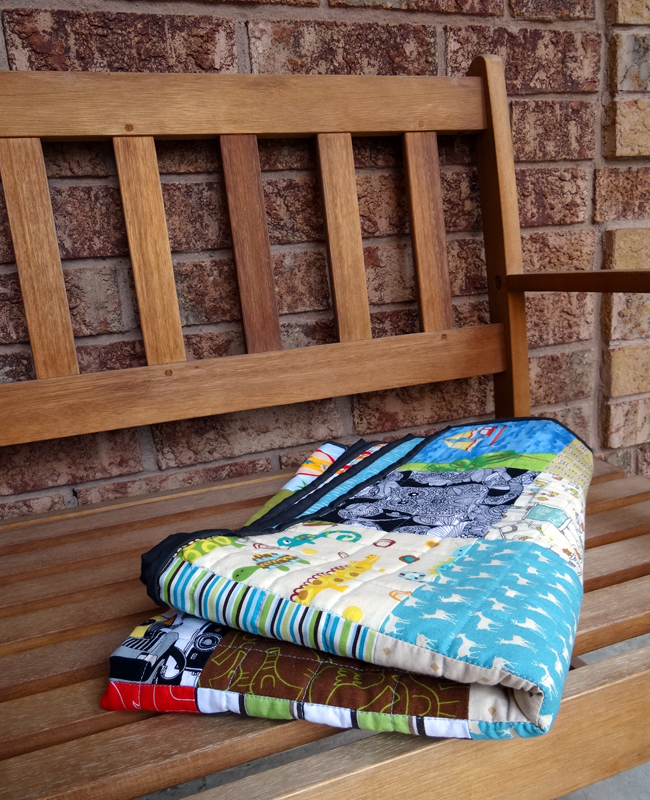
Friends of mine had a baby boy a few weeks ago and I found a great “need” to make him a little quilt. Seems that since I have found this new skill of mine I am anxious to spend lots of time quilting, though the faster projects seem to win out. I think I’m going to have to get good at writing progress posts, instead of only posting finished projects!
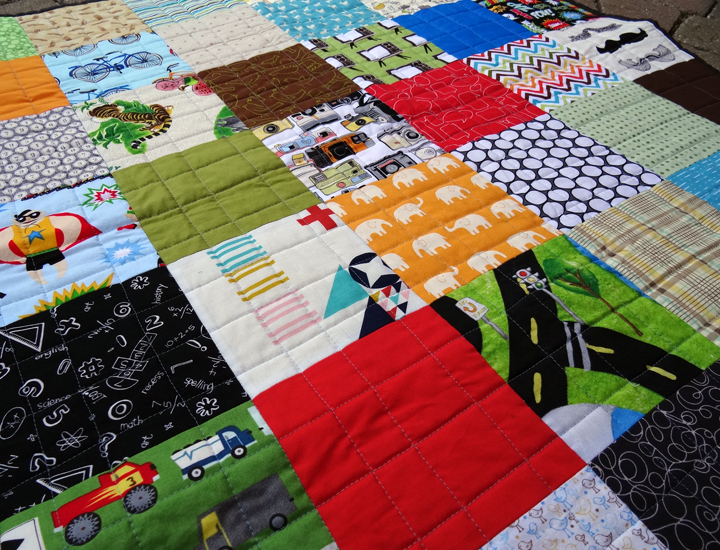
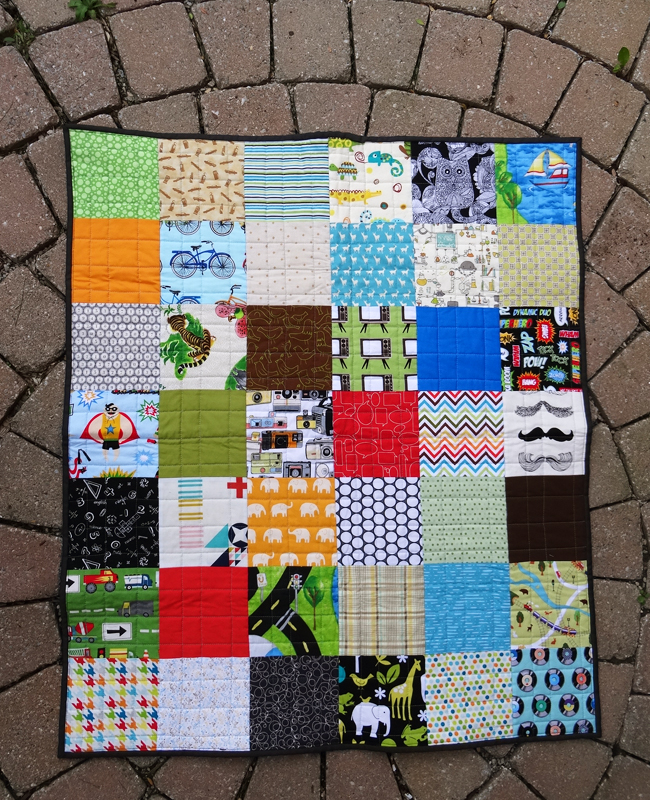
I also have a great desire to rid myself of my overflowing scrap bin – so, I landed on making an I Spy quilt with over-sized squares. It was really a lot of fun going through my stash and scraps to find the 6″ squares with the most fun boyish prints and kid-friendly designs. I even finally found a good place to use a small piece of my mustache fabric!
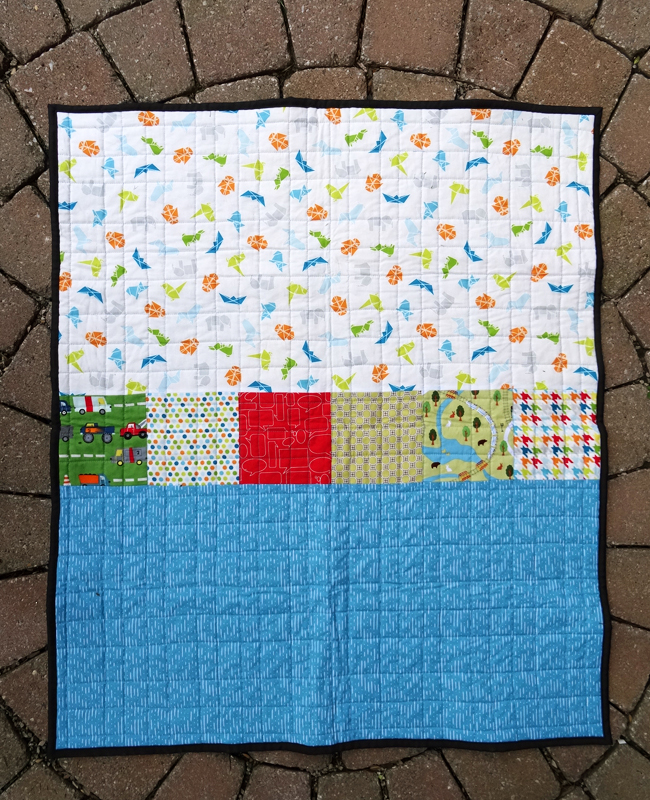
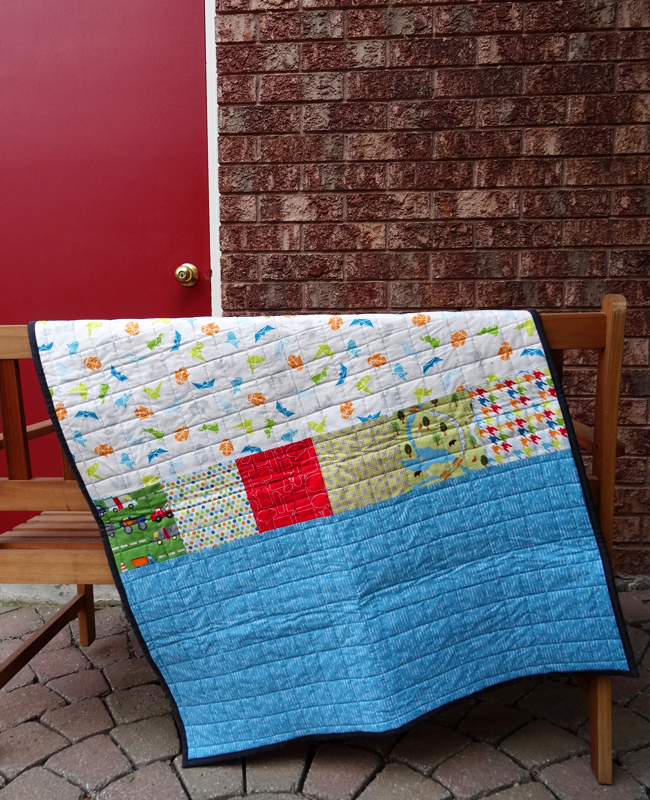
The whole thing was inspired by some multi-coloured Origami Sprouts yardage I recently ordered from Double Decker Fabrics and this quilt from Blueberry Patch. The Mixed Bag collection by Studio M for Moda is perfect for kids and works really well in a little boy’s project. I had 1/2 metre, so I used it for the top of the pieced backing. Thankfully I’ve got a little scrap left to stash for another project, it’s so cute! I also had the blue stripey fabric (some Dear Stella from a stashing trip last year). The pieced squares on the back made the other two larger pieces just long enough to fit the length of the quilt.
As I talked about quilts being slow earlier, that’s actually not the case with this one – even though it did take me a month from start to finish. I know this because of the internet (as usual) since I Insta-documented the beginning on August 15th. Sewing the little squares together and piecing the back doesn’t take long, especially on such a small quilt. Even the wonky “graph paper” straight line quilting (does that have a real name?) only took me a few hours. I likely could have finished the whole thing in 6-8 hours had I been able to find one sewing session that long!
I have to admit, that while I was arranging and piecing the front of the quilt I was a bit skeptical and didn’t figure I would like it. Even after straight line quilting it parallel to the long edge it still looked random to me. It was only after I quilted it in the other direction that I started to like it. I think the last lines of quilting brought the whole thing together. I have learned through this process that I like modern “random” quilts (like the amazing ones Cynthia Frenette makes). But I don’t as much like so many random prints and colours pieced together in such large blocks, because they don’t have any semblance of continuity. Even the colourful “scrappy” vibe is hard to find.
Thankfully, with the quilting in place this one has grown on me and I think it will be fun for the baby to lie on and look at – goodness, it’s got enough going on to keep his attention for at least a little while! Anyhow, if the parents hate the busy side, it’s got a lovely toned-down backing that could be used as the front instead.
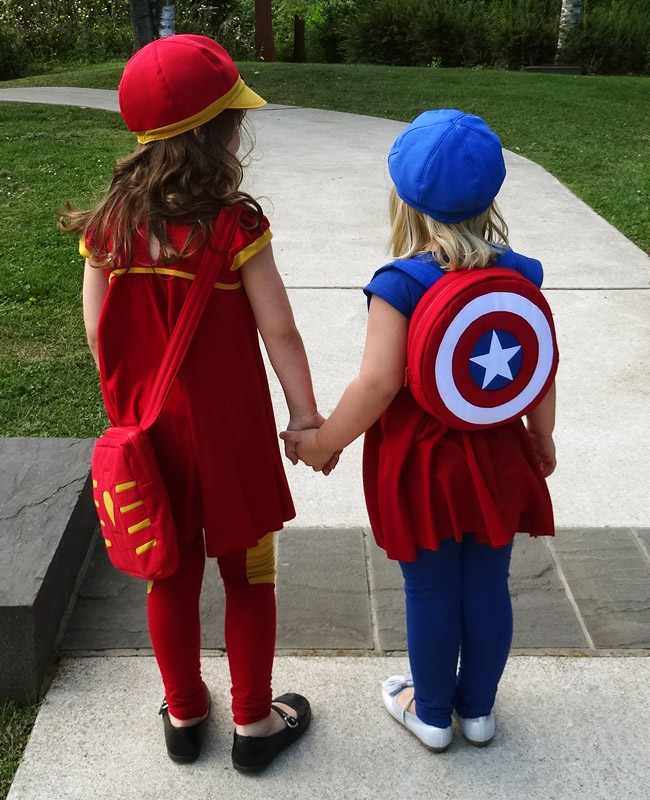
In other news, some BIG happenings I have neglected to let you know about for tooo long… The results of the Crafting Con Avengers month competition were posted earlier this month and I get to be the proud first place winner! I was so excited when I heard the news and I get to find myself some new patterns from PeekABoo Pattern Shop and something from Fabricworm! Hooray! The kids are still carrying around those bags and there might be a plan to make the little round one into a proper sale-able pattern. (yippee…!) You can see my post about the competition here.
Reader Feedback: What is your favorite new baby sewing project?
*This is not a sponsored post, though this blog is proud to say that Double Decker Fabric is a current sponsor. I wanted to share where I got the fabric from so you could find it if you need some. And… an unrelated note to self, iron the quilt before photographing it next time!
by Sherri Sylvester | Sep 4, 2014
Wow! I have severely overestimated my ability to get things done and get two kids started in school. Especially since my body decided to let me catch a cold earlier this week! This past few days has been a rush of emotion and busyness, all while trying to get a few things ready for some really fun events coming up soon. More on that another day, suffice to say – I’m just happy to have “finally” posted something new since last week!
At the risk of using almost the same title twice in a row, I have made another mini quilt. (First one here.) This one is made from a little bundle of pre-cuts I received from Daryl at Fabric Spark. These photos were taken at the end of June, believe it or not. I’m feeling a bit behind in letting you know what’s going on around here! Either way, I am so happy with this little quilt. It has lived in our car for the entire (thankfully cool) summer and been loved a lot. We even have to keep track of who’s turn it is to use the “blanket mommy made”! You can tell we don’t have many of those yet!
(P.S. Fabric Spark is running their Mystery Fat Quarter event again – on now until September 14th! Buy the equivalent of one yard of fabric or more and use the code “FQfun” to receive a coordinating “Mystery” fat quarter absolutely free! Click here to visit Fabric Spark and see her great selection. I think you’ll have trouble stopping at 1 yard!)
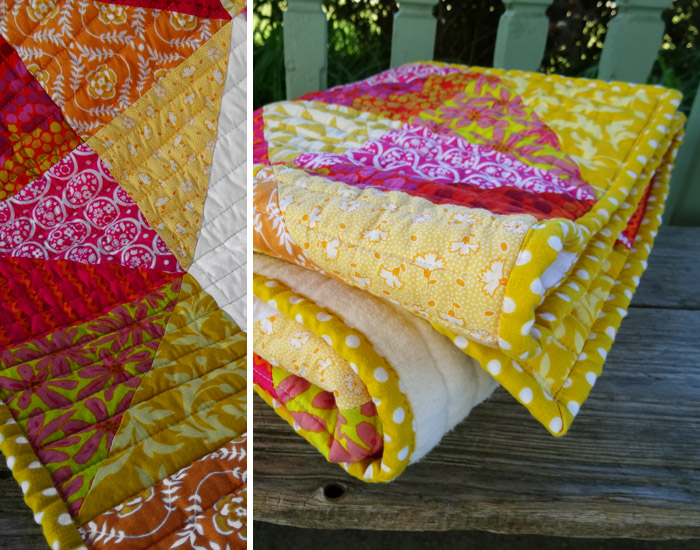
When I got the pre-cut bundle, little did anyone know it would hold the most perfect number of colours and white squares possible! It almost exactly matched the requirements for the Big Love Quilt by Modern Handcraft for Dear Stella. The only thing it lacked was size, so I made it using a 5.5″ square instead of a 10″ square. So I guess instead of a Big Love quilt, I made a Little Love quilt. (hee hee!) I would love to try this again with another set of fabrics. I’ve got at least 4 bundles stashed that are waiting for quilts and I’ve begun cutting a 5th for something else.
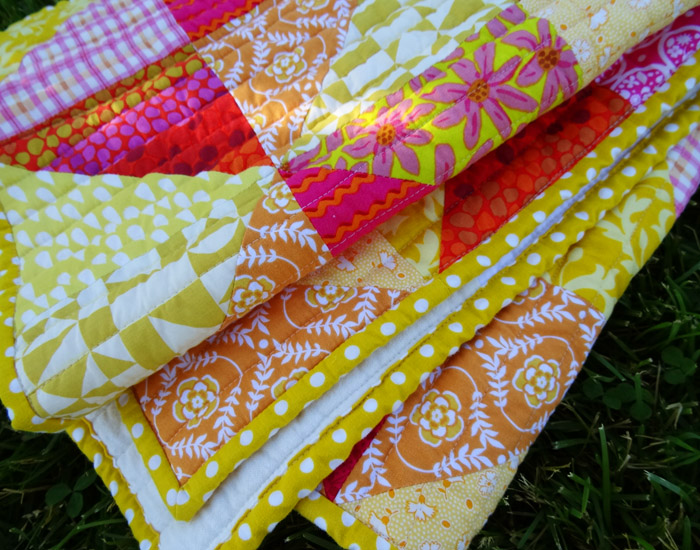
This quilt is made from half square triangles (HST’s), with a few full white squares in the centre of the heart. It was extremely fast to sew up, even for a beginner quilter like me, and I love the results. Actually, I have several heart-related things pinned to my “Quilts I Might Make” Pinterest board, maybe it’s time to do a little round-up? I love that a quilt is an art-piece that you create to keep someone warm and let them know that you love them – so the heart theme is quite appropriate!
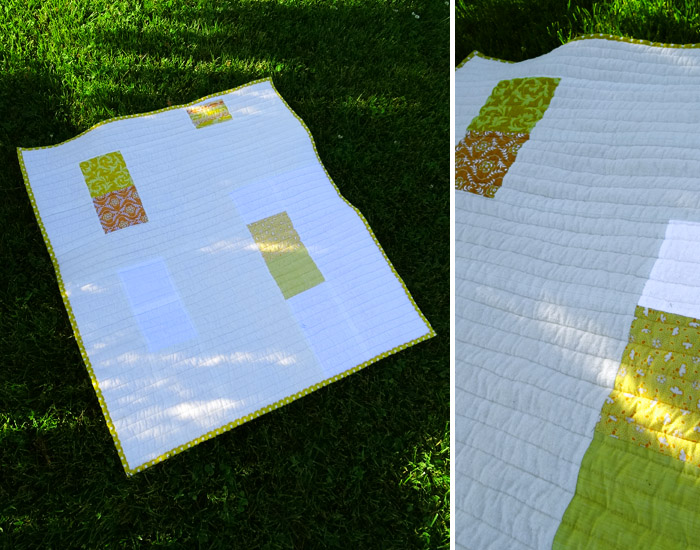
I am absolutely in love with the back of this quilt as well. It was nerve-wracking and fun to sort out how to stitch these pieces together so they came out in the positions I wanted them to, but it turned out great I think! I am quite happy with the low-volume modern-ness that it made itself into. And it’s amazing how clean it has stayed, even in the back seat of our car! (Though there was that one incident with the chocolate milk… but thankfully it came out in the wash!)
It is straight-ish line quilted and I used a double layer of fleece blanket for the batting. That amount of fleece would be perfect for a baby play-mat, nice and squishy! Unfortunately, squishy doesn’t really drape over your lap, but it is cozy, and the kids don’t notice things like drape anyhow! The most perfectly coloured binding is the same vintage yellow dot fabric I used to make my youngest’s Easter dress this spring. I love how it picks up on the yellows in the quilt. It’s machine sewn, since I haven’t had the compulsion to hand-stitch a binding on as yet!
Well, I’d better go now, I’ve got lots of things on the list to do tonight! Amazing how time flies by. First up… clean the house! (Today’s Trivia Question: How many times can you use the word love in a post? A: 11!)