by Sherri Sylvester | Jun 30, 2015
Hello again! I just realized I’ve taken an unintentional week off. My parents are visiting with us for a few weeks and we are so excited to have them. As a result, though, I haven’t been as eager to get on the computer! I do have a super summery project tutorial coming up later this week, and today I’m posting a bit about our vacation.
Before all that I realized that I have not as yet posted the winners of the last two giveaways. Shame on me… here they are:
Seam Allowance Fabrics gave away a $30 Shop Credit to Kathy D. I hope you are enjoying it Kathy! {interview here}
Fabric Please! gave away a Thread Riding Hood Blogger Bundle to Pam P. Amazingly, we sent Pam her congratulatory email on her actual birthday! What are the odds?! {interview here} You can purchase your own Blogger Bundle from Fabric Please! and you can still get 15% off your purchases with the code THREAD15 until July 1, 2015!
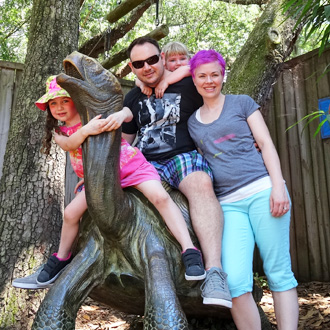
We recently got back from Florida after a much needed 10 days away from our home. I find that since we are all in our home all the time – save business meetings and school – that we go a bit home-crazy every once in a while. We were so fortunate to get away, even if we did work a bit while we were there.
I love that owning our own businesses allows my husband and I work from anywhere in the world – as long as we have wifi! A chance of scenery is so good for us and we come home ready to work again.
On the last leg of the 19 hour drive home, I realized that I was surrounded by handmade. Literally! I packed in it, my kids and I were dressed in it and we stored the stuff in our bags in it too! When we got home I tried to photograph every handmade item as we unpacked. I was curious and wanted to know how much we really had with us and what we used everything for.
Since also love roundups of “things on white backgrounds” – here are the photographs. (Linked to their respective blog posts if applicable of course!) These are some of our most-used handmade items, since only the most useful things are deemed good enough to come on vacation with us! It is also fun to go through some of these older posts, the kids are so little, especially the pink and yellow Tennis Skort post below!
by Sherri Sylvester | Jun 22, 2015

I love when a long, planned project is finally finished. These Diamond String quilt-as-you-go pillows have been on my to-do list for so long now. Amazingly, two great reasons came at the same time so I could justify making a new project!
First, I wanted to use my Fabric Please! blogger bundle to make something, because I love the colours together! Second, PillowCubes contacted me to see if I wanted to review their pillow inserts. (P.S. Enter for a chance to win the blogger bundle until June 23, 2015.)
So…. Pillow fabric + Pillow Insert = Obvious obligation (*wink*) to make the tutorial you’ve been dying to try!
I’ve got a mini tutorial later on with the measurements for making your own 12″ x 16″ Diamond String pillow, but first a word about PillowCubes. When I first looked at their site I wasn’t sure what to expect. A pillow insert is a pillow insert, is a pillow insert, right? For my sample, I checked the list and ordered an Eco-Friendly 12×16 insert. May as well save the environment as much as possible!
When my sample arrived in a Flat Rate envelope I was amazed it would fit in there – turns out they are vacuum sealed to save space. Once opened, the pillow puffs up to its normal size. I love that the pillow is:
- made of good quality unbleached cotton (Less chemicals)
- stitched and edge-finished on 3 edges, the 4th is folded
- and the filling is distributed evenly and out to the corners
- the recycled filler is soft, and fluffy, just like it should be!
All in all I’m really pleased with the insert and I’m especially happy that it is Eco-Friendly. Though, they do have Polyester Fill, 3 types of Down Fill and Synthetic Down, if you’d like more options.
I also really like that you can save quite a bit of money ordering by the “cube” – a box of pillow inserts! If you don’t think you’ll use that many inserts, share with a couple of friends. Or get a box and use your stash to gift throw pillows to everyone this year. (Get a discount below!)
PillowCubes are American Made and ship from the US, they also ship to Canada and Internationally. My order (to Canada) arrived in only 9 days!
Use the discount code: ThreadRidingHood10 to get 10% off your first PillowCubes order. This code never expires! Use the discount code to purchase a sample pillow, a pillow cube or a custom order!
I always dread sorting out the math in my quilty projects, so I thought I’d write out the measurements I used below in case you want to make one too. It perfectly fits a 12″x16″ PillowCube insert!
- Cut 4 pieces of low loft batting as your foundation pieces – 7 1/4″ x 9 1/4″ (these are purposely oversized)
- Create your quilt-as-you-go Diamond String blocks. This tutorial was really helpful, use the batting as your foundation instead of muslin.
- Trim the blocks to 6 3/4″ x 8 3/4″ and stitch them together with a 1/4″ seam.
- Cut 2 backing pieces – 13″ x 13″ – for the envelope back. Hem the inside edge of each piece.
- Layer the pillow front with the envelope backs aligned to each side (hems in the centre). Baste the layers together.
- Bind the edge using your favorite machine/hand stitched binding method. You will need about 70″ of 2 1/2″ wide binding.
Now, just add your PillowCubes insert! Here is the easiest way to place your pillow form into the cover:
Reader Feedback: What is your favorite pillow cover tutorial?
Thanks for reading. Follow along and join me for “thread ride”!
Disclaimer: This post is sponsored by PillowCubes. I recieved a sample product and compensation for this post. I promise I will always write my own opinion and never review anything I don’t love myself. View our privacy policy.
by Sherri Sylvester | Jun 2, 2015
June is a good month! We are leaving to go on vacation tomorrow, school will be out at the end of the month – and it’s my month to pick the bundle for my sponsor Fabric Spark’s fabric subscription program!
This subscription features a bundle of 12 fat quarters from Maureen Cracknell, Very Shannon, Fresh Lemons, Blue Elephant Stitches, Modern Sewciety + The Tattooed Quilter, and me! It was finally my month pick a bundle, and so mid-May I visited Daryl from Fabric Spark and spend a couple of hours choosing my bundle. Not an easy task with such an amazing collection! In the end this fun bundle (loaded with my favorites and lots of Cotton + Steel!) was born and I decided to make a quilt with the bundle she gave me.
If you follow the blog you know I’m not a quilter – but I was determined to make something with all of these fat quarters in it. Because I put them together, so they must remain together! I sorted them by colour (there are 3 of each) and started with a “Trip around the World” in mind. Here’s where I went wrong….
- The groups of colours were not all the same value – ie. 2 dark navy and 1 lighter – they didn’t produce the nice even diamond shape I was aiming for.
- The bicycle fabric ended up all on one side because I made another newbie mistake – I wanted all of the fabrics “right side up”. This meant I needed to make each block with the diagonal lines going in the correct direction, and I couldn’t change them later based on how everything looked.
- The backing is going to be a (most gorgeous ever) border print, but the quilt is a bit larger – so I need to add to it. And since the quilting was going to be in straight lines, I have no idea how to pull off making the quilt top and backing line up so the lines are not crooked on the back.
- I have a navy backing and multi colourful front fabrics – which colour do I quilt in without ruining one or the other by having the thread show up “too much”?
Thankfully my friend Lisa (from Lisa in Port Hope) was over for our Sewcial and gave me a few tips that I think will help.
- Unless a quilt is hanging for a show, you don’t have to have everything to be right side up. You can lie under it whichever way you’d like, so aim for the fabrics to be right-side-up from the centre out.
- If I had not made everything right-side-up I could have moved the blocks around so the fabrics were spread out more evenly.
- Quilt on the diagonal to avoid having straight lines that are not parallel to any lines on the back.
I am not certain that I have solved the quilting thread colour issue. It was suggested that I use gray, but I don’t know that I want it to show up that much? Any suggestions?
Don’t get me wrong – I am not in any way sad or disillusioned about the quilt. I really LOVE the fabrics. It’s the picky details that are bugging me and I could have made it so much simpler by following the second list of “rules” above! (“Wasting” time gets on my nerves!)
I’m taking my machine and quilt(s) with me on vacation, hoping for a bit of down time during our 10 days off. If all goes well I’ll sort everything out and come back with a finished quilt! That would be fun!
Disclaimer: Fabric Spark is a sponsor of this blog. I was given this fat quarter bundle in return for this blog post. As always, my opinion is my own – thanks for reading!
by Sherri Sylvester | Mar 30, 2015
Winter is slowly leaving outside, but at least some Spring colour has come to my couch, disguised as a new throw pillow! This modern scrappy pillow tutorial can make a bright spot in your home too. And it’s made with a charm pack, so most of the cutting is done for you – just grab your favorite print for the back! (Scroll down for your chance to win this charm pack!)
If you’ve been reading here lately you’ll know about my recent obsession with shot cotton and yarn-dyed fabrics. So when my sponsor Fabric Spark suggested making a tutorial with one I didn’t hesitate to say yes! This charm pack contains 15 different light Kaffe Fassett solids, 30 charms in total – just enough for an 18″ throw pillow with a few left over! The different warp and weft colours add an extra layer of amazing colour when woven together.
If you live in the Toronto area, Fabric Spark will have the fabrics needed to make this pillow at the Spring Creativ Festival. I’m already planning for it and I’ve got a few more surprises up my sleeve! (By the way… Get the name of the pillow? Spring Charming, like Prince Charming? Ha, *groan* I know!)
This pillow really is simple to make, it doesn’t even have any matching seams. And it matches every colour scheme! This random-look layout lends personality and warmth, its colours are surprisingly structured and I’ll explain that in the tutorial! When working with any layout, though, it’s hard to know how things will turn out. I originally made this in rows and then loved it more in columns – so I turned it sideways before adding the envelope back.
—
Fabric Spark is giving away a Kaffe Fassett Woven Cotton Charm Pack in Light! This giveaway is open internationally and will run from March 30 – April 6, 2015. Use the Rafflecopter widget below to enter – and if you don’t have Facebook to sign in with, just use your name and email address. There’s a “click to enter” no social media login entry too!
a Rafflecopter giveaway
As usual, please feel free to use my patterns/tutorials for your personal projects and gifts and for charitable fundraising events. Please do not sell anything made with this pattern. If you are interested in making them for sale, please contact me and I will set up a license for it in the shop. Thank you!
Seam allowance 1/4″ unless otherwise noted.
You will need:
- 1 Kaffe Fassett Woven Cotton Charm Pack in Light
- 1/2 yard quilting cotton for envelope back ( I used Starcomb Silver from Parson Gray’s Curious Nature collection)
- 19″x19″ low loft batting
- 19″x19″ backing/muslin for quilted front (this will not be seen)
- matching thread for piecing
- matching thread for quilting
- 18″ pillow form
- square ruler, rotary cutter/scissors, pins/basting spray, removable fabric marker
- Optional: Walking Foot to use when quilting (if desired)
Sewing with a Charm Pack:
When I first approached a charm pack I was not sure how to properly sew with it because of the pinked (zig-zag cut) edges. Here are a few tips I’ve found along the way.
- This charm pack is cut to 5″ square. It has been cut so the outer point of each triangular cut marks the edge of the square. Measured from side to side between outer triangular points it will measure 5″. Cut and sew with that in mind.
- I also found that, for this pattern, it is easier to match and stitch edges that have been cut similarly. Match rotary cut edges and sew OR match pinked edges and sew. This may not be possible with all charm packs due to directional or one-sided fabric.
Cut your Fabric:
- Envelope Back: Cut 2 pieces 14″ high by 18″ wide.
- Charm Pack:
- Stack at least 24 of your charm squares in sets of 4. Use at least 1 of each colour. The colour placement will be “random”, so don’t worry about that for now.
- Cut a straight 90 degree line through each stack of 4 wherever you’d like. Use a ruler to make sure the cuts are square. Make sure to cut at least 1″ away from the left and right sides of the square. If you’d like similarly sized pieces, cut the squares closer to the centre. If you’d like a more scrappy varied layout, cut the blocks closer to the sides to get a variety of skinny and wide pieces in each colour.
Design on your Layout:
At first this part scared me because I wanted it to look a bit random, which I’m not good at! I found that arranging them by colour grouping helped me to have a bit of structure. If you look at my rows, you will see small groupings of green, blue, lavender/pink and orange pieces together. There is one grouping of each of these colours on each row, but the placement is varied from left to right.
- More Structured Option: Lay out 12 pieces side-by-side (matching edges) in a row that is about 24″ long. Lay out 3 more rows below it in the same way. Once you sew them together each should equal 18 1/2″ or more. (My rows were about 28″ long each before stitching & came to 24″ wide after stitching.)
- Random Option: As a quicker alternate option, stitch rows together at random (see sewing instructions below). You will need 4 rows aprox. 19″ long each.
Stitch your rows:
- Match the sides of each piece Right Sides Together (RST) and stitch with a 1/4″ seam until each row is finished. TIP: I like to place a pin on the left-most side of each row to help me remember which piece I’m working on.
- Press seam allowances open or to one side.
- Trim the top and bottom edges of each row if necessary to square them up. (I skipped this step, since my rows were fairly even.) TRIM SPARINGLY! If you cut more than 1/8″ from each long edge your rows will not be tall enough to create an 18″ pillow.
- Pin the rows together RST along each long edge and stitch one at a time.
- Press your seam allowances open or to one edge as you go.
Quilt:
- Press the pieced fabric well, making sure all seam allowances are properly pressed so it is as flat as possible.
- Trim the front to 19″ wide. Do not trim the height, it should be about 18 1/2″.
- Create a quilt sandwich. Place your muslin/19″ square backing Right Side Down. Centre the batting on top of it. Centre the pieced fabric Right Side Up on top of the batting.
- Baste the quilt sandwich layers together. Since this is a small project, I used long pins. You could also use curved safety pins or basting spray.
- Mark quilting lines, if desired. I made a centre line with my hera marker and then used the edge of my walking foot as a guide to stitch every 1/2″ from there.
- Quilt! It took me about 20 minutes to stitch straight lines 1/2″ apart with a slightly-longer-than-usual straight stitch.
Envelope Backing:
This is where I took a look at my quilted front and decided I liked the “rows” as columns, so I turned it before adding the backing. Decide which side is the “top” of your throw pillow before adding the backing so it is the correct way up!
- Trim your quilted front to 18″ square. If your quilting is not near the edges, baste them together with a 1/4″ seam.
- Find your envelope back pieces. Decide which piece will be the top & bottom of the envelope back.
- Hem the top of the envelope back: press the 18″ wide BOTTOM edge up 1/2″, then again by 1″. Stitch close to the first fold to hold the hem in place. Hem the bottom of the envelope back: press and stitch the 18″ wide TOP edge in the same way.
- Lay the 18″ quilted pillow front Right Side Up. Align the TOP envelope back to the top edge of the front, RST.
- Align the BOTTOM envelope back to the bottom edges of the pillow front, RST with the quilted front.
- Pin all edges securely. Stitch with a 3/8″ seam allowance. Trim the corners and finish the edges with a serger or zig-zag stitch.
- Turn your throw pillow right side out. Push out the corners and press the edges flat.
- Insert your pillow form and you are done. Check out your amazing pillow!
I’d love to see your project! You can share your pillow on Facebook, Twitter or Instagram (links below) using the hashtags #alongforthreadride or #threadridinghood. Thank you!
Disclaimer: The fabric used in this post was given to me by my sponsor, Fabric Spark. I always share my honest opinion about sponsored products. Thanks for reading!
by Sherri Sylvester | Mar 9, 2015
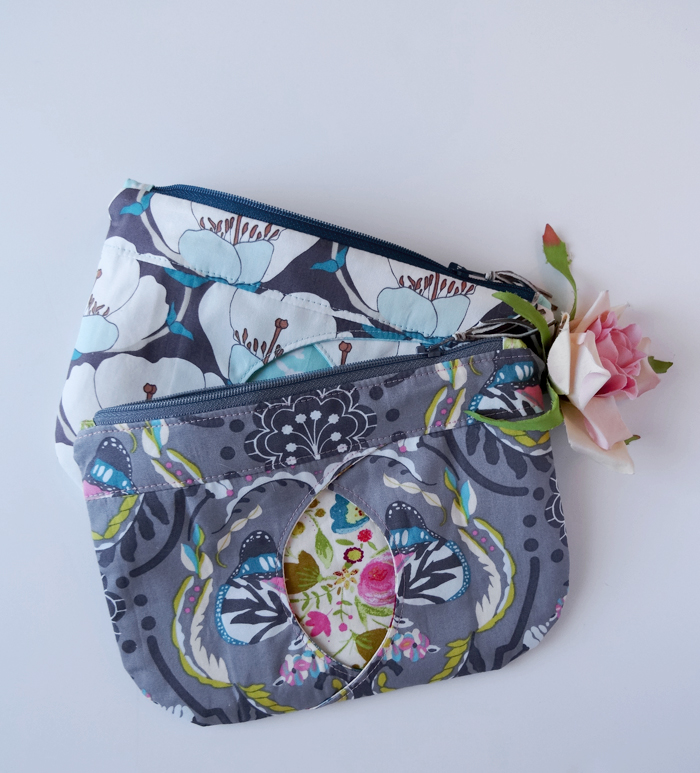
I’m excited to finally share a pouch pattern and tutorial with you! I figure all good sewing blogs generally have a free pouch tutorial and here’s mine. It’s high time after 2 1/2 years! My sponsor Double Decker Fabric supplied the fabrics for this project. Aren’t they gorgeous?! They are listed below if you’d like to get some with the discount she’s graciously offering as well. (Find it below!)
This pouch has been in my “ideas” envelope for a good long time now. The front curves form a unique area that frames your favorite fussy-cut fabric. There are so many possiblities for it! My husband says the shape looks like a Cat’s Eye – and that’s how it got its name.
The finished pouch is 8″ wide and 5 1/2″ deep. Perfect for those miscellaneous things you need to carry around. Pretty things like nail polish, jewellery and makeup, or useful things for jotting down ideas on-the-go! It would be a unique entry for one of those handmade #pouchswaps I see all the time on Instagram too. We’ve used ours already to hold markers and paper for the kids on a trip out for dinner.
* Update: Don’t feel like sewing a pouch yourself? Buy one from a licensed Cat-Eye Zippered Pouch seller! Check out the sellers list. Are you a shop owner? You can buy a Cat-Eye Zippered Pouch seller’s license as an instant download. *
I love the little leather tassel. It adds a bit of extra oomph to the design, I think! It’s easy, and you can add it to any zipper you like – not just this pouch. I’ve included a little trick for how to get the thick leather through the itty-bitty hole in the zipper pull at the bottom of the tutorial!
Head on over to Double Decker Fabric and use the code” march10″ to get 10% off your purchase (including sale items!) for the entire month of March. Discount expires Tuesday, March 31, 2015.
Double Decker Fabrics provided the following Art Gallery fabrics free of charge for use in this project. EMMY GRACE from Bari J: Painted Ladies Flutter, Budquette Dayspring, Knotty Rain (lining) WINGED by Bonnie Christine: Aves Chatter Shine, Nesting Blooms Cool, Wingspan Melon (lining)
——————————————————————————————————————
You can now purchase a 10 page instant PDF download of the Cat-Eye Zipper Pouch Pattern!
| Cat-Eye Zipper Pouch Pattern Sample Page |
This PDF includes:
- Granny’s Sewing Basket – notes and tips to make sewing this pouch easier! ()
- 7 tidy instruction pages with 41 high quality photos and 3 pattern pages
- Check boxes for each instruction & the materials listing, for those of you who love lists!
Aside from these great features, purchasing this PDF supports Thread Riding Hood. Thank you very much!
*NOTE: This link purchases the Cat-Eye Zippper Pouch PATTERN. If you are looking for the Seller’s License please find it in the shop.*
CAT-EYE ZIPPER POUCH PRINTABLE PDF PATTERN: available for any donation!
|
——————————————————————————————————————
HERE WE SEW!
As usual, please feel free to use my patterns/tutorials for your personal projects and gifts and for charitable fundraising events. Please do not sell anything made with this pattern. If you are interested in making them for sale, please contact me and I will set up a license for it in the shop. * Update: The Cat-Eye Zippered Pouch Seller’s License is now available!
Materials:
- 1 fat quarter outer fabric
- large scraps of fabric for pleat & lining
- 9″ zipper
- medium weight fusible interfacing
- scraps of 1/4″ ribbon or about 3″ x 1/2″ of leather for zipper pull (if desired)
- PATTERN PIECES: Free download, click here.
Printing the Pattern:
- Download the Pattern Pieces using the link in the Materials listing. Print out all 3 pages of the pdf on letter size (8.5″ x 11″) or A4 paper. Important: Do not select “fit to page” when printing, make sure you print at the original size. Once you have printed the pages, measure the 1″ test square to ensure the pattern is the correct size.
Prep:
- Trim and discard 3/8″ from the bottom of the Zipper Side INTERFACING (NOT the fabric!), to reduce bulk in the seam allowance. Fuse to each Zipper Side.
- Adhere 1 piece of Outer Back interfacing to wrong side of the Outer Back fabric. Set second interfacing piece aside.
Helpful Notes:
- If a more structured pouch is desired, you can add interfacing to the Front Inside Pleat, Lining and Outer Sides . Be sure to trim ALL SEAM ALLOWANCES (3/8″) off the interfacing before adhering. The added thickness makes it hard to stitch and the front does not lie flat where the layers come together.
- Note that you can top stitch both outer and lining together along the zipper side, but the top corners of the pouch will not lie as flat. I have made one pouch each way. I like only top-stitching the lining to the zipper tape best – it is cleaner and has nicer corners. This is what I have instructed in this tutorial.
- There is a 3/8″ seam allowance allowed throughout unless otherwise noted.
Here we sew!
Pouch Front:
- Place Front-Inside Pleat right side up. Match outer curve of both Outer Front Sides right sides together (RST) with the Pleat fabric. Stitch curves with a 3/8″ seam.
- Trim/clip seam allowance along the curve.
- Turn, press well & top stitch starting about 3/4″ from the ends of the curves. I like to leave a little bit of the Pleat fabric showing along the curve edge. It acts a bit like faux piping.
- Fold the Pleat fabric RST along the two marked lines. These were the side markings from the fussy-cut template.
- Lay the front sides and pleat over the Outer Back interfacing piece you set aside. With the Pleat folded, match the Outer Front Sides to the shape of the interfacing.
- Fuse interfacing as per manufacturer’s instructions. Press well.
- Cross the Pleat ends as desired (see photograph). Baste into place with a 1/4″ seam.
Finish Pouch Front/Back:
- Match bottom (un-interfaced) edge of a Zipper Side to the top edge of the Front Pleat & Sides RST. Match the edge of the second Zipper Side to the top edge of the Outer Back RST.
- Stitch with a 3/8″ seam. Press seam towards Zipper Side. Top stitch as shown.
- These pieces are now called BACK and FRONT.
Zipper Ends:
- Fold Zipper End in half. Top stitch the folded edge. Cut it in half to make 2 pieces that are 1″ square.
- Lay the zipper along the top of the Front or Back for easy measuring. Glue (use this trick!) or baste one Zipper End at each end of the zipper according to the length of the outer.
Install the Zipper:
- Fold the pouch pieces in half temporarily along the zipper edge. The Outer pieces should be RST. Match the Zipper Side edges and pin to prepare to sew the pouch sides.
- Unfold, refold and pin all edges so the Outers are RST and the Lining pieces are RST. The pins from the last step should hold the zipper teeth down on the lining side.
- Stitch the outer edges of the pouch with a 3/8″ seam, leaving a 4″ opening along the bottom of the lining. Take extra care and stitch slowly through the zipper tape and teeth. Once I am sure my stitching is straight I like to double-stitch over this area to make sure it is held securely.
- Clip or Trim the curved corners of the Outer and Lining with pinking shears. Grade or Trim the excess zipper length. Use Fray Check on the zipper tape if desired. Press the lining seam allowance up to prepare for turning.
- Turn the pouch inside out through the opening. Push out all corners/edges and press.
- Match the edges of the Lining opening. Stitch across close to the edge or slip-stitch by hand to close.
- Push the lining into the pouch.
Attach the Tassel:
- Cut a 3″ long piece of leather into 1/8″ strips, or gather two 3″ long pieces of 1/8″ ribbon.
- Thread an extra 6″ excess piece of ribbon or string through the hole in the zipper pull.
- Place the leather or ribbon strips through the loop in the excess ribbon.
- Gently tug and wiggle the leather/ribbon through the hole in the zipper pull using the excess ribbon.
- Remove the excess ribbon and thread the ends of the leather/ribbon through the loop on the right side of the pull. Tug the ends of the leather/ribbon until they are tight against the zipper pull.
Press the pouch again neatly and VOILA, You are finished, Enjoy!
I’d love to see your creations! You can share your projects on Twitter and Instagram @sherrisylvester with the hashtag #alongforthreadride or #threadridinghood, or post them on the Thread Riding Hood Facebook page.
Thanks for reading! Follow along to get more great tutorials and posts:
As usual, please feel free to use my patterns/tutorials for your personal projects and gifts and for charitable fundraising events. Please do not sell anything made with this pattern. Thanks!
Don’t feel like sewing a pouch yourself? Check out these Licensed Cat-Eye Zippered Pouch Sellers.
Are you a seller that would like to buy a Licence to Sew and Sell the Cat-Eye Zippered Pouch? You can buy a license in the shop and receive an instant pdf download!
Disclaimer: This post was sponsored by Double Decker Fabrics. They are also a Thread Riding Hood sponsor, I always share my honest opinion. Thanks for reading!
by Sherri Sylvester | Feb 9, 2015
Good Monday to you! About a month ago Stay Home Fabrics and I planned a tutorial for you, and little did I know that the shop would get a new owner before it got posted! So, today I get to introduce the new owner and give you a cute (and easy) quilted dish mat tutorial. Disclosure: The fabric I’m using was given to me by Stay Home Fabrics for the purpose of creating this tutorial. This is a sponsored post, and my opinions are always my own. Thanks for reading!
If you haven’t made a dish mat before, trust me, you need one! This dish mat is simple with a pieced quilted top and a bath towel as the absorbant backing. I have made tons of these and been using them for years now. It’s perfect for drying the “almost dry” dishes coming out of your dishwasher – and great when you are hand washing as well! Plus, it’s way more absorbent than a tea towel and you can customize it in the perfect fabric to match your kitchen.
When I was playing around with ideas for quilting this dish mat, I was inspired by the look of plates on a plate rack, or lined up on a wall. The Joel Dewberry, Antler fabric would make fabulous plates, don’t ya think?! That inspired the round-ish “plates” lined up in rows with solid sashing between. I made this dish mat extra large because I always have tons of plastics coming out of the dishwasher that need a little extra drying time. This will hold all of them! Hooray! (P.S. This would also make a super-cute table runner. Just piece a few end to end for the front and use batting and backing instead of the towel for the back!)
Before we get to the tutorial, I’d like to introduce the new owner of Stay Home Fabrics, Lisa Sali! And, before we get to her bio, I am 100% certain you want to know that they are offering FREE SHIPPING on all orders placed between Feb 9 and midnight on the 11th!
I am happy to say that Stay Home Fabrics is not moving far, Lisa is located only 10km away from where Lindsay (the previous owner) was living! Here’s a bit about Lisa…
My name is Lisa Sali and I am the proud new owner of Stay Home Fabrics. I am married and have 3 wonderful kids. Sewing has been around me my whole life. Now that my babies aren’t babies anymore I have realized that sewing is something I really enjoy doing; from seeing how different colours and prints go together, to finding the right pattern, all the way through to seeing the final result of a project.
When the opportunity to purchase Stay Home Fabrics arose my husband and I were very excited! As existing business owners we saw the importance of keeping the company located in Saskatchewan. It is also an opportunity for me to do something that I truly love to do while still being able to stay home with our children when they aren’t at school.
I am looking forward to getting to know customers new and old and continuing to provide high quality materials in great colours and patterns delivered right to your mailbox. As always if there is something you would like to see on the website please feel free to contact me and I will do my best to find exactly what you are looking for. Stay tuned to both the website and Facebook page as there will continue to be great promo codes and bundles available.
Now that you know more about Lisa, you can head over to the shop and get some fabric for your new quilted dish mat? (Maybe one of the 45 new Art Gallery prints they just stocked!)
Details:
- Final Size: 30″ x 21.5″
- Use 1/4″ seam allowance throughout, except for binding
- Press each seam right after sewing it.
- Press seams open or to one side.
- This tutorial assumes a bit of prior quilting knowledge, but, if you have a good 1/4″ seam you should be fine!
Materials:
- 1 Fat Quarter Quilting Cotton (or large scraps) Joel Dewberry, Birch Farm – Antler in Damask for 2 plates
- 1 Fat Quarter Quilting Cotton (or large scraps) Hexagon Fabric for 1 plate & 1 partial plate
- 1 Fat Quarter Quilting Cotton (or large scraps) Joel Dewberry, Prism in Egg Blue for 1 plate & 1 partial plate
- 1/2 metre/yard Quilting Cotton Joel Dewberry, Birch Farm – Horse Blanket in Burlap for 1 plate & binding
- 1/2 metre/yard Quilting Cotton Freespirit Solid for plate corners & sashing
- 1 regular size Bath Towel for the backing
- matching thread for piecing
- matching thread for quilting (bobbin to match towel)
** Pre-wash your fabric & towel if desired. I decided to wash the towel and fabric together because I know this dish mat will get a lot of washing! And I wasn’t sure how much the towel would shrink – don’t want to ruin all that hard work!
Cut the following pieces:
- A – 5 fussy cut squares for plates – 8 1/2″ square
- B – 2 fussy cut rectangles for partial plates – 5″ wide by 8 1/2″ tall
- C – 24 squares for plate block corners – 3″ square
- D – 1 horizontal sashing strip – 30″ wide by 2 1/2″ tall
- E – 2 horizontal sashing strips – 30″ wide by 2 1/4″ tall
- F – 2 vertical sashing strips – 1 3/4″ wide by 8 1/2″ tall
- G – 5 vertical sashing strips – 2″ wide by 8 1/2″ tall
- 3 strips for dish mat binding – 2.5″ tall by width of fabric (at least 40″)
- 1 towel rectangle – 33″ wide by 24″ tall (this is over-sized and will be cut down after quilting)
Here we go. First, let’s get the fussy parts out of the way so we can get to the exciting part!
- Binding: Piece the three binding pieces together end to end, using a 1/4″ seam allowance. You should have a piece of binding just a bit less than 120″ long. Fold in half, matching the long edges and press well. Set aside.
- Prep the small squares: Draw a pencil line diagonally from corner to corner on the wrong side of each of your small 3″ squares.
Piecing:
- Place a 3″ square in one corner of a large 8.5″ square, right sides together, as per the photo below. Stitch along your marked line. Trim off the corner of both squares leaving a 1/4″ seam allowance. Press open or to one side.
- Repeat 3 more times, once for each corner of the square. Press well.
- Repeat steps 1 and 2 for each of the 4 remaining 8 1/2″ squares. Square the blocks up slightly if necessary.
- Use the 4 remaining 3″ squares to make the 8.5″ x 5″ partial plates. Make sure the corners are stitched on the left or right sides based on where the partial plates will be in the final layout.
- Lay your pieced plates out on a large surface, as they will be in the dish mat. Place your vertical and horizontal sashing strips as indicated in the drawing/photo below. Refer to the cutting layout above and letter designations in the cutting list to make sure each piece is correctly placed.
- Piece the vertical sashing between each plate to make the rows.
- Now add the horizontal sashing to finish piecing the top.
- Press well. Square to 30″ wide by 21.5″ high if necessary.
Quilting:
- Centre on towel with wrong sides together. Pin baste to secure. Every 4″ or so worked for me. I should be using curved safety pins… but since I don’t have any, these will do!
- Quilt through all layers as desired. I stitched straight(-ish) lines every 1 1/2″ across the width of the top. Match top thread to top and bobbin to towel.
- Cut the excess towel to match the edges of the pieced top. Square up the quilted fabric and towel if necessary.
Binding:
- Bind as desired, or use these instructions to attach via machine binding.
And you’re finished. Go dry your dishes in style!