by Sherri Sylvester | Nov 29, 2016
Dear Diary, Week 2 of playing with the machine embroidery functions on the Janome Skyline S9 has been so fun! I’ve written a brand new beginner friendly tutorial for a simple lined Drawstring Backpack today. (Plus have one very happy girl who gets to use it!) This bag makes a quick gift and you don’t need an embroidery machine to sew one up.

This post is sponsored by Janome Canada.
Ever since Janome asked me to be one of their Artisans I’ve had the amazing chance to try out their Skyline series machines. I’d love so much to be able to let you try them too – but I’ll have to settle with telling you about them instead. Through today’s free Backpack tutorial I’ll be showing you the Skyline S9 – just released a few months ago! Here are a few exciting features I’ll be highlighting:
- Tapering – automatic settings to create unique designs with decorative stitching
- AcuSetter app – Amazing super-simple to use Apple app designed to allow for crazy-exact embroidery design placement. Check out the machine embroidery section of the tutorial for more details. (Trust me, I was grinning like crazy when I used it!)
The Sewing Diaries: Embroidery Edition started last week with an introduction to how machine embroidery works with videos and lots of photos.
On with the tutorial…
Why a Drawstring Backpack? My 4th grader needs a change of clothes for gym class and asked for a bag to put them in – the perfect project for some machine embroidery and embellishment! She chose the design and the colours. (Still enamoured with pink!) I would have loved to use another Anna Maria Horner butterfly design in blue, pink and teal…. but you don’t argue with the 9-year-old. I’ve learned that she loves things she designs. When I don’t ask and make the decisions, handmade items tend to sit around unused.
Drawstring Backpack Tutorial
This lined backpack is easy to make and wear. It lends itself to all kinds of fabrics and embellishments – machine embroidery, hand stitching or applique! Of course you could use that gorgeous fabric you’ve been saving and skip the extras too. Using only 1 yard of fabric in total, the finished size is about 17″ x 14″. The straps are fully adjustable to fit anyone from a child to an adult.
This tutorial will assume you are machine embroidering your backpack. You can also add your own embellishments, omiting the parts of the tutorial that you do not need.
As usual, please feel free to use my patterns/tutorials for your personal projects and gifts and for charitable fundraising events. Please do not sell anything sewn with this pattern. If you are interested in making this item for sale, please contact me and I will set up a license for it in the shop. Thank you!
Materials:
- 1/2 yard/metre outer fabric
- 1/2 yard/metre lining fabric (I used outdoor slicker fabric I had on hand)
- 160″ total (about 4 1/2 yards) 1/2″ ribbon, clothesline or double-fold bias tape
- Two 1″ grommets
- machine embroidery supplies such as stabilizer, appropriate needles, and thread
Prep and Cutting:
- If you will be washing this bag, prewash and press it before beginning to avoid shrinking the fabric later on.
- Cut the outer and lining. You will need one piece cut to 30″ wide by 18″ high.
- Prepare the straps by cutting your bias tape/ribbon or clothesline rope into two equal pieces 80″ long each.
- Mark the outer fabric as indicated below:
Buttonhole:
- Stitch a 3/4″ buttonhole in the area indicated on the diagram above. This will be where the straps feed through the casing.
Decorative Stitching (with the tapering feature!):
My girl loves frills and so I decided to add some stitching near the top to simulate frills and lace. Just to make it prettier!
- Choose your stitches. I wanted to play with the tapering feature on the S9. You can choose from any of the purple marked stitches on the machine and it will automatically taper the stitching for you using several angles. This would be great for the ends of collars or a tapered space like the angle on a sash.
- Mark a line on the bag outer that is parallel to the top of the bag – you will use this to keep your stitching straight. Add a line of stabilizer behind your stitching line. This will not show, so you can use any type you’d like.
- Set up your stitches. I chose an heirloom stitch with a 30 degree angle on each end to make the stitching look lacy and “ruffled”.
- Begin stitching and the S9 will automatically taper the beginning of the stitch. When you wish to start the ending taper, press the auto-lock button.
- The machine will memorize the stitched length and ask you if you’d like to repeat it. I used this repeat function to stitch to the other side of the bag.
- I added a few other stitches. It was really handy to attach and use the guide bar to keep everything straight.
- Here are the finished stitches, along with a few practice ones I made.
Machine Embroidery (using the AcuSetter app):
- Choose and set up the design you would like on the machine.
- Mark the center of your design on the fabric and hoop it. I did not center the hoop on purpose to show you the AcuSetter app. This app is free for Apple users – and Janome loaned me an iPad mini so I could use it. It’s absolutely amazing!
- “Recieve” the design from the machine – it will show up right on your screen!
- Take a photo of the hooped fabric within the app. Match up the small black lines using the magnifying circle in the center.
- The design from your sewing machine shows up on the photograph for reference. You can move things around and resize it if you want! I tilted the heart and lined it up the center markings I made earlier.
- Send the design back to the machine. It is automatically precicly placed exactly where you want it!
- Run the machine to embroider your design. This heart took about 19 minutes + threading time and has 7 different colours!
- Adding a Monogram exactly where you want is easy with the same steps. Program the monogram, hoop the fabric, receive the design, line it up and send the design back to the machine. Now, embroider it in the exact place you put it!
Sew the Backpack:
- Change the machine from Embroidery mode to Sewing mode. Press the toggle button on the LCD screen and close the embroidery arm.
- Match the top edge of the outer and lining with right sides together. Pin and stitch with a 1/4″ seam. Finish the raw edge if desired with serging, zig-zag stitch or pinking shears.
- Open flat and press the seam allowance towards the lining. I used low heat because the slicker fabric melts easily.
- Fold the lining and outer right sides together matching the sides and the seam you just sewed. The outer and lining sides will match up with themselves. Stitch with a 1/2″ seam and finish the raw edges if desired.
- Fold the lining into the outer with wrong sides together, creating a tube. Press and pin along the finished seamline and match the bottom raw edges.
- Edgestitch along the pinned edge about 1/8″ away from the fold. Also stitch along the pre-marked line (aprox. 1 1/4″ down from the top edge) to create the casing.
- The buttonholes should be centered from top to bottom within the casing.
- Turn the bag wrong side out and align all 4 raw edges. Flatten and pin the bag bottom with the back seam centered on the back of the bag. Stitch through all 4 layers with a 1/2″ seam. Trim to 1/4″ and finish the raw edges if desired.
- Turn the bag right side out again. Push out the bottom edge and the corners and press well. Mark 2″ out from each corner and connect the lines to create a triangle in each corner. Also mark a stitching line 1/2″ up from the bottom fold. Stitch on the marked lines to enclose the raw edge and create a sturdy corner for the grommets.
- Attach the grommets in the center of each stitched triangle as per the manufacturer’s directions.
- Insert one strap through the right buttonhole, around the entire casing and out the same buttonhole. Match the right side strap ends and bring them through the grommet from the back. Knot to hold in place.
- Insert the other strap through the left buttonhole, around the entire casing and out the same buttonhole. Match the left side strap ends and bring them through the grommet from the back. Knot to hold in place.
- Fray-check or finish strap ends if desired. They can be re-knotted at any length appropriate to the wearer. Remove all markings and press well.
Enjoy your new Drawstring Backpack!
——————————————————————-
I’d love to see your project! You can share your project on Facebook, Twitter or Instagram (links below) using the hashtags #alongforthreadride and/or #threadridinghood. Thank you!
by Sherri Sylvester | Oct 31, 2016
We’re big fans of the Disney movie Frozen over here.
Since we have two girls – so it’s hard to avoid! But, my husband and I are also impressed with the direction Disney has been taking in their movies lately.
Less “Princess + Boy = Happy Ending” and more “Princess/Girl + Bravery = Happy Ending”.
It’s a win-win for us and our kids. They get the princess story, and we get the more positive role model.
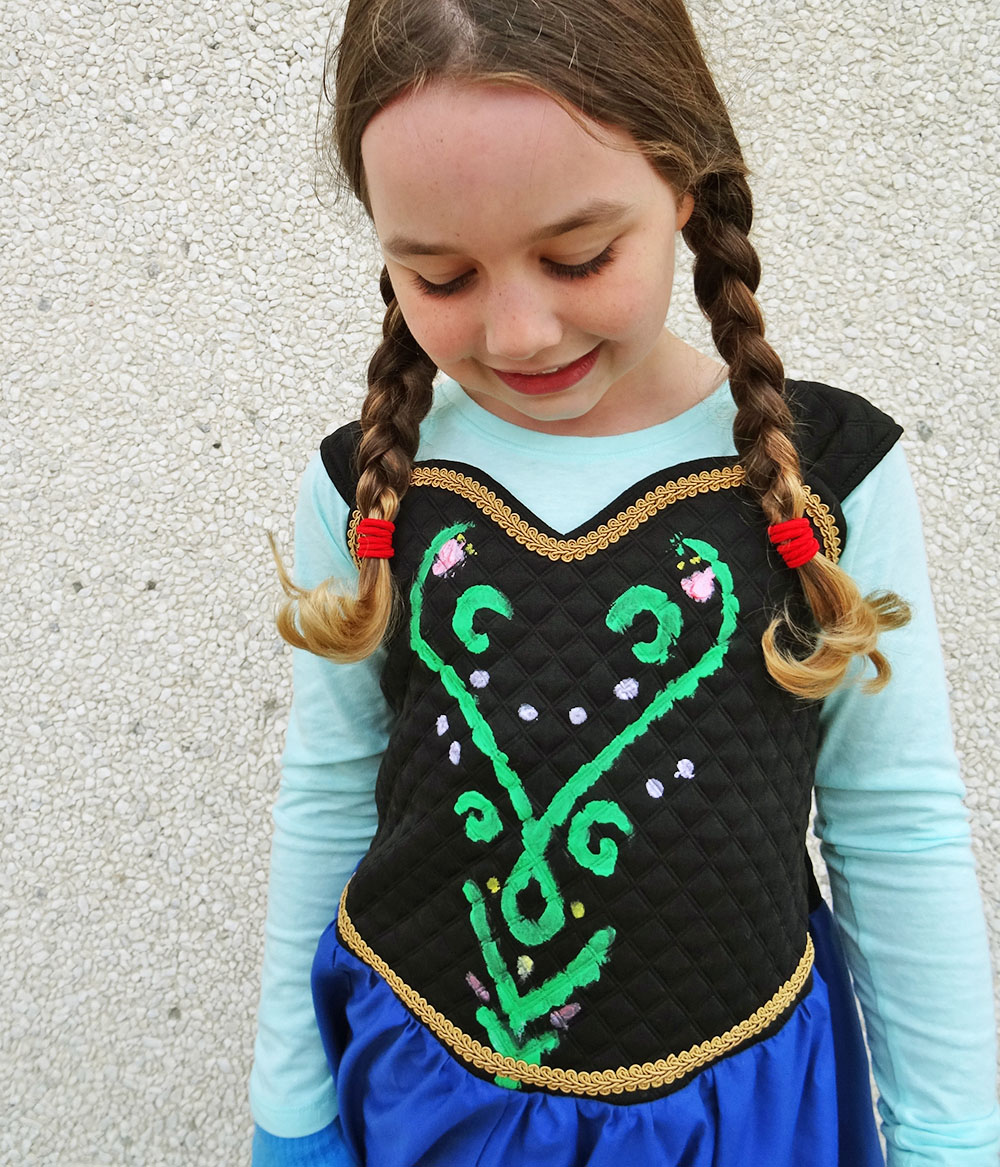
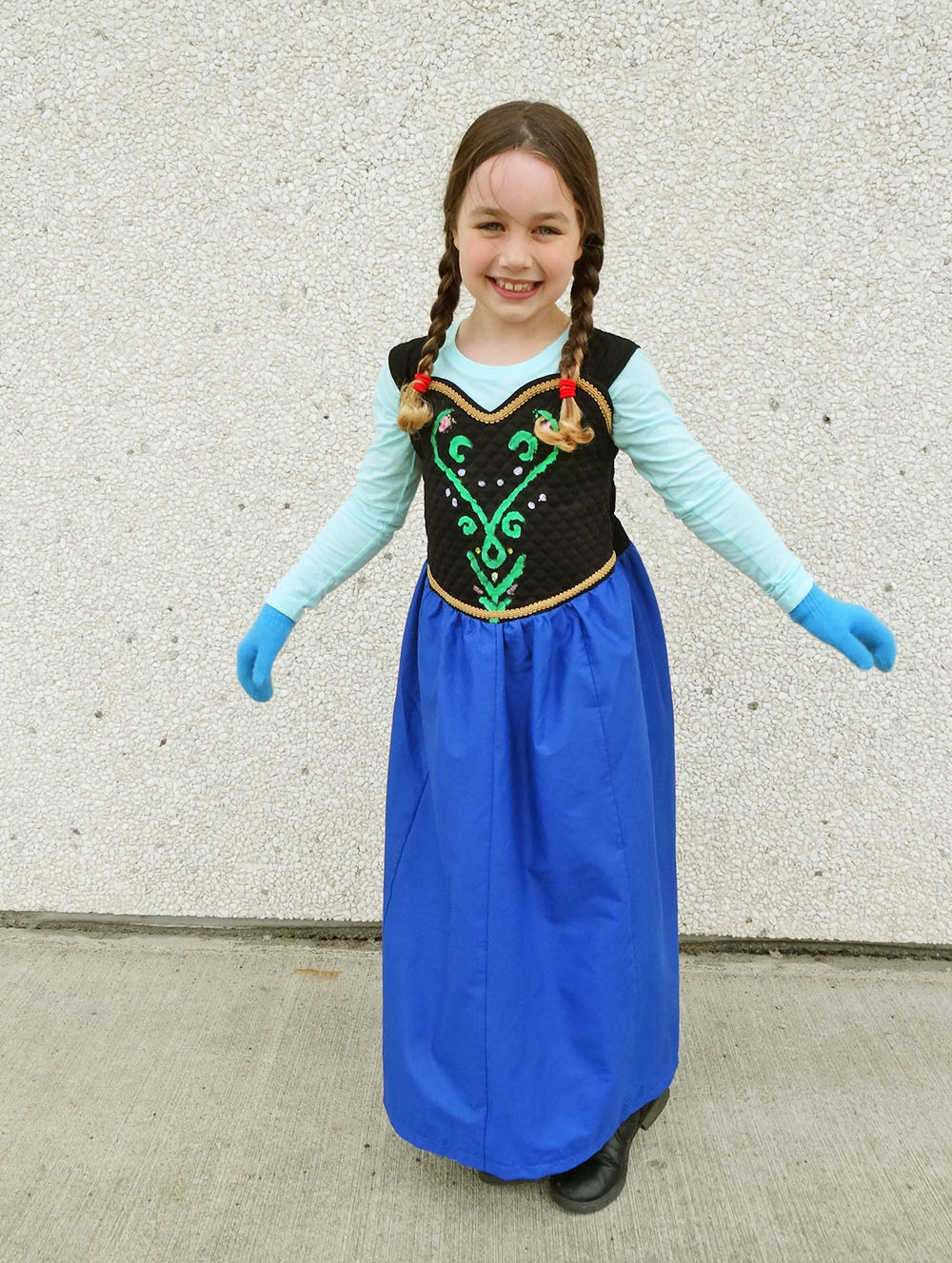
Earlier this year (think spring!) my oldest decided to be Anna for Halloween. No questions asked – this was happening. From here on in there was talk of being Anna. Especially as costumes started to appear for sale.
With my time being directed at getting ready for Creativ Festival, I didn’t think I could make costumes. But, even when face-to-face with the “perfect” Disney Store Anna costume my daughter decided that a mommy-made version was better. Awwww…. good for this sewing mama’s heart – and of course I could be convinced to make a costume!
I really am pleased this year – it’s a minimal effort, maximum effect kind of deal – like their Jake and the Pirate costumes. Thankfully it was also a quick one.
Here is a run-down of how I sped things up:
The Cape:
- Non-fraying and no-hem-needed Fleece for the cape
- Trim inspired by the Simon and Co – Simple Anna Costume tutorial
- Pattern: Cape from “Little Things to Sew” by Liesel Gibson (Same as this Little Red Riding Hood costume )
- KAM Snaps on the front instead of a tie.
- Cut a shorter duplicate of the top of the cape for the second layer.
The Hat:
- self-drafted using the hood pattern pieces from the “Little Things to Sew” Cape (see above)
- I placed our previously made cape inside-out on my daughters head and traced the general shape of the hat. Then transferred it to the pattern pieces, adding a facing to finish the edges.
- To get it to stay on, my daughter had the idea to use a headband – which easily slipped into the facing around the front of the hat.
The Dress:
- Bodice is based on the Annabelle pattern by Violette Field Threads (also made in my favorite blue chambray, and as Easter dresses)
- I had some quilted knit in my stash that was perfect!
- We put a blue ready-to-wear shirt underneath instead of sewing sleeves.
- My daughter drew and painted the “embroidery” herself using fabric paint.
- Skirt is sewn from broadcloth, with a bit of a “V” self-drafted into the front.
What about the little one?
She was happy to wear an Owl costume we found at the consignment shop. Easy peasy – photos later today on Instagram I’m sure!
Funny thing though. I wanted to wash it – being thrifted and all – so it went in with all the week’s socks and underwear. When I opened the washer – Surprise! I had a tub full of stuffing! The owl’s lining fabric frayed, leaving holes where a large bucket of stuffing escaped and mixed with my clothes.
After spending 1/2 hour cleaning stuffing off of socks and underwear I’ve learned my lesson – always read the label. This one says “Spot Clean Only”, of course!
What are your kids dressing as this Halloween?
by Sherri Sylvester | Oct 20, 2016
Just back from a trip to the thrift store? Got 7 shirts in your closet waiting to be upcycled? Scraps from previous re-purposed items still to be dealt with? You’re in luck! Today is all about our last Maker Style – the Eco Expert! Projects include your personal Eco Expert apron, new repurposing projects to try, clever ways to use old clothing and how to make them unique.
This post is sponsored by Janome Canada.
How do you know if you are an Eco Expert?
Take my super fun short quiz to find your personal Maker Style! Don’t miss out on lots more great sewing inspiration, grab a cup of tea and sit down with the new M Series look book from Janome. I really enjoyed looking through it, the project tips and tricks are great and there are free patterns too!
Eco Expert Utility Apron (+ How I Shopped for Thrifted Fabric)
The Eco Expert apron is based on a tutorial from Sugar Bee Crafts. Their Utility Apron is easy to sew and requires minimal yardage – perfect for re-purposing your old or thrifted clothing!
I went thrift store shopping and found 3 skirts. All made from heavier fabrics, since I wanted this apron to be durable. The skirts I chose had various things I wanted to incorporate: denim – because of its durability, skirt tab – a fun detail to use in a new way, and great top-stitched seams – to add detail to the finished apron.
Always check to make sure they don’t have any stains or tears (though you could use that to your advantage too!). To save myself a bit of work I took the tutorial measurements and a measuring tape with me so I could be sure the skirts had enough fabric to fit.
Creative Up-Cycling (Anything is fair game!)
Here are a few ways you can use ready-to-wear clothing details to make your up-cycled project better!
|
Upside Down Hems: The tops of all of these apron pockets are the hems of each skirt. It was really simple to turn the skirt upside-down and cut the pieces out.The pink skirt had a bit of a curve to the hem and I was able to use that as a design feature! |
|
Everything Has a Purpose: The pink skirt had a cute faux-button tab on the waistband. I was able to remove it and re-sew it to the skirt side to use as a scissor holder! |
|
You Haven’t Seam it All: #seewhatIdidthere? Sorry for the joke – but the pre-sewn seams can add a fun detail to your up-cycling! I off-set all three skirt seams to add interest to the apron. Bonus: You won’t have to sew all that extra topstitching! |
|
Stitch it Again: On the topic of seaming things. I had to re-stitch the hem on the pink apron. It had a pleat in the back and to remove it, the hem had to be un-stitched.To make things more fun, I used my favorite “X” stitch that comes on the Skyline and M Series Janome sewing machines. Just grab the F or F2 Satin Stitch foot and stitch right across where the old hem was topstitched. |
|
Re-Use the Pockets: This is a common one. Take the pockets off your jeans and use them in your new project. Again, all that work cutting and topstitching is already done for you! A great example of this is to use one on the lining of my new favorite purse pattern – the Chobe. (Photo via Elle Puls, via Stitchydoo) |
|
Use Plain Space: Ok – this is stretching the use of “ready-to-wear details” a bit, but lettering is so fun! If you use some blank space to add a fun detail like the I did with the word “MAKER” here. Again, this alphabet is available on the Janome Skyline S7 I used to stitch this apron, and the new M Series machines.BONUS: If you have some pre-loved leather around, you can make a simple Leather Label too! |
You can find more ways to embellish your sewing in the Sewing Diaries: 9 Ways to Embellish and Label Your Projects.
Re-Purposing Projects to Try
I’ve found some great up-cycling sewing projects you can try. The quilts are the best since you can destash and a lot of fabric all at once! If you like these and want more, you can follow my UpCycle or Alter Pinterest board. (Made with Eco Experts in mind!)
Hope you had fun visiting today. What is your favorite Upcycling Project? Be sure to follow #alongforthreadride!
by Sherri Sylvester | Oct 19, 2016
What do Flowers, Bunnies, and the colour Purple have to do with each other? I’m so glad you asked! I found this amazing floral fabric on the “specialty fabrics” rack at my local fabric shop a few years ago – and put it in my “stashed with no plans” category! It’s a light fabric, not see through, but comfy with some drape and good body.
I have been experimenting with mixing wovens and knits in shirt patterns this year. Some unblogged, due to the backlog of things I’ve sewn #cantpostthemall! Since making 5 Extraordinary Girl Shirts for my youngest and I last year, including one mixing wovens into the knit pattern. I wanted to try it again.
The first knit/woven Extraordinary Girl shirt I made – with Ann Kelle’s super-cute mermaid fabric – only fit my youngest for about 2 weeks. The woven back didn’t allow enough stretch for her arms and it really didn’t work. Which made me sad, since it was SO CUTE! Ack…
This time around, I was smarter! Practice really does help.
- Added a back yoke in the knit material to help with the stretch and gathered the woven fabric in the center to add some extra ease.
- To capitalize on the long shirt-tail hem trend, I added a longer rounded hem to the shirt front and back as well. Looking at the photos – I think I could have sized up on the shoulders, my daughter is about a size 4 around – but likely needs a size 8 shoulder. Next time I will adjust the width, but leave the shoulder alone.
- Shortened the sleeves (this pattern includes long and 3/4 sleeves).
De-stashing is fun, and you might find the purple knit again on the blog. Turns out little girls’ projects don’t use much! I’ve already sewn an Exposed Zipper Banyan Tee out of it. The knit is super comfy and washes and wears really well. Now the purple Banyan is being worn by the second child. Much to the dismay of the older one who grew out of it… I’ve written an Exposed Zipper tutorial if you want to check it out.
We took these photos on a trip to the Royal Ontario Museum this summer – along with the photos of my youngest’s quilt. I try to capitalize on all opportunities for great photos shoot locations over here. Oh, and the purse! The girls have carried their cross-body purses around everywhere this summer, they are super-cute and really useful.
by Sherri Sylvester | Oct 3, 2016
Fabric comes from the most unexpected places! A few years ago, my neighbor was de-cluttering and showed up at my door with a bag of fabric. Inside were extra cuts of the specialty fabrics used to make the bridesmaid’s dresses at her wedding. Gorgeous soft green satin and a sheer green overlay – and there was a lot of it. (We still have more for another project!) I folded it all and put it on my shelf until inspiration struck.
I didn’t want to use it for just any project, so it took a few years, but we found a good reason to use it! My youngest was asked to be a flower girl last fall, so my oldest was feeling a little left out, it seemed like a great time to make her a fancier dress. Thankfully I remembered the green fabric, and there was more than enough yardage – it was perfect! This dress emerged, a mashed-up a few patterns, into a simple maxi dress. It was almost floor length last year – but she’s grown since I made it!
All the skills I’ve learned while sewing were tested on this dress. It is definitely different using specialty fabrics. Using the right needle, thread and tension is so important. You can tell that I should have lowered the tension on the side seams, now that the dress is finished and washed a few times, they are a puckering. (Could also be that I didn’t press the dress before we took photos! #reallife)
The skirt side seams are both french seams to prevent fraying. And the hem on the overlay is a baby rolled hem, so it doesn’t look too heavy. I was really grateful for my Janome rolled hem foot here -it has been used in a lot of projects. I would never have thought to do a rolled hem before, so I’m glad they include it standard with a lot of their machines.
The bodice is based on the Secret Garden dress pattern. Since I *love* the low back. It also has a side zipper – so you don’t really see it, which made the overlay look a lot nicer. The bodice overlay was drafted to be about twice as wide as the actual bodice, so it could be gathered. In the end I think I should have added less extra around the armholes – since, if you are a picky perfectionist (#likeme) the gathers pucker a bit much there. I really like how it looks though. And I made it easier on myself by gathering the front and not the back of the bodice. The skirt is self drafted, two large rectangles, gathered at the top and attached to the bodice.
The sash created a bit of a problem. Originally it was supposed to be a big bow in the back. I borrowed the sash pattern pieces from the Oliver and S Fairytale dress. Once they were attached, though, the front of the dress needed a little something – the two layers of gathers just didn’t look right meeting at the waistline. At this point I started feeling a bit ill, all the work to draft, gather and sew the new bodice piece and it didn’t even look good… *insert desperate look here!* Thankfully, the extra-long sash was long enough to be crossed at the back and tied it in a knot on the front – much better, Whew! #ideaforthewin
In the end I’m so happy with the dress, and really happy with our photo shoot. My daughter had fun running around in the field in her ballet slippers, and it was a great almost-fall sunny day. She also felt really special wearing it to the wedding, which was so important. And the fact that my neighbor had given us her special fabric made it even better. I’m glad I can sew nice things for the girls when they need them. Really good memories.
What was something you’ve sewn that has special memories?
by Sherri Sylvester | Sep 27, 2016
Wow, these photos are from 2 years ago! I’m switching to a new, much faster (Thank goodness!), computer right now and am in the process of sorting files. Yup – super fun! (haha) But, there’s a silver lining! I found this tutorial, all photographed and ready to go. Easy Peasy! In the middle of all of the excitement and preparations (re: yesterday’s post) I am happy to have less to do!
My girls love skirts and dresses and I love the modesty that shorts provide – so the faux skirt front is a great mash-up for both of us. My oldest is still wearing them – though they are quite a bit shorter now!
This tutorial is a bit more summer- related – but if I wait another year to post it you might not even recognize my kids in the photos! Also, it seemed a better time to write it up when I was planning last week and it was still warm outside. Today is a bit less hospitable – with rain and chilly-ish fall weather. Oops!
Either way, here’s a full tutorial on how to add a faux skirt panel to the front of any shorts pattern, assuming the shorts have a side seam and separate waistband. Depending on your part of the world, you can get a jump on your summer sewing, next summer’s sewing, or pin the tutorial for later! Of course, these would look great in a nice wool plaid with tights underneath. #justsayin
For simplicity’s sake, I have referred here to the free Oliver and S Sunny Day Shorts pattern. To prepare, download the pattern and cut out all pieces according to the instructions. Make sure to leave excess fabric for the faux-skirt front. If the pattern pieces look a little different, it’s because I usually lower the rise on the front of my kids’ shorts – it tends to fit them a bit better. Here I’ve lowered the front rise by 1 1/2″.
Draft and Cut the Skirt Front
1) Fold Skirt Front fabric in half. Place Center-Front pattern piece near the fold as shown in photo. The Shorts Side is parallel to the fold. Leave 1/2″ or so before the top of the Center-Front to add ease for movement to the front of the skirt. (The curves on the top of the pattern will make it easy to ease this fabric back in later on.) Trace the top of the shorts pattern to mark the top of the skirt front – the excess at the Center-Front is free-hand marked at 90 degrees to the fold.
2) Pivot the pattern piece so the bottom of the Shorts Side is 1-2″ over from it’s original placement. The top of the Shorts Side matches up with your line from step 1. Trace the Shorts Side, including the notch placement.
3) Draw a line from the bottom of the Shorts Side to the fold. The line is at a 90 degree angle to the folded edge.
4) To make hemming easier, we need to straighten out the angle at the bottom of the Skirt Side. Line up the bottom of the Shorts Front with the bottom edge of the Skirt. Trace the side of the shorts, making a 1 1/2″ line 90 degrees up from the bottom edge.
5) Cut out the faux Skirt panel.
6) Hem the Skirt Panel. Follow the instructions for the Sunny Day Shorts – “Finish the Shorts” Step 1.
7) Sandwich the Shorts Front, Skirt Panel and Shorts Back as shown. Shorts Front and Skirt Panel are right-side-up. Shorts Back is wrong-side up. Align the straight side edge – this is the wearer’s right side seam. You can use the notches to line everything up properly.
8) Pin the side, making sure all three layers are aligned. Fold the skirt panel out of the way. match and pin the inner leg, matching the Shorts Front and Back. Stitch as indicated in the Sunny Day Shorts instructions – “Prepare the Shorts Front and Back” Step 1.
9) Repeat step 8 for the wearer’s left side. Fold the other shorts leg and skirt panel out of the way and stitch the side and inner seam.
10) Follow “Prepare the Shorts Front and Back” Step 2 to sew the rise. Be sure to fold the skirt panel out of the way while stitching! Pin the raw edges of the Skirt Front to the Shorts Front. Ease in the excess Skirt fabric and baste with a 1/4″ seam.
11) Continue to follow the Sunny Day Shorts instructions to attach the waistband and insert the elastic.
12) Fold up and press the shorts hem as per “Finish the Shorts” Step 1.
13) Open the skirt panel and pin the hem where it meets the skirt panel. Stitch the hem, beginning at the pin and ending where the hem meets the skirt panel on the other side.
All done! Enjoy your new skirt 🙂
Let me know what you think! Or even better – post some photos? I’d love to see them! Share your photos on Facebook, Twitter or Instagram using the hashtags #alongforthreadride and/or #threadridinghood. Thank you!