by Sherri Sylvester | Aug 25, 2016

This blog post is brought to you today by the letters “L” and “B” and by the number 2! Kudos to everyone who remembers where that reference is from. Ah, the days of childhood!
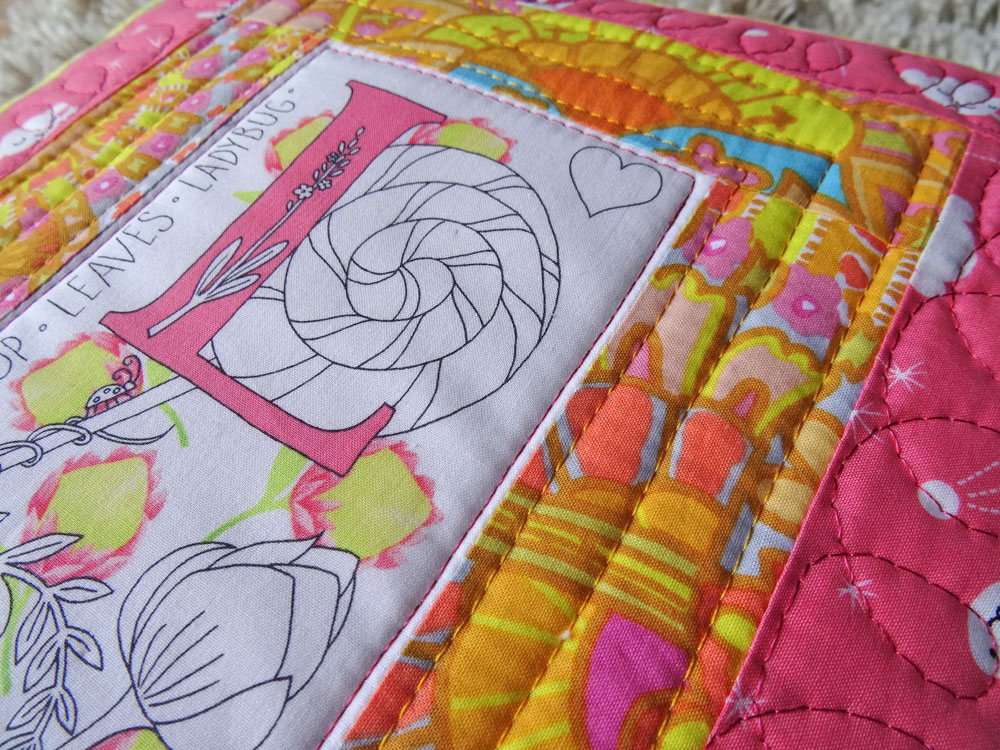
When I worked with my sponsor Fabric Spark to make my daughter’s isogram mini-quilt earlier this year, I wanted to make sure I used up the other letters in the alphabet panel. Enter two quick and easy projects with the letters “L” and “B”. Fabric Spark is sold out of this Tamara Kate panel – but has the Joie de Vivre – Joyeax Alphabet from Bari J in stock – it’s just as pretty!
First, I sewed up a quick quilted pillow for my daughter’s friend as a birthday gift. I really, really loved making this pillow. Using up scraps and piecing them log-cabin-style made a quick and easy finish. (My husband had just bought me the perfect tulip bouquet for the photo shoot – super extra bonus points for him!) I always love the quilting, it’s just so satisfying – and always looks amazing. I even dug out my rusty free-motion skills to make a few loops as well. The automatic settings on my Janome Skyline S7 are really helpful – they set everything up for you!
The second project I made was a monogrammed hand towel for my mom’s birthday this July – though she may never use it for fear of dirt! Their last name begins with “B”. I used a simple hand-towel, turned under the edges of the fabric and stitched the letter on. If I had more time I would have loved to embroider some texture into the block. But since I was finishing it the morning we were leaving to take it to her – I wasn’t able to! #procraftinators #unite!
Since I think I have an “M” and a “P” in my alpha-stash (it’s a thing!) I am excited to make my kids some monogrammed pillows too. We are playing “musical rooms” in our house this summer. Moving the sewing room to the (much larger) basement space (yay!) so the kids will each have their own space. We’ve got a “Red Riding Hood” room on tap for the little one and a “pink/teal-blue/yellow” design up for the oldest. Kids are fun and I can’t wait to see how their rooms turn out!
by Sherri Sylvester | Aug 15, 2016
I try not to start my blog posts with “I’m so excited to share” – but today I can’t help it – I’m really so excited about my new bag! It’s the Chobe from Elle Puls – same pattern designer that brought us the amazing Bethioua top. When Elke emailed me a few months ago, I was so happy to accept her invite to try the new pattern. My previous everyday bag’s zipper had just broken and this pattern was a perfect replacement – right down to the exact size and style! I took my Chobe on vacation in July and I’ve been using it every day since.
So I made it in gold! I really had to think hard about this… I’ve never carried around a gold bag – but I wanted to use my stash as much as possible. Maybe if we call it beige or champagne it would be ok?! I really don’t mind the colour now that I’ve made it. It helps that it matches everything – which is great because I’m a very non-fussy bag carrier and don’t switch them according to what I’m wearing. The thin stretchy hole-filled vinyl adds a bit of a sporty look. And I happened to have exactly the right Kona cotton to use as a lining. And exactly enough leather in the right shade to match for the base and shoulder strap!
I really like patterns that allow me to learn new sewing techniques, and the Chobe is great for that. The illustrated instructions are really easy to follow and allow for a super-professional finish.
Here are a few new things I learned:
- Rivets! I got to use them for the first time and I LOVE them! They made this bag look super professional and I was really excited to learn that they are really easy to install. One of them loosened two weeks into my vacation, but that was easily fixed when I got home. And now I own the rivet tools I want to use them everywhere – yay!
- Hardware. Ok, so I’ve used bag hardware before – but I love how ready-made these Snap Hooks look. And the matchy rivets and rectangular rings – have I mentioned how much I love rivets yet?!
- Recessed Zipper. I have a confession to make, the Cat-Eye Zipper pouch was supposed to have a recessed zip – but I couldn’t figure out how to make it work! I was so grateful for Elke’s straightforward instructions. It comes together so well and I’m so proud of how it looks!
Here are a few things I changed when I made my Chobe:
- Cross-body strap. I used the snap hooks to connect a simple cross-body strap. I copied my well-loved Coach everyday bag and snapped them onto the same rings that connect the shoulder strap. This lets you remove the long strap for a cleaner look.
- Flat Front. The fabric I chose didn’t really allow the pieced front to be made easily – since it has holes (and stretch), I needed to line each place I used it. Again, I copied my everyday bag and created a 2 piece front instead. The top-stitching makes it look a bit more ready-made.
- Interfaced Lining. My bag was pretty un-structured because I used thin vinyl instead of the recommended denim. To compensate a bit I added a layer of interfacing to the lining and it’s worked really well.
- Strap Attachment. Because I was so short on matching leather I had to shorten the shoulder strap and attach it creatively. I love how the straps are sewn on the outside of the original bag. But since my fabric was short I sewed them into the top seam instead.
Here are a few things I would do next time:
- Up Cycling. With the Canadian Tuxedo back in style (denim on denim on denim!), I figure we could add a bag to the mix? The original Chobe is made from a recycled pair of old jeans. Down to adding the pocket and label. The casual style would be fun to pull off.
- Outer Exposed Zipper. One day I will learn! For an outer zip to look professional the lining should match the outer, so the fabric doesn’t show on the outside of the bag. Argh. I did this the wrong way on my Makers Tote as well.
- Height. I might make the bag slightly shorter – by about 2 inches or so – since my kids are older now and I don’t need as large of a bag to stash things!
Have you ever attempted to make a bag? How did it go?
In the end my on-loan Janome Skyline S7 sewed through layers and layers of leather with no issues what so ever. The hardest part was getting used to sewing the vinyl outer. I did find that since the pattern was in centimeters I needed to do a bit of conversion before I started. But Elke includes a printable ruler, and I typed all of the measurements into Google and let it convert them for me – easy peasy!
I am so proud of this bag! And am loving the interior fabric a ton. It was stashed to eventually become a skirt, but this seems way better, since I get to see it everyday! All of the professional tips and tricks, the instructions on how to make your own leather handle, the recessed zip. So good!
I highly recommend the Chobe bag pattern. Elke has done a wonderful job on it, and she’s included tons of creative ideas to make it your own – along with great inspiration photos as well. Hats off to her! This bag is going to be my go-to pattern for a long, long time.
by Sherri Sylvester | Aug 8, 2016
It’s SUMMER! It’s been fun and busy over here – with things happening every weekend – as you can tell from the infrequent posting going on over here! After visiting Chicago, Minneapolis and Green Bay on a two week vacation and recovering from the craziness of Thanks to YOU Week and two trunk shows at Quilts at the Creek, I’ve been cottaging in Killarney, Ontario without cell service and then planning my youngest’s 6th birthday party – cat themed! Whew! I’m hoping to get better at quick, fun photo-based posts so I can share them all with you.
With all of this going on, I haven’t sewn anything significant in 5 weeks. I’m going a bit crazy over here and need to get my fix in! It doesn’t help that my sewing room is a mess – which is not really conducive to making anything. Since we don’t have any major plans before school starts in September, I’m hoping to blog about past projects and get on with making some new ones so I can share them with you in the fall. I’ve got some photos from a few years ago to share!
Today’s project is one of my favorite things – and I got to give it to my sister earlier this year for her birthday! I posted progress photos of the project on Instagram in black and white, so she hopefully couldn’t tell what I was making. It’s a fun series of photos to go through!
This Makers Tote is a pattern from Noodlehead, one of my favorite bloggers and bag designers – I love her simplicity. Nothing is over-complicated, the projects have clean lines and are super-useful – my favorite! The linen is my current favorite fabric crush, Mochi Dot from Moda, gorgeous!
This is also the first time I used by Annie’s Soft and Stable and I love the easy structure it gives the bag. I used it again in these cute purses for my kids and they stand up to wear so well. They keep their super-crisp shape no matter how much they get tossed around. And it’s great for creating a nice quilted look. The only thing I’m not crazy about is that it’s on the pricey side. In the long run, though, it is really worth it, since it does create a more professional looking project. (I’ve ended up with some Pellon Flex Foam and Bosal In-R-Form through different recent sales and I’m interested in comparing pricing and how the final product looks.)
The Makers Tote comes in two sizes, and I made the smaller version. I’d love to make the large one sometime as well. My friend Lisa (Lisa In Port Hope) made one and brought it to one of our sewing night and it’s a really nice size – perfect for carting larger projects around. I can also see my kids using it as a small overnight bag, complete with pockets for toiletries!
This bag, despite taking me a long time to sew in small time allotments, is really simple to make. It’s very straight forward, and if you have a bit of experience quilting, you can add that in as well. The only tricky bit is sewing the binding around the bottom curves. My Janome Skyline S5 (on loan at the time) handled it beautifully! I even surprised myself and hand-stitched the binding! Not so bad as I assumed, and very satisfying. We might eventually make a hand-quilter out of me – just hang on until my kids get a bit bigger first!
The only thing I changed from the original pattern, was to sew the free end of the zipper to the outside panel – since the one I used was too long, and I didn’t want to shorten it. If you do this, make a pretty cover for the end of the zip and be sure to leave enough room for it to open all the way. I really like how it looks – a bit cleaner without the end of the zipper hanging off the edge – but it was tricky to do, since it has to be sewn after the bag is fully finished. Maybe would be simpler with a properly sized zipper next time.
As usual, with any Noodlehead pattern, I’d wholeheartedly recommend this one as well. And have you seen her cute new free basket pattern? I’m going work that into my organizing plan somewhere soon!
Is your summer busy? What are you working on right now?
Pattern: Noodlehead Makers Tote Green Fabric & Stabilizer: Linen Mochi Dot, Horizon Flora by Kate Spain for Moda, by Annie’s Soft & Stable (from my sponsor, Mad about Patchwork) Orange Fabric: Marmalade by Bonnie & Camille for Moda (from my stash)
by Sherri Sylvester | Jul 14, 2016
I usually bring my sewing machine and a project or two on a family vacation – and this one is no exception. We’ve been enjoying Minneapolis for the past week and I am finding that I don’t need such a large project, since we are visiting with family – not as many free evenings as when we vacation alone!
Disclaimer: This is a sponsored post. Bluefig sent me the DS23 Wheeled Bag in Butterfly and the Dottie Notions Bag to review for this post and this is my honest opinion about them.
I’ve collected my best tips on how to pack up your sewing project – and how not to forget anything when you do!
Bluefig contacted me a few months ago to talk about a possible post to highlight their new Canadian website. Hooray for us! This company is well known in the US, and are now bringing their product to Canada – with free shipping even. (Yay!) Now that I’ve seen and used their bags I am even more happy to highlight them here for you today.
Let’s get started! Grab a spare basket or box to temporarily collect everything you want to pack. (I would collect it in a pile on my sewing table – but let’s be honest – it’s generally covered in piles of other projects!)
Tip #1: Pattern & Fabric First!
The most important part of any sewing project! Make sure you have a copy of the pattern and enough fabric to make your project. No brainer, right? Print out/grab your pattern and double-check your yardage. I find it useful to use a highlighter to mark off items as I collect them.
I’m using this super cute Tree Party fabric from Riley Blake Fabrics that Canadian designer Kelly Paccini sent to me to make my girls each a Cargo Duffle. I fit the pattern, printouts and machine instruction book into the zippered front pocket of the wheeled bag – so handy!
Tip #2: Collect Other Materials
Make sure you have the rest of your materials according to the pattern listing. Read the pattern over, sometimes the designer will mention recommended items along with things listed in the materials. Matching thread, zippers, bag hardware, interfacing and stabilizers are some things you might need to find.
Tip #3: Don’t forget your Notions
Gather up all of the notions and sewing supplies you need. This tip is likely the most involved and requires the most thought. I like to read through the pattern, thinking about what I will need to complete each step, and write down a list or gather items as I come to them. Most supplies are obvious – sewing scissors, rotary cutter, bobbins and needles.
If you read carefully you might come up with something you didn’t think of – for example, this pattern calls for a double zipper that closes in the middle. Since I am making my own, I brought along wire cutters and pliers.
I loved having the Bluefig Dottie Notions Bag to pack everything into. It is divided up with enough clear zippered pockets to make my organizer’s heart super happy! The bag has 1 large pocket, 2 1/2 pockets and 8 smaller ones, plus an outside pocket for your pattern or quilting ruler. (The notions bag comes as part of a 3 Bag Combo with the Wheeled Bag and Project Bag.)
Here are photos of my packed bag to give you ideas of items you might need to bring along:
Tip #4: Safely Pack your Sewing Machine
It’s your baby, and it allows you to create – you love your sewing machine and it’s important to pack it safely for your trip. (Side note: I had a machine that tipped over in my car once, and it was never the same after that – in fact I ended up having to replace it soon after, so I know the importance of this tip first hand.)
Bluefig bags are made especially with your sewing machine in mind. They come in various sizes, and lots of great colours. Of course I picked the red one in keeping with the Thread Riding Hood theme! It’s made from a brushed Chenille fabric with an appliqued felt butterfly on the front.
I packed and photographed two machines into this bag to give you an idea of size. This 23″ bag is made for larger machines like the Skyline S7 that I have on-loan from Janome Canada. The mesh pockets inside this bag fit my shorter quilting ruler and rotating cutting mat too, which is nice. I also like that the soft sides zip all the way down – making it easy to get your machine in and out of the bag! Bluefig has also provided lists on their website to tell you which machines fit into the Bluefig 19″ or 23″ wide bags.
I actually brought my smaller Janome 2030QDC on vacation with me. I didn’t think it was good to travel with an on-loan machine! Plus, I was glad for the extra space allowed in the DS23 bag from packing a smaller machine than it was meant for. You can see in the photos below that I strapped it in and then placed the hard case on it so I could pack around it. The notions bag on one side and the foot pedal on the other.
If you don’t have a Bluefig bag yet, you could also use a large plastic tub – one that holds your machine upright. I’ve done this in the past, and the machine was squished held in place securely with all the supplies I was bringing!
Tip #5: The What If’s & Expendables
Of course you know by now that I am one of those people that over-prepare for absolutely everything! So I’m recommending you don’t forget a few more things that you might possibly need – you can never be too careful right?!
Consider bringing anything else you might use on a regular basis. Space permitting of course – and I had room in the large 23″ bag for some extras. Things like embroidery scissors, fabric glue, an extra rotary blade, hot iron cleaner, washi tape (marking lines/labeling fabric pieces), safety pins, hand sewing needles, regular pins, a pressing cloth and an iron might come in handy.
Now that you are packed, enjoy your trip!
I’m really impressed with this bag and how convenient it was to carry my things safely. Plus the materials used in the bag are really good quality and substantial. When I get it home and unpack, it’s good to know that it will fully collapse so I can store it in my small space until I need it again!
Do you take your sewing machine on vacation?
by Sherri Sylvester | Jul 8, 2016
We are on vacation! I’m excited to have visited Chicago early this week and now we are relaxing in Minneapolis with family. Know any good quilt stores over here?! I’m trying to get a few photos on Instagram if you want to follow along.
When Brenda contacted me to see if I wanted to make the Sweet Talk Phone Bag pattern we were in vacation planning mode, and my kids were on my mind. This bag looked like the perfect size for a kids’ purse, and I had grand plans to make one for myself as well. I got the kids’ bags done at least – they love them – and they really are the perfect size! I got to use some fabric that I had stashed “for forever” waiting for the right project – and I’m so pleased with how they came out.
Disclaimer: This is a sponsored post. Among Brenda’s Quilts and Bags sent me the Sweet Talk Phone Bag pattern to use in this post and this is my honest opinion about it.
This pattern makes a cross-body purse with two zipped pocket areas and one front open pocket. It is interfaced with Bosal In-R-Form or byAnnie’s Soft and Stable to create a super sturdy bag – originally intended to carry your cell phone safely – and a great way to keep a nice shape in a purse. The pattern also includes instructions to make a card holder with clear pockets. I didn’t figure the kids needed one quite yet, so I skipped that part.
The instructions are well explained and easy to follow. The pattern pieces are cut out using measurements. It is fully illustrated with photos and lots of text to help explain everything. Plus I like that it was a paper pattern, so everything was already printed out and ready to go!
The original bag has options for a front flap or bow, which I fully intended to use for one of the bags. Plans were waylaid when one girl got word that the other one was going to have ruffles on the front of her bag. So it was settled, the ruffles had to be on both – of course! It was simple to add, I shortened the pocket by 2 inches and then cut a piece of fabric 4″ x double the width of the bag front. Folded it in half, gathered the raw edges and set them into the top edge of the front pocket/pocket lining. It’s pretty cute – but I have to admit I really wanted one to have a bow! Next time… these would make super-cute Birthday gifts too!
The cross-body strap (that I shortened to a 36″ kid-size) is perfect for touristing. No complaints from the kids, who are usually not very excited to carry their own things. They filled them with sunglasses, tiny clipboards and markers to keep them entertained on our Chicago Architecture Boat Tour. My youngest also wanted to bring her mp3 player with her and the front pocket was perfect for the earbuds.
They also like having multiple zippered pockets for organizing their things – so cute! I love the back pocket. I put one the “right way” and flipped the other one to better fit beside the horse on the back of the purse. #fussycut everything!
I checked to see how the bag would fit my extra-large cell phone, and it works great! I’m really excited to use some of my hoarded Japanese fabrics to make one for myself. It would be so useful for running into the grocery store – or to carry my phone and cash on summer walks with the kids. I think I might attach the straps with rings and swivel snap hooks so I can take them off and use the bag like a wallet as well.
Brenda also has lots of other really great patterns, plus she sells kits or the notions, batting and stabilizers to go with them. I really like the Voyager bag and the Around the Block Bag too. I’d really recommend that you check out this Canadian shop!
I’m back to vacation mode for a few more days, but I have more fun things next week and I’m so excited for a special bloggy event – coming super-soon! (Hint, hint… It has something to do with this!) Plus, I’ll be speaking at Quilts at the Creek on July 23/24th in Toronto – so if you are in the area I’d love to see you there.
by Sherri Sylvester | May 22, 2016
I’ve spent the last few weeks slowly getting into gear and planning the next few months of blog posts. So many things to share! I think I could schedule posts until November if I wanted to. I’ve also been cleaning house here – literally – and donating/organizing and re-organizing our spaces.
I’ve been taking stock of things here on the blog as well and doing my best to make good on long-promised tutorials. Today I’ve written a tutorial on how to transition a summer short-sleeved dolman top pattern for spring/fall.
This tutorial will show you how to draft a longer sleeve addition for any dolman top. I LOVE 3/4 length sleeves in the spring and fall – and this tutorial works great for those and for adding length for long sleeves. I’ve seen sleeve additions like this showing up in ready-to-wear dolman sleeve clothing a lot as well. It’s great alternative to cutting long sleeves directly with the bodice of a dolman top, since you can save fabric by cutting the longer sleeve piece separately.
I wear the first Seafarer Top I made with longer sleeves (above) all the time. It is my most-worn handmade top by a long shot. I think the reason is it’s versatile colour (gray!) and also that the fabric is really easy to wash and wear. The silver and cream striped top I made for this post (below) is not likely to get the same treatment. Unfortunately the fabric I purchased washed up scratchy and clingy – not sure it will last long in my closet. I did widen the neckline by cutting two front pieces (on purpose!) instead of a front and a back to make a super comfy larger neck opening. I’m excited to find some better quality fabric and repeat that in my next version.
You can use any dolman sleeve pattern as a base for drafting this sleeve addition. I have used the kid size dolman Skipper Top from Sew Much Ado because the pattern pieces are smaller and easier to photograph. (Find the women’s Seafarer here.) You can also easily draft and sew your own Dolman Sleeve Top using a well fitting tee.
Draft the Dolman Sleeve Length Addition Pattern Piece
Materials:
- paper
- ruler
- marker
- pattern weights (or heart shaped rocks!)
- any dolman sleeve pattern
This tutorial is written for pattern pieces with seam allowances included. The new sleeve addition will have added seam allowances as well, except where noted. Mark and fold back the seam allowance along the sleeve opening of your pattern. Note the seam allowance for your particular pattern and use this throughout this tutorial.
Step 1: Measure the wearer’s arm or an existing tee to find your desired sleeve length. Keep in mind that this method adds to the length of your pre-existing dolman sleeve. The lengthening starts AFTER the sleeve, not at the shoulder where a normal sleeve would start. Also, if your pattern calls for sleeve bands instead of hemming, make sure to shorten your desired additional length accordingly, leaving a seam allowance on end of sleeve where the band will be sewn.
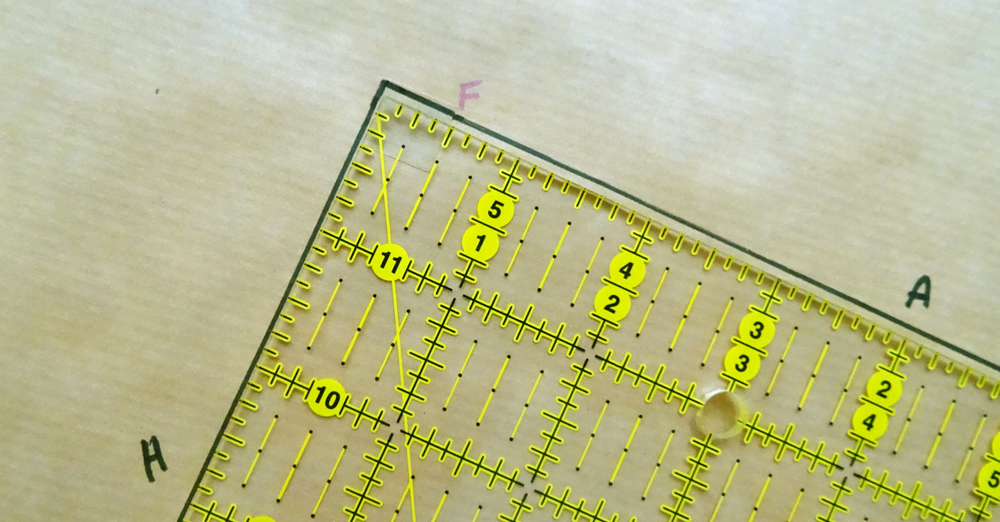
Step 2: Draw a line 90 degrees from top of shoulder/sleeve to your desired length. (A)
Step 3: Decide how wide the end of the sleeve needs to be to fit around your arm. Divide this measurement by 2 and add your seam allowance. Draw this measurement as a line 90 degrees down. (A) to (B).
Step 4: Draw line (C) connecting (B) to the bottom of the original pattern’s sleeve opening.
Step 5:Add the sleeve opening seam allowance.
- Unfold the seam allowance on your original pattern piece.
- Mark seam allowances at top and bottom as ((D) and (E)
- Mark the edges of your drafted sleeve addition as (F) and (G)
- Place the original pattern right side down on the new sleeve addition matching pints (D) and (F) and points (E) and (G).
- Trace the bottom seam allowance – from points E and G to the edge – and then trace the sleeve opening as line (H).
- Remove the pattern piece and connect line A to line H with a 90 degree corner.
Step 6: Label your pattern piece with all the necessary information and mark the “Cut on fold” line.
Determining new sleeve band size (if applicable): Sleeve band width is the same as the hem band width. Measure double the final width of the new sleeve opening (A) to (B). Double this measurement to determine the final width. Remove about 1/4″ of this width to get the new width for the sleeve band. Since all knits stretch differently, this is only a guide. Use your judgement as to how tight you want the final sleeve band to be.
Example : Sleeve Opening = 9″ (includes seam allowance), remove 1″ (1/2″ seam allowance on each side) = 8″ final width. Remove 1/4 of 8 = 6″ width. Add the seam allowances back in 6+ 1″ (1/2″ seam allowance on each side) to get a 7″ final width.
How to Sew the Dolman Sleeve Length Addition
Materials:
- sleeve length addition pattern piece, drafted above
- dolman tee pattern
- fabric (you may need extra to account for the longer sleeve)
- general sewing things
Step 1: Follow your pattern to the step where both shoulders are sewn together.
Step 2: Line up the long sleeve addition right sides together with the original sleeve, matching the sleeve openings.
Step 3: Sew the seam with the original pattern’s seam allowance. Serge/finish the edges and press the seam allowance towards the new sleeve.
Step 4:Finish your tee as indicated in your pattern.
I hope you enjoy your tee! Check out more tutorials like this on the tutorials tab above, or follow along to keep track of new projects!