by Sherri Sylvester | Apr 28, 2015

I’m tired y’all! I had an amazing weekend at Creativ Festival – but I think the amount of time and energy I put into getting everything ready is now showing – I haven’t even unpacked or pre-washed any stash yet! I’m going to post a review of the weekend, but first I’ve got a quilt for you. (And, if you are expecting an email from me about the weekend I’ll hopefully get it out tomorrow!)
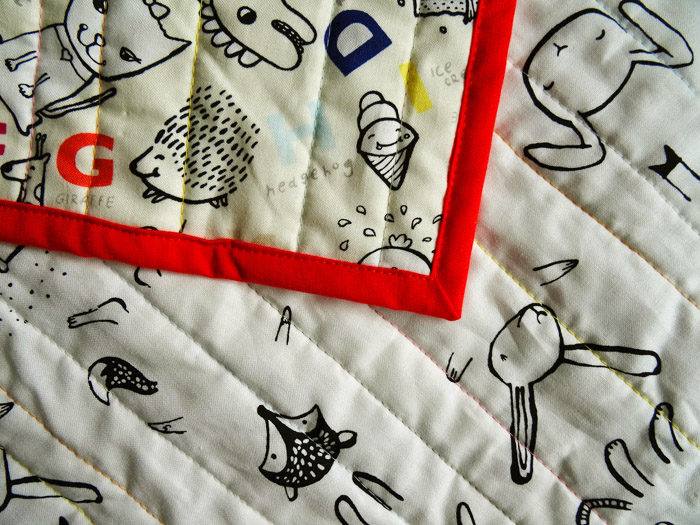
This is one of the projects I made in collaboration with my sponsor, Fabric Spark – for use at Creativ Festival. It’s a blanket/play mat made using the Wee Gallery collection from Dear Stella. I’d already fallen in love with the front “Dress Me” fabric when Daryl suggested making this quilt for the show. (I’ve got a yard stashed away from when Daryl first listed it!)
After I got the kit I was totally smitten with the backing fabric – Wild – Alphabet! Would you believe it’s even got a “N is for Narwhal” on there? (If you are looking for the “Dress Me” fabric, this little quilt did its job and now Fabric Spark is sold out of the “Dress Me” print. You can still get Wild – Alphabet here. *EDIT: Apparently Daryl is all sold out of the Alphabet as well.)
The quilt is made using the free “Dress Me Up!” Tutorial by Modern Handcraft on the Dear Stella blog. It’s such a cute idea! The only thing I changed is to use coloured thread for the quilting. In an effort to make it unisex, I used pink, blue, orange, yellow, gray and cream – generally matching the colours on the Alphabet backing – but lighter. I had a false start with a few quilted lines in bright pink and darkish blue that “showed up” too much for my liking.
Using wool felt for the character’s clothing is such a great idea. My oldest has already been designing clothes for them with the left-over felt. I’ve never used wool felt before, and I was so pleased with the quality and feel of the pieces provided in the kit. You can get wool felt from Fabric Spark as well – they have wonderful names like “Pea Soup”, “Vanilla Latte”, “Fresh Linen” and “Bluer than Blue”!
I learned a good lesson from this quilt as well – a quilt does not have to be hard, or even pieced! This whole-cloth quilt was so simple to make – and the end result is so cute! My favorite part is the coloured quilting. I didn’t even use any fancy quilting thread.
My new motto more often needs to be “Simplify Your Projects” and “Done is better than Perfect”!
Your Turn! What is your favorite sewing motto?
Disclaimer: I received this quilt kit at no cost in exchange for it’s use at the Fabric Spark booth during Creativ Festival. All of my opinions are my own and I won’t take on projects I don’t believe in. Thanks for reading!
by Sherri Sylvester | Jan 5, 2015
Here’s to another great year last year! This year especially there have been many, many times I felt amazed because of a project opportunity or a relationship that was built. I feel fortunate to be a part of the online sewing community.
Thanks for hanging out and sticking around! You are so appreciated!
As I was working on this post I moved all of my 2014 post files away in their own folder – that makes 3 sections now – 2012, 2013 and 2014! It’s fun to think of how much this blog has been through. I was inspired by the Sewing Rabbit to create an infographic of sorts to summarize what happened last year. Lots different from my usual wordy posts – so I hope you don’t mind the numbers. I had lots of fun going through my stats finding out which posts were the most read, and I was excited to see that most of my favorite projects were your favorites too!
Below the analytics in the graphic, I’ve listed the top 10 posts created in 2014 and the top 5 posts of all time. (I linked each section – so you can click on them if you want to find out more.)
Happy New Year and I hope you and yours have a wonderful memorable year!
To talk bloggy – SO many moments stand out over the year! The day I got 11 938 page views because The Quilt Show linked to my Fabric Tray. The day I met Elizabeth Olwen and started planning the Warp & Weft Weekend Event. Designing the Forest Glen Satchel. The day I taught my very first workshop. Releasing the Satchel pattern! Sewing my youngest her Red Riding Hood costume and making my first Alder Skirt. I still LOVE the girls’ Easter dresses the most of all. Winning the Crafting Con Avenger’s month challenge was pretty cool too!
Looking ahead? More purposeful posting. I’m also excited to start quilting a bit more in 2015. And more clothing! Now that I have a serger for finishing seams the thought of stitching something up seems that much more simple and quick. I’ve got quite a few pieces waiting to be photographed and posted too… I could think of more – but I’ve got to run shower before going out in the (feels like) -22C weather to pick the kids up from school. See you again soon!
The Fat Quarter Skirt PDF Pattern is Now Available!
Purchasing this fully tested skirt pattern gives you access to 5 sizes, child’s 2-6, to create a skirt that is 9-11 1/2″ (23-30cm) long. Expect lots of tips and tricks throughout, a glossary of terms, recommended best practices and instructions geared towards an absolute beginner. This pattern is truly a quick sew – allow yourself just 1-3 hours to finish, including your fabric cutting time. It’s also a great stash-buster, requiring only 2 fat quarters and a length of elastic… things you probably already have in your stash! To find out more about the pattern, click here.
Purchase the Fat Quarter Skirt PDF Pattern – $8.50 CDN
Thank you for your support!
by Sherri Sylvester | Dec 11, 2014
Last page folks – truly and for real! Thisis the last of the Quiet Book pages. Now all we need is the cover and all will be right with the world…. except I need to start sewing my other Christmas gifts… hmmm!
This page is the size of 3 regular sized pages in this book, since it opens up to become a full sized race track. This page is significantly different from the original book – so much so that I haven’t included the original photos. If you need a reference point you can refer back to the original quiet book photos in this post.
The shopping list for this page looks daunting… but in the end it’s worth it! Not too bad, just lots of little pieces that go together quickly once they are cut. Here is a layout to refer to when placing items on your page.
You will need:
- Background Fabric (Grass): 1 piece quilting cotton 18″ wide x 9″ high (behind racetrack) + 1 piece quilting cotton 9″ wide x 6″ high (behind mechanic)
- Page Interfacing: 1 piece 18″x9″ + 1 piece 9″x9″ square, medium weight fusible interfacing (you will have this from your Week 1 shopping list)
- Mechanic Garage: 1 piece 9″ high x 6.5″ wide orange quilting cotton
- Mechanic Symbol: Black Fabric Paint, Freezer Paper (for stencil)
- Mechanic’s “Door”: 1 piece 4 1/2″ wide x 2 3/4″ tall clear plastic (6 or 8 gauge recommended)
- Mechanic Parking Lot: 1 piece 9″ wide by 3 3/4″ high black quilting cotton
- Parking Lot lines: 2 pieces 1/4″ silver ribbon 2 1/2″ long
- Race Track: 7″ x 18″ black quilting cotton
- Pit Stop: 1 1/2″ x 4″ black quilting cotton
- Pit Stop Yellow Lines: aprox. 11″ 3/8″ wide yellow ribbon
- Bridge Guard Rails: 4 pieces 1/4″ silver ribbon 3 1/4″ long
- Cars: Scraps of faux vinyl in car colours and wheel colour
- Cars: attachment strings, 3 pcs 20″ long 1/4″ wide grosgrain ribbon (not pictured below)
- River: 1 piece blue quilting cotton 6″ wide x 10″ high
- Black Velcro Fastener: 1″ long x 1/2″ wide (TIP: cut a regular piece of velcro in half widthwise)
- Fusible Web (I use Steam-A-Seam)
- Craft Knife: to cut freezer paper stencil
- Ribbon Tab: 3 1/2″ long for the side tab
- Matching Thread for Satin Stitching and Top-stitching
- Leather needle
- School Glue Stick
- Small Safety Pin
- Race Track Pattern Pieces -> Click here to download
Please ignore the cork and the yellow paint. The plan for them didn’t work out so well!
Before we begin/Important Notes:
- Print out the pattern pieces pdf on letter size (8.5″ x 11″) or A4 paper. Important: Do not select “fit to page” when printing, make sure you print at the original size. Once you have printed the pages, measure the 1″ test square to ensure the pattern is the correct size.
- Cut out all fabric that uses a pattern piece. Cut as indicated on the pattern piece, the racetrack is cut on a fold. Cut Fusible Web using the Race Track & River pattern pieces. Also cut one piece 1 1/2″ x 4″ for the Pit Stop.
- When you are sewing this book it is good to remember that some of the edges will be covered after the book is completed and sewn together. 1/2″ on the top edge of your page and 3/4″ on each side edge will not show in the final project. * This is especially important for this page *
- Remember to use your iron liberally when you are sewing this book. It is going to be a work of art when you are done! Since it is thick and some of the pages will not be iron-able once you are finished with them it is advisable to take all of the care you can to remove wrinkles so they are not accidentally permanent in your final book.
Here we go:
Cars
- Glue the end of an attachment string 1″ onto the wrong side of the “back” of one side of each car piece. (Glue is used in lieu of pins, to prevent permanent holes.)
- Glue the two car pieces wrong sides together with the ribbon in between the layers.
- Place and glue the tires in place – two on each side of the car. Only glue the part of the tire that is touching the car body shape. Let the glue dry to securely hold the pieces together.
- Top-stitch around the edge of the car, and over the tires, to hold everything in place. Backstitch-stitch over the tires and ribbon as you sew, for extra security. * You may need to use a leather needle to sew through all of the layers *
Mechanic’s Garage
- Fold the orange garage fabric in half wrong sides together to create a 6 1/2″ wide x 4 1/2″ high rectangle with a fold along the top. Draw a 4″ x 2 1/2″ rectangle in the centre of the bottom raw edges.
- Stitch the open sides of the rectangle with a 1/4″ seam allowance. Also stitch along the lines of the rectangle you just drew.
- Trim the inside of the rectangle to 1/4″ and clip into the corners. Clip the top corners of the side seams as well.
- Turn the rectangle right side out through one of the bottom openings. It’s a bit of a tight squeeze, but take your time, it will work.
- Use a chopstick or pencil to push out the corners and sides. Press the shape flat.
- Cut a 4″ x 6″ piece of freezer paper. Trace and cut out the mechanic symbol to make a freezer paper stencil. Apply the stencil, paint the symbol black and let it dry. If you have not used a freezer paper stencil before these are good instructions.
- Stitch several straight lines through the piece of vinyl, to represent the frames in the panes of glass usually found on a mechanic’s garage doors. Use this trick if your presser foot sticks to the plastic.
- Place the plastic behind the garage door opening. Secure it with pins inside the seam allowance (to avoid permanent holes).
- Top-stitch along the sides and top of the opening to secure the plastic. Top-stitch along the top edge of the garage – this will be the opening for the pocket.
Finishing the Mechanic Page
- Fold the end of each 2 1/2″ silver ribbon under by 1/4″. Place the centre of each ribbon 3 1/4″ in from each side of the black “parking lot” rectangle. Stitch from the bottom to the top to secure.
- Place the garage at the centre bottom of the 9″ x 6″ background fabric. Top-stitch the sides only to secure and create the pocket.
- Thread the car attachment ribbons through the pocket and out at the bottom centre. Stitch them in place with a scant 1/4″ seam.
- Match the top edge of the parking lot with the bottom edge of the background, wrong sides together. Stitch with a 1/4″ seam. Press the seam open – being careful not to press the vinyl.
- Fuse the 9″ x 9″ interfacing to the back of the mechanic page. Be careful not to melt the vinyl! It is best to avoid fusing the centre of the page, just fuse the edges enough to hold it on.
Make the Racetrack Page:
by Sherri Sylvester | Nov 13, 2014
Eeek! The Forest Glen Satchel Pattern is likely going to be released within the next 24 hours! I’m just finishing up the last few things. (I’m so excited to finally be able to share it with you!) Back on topic….
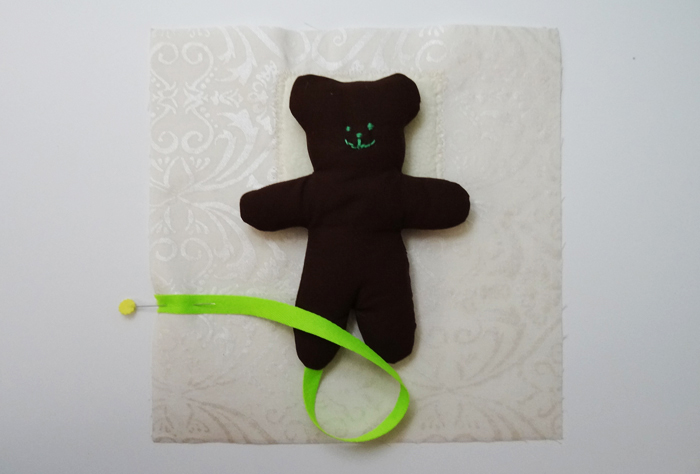
This Quiet book page is another one that my kids loved most. Putting someone or some-bear to bed is apparently enthralling! This also gives you the chance to put together a super-cute mini quilt. I used tiny pieces of my hoarded Geekly Chic Cassette Tapes from Double Decker Fabrics in mine. (Get a discount code for Double Decker Fabrics, expires Nov 21, 2014) Add in a little pillow and prepare to be sleepy! This Quiet Book page is found along with other information and tutorials links on the Sew Along page.
Here are a few little extras you can keep in mind when making this page…
Tips for a better page:
- Use a piece of low loft batting under the pillow to make it stand out a bit more.
- Place a small jingle bell inside the bear – make double sure to secure the opening well to avoid a choking hazard.
- Don’t make the bear or pillow too thick or the page will not fit inside the book properly.
- Replace the pieced quilt with one piece of fabric for a simpler and faster page finish.
Ready to start?
You will need:
- Background Fabric/Bed Sheet: 1 piece quilting cotton exactly 9″x9″ square
- Page Interfacing: 1 piece exactly 9″x9″ square, medium weight fusible interfacing (you will have this from your Week 1 shopping list)
- Pillow: 3 1/2″ x 2 1/2″ faux fur or fleece
- Quilt: 9″ wide by 4 1/2″ high pieced fabric
- Blanket: 9″ wide by 7 1/2″ high sweater knit or fleece
- Quilt Binding: 9″ wide double fold bias tape
- Teddy Bear: 8″ high x 12″ wide quilting cotton or corduroy
- Teddy Bear Ribbon: 11″ piece of ribbon/twill tape/rick rack
- Teddy Bear Face: embroidery floss/needle
- Small amount of stuffing
- Ribbon Tab: 3 1/2″ long for the side tab
- Small Safety Pin
- Teddy Bear Pattern Pieces -> Click here to download
Before we begin/Important Notes:
- Print out the pattern piece pdf on letter size (8.5″ x 11″) or A4 paper. Important: Do not select “fit to page” when printing, make sure you print at the original size. Once you have printed the pages, measure the 1″ test square to ensure the pattern is the correct size.
- When you are sewing this book it is good to remember that some of the edges will be covered after the book is completed and sewn together. 1/2″ on the top edge of your page and 3/4″ on each side edge will not show in the final project.
- Remember to use your iron liberally when you are sewing this book. It is going to be a work of art when you are done! Since it is thick and some of the pages will not be iron-able once you are finished with them it is advisable to take all of the care you can to remove wrinkles so they are not accidentally permanent in your final book.
- Fuse the 9″ square fusible interfacing onto your 9″ square background fabric.
Here We Go:
by Sherri Sylvester | Nov 7, 2014
I’m so excited to get this posted! I’ve been trying since Monday to get everything finished. Between unexpected design work and my husband working 19 hour days it’s been a challenge! The joys of working from home, though, I think the outweigh the more difficult times!
As far as this page, if you’d like some help teaching your little one buckles, snaps and buttons you are in luck! And, you know how much little kids think belly buttons are hilarious? This page has one built in! (It’s my favorite part.) This Quiet Book page is found along with other information and tutorials links on the Sew Along page.
When you are looking for supplies for this page, here are a few tips:
- I used clothing that my kids had outgrown for this page. Make sure the pants and shirt are at least 9″ across if you’d like to use them.
- Pick pants that open easily and make sure they have belt loops along the waistband.
- Choose ribbon and a buckle that are the same width and fit through the belt loops.
- Pick a snap or button closure on the pants, depending on the skills your little one has.
- The best shirts for this page have a design along the bottom. Unfortunately I didn’t have one to use this time.
- Check the buckle to make sure it is easy for a child to open. Some are very stiff and almost impossible to use with small hands.
You will need:
- Background Fabric: 1 piece quilting cotton in “skin” colour exactly 9″x9″ square
- Page Interfacing: 1 piece exactly 9″x9″ square, medium weight fusible interfacing (you will have this from your Week 1 shopping list)
- Belt: 2 pieces 5 1/2″ long belting/ribbon as wide as buckle
- Pair of Pants: (front only) with belt buckles or make them (will use a 9″ wide by 6″ high piece of front only)
- Shirt: bottom of shirt or hemmed knit (will use a 9″ wide by 4″ high piece only)
- Belt Buckle: Clip Buckle, mine is 1″ wide
- Belly Button: small button (1/2″ – 3/8″) – will not show, is used to “fill” the belly button
- small 2″ square scrap of fusible interfacing
Before we begin/Important Notes:
- When you are sewing this book it is good to remember that some of the edges will be covered after the book is completed and sewn together. 1/2″ on the top edge of your page and 3/4″ on each side edge will not show in the final project.
- Remember to use your iron liberally when you are sewing this book. It is going to be a work of art when you are done! Since it is thick and some of the pages will not be iron-able once you are finished with them it is advisable to take all of the care you can to remove wrinkles so they are not accidentally permanent in your final book.
- Fuse the 9″ square fusible onto your 9″ square background fabric before you begin.
Here we go:
- Melt ends of synthetic ribbon/belting or hem ends of non-synthetic. Attach buckles to ends.
- Cut 6″ high by 9″ wide piece out of front of pants with top front as top edge. I find it easiest to cut the front off of the pants first, then draw the cutting line before cutting it to make sure everything is correct. It is ok if the middle front of the pants curves down a bit.
- Cut the shirt to 9″ wide by 4″ high. Use the hem from the shirt as the bottom edge.
- Align the edges of the pants with the bottom of the background rectangle. Baste sides and bottom edges with a 1/4″ seam.
- Stitch over the original pants top-stitching between each belt loop and the side edge using a matching thread. Leave the centre portion un-sewn so the child can still open and close the fly.
- Stitch over the original fly top-stitching. Leave the zipper opening so the fly will still be workable. You may need to use a denim needle to get through the multiple layers.
- Top-stitch over the pocket edges if you want them to stay closed.
- Place the button on the back of the background fabric where you want the belly button to appear. Place the extra piece of interfacing over the button and fuse it to the wrong side of the background fabric, enclosing the button.
- Hand-stitch around the button to secure it better and add more depth to the belly button shape. I used invisible thread to match the background best.
- Align the side and top of the shirt to the background fabric. Place the ribbon/belting into the belt loops. Baste top and side edges of the shirt and belting with a 1/4″ seam.
- Fold the 3 1/2″ matching ribbon tab in half and use the small safety pin to attach it to your page so it does not get lost.
See you next week! (PS. Only 2 more pages and the cover to go!)
by Sherri Sylvester | Oct 28, 2014
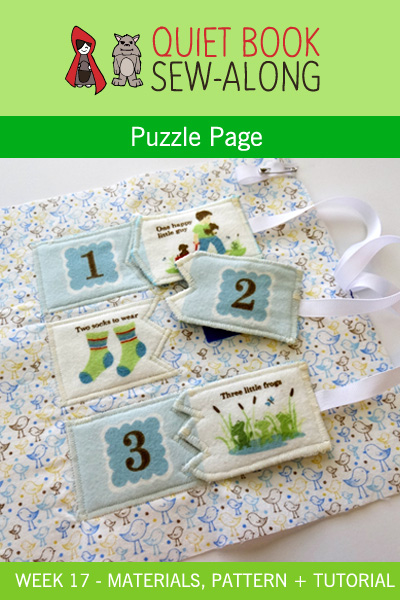
Here’s the next Quiet Book Page (for last week!). I should have known I wouldn’t be able to finish it last Saturday while Creativ Festival was going on. Ah – the nievity of thinking everything can be accomplished in minimal time! We’ve talked briefly about this page before, mentioning that it might be a good idea to find an appropriate fabric to work with. This Quiet Book page is found along with other information and tutorials links on the Sew Along page.
This is a favorite page as well – due mostly, I think, to the perfection of the fabric. The matching squares make it perfect for a puzzle. Of course you can match animal heads and tails or the front and back of vehicles. I also think it’s pretty funny that I still have yardage in the blue versions of both fabrics I used over 3 years ago now. Though I’m not sure if that’s a good or a bad thing! Although the puzzle piece size is mentioned in the materials listing, you will need to wait until the instructions to cut anything so it is cut out correctly.
You will need:
- Background Fabric: 1 piece quilting cotton exactly 9″x9″ square
- Page Interfacing: 1 piece exactly 9″x9″ square, medium weight fusible interfacing (you will have this from your Week 1 shopping list)
- Puzzle Pieces – Left Side: enough fabric to fit 3 pieces aprox. 2 3/4″ wide by 2″ high
- Puzzle Pieces – Right Side: enough fabric to fit 3 front pieces and 3 back pieces aprox. 2 3/4″ wide by 2″ high
- Fusible Fleece: 1 piece about 9″ by 4″
- Ribbon to attach puzzle pieces: 3/8″ grosgrain, 3 pieces 7″ long
- Velcro: Three 1″ pieces of both sides (hook and loop)
- Ribbon Tab: 3 1/2″ long for the side tab
- Removable Fabric Marker
Before we begin/Important Notes:
- When you are sewing this book it is good to remember that some of the edges will be covered after the book is completed and sewn together. 1/2″ on the top edge of your page and 3/4″ on each side edge will not show in the final project.
- Remember to use your iron liberally when you are sewing this book. It is going to be a work of art when you are done! Since it is thick and some of the pages will not be iron-able once you are finished with them it is advisable to take all of the care you can to remove wrinkles so they are not accidentally permanent in your final book.
- Fuse the 9″ square fusible onto your 9″ square background fabric before you begin.
Here we go:
- Use a removable fabric marker to draw a 5.5″ x 2″ rectangle around the area you will use for BOTH puzzle pieces.
- Draw a line down the centre of the rectangle, creating two pieces 2 3/4″ wide by 2″ high.
- Draw your notches as desired, I used the number of notches that matched my fabric numbering. You could put one or two notches on all pieces – be creative. Maybe the notches could be curved lines, or other shapes, like rectangles or half circles.
- Fuse an over-sized piece of fusible fleece directly behind the puzzle pieces. Cut out the two pieces with the fusible fleece attached.
- Cut a small piece of backing fabric for the puzzle piece on the right side. To use the cut puzzle piece as a guide, place it wrong sides together with the backing fabric, then trace and cut.
- Repeat steps 2-5 for the other pairs of puzzle pieces.
- Stitch the soft side of a piece of Velcro onto the centre of each piece of backing fabric. A glue stick is great for holding the small pieces on while you sew.
- Place the right side puzzle pieces wrong sides together with their backing fabric. (Another great place to use a glue stick!) Insert about 1″ of ribbon into the side opposite the notches, between the fabric layers.
- Stitch around the edges of the puzzle piece with a short zig-zag stitch. Double-stitch over the end where the ribbon is inserted to secure it.
- Place the puzzle pieces onto the background fabric as desired – lining up the notches.
- Stitch around the left side puzzle pieces to secure them.
- Place each right side puzzle piece and mark where the Velcro is located.
- Stitch the hook side of the Velcro onto the backing fabric in place as marked in Step 10, so the Velcro will line up when the puzzle pieces are placed correctly.
- Baste the three long ribbons side-by-side along the centre-right edge of the background.
- Fold the 3 1/2″ matching ribbon tab in half and use the small safety pin to attach it to your page so it does not get lost.
And you’re finished with another page. Only three more to go! See you back again later this week.