by Sherri Sylvester | May 22, 2016
I’ve spent the last few weeks slowly getting into gear and planning the next few months of blog posts. So many things to share! I think I could schedule posts until November if I wanted to. I’ve also been cleaning house here – literally – and donating/organizing and re-organizing our spaces.
I’ve been taking stock of things here on the blog as well and doing my best to make good on long-promised tutorials. Today I’ve written a tutorial on how to transition a summer short-sleeved dolman top pattern for spring/fall.

This tutorial will show you how to draft a longer sleeve addition for any dolman top. I LOVE 3/4 length sleeves in the spring and fall – and this tutorial works great for those and for adding length for long sleeves. I’ve seen sleeve additions like this showing up in ready-to-wear dolman sleeve clothing a lot as well. It’s great alternative to cutting long sleeves directly with the bodice of a dolman top, since you can save fabric by cutting the longer sleeve piece separately.
I wear the first Seafarer Top I made with longer sleeves (above) all the time. It is my most-worn handmade top by a long shot. I think the reason is it’s versatile colour (gray!) and also that the fabric is really easy to wash and wear. The silver and cream striped top I made for this post (below) is not likely to get the same treatment. Unfortunately the fabric I purchased washed up scratchy and clingy – not sure it will last long in my closet. I did widen the neckline by cutting two front pieces (on purpose!) instead of a front and a back to make a super comfy larger neck opening. I’m excited to find some better quality fabric and repeat that in my next version.
You can use any dolman sleeve pattern as a base for drafting this sleeve addition. I have used the kid size dolman Skipper Top from Sew Much Ado because the pattern pieces are smaller and easier to photograph. (Find the women’s Seafarer here.) You can also easily draft and sew your own Dolman Sleeve Top using a well fitting tee.
Draft the Dolman Sleeve Length Addition Pattern Piece
Materials:
- paper
- ruler
- marker
- pattern weights (or heart shaped rocks!)
- any dolman sleeve pattern
This tutorial is written for pattern pieces with seam allowances included. The new sleeve addition will have added seam allowances as well, except where noted. Mark and fold back the seam allowance along the sleeve opening of your pattern. Note the seam allowance for your particular pattern and use this throughout this tutorial.
Step 1: Measure the wearer’s arm or an existing tee to find your desired sleeve length. Keep in mind that this method adds to the length of your pre-existing dolman sleeve. The lengthening starts AFTER the sleeve, not at the shoulder where a normal sleeve would start. Also, if your pattern calls for sleeve bands instead of hemming, make sure to shorten your desired additional length accordingly, leaving a seam allowance on end of sleeve where the band will be sewn.
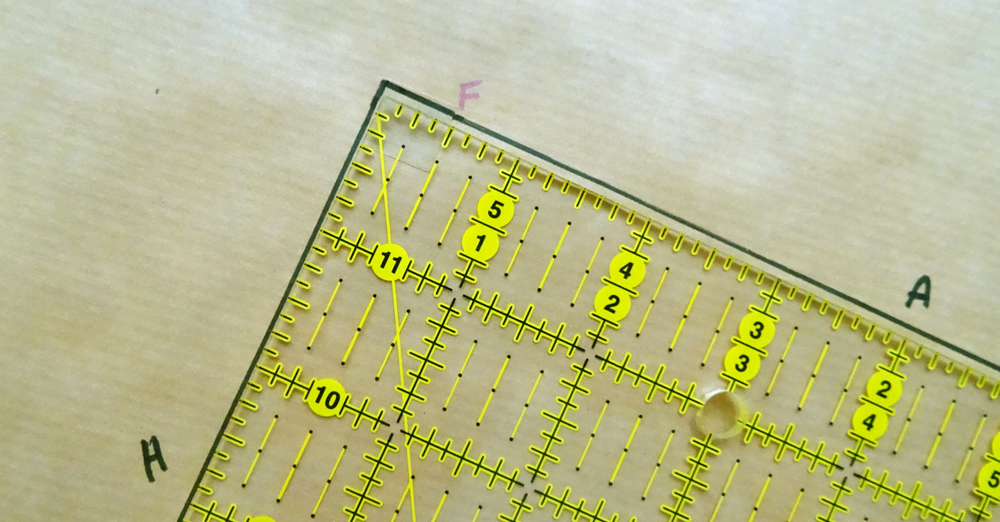
Step 2: Draw a line 90 degrees from top of shoulder/sleeve to your desired length. (A)
Step 3: Decide how wide the end of the sleeve needs to be to fit around your arm. Divide this measurement by 2 and add your seam allowance. Draw this measurement as a line 90 degrees down. (A) to (B).
Step 4: Draw line (C) connecting (B) to the bottom of the original pattern’s sleeve opening.
Step 5:Add the sleeve opening seam allowance.
- Unfold the seam allowance on your original pattern piece.
- Mark seam allowances at top and bottom as ((D) and (E)
- Mark the edges of your drafted sleeve addition as (F) and (G)
- Place the original pattern right side down on the new sleeve addition matching pints (D) and (F) and points (E) and (G).
- Trace the bottom seam allowance – from points E and G to the edge – and then trace the sleeve opening as line (H).
- Remove the pattern piece and connect line A to line H with a 90 degree corner.
Step 6: Label your pattern piece with all the necessary information and mark the “Cut on fold” line.
Determining new sleeve band size (if applicable): Sleeve band width is the same as the hem band width. Measure double the final width of the new sleeve opening (A) to (B). Double this measurement to determine the final width. Remove about 1/4″ of this width to get the new width for the sleeve band. Since all knits stretch differently, this is only a guide. Use your judgement as to how tight you want the final sleeve band to be.
Example : Sleeve Opening = 9″ (includes seam allowance), remove 1″ (1/2″ seam allowance on each side) = 8″ final width. Remove 1/4 of 8 = 6″ width. Add the seam allowances back in 6+ 1″ (1/2″ seam allowance on each side) to get a 7″ final width.
How to Sew the Dolman Sleeve Length Addition
Materials:
- sleeve length addition pattern piece, drafted above
- dolman tee pattern
- fabric (you may need extra to account for the longer sleeve)
- general sewing things
Step 1: Follow your pattern to the step where both shoulders are sewn together.
Step 2: Line up the long sleeve addition right sides together with the original sleeve, matching the sleeve openings.
Step 3: Sew the seam with the original pattern’s seam allowance. Serge/finish the edges and press the seam allowance towards the new sleeve.
Step 4:Finish your tee as indicated in your pattern.
I hope you enjoy your tee! Check out more tutorials like this on the tutorials tab above, or follow along to keep track of new projects!
by Sherri Sylvester | Apr 27, 2016
I’m a bit embarrassed to show you this project today… I love taking pictures of perfectly sewn products and posting them here. Of course, it’s not a realistic view of how I live – my house looks like I haven’t cleaned in a month right now! (Which might be right – argh!) But it sure is satisfying to make everything look pretty.
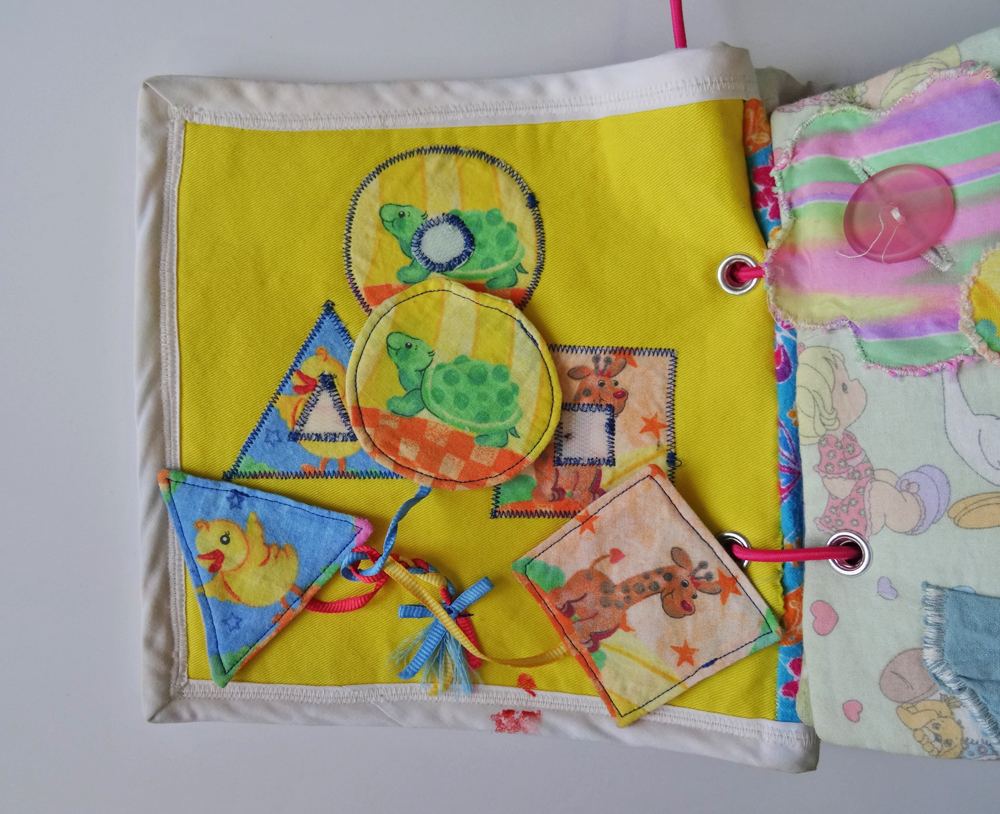
I promised everyone at my Creativ Festival Trunk Show over the weekend that I would post the quiet book that started my free 12 page Quiet Book patterns. The one I made my oldest for her first birthday, about 8 years ago now! This Quiet Book is anything but perfect. I had so much to learn about sewing and was working it out as I went along. It has so many things I’d change now, least of which are my fabric choices. Pattern & character overload – wow!
This book’s unperfectness (#itsaword) is exactly what I want to share today. Things don’t have to be perfect to be loved and given away. My oldest was thrilled when I found this book in storage. She spent time looking at each page and laughing at the photos. Her smallest cousin isn’t even in the book, and everyone is 8 years younger. Crazy how fast things change. She doesn’t care about the overuse of the zigzag stitch and fraying edges. She just likes it because I made it just for her.
So here’s my unPerfect Quiet Book. I’m hoping it might inspire you to go ahead and make that project that you’ve been putting off – because you “don’t know enough” or “won’t get it exactly like the Pinterest photos”. Comparing is not allowed when you are doing what you love!
I’ll be sharing my Creativ Festival re-cap later this week and the lovelies I brought home on Instagram as well. See you again soon!
by Sherri Sylvester | Apr 21, 2016
So there’s thing called an isogram, which I didn’t know about until my sponsor Fabric Spark emailed to see if I wanted to make a project with a Nature Walk Alphabet Panel. It’s gorgeous, but right away I was worried… my kids are too big for alphabet projects, no matter how amazing the fabric is! Of course, I now *needed* the fabric, so for a couple of days my husband and I thought of things to write with one panel of the alphabet until I Googled it and found out what I needed was an isogram: “a word or phrase without a repeating letter”.
Moving ahead for a second, this project is the last thing I need to finish before my Trunk Show at the Creativ Festival in 2 days! Wow! I am running around like crazy person over here. If you are in the Toronto area, I will be presenting a Trunk Show – “Be Brave and Sew” on the Fashion Arts stage at 2:30 on Friday and 9:30 am (gulp!) on Saturday. You can also see the original sample projects from the Sewing Diaries, other past projects and the girls’ Easter Dresses. I’m so happy to be working with Janome to present this!
But, back to isograms, it turns out there are tons of these things! I got a few from this website – “Stand By Me”, “Rocket Man” or “Rhapsody in Blue” (plus lots more) if you are a music enthusiast and Playground, Trampoline, Ambidextrous or Subdermatoglyphic (!) according to Wikipedia. I also found a great example of a sewing isogram after I finished my project, from Sherri Noel (great first name, btw!) – she wrote “Sew Crazy” on her sewing machine cover! Of course, you could always think up another phrase and buy two or three alphabet panels.
One last thing still bugged me – cutting up the panel without a use for the leftover letters. But, I’m in luck and know a whole bunch of people with first and last names that start with each of the leftover letters – so, if you know me – you “might” be getting a pillow or zippy pouch (or other sewn something) with a letter on it for your next birthday/Christmas or other random holiday!
This project, however, is for my oldest daughter. I thought the isogram “Quick on the draw” was perfect for her bedroom wall. She does not stop drawing – and you rarely find her without a drawing implement of some kind in her hand. She visits art supply stores like they are candy shops – she needs this mini quilt! Fabric Spark was amazing and sent me the alphabet panel and some of her other fabrics from Tamara Kate’s Nature Walk collection for Michael Miller Fabrics. I love that this Tamara Kate art can inspire my little girl!
I’ve made up a little mini tutorial for the project below, with links to all of the fabrics I used, plus the gorgeous Little World in Amberthat didn’t make it in – vetoed by the fact that after it was pieced in it didn’t really match my daughter’s room so well.
Keep in mind that the amount of fabric you need will drastically change depending on the phrase/word you want to spell! This mini quilt is actually quite large at 35″ x 23″. If you are coming to the Creativ Festival, it will be on display in the Fabric Spark booth, #248!
As a gauge I used this much fabric:
1) Cut alphabet rows apart. Measure the halfway point between the rows, mark first, cut after!
2) Cut letters apart with 1/4″ seam allowance on both sides, making sure to keep the sides parallel. We will trim the top and bottom after sewing each line.
3) Sew the letters together into words with a 1/4″ seam, I pressed my seam allowances open. Make sure to align the letters so they line up side by side before sewing, don’t align the top/bottom of the white space or they will be uneven.
4) Cut and sew 2 1/2″ wide strips for spaces between words and sew words into lines. Trim the top edges, including a 1/4″ seam allowance on each, so everything is square. My letter rows ended up about 7 1/4″ tall each. Make sure each row is the same height.
5) Add 2 1/2″ strips to each row end, then the top and bottom and between your rows. I pressed these seams open as well.
6) Sew all the rows together to make the center of the mini quilt.
7) Cut & sew 2″ strips to the top, bottom and sides to create the border.
8) Piece your backing if desired, make a quilt sandwich and quilt your project. For lack of more experience, I mostly stitched in the ditch around the letters. Then did a few border rows around the edge.
9) Add quilt hanging sleeve if desired.
10) Make enough binding with 2 1/2″ strips to go around project. Then bind with your favorite method.
I hope you love your new mini quilt! My daughter is so excited to hang this in her room.
by Sherri Sylvester | Apr 7, 2016
This past week I have been busy organizing, labeling and embellishing my projects. I’ve collected 9 ideas you can use with your sewing projects to make them more useful, or more fun! I’ve used the alphabet feature on the Janome Skyline S7 a lot for this week’s content. But I made sure to include several ideas that don’t require any special stitches at all – I hope you like them!
For my main project this week I wanted to make a couple of Fat Quarter Skirts. This tutorial is a few years old now and is so easy to make (and so cute to wear!) – a great beginner project. Perfect for embellishing, and using up any “spare” fat quarters you might have lying around! I added permanent shorties underneath these as well using this Add Shorts to the Fat Quarter Skirt follow-up post from last year.
The Fat Quarter Skirt PDF Pattern is Now Available!
Purchasing this fully tested skirt pattern gives you access to 5 sizes, child’s 2-6, to create a skirt that is 9-11 1/2″ (23-30cm) long. Expect lots of tips and tricks throughout, a glossary of terms, recommended best practices and instructions geared towards an absolute beginner. This pattern is truly a quick sew – allow yourself just 1-3 hours to finish, including your fabric cutting time. It’s also a great stash-buster, requiring only 2 fat quarters and a length of elastic… things you probably already have in your stash! To find out more about the pattern, click here.
Purchase the Fat Quarter Skirt PDF Pattern – $8.50 CDN
Thank you for your support!
Back to the post… Each skirt uses just 2 fat quarters, and my sponsor Country Clothesline was kind enough to provide this week’s fabric. These fabrics are just gorgeous together. They almost look like the came from the same fabric line! Country Clothesline curates a lovely country-inspired shop full of fresh and pretty fabrics. The butterfly skirt is a mixture of Kate Spain’s Aria in Begonia Butterfly and Bonnie & Camille’s Vintage Picnic Check in Coral. The floral one (my favorite!) is from Colette – Floral Leaf Paisley mixed with Tanya Whelan – Barefoot Roses in Pink Dot. The extra green on shown in the photos is from Tanya Whelan as well – Rosey in Green Plaid.
I thought it would be fun to add a book quote to one of the Fat Quarter Skirts using the Skyline S7 alphabet feature. It turned out so cute! Check out Idea #9 below for more details. (P.S. Do you know which book it is?!)
Disclaimer: A Skyline S7 has been loaned to me for the purpose of writing this series. As with all products I write about, I will always tell you my own honest opinion. I purchased and loved Janome machines long before they contacted me. Janome has not asked me to qualify my opinions in any way. Also, the fabric for this post was given to me by my sponsor Country Clothesline. Thank you for supporting my sponsors!
9 Ways to Embellish & Label Your Projects
Idea #1: Twill Tape Size Label – Three Ways!
- Cut twill tape to about 3″ long. Write the size using a fine tip fabric marker. Heat set the marker ink on high heat for about 30 seconds. Use pinking shears and/or Fray Check to seal the raw ends. Fold the ribbon in half. Sew into the back of your project.
- Follow the first method, but use your machine to embroider the size onto your twill tape. Make sure to use a stabilizer under your ribbon for a clean finish.
- Use your machine to write the size and any other embellishments (like a super-cute clothesline!) parallel to the ribbon edge. Remove excess stabilizer. Use pinking shears and/or Fray Check to seal the ends. Fold the ends under 1/2″ or so – I use a school glue stick to hold the ends in place. Sew across each short end to attach it to your project. You can also attach these over the side seam! Tip: Use bobbin thread that matches the outer fabric so the stitching is less visible. (Check out the blue Soleil Dress pictured + 12 tips for sewing knits in Week 4 of the Sewing Diaries.)
Idea #2: Decorative Ribbon Loop
Little ribbon tags are so cute and add a little extra to the side seam of your project.
Cut decorative ribbon to an appropriate length, depending on the ribbon pattern. Fold the ribbon in half. Insert the ribbon along the side seam of your project as it is being sewn. Be sure to allow for the seam allowance when you are aligning it – Ex. for a 1/4″ seam allowance, make sure the ribbon design is at least 1/4″ over from the raw edge of the ribbon.
Idea #3: Fancy Top-Stitching
Use a zigzag stitch (or another decorative stitch on your machine) to top-stitch, instead of always using a straight stitch. I chose a medium width zigzag for the Butterfly skirt.
Idea #4: Leather Labels
I could have made these for days! I used one in the Forest Glen Mini Satchel a few weeks ago and it was so easy. I didn’t even need stabilizer – and they look so professional. Plus it helps that the Skyline S7 went through this leather like butter! Remember that any holes you make are permanent, and use a leather needle for your stitching. Check out these tips for sewing thicker fabrics from Week 3 of the Sewing Diaries.
Idea #5: Custom Stitches
The Skyline S7 comes with a really fun feature – you can build your own stitches! The Stitch Composer loads onto your home computer and allows you to build the stitch, save it, and transfer it to the sewing machine through its USB port. I found a butterfly picture to use as a template and then traced my own butterfly stitch. Woo Hoo! I would love to try to make a Little Red and the Wolf using my logo when I get more time to play with it.
My first butterfly had something like 175 stitches in it, and only came out about a 1/2″ wide! Oops! You can see what this tiny butterfly looked like on Instagram.
I can’t get WordPress to upload the file directly. So if you have a machine that can accept .stx Stitch Composer files and would like the butterfly file, please send me an email and I’ll send it over to you!
Idea #6: Add Ribbon
An easy way to make a zigzag stitch a bit fancier is to zigzag over ribbon! Cut ribbon to the width of the panel you are making. Glue baste or pin the ribbon in place before stitching a wide zigzag stitch over it. Start and end your stitching with 3 or 4 straight stitches to hold the ribbon in place. I also sewed ribbon on with a straight stitch in an embellished skirt tutorial a few months ago.
Idea #7: Quick & Dirty Camp/School Name Labels
Create quick fusible name labels for everything your kids own!
Stitch names onto twill tape, I didn’t use stabilizer for this one because I wanted these to be super-fast. You can see they are slightly wonky but not too bad! Attach fusible web to the back. I love to use Steam-A-Seam (#notanad) because it is tacky and allows for easy placement and trimming. Press the fusible lightly to adhere it permanently to the label. Cut the labels apart and store them until needed. Then just iron them on! You can Fray Check the ends if desired – but the fusible should be enough to stop them from fraying. (The shirt is my oldest’s well-loved Extraordinary Girl shirt. Pattern from Filles à Maman.)
Idea #8: Printed Fabric Labels
Design and send a file to Spoonflower and have your labels printed! I ordereded these a few years ago on a knit fabric. This way they are easy to cut out with no need to hem because they won’t fray. You could apply fusible web to the back of these (as per Idea #7) and have simple- to-make fusible labels with your own design! Or you can buy a pre-made design and support a designer. #goodforyou!
Idea #9: Adding Text
I love the idea of personalizing a project with a fun quote and this floral paisley skirt just needed something from “The Secret Garden” on it! My kids love to plant flowers in the spring, water them (too much!) and watch them grow. I re-found my grandmother’s Ladybird Book copy of the book to go with the skirt so now we can read the abridged version together as well!
“However many years she lived, Mary always felt that ‘she should never forget that first morning when her garden began to grow’.” ― Frances Hodgson Burnett, The Secret Garden
- Type in a few words and test the width of your lettering. This is very general, since spacing depends a bit on how fast you are stitching! My machine works out to 5 or 6 letters/spaces per inch. So I would need about 22-27 inches for the quote + the length of my test text.
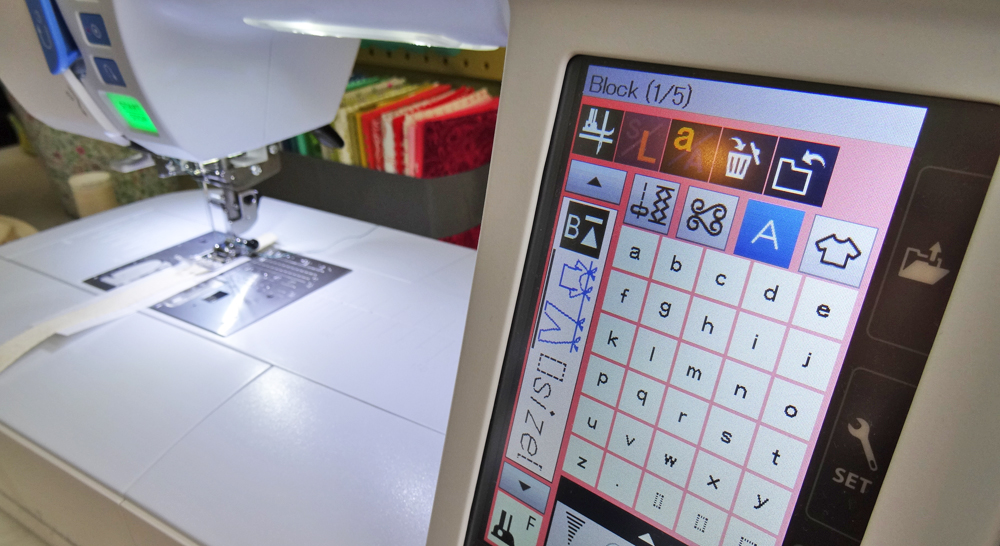
- Cut some twill tape double the width of the skirt panel. Enter the quote into your sewing machine. The Skyline S7 has a built in memory – so I stored the quote as 3 files in the machine. Double-check your spelling! This machine has a view screen where you can see all of the text all at once. Really helpful.
- Place stabilizer on the back of your twill tape. I used a glue stick very lightly to adhere the two together.
- Start stitching about 1-2″ in from the raw end. I used a slower speed and it took me about 25 minutes to stitch, open the next file, stitch, add leaves to fill the open space and double-check my work. Remove the excess stabilizer and cut/remove the threads between letters if desired.
- Sew one side of the skirt panel/contrast border together. Glue baste or pin the ribbon near the bottom and edge-stitch it on. I like using the over-edge foot that comes with the S7 to make my stitches really straight. The edge of the twill tape runs along the edge of the black divider on the foot and works to keep everything in place.
- Once the ribbon is sewn on, finish the other side seam and then finish the skirt!
I hope you found a few new fun ideas to use from this list! Next week we are going to talk about quilting. I’m looking forward to trying all of the piecing/quilting options on the Skyline S7. Plus I’ve been wanting to make the project I’ve chosen for ages now. Nothing like a deadline to get ‘er done. Have a great week!
by Sherri Sylvester | Apr 5, 2016
Today is a momentous day, the Quiet Book Sew-Along is finished! I am so glad that to share this book and I am excited to know that there are so many of you that want to make one too! I will always treasure the Quiet Books I have made for my kids – and hope they treasure them later on as well. (I should find the one I made my oldest and post it. I made it when I was a “sewing newbie” and cringe looking at it now – let’s just say my tastes have changed a bit! *edit* The very first Quiet Book is now posted!)
Welcome! Find everything you need to sew this Quiet Book here. All post listings, links, buttons and more. All of this information was posted in a Sew-Along tab at the top of the blog. I’ve decided to move everything here to keep things simpler. You can also find a link to all of this information on the right sidebar.
(pages pictured above are from the original Quiet Book)
This 12 page Quiet Book Sew-Along is finished! These pattern pieces and tutorials will be always be available, so feel free to join in whenever you can.
Please share your quiet books!
- Join up on Flickr. Join our Sew-Along Flickr group and post your photos, comment and see what other members are sewing as we go. (I did a little tutorial on joining Flickr and posting photos to help you out!) *Note – this page has not been updated recently
- Post photos on Facebook!
- Post photos on Twitter or Instagram! Hashtag your Sew-Along posts with #quietbooksewalong and/or #alongforthreadride
- Blog about it! Blog your progress, it provides a place for you to let us know more about your process!
QUIET BOOK TUTORIAL POSTS
Click on the photos or text below to access each post.
*edited* The First Original Quiet Book is now posted as well! I finally photographed my oldest’s book with new page ideas not in this tutorial set.
The Original Quiet Book:
Overviews:
Page Construction Tutorials:
Want more tutorials and posts like these? Follow below and come #alongforthreadride. Thank you!
by Sherri Sylvester | Apr 5, 2016
We are here, this is it, you are ALMOST finished! Making the cover is the easy part in comparison to your amazing quiet book pages. Here we go!
(If you are just starting find all the information you need on this Sew-Along page.)
Before we begin/Important Notes:
- Remember to use your iron liberally when you are sewing this book. It is going to be a work of art when you are done! Since it is thick and some of the pages will not be iron-able once you are finished with them it is advisable to take all of the care you can to remove wrinkles so they are not accidentally permanent in your final book.
Materials:
- Cover: Cut 2, 11″ high x 21″ wide, from the Yardage Overview
- Fusible Fleece: Cut 1, 11″ x 21″ for the outer cover
- Inside Cover Ribbon (to hold binder/key rings): Cut 1, 11″ high, I used 1″ grosgrain
- Outer Wrap-Around ribbon: Cut 1, 27″ (roughly, see below) and 1 piece 9″ long
- Strap Tab (Fabric): Cut 2, 3″ wide by 1.5″ high (1/4″ seam)
- Velcro: Cut 1 each hook & loop, 1.5″ long
- 2 binder rings or key rings
Outer Cover:
-
- Press fusible fleece to the outer cover as per the manufacturer’s directions. Quilt if desired. Note that the wrap-around ribbon will be sewn horizontally in the center of the cover.
- Place the shorter length of wrap-around ribbon directly over the longer piece matching the ends and edges. Baste, fuse or use a glue-stick to temporarily hold them in place. Top-stitch the long edges to hold the two pieces together.
- Pin the wrap-around ribbon horizontally across the outer cover parallel tot he long edge. The double-layer from Step 2 will be on the left, with the shorter edge underneath. The shorter ribbon should overlap the cover by at least 1 1/2″.
- Mark 1″ over from the left side of the outer cover edge, beside the double ribbon layer. Stitch a large rectangle around the edges of the ribbon to secure it to the cover, pivoting at the 1″ mark.
- Stitch the soft side of your Velcro 2 1/2″ over from the right edge of the outer cover.
- Attach embroidery or label at least 1″ away from all edges, if desired. The right side of the cover is the front, the left side is the back.
Inside Cover:
- Pin the inside cover ribbon down the centre of the cover, marking openings for the rings that match up with your page ring tabs. I marked 3 1/2″, 4 1/2″, 6 1/2″ & 7 1/2″, measured from the bottom edge of the inside cover.
- Stitch around the ribbon edges, leaving the spaces between the markings un-sewn.
Assemble Cover:
- Place the outer and inside covers right sides together. Stitch around the edges with a 3/8″ seam leaving a 3″ opening along one edge. Make sure NOT to sew over the free end of the wrap-around ribbon, it should be in between the layers of fabric.
- Clip all corners, turn, press and top-stitch all edges. Again, do not sew over the free end of the wrap-around ribbon.
- With the inside cover facing up, top-stitch through all layers 1/4″ from either side of the inside cover ribbon to hold the cover together.
Add the Velcro Tab:
- Place your finished Quiet Book pages inside the cover to measure the thickness of the book. (Do not insert them into the key rings yet!) Test the length of the wrap-around ribbon and shorten it if necessary. The ribbon should wrap around the book with all pages inserted and cover the front Velcro.
- Fold the right short edge of the top tab fabric in 1/2″. Fold the left short edge of the bottom tab fabric in 1/2″ – this side will face the cover and have the Velcro attached.
- Stitch Velcro to the bottom tab, 1/4″ from the folded edge.
- Place tab pieces right sides together with the folded edges matching. Stitch with a 1/4″ seam, leaving the folded edges open. Clip, turn and press.
- Insert the free end of the wrap-around ribbon into the open end of the tab. Top-stitch the tab, catching the ribbon and stitching the folded edge closed.
Finishing Touches:
- Insert the binder or key rings into the book.
- Attach the pages in the order you have determined. (Take photos to share with everyone!)
- Gift wrap and give your work of art to a small-someone you love.
- Feel so proud to have accomplished this amazing book! Wow!
** As usual: This tutorial is for personal or charitable use only. Please do not sell items made with the Quiet Book Sew Along posts. If you wish to sell these please contact sherri@threadridinghood.com for information on how to purchase a license. Thank you!